The phenomenon of "choking" in competitive sports is well known. It refers to those high-stake moments when a competitor performs far below his normal ability, as if he has forgotten to be himself. Choking is particularly in sports that require highly precise techniques, such as figure skating. After years of watching skating live, it's become clear to me that, in an important competition, figure skaters routinely achieve no more than 70% of the highest level of difficulty they are capable of in practice. This level can drop further if the skater is temperamentally sensitive to the psychological pressure. For skaters often called "headcases," he might fail on techniques in a critical championship that he would succeed with 90% certainty in practice. Why? Perhaps the reason is that figure skating is exquisitely affected by the skater's mind. I have done a little bit of recreational swimming, running, and skating, and found that skating demands the most attention and concentration. Therefore, when the brain is wandering toward the thoughts of winning and losing, it is so easy to lose focus, which destroys one's technique.
The fact that many of my favorite skaters are prone to "choking" has vexed me for years and led me to wonder years why the mind fails them. Do they unconsciously sabotage their own success? Or does the chance of choking increase with how badly one wants to win? If so, how does one suppress the desire to win for a few minutes in order to focus on just the skating?
This is why, when I first read one of the themes in Bhagavad Gita, "detach from the fruits of your action," I immediately felt a tingling inside my skull. There is something profound and subtle about this seemingly paradoxical about the advice.
And this phenomenon is not limited to sports, for in life the wish to have something does not often lead to choices toward its realization. Thinking about what you want may spur you on sometimes and paralyzes you other times. The problem of self-defeating behaviors is complicated and difficult to remedy.
Showing posts with label skating. Show all posts
Showing posts with label skating. Show all posts
Thursday, April 9, 2015

Tuesday, March 4, 2014
A Historical Day in My Life
March 4, 2014
I did crossovers! While gliding!
Since I started learning to skate a year ago, the idea of crossing one foot over the other foot and leaning the body outward has haunted me. It has always seemed unspeakably terrifying to do. I've hesitated and delayed learning forward crossovers because of mental images of stumbling and falling conjured up by my brain.
Today I did it. I crossed one foot over the other. I took the leap (figuratively speaking)! And I'm fine. No falls. No broken nose. It was not pretty, but the mental block was overcome and I can now practice and improve.
The video below shows what (good) crossovers look like:
Tuesday, May 7, 2013
Sketch: The Coach
"You see how she holds the edge?" She poked at the iPhone screen with a finger to play the video.
"Wow," was all I could say. The girl in the video covered the entire length of the rink in three strokes. It takes me three times as many wobbly steps.
"Bet your knees! Back straight! Tuck in!" She shouts at me as I stumble around on two feet. Good skating requires predominantly one-foot skating, preferably on one edge. (Each skate blade has two edges.)
She's short with chubby cheeks but moves on ice like fish in water. And she seems to have a soft spot for complete newbies like me. Sure, any coach would want to hold the hands of cute little toddlers bundled up like teddy bears and teach them march-march-glide, but clumsy old legs and flabby middle-aged bodies stepping on the ice for the first time in our lives? Her eyes tracked her adult students with utmost seriousness.
"You just need more confidence," she said. "Take a longer stroke. Don't put the free leg down."
"I felt like I was falling over," I whined. Slamming the body onto the cold, hard white surface hurts. Scarier than the pain is the sense of losing control, not knowing one's place in space.
"What?" She leaned in with a palm over the right ear. She's a bit deaf and wears hearing aids.
"I just need more practice," I raised my voice a little. She nodded and said she'd send me a couple of videos of off-ice exercise to do at home.
In off-ice chatting, she let it slip that she went to law school. I don't think she is practicing law though, knowing that she coaches skaters on weekdays. She also teaches mentally disabled kids speed skating. "My kids threw up on ice at the Special Olympics," she said with a laugh. "I took a shovel and got on the ice. And then we went right on."
She talked about ice dancing with her father as girl in New York, on the rink by the Rockefeller Center. "It's the best memory of my life," she said dreamily. Her mother still lives in New York and she goes up regularly to visit. Of all the women I've met in figure skating fan circles, a large proportion have never married. I wonder whether it's the case with her as well. She mentioned she has never owned a house.
She may or may not have given up a career in law (a speculation to be confirmed), but her career in coaching is no doubt her ultimate calling. She never gets off the ice immediately after her coaching session is over. As she leaves us students to practice in public sessions, she would linger on ice and give a pointer or two to unsuspecting kids or adults gliding around. If they're interested, she would give them an impromptu --- and free --- mini-private lesson right there.
"My friend Debi Thomas ..." She remembered happily. Along with the off-ice exercise video links, she sent me another link of Debi Thomas doing her popular and hilarious Wanda Beezle character --- a stumbling new learner struggling to do the basic stuff. I bet I look just as bad as Wanda and unable to do most of the skills she does.
Monday, November 26, 2012
Transitions (TEB)
I'm slowly going through free skates at 2012 Grand Prix TEB. Technical elements are in brackets.
Jeremy Abbott:
Simple 2-foot turns (2fts), stroking, 2fts, short glide, (3Lz), more 2fts, 3turn, stroking, (4T), hop, (CCSp), 2fts, 3turn, short (semi-)spread eagle, crossovers, short spiral, 3turn, (3F2t), 3turn or rocker, 2ft, lunge, (CCoSp), rocker, 3turns, stroking, (3A), stroking, (1A2t), (FSSp), 2fts, crossovers, hops, choctaw? (3Z3t), 3turns, (3Lo), (StSq), (2S), 3turn, (ChSq).
Overall: Not many crossovers or stroking. Mostly simple turns. Few difficult turns. Simple steps before jumps. Quality high. Variety medium. Difficulty medium to low. It might be a little unfair to say the difficulty is medium to low because for another skater the content might be medium, but to Abbott it is obviously too low. He could do these transitions in his sleep.
My TR score: 7.25
Judges' TR score: 8.00
****
Takahiko Mura:
3turn, crossovers, (4T), 2fts, crossovers, 3fts, a flat choctaw, (3Lz3t), 3turn, 2fts, (3A), knee and arm movements, (CCSp), rocker, stroking, counter, (3Lo), 2fts, (3A2t), (StSq), short spread eagle, 3turn, (3S), (CCoSp), 2fts, flat mohawk, (3Lz), 3turn (1F), 3turn, 2ft, (FSSp), (ChSq), hydroblade.
Overall: His transitions are quite spare compared with the top Japanese men, but certainly a lot more and better than Amodio. Quality medium. Variety medium. Difficulty medium.
My TR score: 7.25
Judges' TR score: 7.29
****
Florent Amodio:
Stroking, crossovers, 2fts, (4S), 2fts, 3turn, flat mohawk (3Lz2t), 3turns, crossovers, 2fts, (3A), 2fts, (FCSp), 2fts, (StSq), standing and moving arms, 2fts, (3Aseq), twizzles, 2ft, a flat choctaw, 3turn, (3F), walley jump, a flat choctaw, (3Z), (2A), 3turns, 2fts, 3turn, (3S3t), 2fts, (CSSp), (ChSq), (CCoSp).
Overall: It's so much easier to count his transitions because they are few and simple. No intricacy to speak of. Quality medium to low. Variety low. Difficulty low.
My TR score: 6.50
Judges' TR score: 7.11
****
Tomas Verner:
1-foot toe turns, 2-foot edge work, 2fts, choctaw, 2fts, (4T), 2fts, 3turns, crossovers, bracket, (2Lz3T), mohawk, rocker, 3turns, double 3's in both directions, (1A), (StSq), (FUSp), toe steps, rocker, crossovers, 3turns, (1A fall), 3turns on both feet both directions, (3Lo), 2fts, 3turn, crossovers, (3Lz), counter, 3turns, (3F), (2A), (CCoSp), (ChSq), (CSSp).
Overall: Not many crossovers or stroking. A good mix of simple and hard turns. Simple steps before jumps. Quality high. Variety high. Difficulty medium to high.
My TR score: 8.00
Judges' TR score: 7.04
****
Brian Joubert:
Stroking, 2fts, crossovers, 3turn (4T fall), 3turn, bracket, 3turns, 2fts, stroking, 3turns (3T), 3turns, stroking, (3A2t), hop and lunge, (CCoSp), hair-stroking, (StSq), 3turns, crossovers, 2fts, a very flat mohawk, (3F), 3-turns, (3Lutz), 2fts, 3turns, crossovers, (3Lo), 3turns, crossovers, (3S2Aseq), ChSq, (CSSp), (FUSp), 2-foot hop.
Overall: Can't say he doesn't have any transitions, but nearly all are 3turns and simple 2-foot turns. Quality medium. Variety low. Difficult low.
My TR score: 6.50
Judges' TR score: 6.79
****
My ranking:
1. Verner, 2. Abbott, 3. Mura, 4. Amodio, 5. Joubert. Amodio is no better than Joubert in quantity or quality, but slightly better in variety.
Verner is better than the rest of the bunch in terms of intricacy, variety, and difficulty, and his quality is as good as or just a smudge less than Abbott's.
The judging quality was not atrocious, but can't be called good either, which is true in nearly every grand prix event every year.
Sunday, August 12, 2012
Reinhold Gliere

听广播的时候撞上一首深得我心的曲子,很提神的 chords,但又不突兀。回家一查电台的 playlist,是苏俄时期的近代作曲家 Reinhold Gliere 写的芭蕾 Khrizis, Suite No. 2. 很喜欢。
去查 Gliere 的背景,原来当过 Prokofiev 的师父,Hmm...
Khrizis 似乎挺冷僻的,在 YouTube 上没找到试听版,倒是发现 Gliere 比较有名的作品是个叫 The Red Poppy 的芭蕾。不看不知道,一看吓一跳,原来这个舞剧讲的是苏俄红军在中国解救劳苦人民的故事,主要人物是个美丽的中国姑娘,爱上了苏俄船长,还为他牺牲。哇哈哈笑死我了,原来俄国男人跟西方男人一样对东方姑娘有各种幻想,连布尔什维克也这样。
然后又吓一跳,原来 Michelle Kwan 早在97年即用过 Red Poppy 的音乐做短节目。
Wednesday, June 13, 2012
Choreography -- Use of Space
今天在看 So You Think You Can Dance 第九季时忽然开窍了,对花样滑冰规则中关于 choreography 中的一条 "use of personal and public space" 有了感性认识。有些舞蹈者技巧和乐感都不错,但是跳来跳去局限于舞台的一角,或者只利用一半舞台空间,或者留在中心很少向两边动。当然,也不能机械地左一下右一下,或者漫无目的地满世界游荡而没有中轴。空间的利用还真挺讲究的,追求的是看似信手拈来但却自然平衡的美感。
Friday, June 1, 2012
Ragtime

最早接触到 Ragtime 音乐是在电视上看见一个节目介绍百老汇音乐剧 "Ragtime",至少有十年了,具体是哪一年已经不记得。这个音乐剧根据 E.L. Doctorow 的同名小说 (1975年)改编,叙述二十世纪初期,即 Ragtime 类音乐正当红的时代,社会上层的白人,东欧移民,和社会下层的黑人音乐家三组人物的故事。男主角由男中音 Brian Stokes Mitchell 担任,节目中虽然只有剧中片段,都给我留下很深的印象。尤其是主题曲 Ragtime,不知为什么,听过很少几次,它的旋律就留在我的脑子里长久不去。不过呢,主题曲虽然是 Ragtime 类音乐,剧中大部分曲子仍然是音乐剧歌曲,并不是 Ragtime 风格。
后来好几年没什么动静,直到两年半三年之前,我偶然地发现本地NPR电台WAMU每周六晚上播出的老派(1920-1940年代)爵士乐节目 Hot Jazz Saturday Night ,迅速地迷恋上了传统爵士乐。然后又过了一段,差不多两年前,在这个节目上听到了年轻钢琴家 Bryan Wright 录制的 Bix Beiderbecke 作曲的印象派钢琴组曲,极其惊艳,就去找来 Wright 刚刚出版的 CD "Breakin' Notes",这时才彻底地爱上了 Ragtime 音乐。
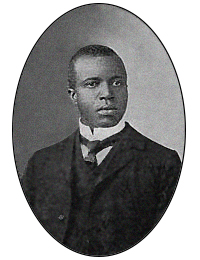
Ragtime 或许不能算是 Scott Joplin 发明的,但毫无争议是被他作的一系列经典钢琴曲推上主流音乐舞台的。
 |
| Scott Joplin |
贴两段很喜欢的曲子:
Bryan Wright & Martin Spitznagel 两人合奏的经典名著 Maple Leaf Rag。两人交接的时候特别有趣可爱。
现代 Ragtime 作曲家 David Thomas Roberts 演奏的 Gladiolus Rag,跟一般的 Ragtime 欢快的演奏风格不同,速度较慢而温柔,于是 melancholy 十分明显。
今天在友人收集的花样滑冰节目中看到 Matt Savoie 的2004年自由滑节目 Ragtime Medley。这个节目我过去没见过,一看之下联想起 Ragtime 的各种美好。故记之。
****
加一句奇异的巧合。
在 YouTube 上翻 Ragtime 视频时发现原来有个叫 World Championship Old-Time Piano Playing Contest 的东西,一群 Ragtime 爱好者混在一起弹奏极老的古董钢琴,还比赛。惊奇地发现这玩意儿每年在 Peoria, Illinois,这地方我虽然没去过,却早已听说过,原来是 Matt Savoie 的家乡!
Wednesday, May 23, 2012
Braden Overett
It's not easy to explain my impression of Braden Overett. During his competitive career, he was never a top skater and even failed to make it to the Nationals in some years. He was also one of the most popular skaters among the hardcore American skating fans. At 26, he won the Professional Skating Association's Choreographer of the Year award for the free program he choreographed for himself ("Pirates of the Caribbean"). He is one of the most musical skaters I have ever seen. He can catch every beat and every turn of melody with his arms and fingers and just a look. His style is, as pointed out by a friend of mine, both musical and masculine. Very, very few skaters have that.
I am almost a little ashamed to admit it, but when I first arrived I was a bit in awe of the mythical "American Youth" that swarmed the college campus. They seem to exude casual confidence, relentless optimism, and benevolent self-satisfaction that remain untroubled by the world. They walk around with a "the world is my oyster" swagger that filled my heart with envy and a twinge of bitterness, for I will never have this kind of natural confidence.
Two decades later, my wide-eyed fascination has largely turned cynical with experience and familiarity. Perhaps all of this is mere projection of my mind, but Braden Overett still reminds me of the best kind of the mythical American Youth. He doesn't seem to work too hard, but his confidence is almost intimidating -- but then the American Youth is also sunny, personable, and easy-going. He has an abundance of brilliance, talent, and charm that move people without the obligatory achievements and success in the conventional sense. He is the kid in class who never studied but always got A in everything.
Perhaps my impression is completely wrong. Had I known him, perhaps all this silly mythologizing would have immediately evaporated. Perhaps he has plenty of struggles of his own. Who knows. Since retiring from skating, Overett did some choreography for his friend Bebe Liang but not much else. He toured with a skating company for a year in Europe. I saw him in person at this year's Nationals in San Jose, but I didn't go chat him up.
A couple of videos:
The award-winning program;
A recent piece of choreography.
 |
| Braden Overett |
I am almost a little ashamed to admit it, but when I first arrived I was a bit in awe of the mythical "American Youth" that swarmed the college campus. They seem to exude casual confidence, relentless optimism, and benevolent self-satisfaction that remain untroubled by the world. They walk around with a "the world is my oyster" swagger that filled my heart with envy and a twinge of bitterness, for I will never have this kind of natural confidence.
Two decades later, my wide-eyed fascination has largely turned cynical with experience and familiarity. Perhaps all of this is mere projection of my mind, but Braden Overett still reminds me of the best kind of the mythical American Youth. He doesn't seem to work too hard, but his confidence is almost intimidating -- but then the American Youth is also sunny, personable, and easy-going. He has an abundance of brilliance, talent, and charm that move people without the obligatory achievements and success in the conventional sense. He is the kid in class who never studied but always got A in everything.
Perhaps my impression is completely wrong. Had I known him, perhaps all this silly mythologizing would have immediately evaporated. Perhaps he has plenty of struggles of his own. Who knows. Since retiring from skating, Overett did some choreography for his friend Bebe Liang but not much else. He toured with a skating company for a year in Europe. I saw him in person at this year's Nationals in San Jose, but I didn't go chat him up.
A couple of videos:
The award-winning program;
A recent piece of choreography.
Monday, May 21, 2012
Phrasing
Went to a figure skating judging seminar last Saturday. Joe Inman talked about musical phrasing and movement choreography on ice that corresponds to the musical phrases. It seemed a bit absurd to watch him trying to explain the concept to a bunch of kids there who are apparently aspiring skaters. Perhaps he should try to teach all the judges first. Who would have thunk being a figure skater requires more than a passing knowledge of music theories ... No wonder my friend (a judge) likes to say this is the most intellectually challenging sport. But still, sometimes I think it is all too much.
Friday, March 16, 2012
随便发发牢骚

Thursday, March 15, 2012
男单10
总算凑齐了十个 (2003-2012)。
1. The Mission (Matt Savoie/Tom Dickson)
2. Naqoyqatsi (Jeff Buttle/David Wilson)
3. Schindler's List (Jonathan Cassar/David Wilson)
4. Eight Seasons (Jeremy Abbott/Tom Dickson)
5. Chocolat (Stephane Lambiel/Salome Brunner)
6. Pirates of the Caribbean (Braden Overett/Braden Overett)
7. Jazz Medley (Yannick Ponsero/Laurie May)
8. Harlem Nocturne (Derrick Delmore/Jill Shipstad?)
9. Insane in the Brain (Adrian Schultheiss/Galina Lutkova)
10. Swan Lake (Daisuke Takahashi/Nikolai Morozov)
Sunday, February 12, 2012
Masculinity in FS and FT
Over a decade ago, during the height of all the Tanya Harding-Nancy Kerrigan hoopla and the rising dominance of Michelle Kwan, my friend did her theater-major Ph.D. thesis on femininity in the figure skating culture. She is now a figure skating judge (they're all volunteers).
It seems that good ideas often come to me in showers. As I did this morning I suddenly realized that I'm fascinated by masculinity in the figure skating culture. How did I get to this thought? I traced my thoughts back to last night. I was looking up a folk tale and stumbled upon "Iron Hans" in Grimms's fairy tales (type 502 in the Aarne-Thompson system). In the early 1990s, the story became the basis of a men's self-help movement started by the poet Robert Bly known as "Iron John."
How does this relate to figure skating? I came upon the realization that figure skating is perhaps one of the few places in sports where masculinity, as it is represented, is ambiguous, diverse, and complex, while most other competitive sports present masculinity in a linear way: more versus less, win versus loss, or dominance versus surrender. This is perhaps because figure skating is not a "pure" competitive sport, but rather a mixture of performance and competition of physicality and athleticism. There is a constant tension in figure skating between the performance and the athleticism that divide not only fans but also the judges and rule-makers.
I read the Iron John story and it is curiously not about the competition among men or dominance of women. I need to look into it some more.
It is figure skating that has taught me the diversity and complexity of masculinity, instead of the reductionist and linear view that controls the American social culture, which I think is incredibly idiotic. Masculinity is not at all simple and deserves more extensive study.
冰舞10
凑够十个了,Woohoo!
冰舞:
1. La Valse (Jane Summersett & Todd Gilles/Tom Dickson)
2. Devdas & Bunty Aur Babli soundtracks (Meryl Davis & Charlie White/Marina Zueva)
3. Somewhere in Time (Marie-France Dubreuil & Patrice Lauzon/David Wilson)
4. House of Flying Daggers (Trina Pratt & Todd Gilles/Christopher Dean)
5. Carnival in Venice (Isabelle Delobelle & Olivier Schonefelder/Pasquale Camerlengo)
6. Pink Floyd (Tessa Virtue & Scott Moir/Igor Shpilband & Marina Zueva)
7. Samson et Delila (Meryl Davis & Charlie White/Shpilband & Zueva)
8. Hitchcock soundtracks (Piper Gilles & Zachary Donohue/Tom Dickson)
9. Organ Donor (Natalie Pechalat/Fabian Bourzat/Sasha Zhulin)
10. The Landing, Turn Around, and Gravity of Love by Enigma (Sinead & John Kerr/Evgeny Platov?)
Sunday, January 29, 2012
Whew
I'm so fucking exhausted. Will need a couple weeks to recover. Have no idea how I'll cope with work next week.
Seriously I cannot do this again next year, unless I win the lottery before next January and retire.
Seriously I cannot do this again next year, unless I win the lottery before next January and retire.
Tuesday, January 24, 2012
Friday, January 20, 2012
2003年后有印象的节目
Updated 1/25,说不定能凑够10个。
男单:
1. The Mission (Matt Savoie/Tom Dickson)
2. Naqoyqatsi (Jeff Buttle/David Wilson)
3. Schindler's List (Jonathan Cassar/David Wilson)
4. Eight Season (Jeremy Abbott/Tom Dickson)
5. Chocolat (Stephane Lambiel/Salome Brunner)
6. Pirates of the Caribbean (Braden Overett/Braden Overett)
7. Jazz Medley (Yannick Ponsero/??)
8. Harlem Nocturne (Derrick Delmore/Jill Shipstad?)
9. Insane in the Brain (Adrian Schultheiss/Galina Lutkova)
冰舞:
1. La Valse (Jane Summersett & Todd Gilles/Tom Dickson)
2. Devdas & Bunty Aur Babli soundtracks (Meryl Davis & Charlie White/Marina Zueva)
3. Somewhere in Time (Marie-France Dubreuil & Patrice Lauzon/David Wilson)
4. House of Flying Daggers (Trina Pratt & Todd Gilles/Christopher Dean)
5. Carnival in Venice (Isabelle Delobelle & Olivier Schonefelder/Pasquale Camerlengo)
6. Pink Floyd (Tessa Virtue & Scott Moir/Igor Shpilband & Marina Zueva)
7. Samson et Delila (Meryl Davis & Charlie White/Shpilband & Zueva)
8. Hitchcock soundtracks (Piper Gilles & Zachary Donohue/Tom Dickson)
9. Organ Donor (Natalie Pechalat/Fabian Bourzat/Sasha Zhulin)
双人:
1. Pina (Aliona Savchenko & Robin Szolkowy/Ingo Steur)
2. L'Oiseau (Aliona Savchenko & Robin Szolkowy/Ingo Steur)
3. Galicia Flamenca (Jessica Dube & Bryce Davison/Lori Nichol, David Wilson)
4. Daphnis et Chloé (Amanda Evora & Mark Ladwig/Jim Peterson)
女单:
绞尽脑汁想不出来。这么多节目白看了。以后干脆全部跳过得了。
总算想起一个。
1. Dr. Zhivago (Alissa Czisney/Davis Wilson)
Thursday, January 5, 2012
Two Weeks

Two more weeks before going to San Jose for a week for US Nationals. I'm biting my nails and bidding my time. Waiting is such a pain in the butt. The good feeling is that just this morning I realized that I have nearly forgotten some of the most traumatic experiences at the Agency that occurred within the year past.
Wednesday, July 6, 2011
Liberty
下周三至六将在 Aston, PA 的冰场看俱乐部比赛。Nathan 小同学已经报名,希望能看到他。
可以算小小一个假期,只是坐三天冷板凳,对一把老骨头是种考验。
顺便提醒下自己,出发前别忘了带厚外套。
可以算小小一个假期,只是坐三天冷板凳,对一把老骨头是种考验。
顺便提醒下自己,出发前别忘了带厚外套。
Monday, April 25, 2011
Live Broadcast
早睡早起身体好!
Wednesday, April 27
5:30 a.m.: Men's short program
11:30 a.m.: Pairs short program
Thursday, April 28
5:00 a.m.: Men's free skate
10:00 a.m.: Pairs free skate
Friday, April 29
5:30 a.m.: Ladies short program
10:30 a.m.: Short dance
Saturday, April 30
5:30 a.m.: Ladies free skate
10:30 a.m.: Free dance
Monday, April 11, 2011


Subscribe to:
Posts (Atom)
The Ending of Le Samourai (1967), Explained
A quick online search after watching Jean-Pierre Melville's Le Samourai confirmed my suspicion: The plot is very rarely understood by E...
