Search This Blog

Showing posts with label mysteries. Show all posts

Friday, August 14, 2026

Rewriting Rebecca in Another Genre


Coming at this story, which I had known since teenage years through the Hitchcock movie, as a middle-aged person, I have certain perspectives. For one, I have known for some years that "the third wheel" type of romantic construct, especially when the married (or pre-existing) couple are older while the newcomer into the relationship is much younger, is predominantly Oedipal. (Oedipus Complex can be applied to any parents-child triangle, regardless of gender.) The novel Rebecca is indeed a fairly obvious example. The nameless (significant) protagonist and narrator, whose unusual first name never shared with the reader, was given by her dead father (even more significant), is exactly half the age of her husband, Maxim DeWinter (42). Her lack of power in this marriage is near absolute, being disadvantaged in her gender, age, and experienece, and mostly in her economic status --- Mr. DeWinter's wealth as a landed gentleman is perhaps on par with Mr. Darcy of Pride and Prejudice. She is keenly aware of herself as the late-coming intruder in a (supposedly) perfect marriage.

Imagine my shock (not!) when I read, after reading the novel, that Daphne du Maurier's father, Gerald, was alleged to have an unhealthy obsession with Daphne that may have gone too far. Who could have guessed! Gerald was a famous actor and theater manager and (also alledgedly) a volatile alcoholic. 

Be that as it may, what makes the novel interesting is the violent and evil undertone in Mr. DeWinter, despite the narrator's protest (a tad too much) of her love and devotion to him. Indeed, his portrayal of Rebecca, his wife, is supposedly evil, because she ... well, it's never clearly explained, because, you know, the English never talk about sex even between spouses. According to DeWinter, Rebecca had a massively promiscuous lifestyle while pretending to be a perfect wife. On the surface, the reader is supposed to sympathize with Mr. DeWinter for his injured male pride and his necessity to kill his wife. We are supposed to overlook the how of the murder: He not only carefully avoided being seen but also covered it up as either an accident or suicide. If we stop and think about it though, he really IS a murderer who gets away with it. Underlying the narrator's joy for being the sole possessor of Mr. DeWinter's love (whatever that means) is the fear of his cold murderous nature.

Perhaps more curious though is the daughter's idealization of the mother, because the idealization of Rebecca is firmly established throughout the book, despite the ambiguous revelation of her villainy, which only makes her even more fascinating. It is difficult to measure whom the daughter loves more, the father or the mother. Rebecca is the archetypal "bad woman" throughout the history of literature that embodies the indomitable feminine sexuality that strikes fear in everyone's heart. Consciously or unconsciously, the author preserves her mystique by keeping her outside of our direct gaze, making her a goddess for worship and ... yes, fear. (Perhaps the fear is also rooted in the daughter's longing to become her mother and possess [what seems to be] a vast amount of power.) 

---------

Psychoanalysis aside, the story's perspective is not entirely satisfying, given the narrator's lowest position of power in this triangle. I imagine retelling the story from the viewpoint of another person. For example, if Maxim DeWinter narrates this story, it could be a James M. Cain-style noir, in which a perfect crime goes all kinds of wrong. That night, he meticulously constructed his alibi, so that none of the servants at Manderley knew he went out to the cabin with a gun and killed his wife and put her body in her boat and sank the boat. A few months later, a body was washed ashore, which he identified as his wife. It was the perfect crime. No one suspected anything. The entry county felt sorry for him. After a suitable period of "mourning," a year later he felt he was secure enough. He marries a very young woman with no experience in life and zero risk of suspecting him. Happily ever after, right? 

An entirely random event --- a shipwreck in the bay --- destroys the best-laid plot. The diver finds Rebecca's boat and, even worse, her body. With so much evidence suggesting foul play, suspicion obviously falls on the husband, especially if (when) the victim's cousin Favell reveals that the husband had ample motive. Nevertheless, his alibi is solid, and his social position protects him from legal peril. Local coroner, who is a drinking buddy of Mr. DeWinter (as pointed out in the novel), rules the death a suicide. He may not be as gossip-proof as he was a year ago, but there is no risk of criminal suspicion. 

The last bit of suspense on whether Rebecca was pregnant is, of course, necessary for the ending of a romance-driven story. In the noir genre, more things may surface ... to make DeWinter's life difficult, including but not limited to his new wife's suspicion and the need to kill a witness or two to keep the lid on the first crime. That would work quite well. 

---------

A different genre it could fit would be a detective story or thriller. I'm sure Agatha Christie would have made a beautifully convoluted plot out of this story. Mrs. Danvers is in the perfect position to want to investigate the suspicious circumstances of her, uh, lover's death. The only thing in the original setup that prevents her from become an amateur sleuth is the English class hierarchy and culture. Not unlike the narrator, Mrs. Danvers has always believed in DeWinter's devotion to Rebecca, which is the weakest part of the novel. This makes Mrs. Danvers look stupid and obtuse. Surely an intelligent servant, not to mention a possible lover of the mistress, is the first to know any disharmony between the lord and lady of the house. 

Only a small tweak is needed to let Mrs. Danvers suspect the conflict between Rebecca and DeWinter, thus leading her to quietly collect evidence of DeWinter's guilt. She may even exact revenge on the murderer after he gets away with it. Of course, the ending of the novel implies that the destruction of Manderley could be committed by Mrs. Danvers, but one would imagine that she may want to do more to the killer of Rebecca in a slightly more modern retelling.

Wednesday, December 31, 2025

The Mysteries of "The Final Problem" (and Attempted Explanations)


To this day, the public generally believes that the reason for the death of Sherlock Holmes in "The Final Problem" was that Arthur Conan Doyle was tired of writing these stories and wanted to stop, and the reason for its reversal in "The Empty House" was the unending pressure from fans on the author.

However, David Pirie (who wrote "Murder Rooms" starring our Dr. Doyle and his mentor Professor Bell) questioned this oft-repeated theory and pointed out that Doyle went on a Holmes hiatus for a long 8 years. If public pressure was the reason for his reversal, he would have done so in the first year or two, when the outcry was the loudest. It is hard to imagine that the public was still pressing him to revive Holmes 8 years after the death, so much so that he caved under the pressure to write one of the best entries in the collection, "The Hound of the Baskerville." Pirie also pointed out that Doyle wrote the story in 1893, about the same time his father died, which might have been a dark and painful event. 

I recently re-read "The Final Problem" and "The Empty House." There are many peculiar elements surrounding the death and resurrection of Sherlock Holmes, which convince me that the conventional wisdom is, if not entirely wrong, at least missing the point. I tend to agree with Pirie that the story is associated with some emotional clouds on Doyle's mind. If he wanted to stop writing Holmes stories, he can just stop writing them without killing Holmes. The death is about death, not merely a callous middle finger at his fans. 

Where Is the Body?

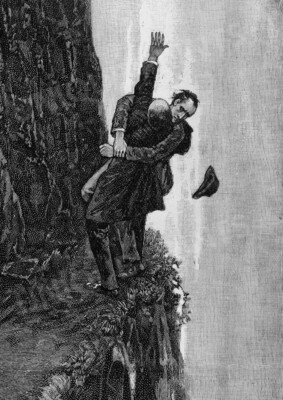
The first question is, if the Sherlock Holmes fanbase flooded the publisher's mailbox demanding that Doyle bring him back to life, whose fault is that? Can you blame them for thinking that Holmes was still alive, because there is no body? Naturally, one has to wonder, Why isn't there a body? Surely ("Don't call me Shirley!" to quote Leslie Nielsen), if Doyle really wanted to kill off Sherlock Holmes, he could have at least produced a body in the river, somewhere downstream from the Reichenbach Fall, and give Holmes a proper burial.

So, the only explanation is the simplest. Doyle did not truly intend to kill off Holmes. I doubt he consciously planned out the details of how to bring him back later, but a part of his mind must have left open a backdoor for the possibility of revival. 

In other words, the ending of The Final Problem is meant to be ambiguous. Even if he did not know whether he would write another Holmes story ever again, he did not want to give us, or himself, Holmes' corpse. I also suspect that he at least had a vague idea about the escape route, ie, scaling the cliff, just in case he wanted to bring Holmes back to life. Perhaps he didn't even expect to wait as long as 8 years. 

Why Do They Leave Britain? 

The general theory is that Doyle was impressed by the natural beauty of Meiringen during a vacation, also in 1893, and decided to place the climax to the story there. However, the way the story takes Holmes and Watson there is decidedly bizarre and uncharacteristically nonsensical. 

In the first half of the story, Dr. Watson (and hence the reader) was dragged by Holmes on a fast and furious trip from London to France, and from France to Belgium, and then onward to Switzerland, in order to escape the assassination attempts by Moriarty's criminal organization (as Holmes claimed). However, Holmes also told Watson that he needed only 3 days to stay alive and wait for the police to arrest everyone in the organization. Three days was all. 

"In three days--that is to say, on Monday next--matters will be ripe, and the Professor, with all the principal members of his gang, will be in the hands of the police."

When Holmes said the above lines to Watson, it was obviously Friday. They went to Victoria station the next morning, which must have been Saturday. So, he needed only to pass the weekend without being killed. 

To buy 2 days of safety, he had to run all the way to the continent? That makes no sense. I can think of a dozen solutions to Holmes' dilemma. For example, he could call in a favor with the Scotland Yard to assign a few policemen to him in a hotel across the street from the headquarters. Or he could use the incredible makeup and acting skills and hide out in an opium den, like "The Man with the Twisted Lip." Or he could hang out for 3 days inside the Diogenes Club, which was, supposedly, next door to Whitehall. He could even hide out in the Whitehall for 2 days, since it was the weekend anyway. Even if he had to play cat and mouse with Moriarty on the road, he could have gone anywhere on the British Isle, from Wales to Scotland. Why did he have to cross the Strait? Was Doyle too lazy to make up an excuse for the long journey? 

Despite the meticulous instructions for Watson to shake any tail, they were still followed at the train station toward ... presumably Dover, then boat, then Calais, then Paris. The destination is confirmed a couple of pages later:

"Moriarty will again do what I should do. He will get on to Paris, mark down our luggage, and wait for two days at the depot (emphasis mine)."

Why did he expect Moriarty to wait for 2 days in Paris? Two days later, ie, on Monday, if he were still in Paris, he would not be arrested "with all the principal members of his gang," would he? And, indeed, that was exactly what happened. On Monday, in Strasburg, Holmes telegraphed to the London police and received a response, to which he made a most unconvincing reaction: 

"They have secured the whole gang with the exception of him. He has given them the slip. Of course, when I had left the country there was no one to cope with him."

Right. So why did you leave the country in the first place? Besides, did Moriarty escape the police or was he still in Paris, waiting for the arrival of Holmes and Watson?

Again, the only explanation is the simplest. Holmes was not trying to escape Moriarty but rather lure him to the continent. The reason he left Britain was to make sure that Moriarty is not arrested on Monday with the rest of his gang.

Why Not Go Home? 

At this point, I'm sure you are wondering, why would he do that? Why go on this journey abroad just to cause Moriarty to unknowingly escape the British police?

But let's first look at another baffling choice here. Now that the arrests had happened and the gang was behind bars, Holmes decided to go on to Switzerland. Was he still trying to outrun Moriarty? (Even though he, obviously, never did try to outrun Moriarty in the first place.) No.  

"This man's occupation is gone. He is lost if he returns to London."

So, if Holmes wanted personal safety, he only needed to go home, since Moriarty could never return to Britain legally. He even suggested that Watson go home. Then why not go home together but rather head toward Meiringen? 

The narrative from Strasburg to Meiringen is even more transparent that Holmes was baiting Moriarty, leading him to a particular location. On the dead-end path by Reichenbach Fall, Holmes went as far as admitting that he knew the message to Watson was fake and devised by Moriarty to attack him. 

The simple explanation is that Holmes orchestrated the entire journey in order to get Moriarty to this place, alone, for a violent confrontation. In other words, Holmes had always planned to kill Moriarty here, far away from the British authority.

In many other stories, we have seen Holmes circumvent the law to let a criminal, even a murderer, go. He has shown at least a moderate degree of cynicism or distrust for the official legal system. I have no doubt the stories would have been much darker and more cynical, if Doyle had not tried to protect the public's sense of morality and belief in authority. Here, however, I am sure he knew that personal vigilantism was one step too far for his Victorian readers.

On the trip Holmes made a number of oblique remarks to Watson that sound like suicide notes, almost as if he had foreseen his own death together with Moriarty. However, if we read this part again, we can also interpret these as not biological but rather career suicide, and it sounds like protestation for his professional reputation:

"If my record were closed tonight I could still survey it with equanimity. ... In over a thousand cases I am not aware that I have ever used my powers upon the wrong side. ... Your memoirs will draw to an end, Watson, upon the day that I crown my career by the capture or extinction of the most dangerous and capable criminal in Europe (emphasis mine)."

Why Send Watson Away? 

This is never explicitly stated in the story, but the tone suggests (very vaguely, if I may say so) that Watson believed that Holmes knowingly sent him down the mountain in order to protect him from any risk of injury or harm by Moriarty. Or perhaps the Victorian readers assumed that Holmes adhered to the medieval battle code of duels, mano-a-mano. If Holmes were merely waiting for Moriarty to come at him so that he could arrest him alive, wouldn't it make sense to keep Watson around with his army revolver?  Holmes never let any medieval machismo prevent him from recruiting Watson's help on apprehending criminals on other cases before. 

When I presented this question to a generative AI, it replied that, besides protecting Watson, Holmes wanted the world to believe he was dead, implying that somehow Watson could not keep a secret. We saw him play a similarly cruel trick on his old friend. However, that story was written in 1913! In 1893, when Doyle wrote this story, Holmes was not supposed to pretend to be dead ... or was he? 

If Holmes really wanted to merely capture Moriarty, surely ("Don't call me Shirley!") a two-on-one confrontation is a much better bet. The only possible explanation for knowingly sending Watson away is to remove any witness of his illegal action next, which is ... more on that later. 

And, of course, removing Watson also serves the purpose of keeping Holmes' fate open-ended. Otherwise, Doyle could have written a scene in which Watson came back just a smidge too late, watching both Holmes and Moriarty plunge into the abyss ... but he did not.  

What Actually Happened? 

There is no way of knowing what Doyle actually intended to do with the duel between Holmes and Moriarty. However, as I argued above, he did not want to definitively kill Holmes. The situation is in fact very similar to the final problem of Hecule Poirot, where the detective did play the vigilanti and kill the bad guy. In that case, however, Poirot was driven to definitive suicide by his own conscience. This is certainly one possibility for Holmes ... maybe? The question is whether Doyle respects the standards of justice as much as Agatha Christie. I don't know the answer.

However, in 1903, Doyle gently soothed readers' sense of justice by portraying Holmes' survival and the killing of Moriarty as a fair fight in self-defense. This trick continues to be used in today's movies and thrillers. The good guy does not mean to kill the bad guy, but, oops, he killed the bad guy accidentally or unintentionally. All of our conscience is safe. 

Alternatively, since Doyle left the door open for himself, I can also imagine the final fight scene, in which the well-prepared Holmes pulled out a knife, maybe from his walking stick that got mentioned so many times, and stabbed Moriarty as soon as the latter got close enough, or perhaps pulled out his own revolver and shot the professor on sight. Then he calmly threw the body into the abyss. 

That would probably have lost him a bunch of fans, but I kind of like it. 

Saturday, October 7, 2023

The Talented Mrs. Sacret

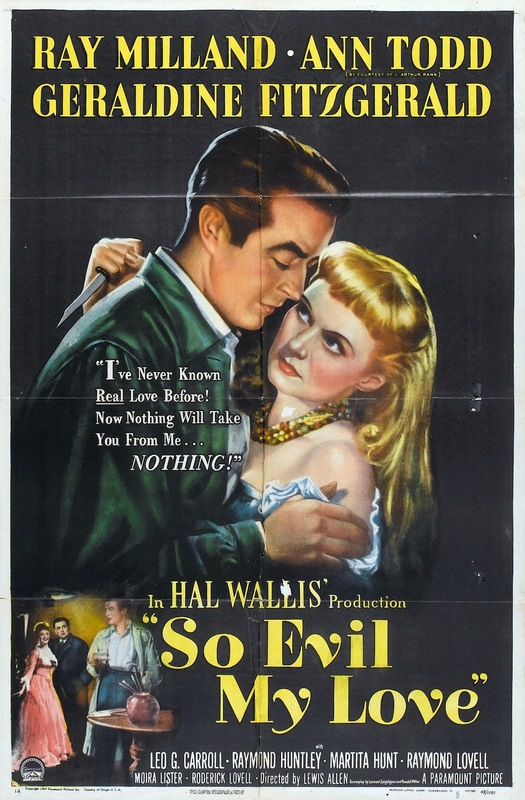
The 1948 movie "So Evil My Love" tickled my brain when I happened on it on Criterion channel. There was so much plot, and the relationship between the lead characters (played by Ann Todd and Ray Milland) was both fascinating and fragmented. One couldn't help feeling that there was a lot more to the story. While the movie takes largely Milland's point of view, I couldn't help but conjure up Todd's perspective the whole time, which seemed far more interesting. The predictable moralizing common in Hays Code-era movies is kept to a minimum, delivering a tense and unusual noir. 


And it turned out to be based on a crime novel, published only a year before (1947), written by Marjory Bowen under the male pseudonym Joseph Shearing and originally entitled "For Her to See." Surprisingly (not!), the novel is almost entirely told from the point of view of the female character Mrs. Sacret (changed to Mrs. Harwood in the movie), while the movie not only shifted it to the male character, a painter who calls himself Mark Bellis, but also made him much more sympathetic than he was in the novel. It was obvious that the filmmakers (the screenwriters and director were all male) needed a male anchor to this story or they wouldn't know how to handle it. 

In many ways, the novel reminded me of "The Talented Mr. Ripley" by Patricia Highsmith, published just 8 years later. I wouldn't be surprised if Highsmith took inspiration from For Her to See. A key difference between these two novels --- and the element that makes this novel extremely original --- is that the main character is not a hero, not even an antihero, but rather a loser. This choice is so daring and difficult to pull off that very few writers have even attempted it. It is so much easier and more appealing for both the author and the reader to identify with a master criminal and imagine oneself to be the smartest guy in the room. It is much more difficult to enter the mind of a not-too-smart character without making it drab and boring. No part of Mrs. Sacret's limited understanding of the world around her is boring, even if I, as the reader, often know more about what's going on than her. As an unreliable narrator with poor insight into other people's motives, it is a darkly comical pleasure to see the world through the very distorted lens of her eyes and introduces a modernist uncertainty rarely seen in this genre. 

In real life, the vast majority of criminals are not nearly as intelligent as the movies and thrillers want us to believe. Mrs. Sacret's motives and calculations are so petty and common that most authors have no interest in exploring them. The central similarity between her and Mr. Ripley is their resentment and envy toward their rich friends. In other words, money. Their conviction for taking money from their friends by any means necessary push the theme of class struggle very near the surface, which might be a source of discomfort for other writers. Mrs. Sacret especially is driven by a sense of grievance and entitlement that is possibly the most prevalent motivation among criminals of our time. We are startled in our recognition of this pervasive sentiment. "I deserve more. I don't have it because those people cheated me. I am wronged. I have cause to take revenge on all of you." 

The psychological insight throughout the novel is refreshing because it is more astute than most thrillers and, let's not kid ourselves, literary fiction about the lives of college English professors. All of the characters are ambiguous and test the limit of our sympathy. This comes with the unreliable lens of Mrs. Sacret and makes the reading experience delightful (especially for a cynic). 

Unlike the movie that centers around the male seducer/mastermind, the novel keeps him in the shadows, drawing a most chilling and irresistible psychopath rarely seen in other works but resonates with reality. The ending is really stunning in its lack of complete resolution. Even after decades of reading mysteries and crime novels, I am hard pressed to name a villain as well written as "the painter." 

What I like the most about this novel, however, is how aggressive and pungent the language is. In a novel by a woman (an English one no less!), about a woman's crime, told in the woman's voice, and filled with female characters, the pages are unapologetically filled with words like "power" and "stupid" and "hate." No euphemisms, no circumlocution, no fluff. Perhaps that was why Bowen chose to publish it under one of her male pseudonyms?

Tuesday, July 5, 2016

The Famine Pact


I've been re-watching some episodes of the French TV series "Nicolas Le Floch," based on the historical detective novels written by Jean Francois Parot. In addition to being glorious swashbuckling whodunnit fun, the series place fictional characters within the historical context of eighteenth century French politics. Being almost completely ignorant of this part of history, I can barely keep up with the intricate conspiracies and court intrigue.

One of the books entitled "The Baker's Blood," which I have not read, has to do with the Famine Pact. Under the pressure of chronic food shortage, Louis XV tried to stock up on grains during relatively good years as reserves for bad years. The intention was reasonable. Upon hearing the explanation, Nicolas Le Floch reacted as any of us would: "There's nothing shameful in that." Yet, the policy backfired and caused grain price to go up during good years and skyrocket during famine. Bureaucrats who carried out the policy saw an opportunity to make obscene amount of money through speculation, while shifting the blame on the king. Rumors began to circulate about the royalty's attempt to starve and rob the people. Riots broke out. These rumors, while untrue, directly contributed to the French Revolution a few years later.

Being a diplomat and historian, Parot seems to be quite sympathetic to both kings, Louis XV and XVI. He describes them as trying but failing to reverse the course of doom. Without the benefit of hindsight, Louis XVI supported the American Revolution against the British Empire, only to boost his own subjects' confidence in creating their own republic. Could they have done anything differently to avoid the revolution? The answer seems to be no. They were doing the best they humanly could. One could argue --- and Parot does argue --- that by then the system was too corrupt to be saved by any one person, even le roi. But then it's clear that nonpolitical factors, such as population growth, immigration failure (unlike Spain and Britain), weather, and other random events have as much or more effects on history than human policies and wisdom.

What disturbs me in all this is how little we seem to understand history. We don't know why the American Revolution was a success, but the equally promising French Revolution deteriorated into a bloody mess within four years. It was the French idea to begin with! Hell, we still have no idea what caused World War 1, and that was only 100 years ago! Is history a series of random chaos that can only be observed but never predicted? Or are we merely waiting for a theory to make sense of our own past and future with just the right variables and math? What is the force of history? And are humans both self-deluded participants and powerless puppets in the process?

Perhaps most curious, why do people behave in the same way over and over? "The Queen says, let them eat cake." "The King wants to starve you all." "The federal government is going to break into your home and take away your guns and wives." "The President eats babies for breakfast." Time has stood still and the same rumors are whispered across hundreds of years. Nothing has changed. "The people," as they are called --- are they real individual persons or recycled copies of the same marionette, generation after generation?

The TV series run up to early 1780s, with a disillusioned Le Floch sailing to the New World at Marquis de Lafayette's beckoning. (One cannot hear the name "Lafayette" without conjuring up the irresistible Daveed Diggs in mind.) There is an eeriness in this. Before a disaster hits, before people begin chopping heads off, we are all going about our business as if everything is normal. We may smell the rottenness around us and hear grumblings of discontent, but the smell and noise have always been there and nothing's happened so far ... 


Saturday, September 27, 2014

The Trope

This is one trope that I thought I would not get tired of, but right now I'm afraid it might be wearing thin for me, after seeing the thousandth police detective/inspector/lawyer/other kinds of crime solver with a completely screwed up life. He works too much. He has an addiction (drinking, gambling, sex, drugs). He is self destructive. He alienates family and friends around him. He has a boatload of psychological baggage and/or memories of trauma. Solving crime is the only escape and redemption ...

I have read and seen so many of them. From Kurt Wallander to Harry Hole to Clive Owen in Second Sight to Jane Tennyson in Prime Suspect. Lydia Chin might be a well-balanced young woman but she is plagued by an unrequited pining for her hopelessly dysfunctional partner Bill Smith. My God there are so many of them. I just finished the Australian series Rake. It's pretty well written, but almost entirely focused on the lead character's self-created problems. 

The only detectives with a happy family are Maigret and Ray Curtis in Law and Order --- Wait, even Curtis had a brief moment of crisis brought on by his excessively gorgeous looks. But at least he reconciled with his wife. 

Ah, right now I appreciate Law and Order so much for keeping the recurrent characters' personal lives complete off screen! So what if Jack McCoy has no time to date any woman outside of the DA's office. I don't care! I don't want to hear about it! Thank you. 

Friday, August 8, 2014

The Damsel-in-Distress Trope

Women have griped about the trope a lot. I can understand the complaint. Although it is true that most homicides are committed by men, most victims of homicides are also men, with the exception of domestic homicide (Kellerman and Mercy, 1992). The line between condemnation and exploitation on the writers' part and between being horrified and thrilled on the readers' part can be blurry.

In The Devil's Star, a thriller by Jo Nesbo in the Harry Hole series, a series of four murders were committed, in which 3 victims were young women, 1 was a young man. I searched my heart and, to my chagrin, had to admit that the death of the young man seemed less "thrilling" (or what the Chinese call 惊悚) than the women's. Perhaps because I am a woman, the murder of a woman seems more identifiably terrible to read about. Why do men like to read about murders of women, especially a young, pretty woman of reproductive age? Maybe this is a belief or instinct buried in all humans --- women are a more valuable/precise/scarce resource than men to our species/tribe, thanks to the inefficiency of childbearing. Every woman is needed in the game of reproduction for the tribe. Instinctively, we feel a greater loss in a woman's death. The same reasoning goes for our feelings toward the untimely death of a young person versus an old one. 

Also, yes, murders with a sexual motive thrill readers a lot more than murders for money. Financial motives were once common in "cozy" mysteries, in which one has much room to play with the issue of inheritance. Social changes have rendered those stories obsolete, even if homicide for money remains common in the real world. What other motives can mystery writers use but sex and revenge? Political murders and assassinations belong in its own subgenre. 

Well, frankly, murders for money or politics are just not as intimate and therefore as thrilling as more emotional and personal motives such as revenge and sex (including jealousy and various perversions). It's human nature. The market is unlikely to get tired of them any time soon.  

Monday, June 9, 2014

The Bridge


I've been binge-watching "The Bridge" season 1. It is fantastic! I love how it toys with social issues and our expectations. So good. In comparison American TV is complete crap. Only early seasons of Law and Order and Law and Order: Criminal Intent were not crap, the rest is all crap crap crap, from plotting to character to social context. All crap.

Tuesday, June 3, 2014

Ornen


Binge-watched this Danish TV series this weekend. 3 seasons, 24 episodes, 1 hour each. Yikes. If I didn't have a lot of work to do, I'd have gone on to binge-watch The Bridge. Scandinavian detective series are SO addictive.

Friday, November 22, 2013

Fatal Attraction

A person, often but not always a woman, has a romantic liaison with someone, but then changes her mind or loses interest. The jilted lover is so obsessed and/or angry at the end of the affair that he stalks her and kills her. The plot is used often in murder thrillers. Underneath the obvious condemnation of the perpetrator is a faint suggestion of blame that the victim somehow brought it on herself. If she had not slept with the wrong man, if she had kept her eyes open and nose clean, if she had read him correctly ... she would not have provoked his murderous obsession.

Such things obvious do happen, including some high-profile cases, but I wonder how often they really occur. Of all the people I have met and known in my life, no one behaved obsessively and possessively toward their partner, nor were they trapped in a relationship with an obsessive and possessive partner. What's it like to believe, with conviction, that your life will be destroyed if she leaves you? It must be a frightening feeling. It's not realistic of course, but it's a possibility in rare circumstances. Does it happen to only a rare person, or could potentially happen to most people if the "right person came along"? 

Saturday, November 2, 2013

Kate Shugak 侦探系列


最近开始看 Dana Stabenow 的阿拉斯加女侦探 Kate Shugak 系列。情节其实并不怎么悬疑,设局也毫不复杂,看点是跟现代都市环境截然相反的生活方式,交通不便的野外生存的社会状态,石油工业和原住民和酒民的文化。女主角是有 Aleut 血统的本地人,独自住在森林里,砍树修路赶熊样样拿手,并参与原住民社区的家长里短邻里纷争,兼破案追捕凶手,英明神武,但细节跟真的似的。照她的说法,阿拉斯加有很多移民,都是因为在大陆上受不了“正常的”生活方式或者社会氛围而逃到阿拉斯加森林,“远离喧嚣的人群”。看 Stabenow 的描述,闹得我都要产生去阿拉斯加看看风景的念头,但是她描写的棕熊吃人的段落又让我心惊肉跳。

Saturday, October 12, 2013

扮鬼脸

很厚的一本小说被我两天半看完,情节实在抓人。人物繁多剧情复杂令人叹为观止。每个人物能看见不同的鬼,有人能看见所有的鬼,有人能看见某个鬼,有人能看见两个鬼,有人完全看不见鬼,谁能看见哪个鬼的原因还都不一样,而且还有几场大家“欢聚一堂”的高潮戏,鬼看鬼,鬼看人,人看鬼,人看人,必须搞清楚谁能看见谁。每个怨鬼的纠结历史在每个活人眼前的矛盾身上都有呼应,同时还有 serial killer 的背景,还有经营料理店的情节。我脑子都晕了,而作者写得严谨缜密,找不出漏洞错误,这都是技术活啊!读者一般很少会注意到这些地方对功力的考验,我自己写一篇只有六七千字儿的短篇,改过几遍,还被人指出:同学你有好几处前后矛盾逻辑错乱 ...

大结局非常精彩,层层揭密,如一场高潮迭起的盛宴,令人十分满意,最后还把我看哭了,余味无穷。

Friday, October 11, 2013

宫部美幸

在图书馆借了本她的中文版 period novel 《扮鬼脸》。有点类似于 GRRM 大叔(最近还同时在重读冰火第四部),她也很喜欢玩 mixed genre 混合型故事,这里包含了近代历史细节,儿童小说视角,悬疑成分,鬼故事成分,世情成分,最后还少不了...料理!剧情设定在一家刚开张的料理屋,充满了街坊邻居的生活和关系。虽然我不是日式料理的粉丝,但还是很爱看的,而且她的描写注重勤劳工作人民的日常细节,很家常又很真实。整体格调是明亮的,但也并不刻意粉饰美化现实中的冲突和矛盾,人性的弱点。跟 GRRM 大叔类似的地方还有她对人物的细心刻画,即使是很小的配角也栩栩如生,历历在目,无比精致。GRRM 大叔也很爱吃,写到宴席之处必不放过,每道菜都详细描述,可惜建立在中世纪欧洲历史上的菜谱,再怎么描写也引不起胃口,他应该去成都拜访一下!

这种故事很容易落入节奏缓慢戏剧性弱的trap,但宫部有写推理小说的功底,节奏和悬念非常工整有序,人物与情节与环境样样不落下,每章结尾必留悬念让人欲罢不能。真是太厉害了,我好崇拜她。

或许更难得的是淡淡的恰到好处的幽默感,冷不丁地来一下,不注意就错过了。

哦,对了,还有,不看这部小说还真不知道,江户的意思就是大江入海的关口,是水乡,跟上海一样嘛。小说中描写的料理也免不了跟鱼虾海鲜大有关系了。

Thursday, August 1, 2013

Junkyard Dogs (Walt Longmire Mystery #6)

The series is getting better and better. This one is not only hilarious but also elegantly plotted. I read it in 3 days.

Wednesday, July 24, 2013

Hell is Empty (Walt Longmire #7)

Unlike the leisurely pace of the previous Walt Longmire mysteries, this one is very gloomy and scary right from the beginning. It's so gripping that I can barely put it down. Although Sheriff Longmire has trekked snowstorms before, the novel is far more chilling than any other. The atmosphere (literally and metaphorically) is freezing. I'm huddled in bed and shivering through page after page.

The novel is an unabashed tribute to Dante's Inferno. The "Devil" in the story made only a very brief appearance at the beginning and goes behind the scene for most of the novel, but his dark presence is felt on every page. Fused with Indian mythology, the journey in reverse hell is breathtaking --- I can almost see my own breath of condensed vapor in front of me in this steamy July when I'm reading the book. So good!

And ... the books have been made into a TV series! I've not seen it but apparently it's been renewed for a second season. I am pleasantly surprised that the lead actor is not a recognizable face.


Monday, November 19, 2012

The Godwulf Manuscript

Found this "first Spenser" novel, originally published in 1973, in the piles at the second-hand bookstore behind Eastern Market.

It's very Raymond Chandler. Perhaps the most tonally close to Chandler than any other hard-boiled mystery I've read. The only difference from Chandler is that Spenser had sex with female clients liberally, while Philip Marlowe never did so on any of the pages, although in one of the novels it was implied.

Come to think of it, why did Chandler avoid a more promiscuous life for Marlowe and deliberately make him into a medieval white knight in his approach to women? It was in stark contrast with Hammet's attitude toward nonmarital sex. One of the theories I've seen is that Chandler was gay. I have no way of verifying that claim, except that I saw a clip of him at a party some time in the 50s, and the clip was in a documentary about Christopher Isherwood.

Sunday, October 28, 2012

The Age of Doubt

最新翻译的Montalbano系列刚出炉,在图书馆网站上下载了有声书。Salvo 象个小男生一样地热恋了一把,顺便印证了意大利男人永不停止恋爱的谣言。其实情节有点狗血,有点男性范特西,但被 Camilleri 讲出来不知怎么的完全可以接受。这一本的情节还相当复杂,也很赞。

从明天开始,本地电视台将连续播出“青年 Montalbano” 系列剧,很期待。最近的周日晚上黄金档电视,我一直在追看 "Inspector Vivaldi" 系列。看意大利剧,景色是一大重点,这部外景在 Trieste;另一重点是风采各异的男演员,从男主角到打酱油的小警察到处都是惊喜 eye candy,连不美的老头男主角都很有气势。最好玩的是,老头不仅是威风八面的探长,而且做得一手美味饭菜,今天 swordfish,明天 penne alla norma。

Tuesday, October 9, 2012

The Redbreast by Jo Nesbo

I have heard of Nesbo (don't have that o-with-a-slash character on my keyboard) for at least a couple of years but was not moved to try him out until I saw a movie adapted from his novel. (The movie is "The Headhunter" BTW.) So I randomly picked up "The Redbreast" from the library shelf.

The first two chapters are very slow-going. The translation (apparently done in UK) was terrible, clearly by someone whose native language is NOT English. The text is littered with bizarre expressions such as "hairslide" (hairpin?) and stuff. I took it up and put it down for a couple of weeks.

I gave it another try on vacation last weekend at the secluded Black Walnut Point Inn on the tip of the Chesapeake Bay and made some progress between eating crabs, crab cakes, and soft-shell crabs. Soon enough I was hooked and have been unable to put it down!

The pacing, oh, the pacing is incredibly clever. The case itself is not terribly complex and follows a thriller/adventure structure rather than a mystery structure (ie, corpse -> investigation -> solution). However, he is soooooooo good at pacing the intertwining chapters with two parallel timelines and multiple points of view of characters. There are chapters that are really exposition with no death or carnage involved, but he is able to keep up the suspense even in the actually mundane segments. Master manipulator this guy is!

Character-wise, Nesbo is clearly weaker than Mankell or Connelly, but he's not too bad and has the familiar black humor typical of Scandinavia.

The best part for me, however, is to immerse in a realistic sense of the psychological conflicts that plagues the Norwegian national conscience in terms of Nazi-ism, the fallout of WWII, and the long-term aftermath. This is something distinctive to Norway, not shared by Finland or Denmark (not sure about Sweden though), which retrospectively explained another Norwegian novel I read a few years ago. Such a nuanced, unflinching dissection of an incredibly complex collective psyche is a rare and unexpected find in a thriller/mystery novel. Just proves again that the mystery genre, if done well, provides the best medium for the grand tradition of literary realism on each particular society and its conditions, on real people and lives, on every particular place and time.

Sunday, January 8, 2012

The Nine Tailors

Dorothy Sayers 的侦探小说,Lord Peter Wimsey 系列之一。开头全部在讲英国东部 The Fens 地区的环境和社区,以及复杂的Change Ringing敲钟法。很有趣。搞得我又有点动心了。英格兰到处是这个村庄那个村庄的,只在侦探小说里读到过,希望有空可以去走走看看。

已经看到第三章了,尚未出现凶案,幸好地区性描写十分新鲜有趣,也不乏味。

Change Ringing 敲钟法在 YouTube 上可以看到,否则光读书里的描写,靠脑子想象也挺费劲的。小说一开头描写新年夜九个人要拉绳子连续敲上九个钟头!看了 YT 才知道原来这玩意儿在华盛顿的大天主教堂也有。

Sunday, September 25, 2011

The Winter Thief

Jenny White 果然又出了一本 Kamil Pasha 侦探小说,我到图书馆去借了来打算慢慢地看。

各种土耳其生活画面与细节,尤其是城市与食物,真让人向往。

Wednesday, August 3, 2011

The Fifth Witness

有声书。Michael Connelly 之 Mickey Haller 系列中之新书。So so 吧,不算特别出色。

倒是听说 George Pelecanos 和 SJ Rozan 的新书都快要出版了。Something to look forward to.

The Ending of Le Samourai (1967), Explained

A quick online search after watching Jean-Pierre Melville's Le Samourai confirmed my suspicion: The plot is very rarely understood by E...