When I was a hormone-raging teenager (yes, that happened to me too), I happened upon a Chinese translation of Octavio Paz's prose poem The Blue Bouquet. Its indelible impression on me never faded. Yet it took me decades to seek it out again, as I recently began to read other poems by Paz.
Perhaps my excuse is that I have been afraid of poetry all my life. Reading poetry for me is like going to an art museum, especially a modern art museum. I walk by most exhibits and nod with a smile on my face, and promptly forget about them as I turn to the next piece. Only occasionally would a piece strikes me dead on the spot.
I borrowed a collection of Paz's poems from the library, but it's very slow going. They seem dense to me. In my mind I slowly piece together his words into a series of images, which may or may not produce any meaning. Yet often enough an image punches me in the face. For example,
I walk without moving forward
We never arrive
Never reach where we are
Not the past
the present is untouchable
-- Return
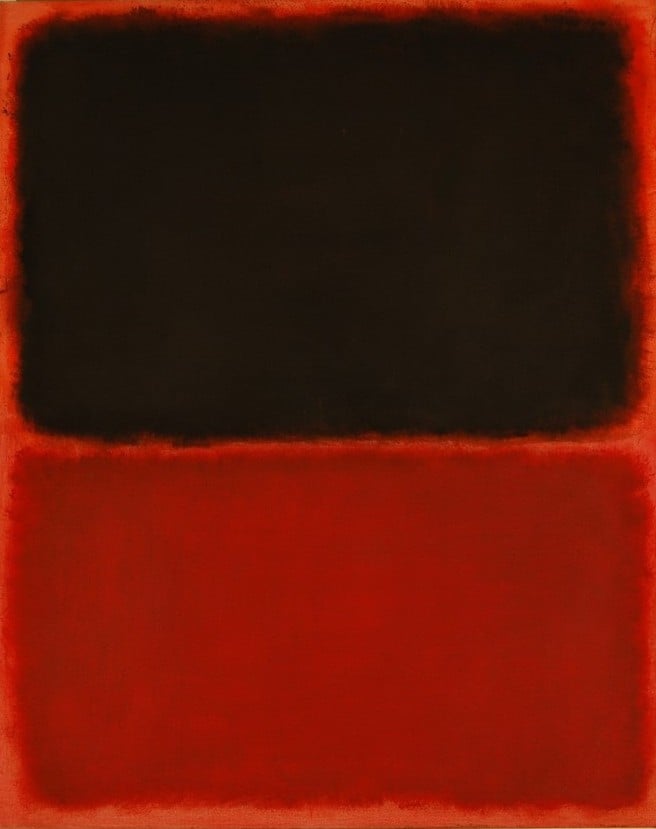
I don't know what it means. I only know how it makes me feel. And how it makes me feel is almost the same as how certain abstract artworks make me feel, primarily Mark Rothko.
It's kind of meaningless to see a Rothko in any medium other than seeing the real thing, because the real impact is in the details.
Rothko's abstract paintings (not his earlier works) get into a part of my mind that lies underneath language and conscious thoughts, straight into the amygdala, where dark tides of neurotransmitters roil in the electric storms.
I do believe that people can transmit feelings between them without words when they are in close physical proximity. My Yoga teacher likes to call anything that tingles in the body as "vibrations", so I might as well use the same term. Even though humans do not have telepathy, we catch each other's vibrations when we are in the same room and paying attention. Such transmissions are usually impossible remotely with words but can be done with reduced efficiency with images, which is why moving pictures evoke emotions faster than written words.
What exactly is remotely transmitted into my head from some of Paz's words and Rothko's images, I don't know, but it's not nothing.