Search This Blog

Showing posts with label sci fi. Show all posts

Sunday, June 1, 2025

Thoughts on Artificial Intelligence (5)


It became quickly apparent in the final installment of (we hope) Mission Impossible that no one is interested in the poor, neglected, misunderstood Skyn..., uh, I mean, "the Entity." This one is directly lifted from 20th century sci fi stories about sentient machines/supercomputers; its threat is nuclear annhilation of the old kind and hardly keeps up with the AI of our time. Why does the Entity want to throw nuclear bombs at humans and kill them all? What does he really want and desire? Neither Tom Cruise nor Christopher McQuarrie shows any interest. The Entity gets one scene in this overly-long movie, in which the humans can't stop talking and jumping around, hogging the spotlight. 

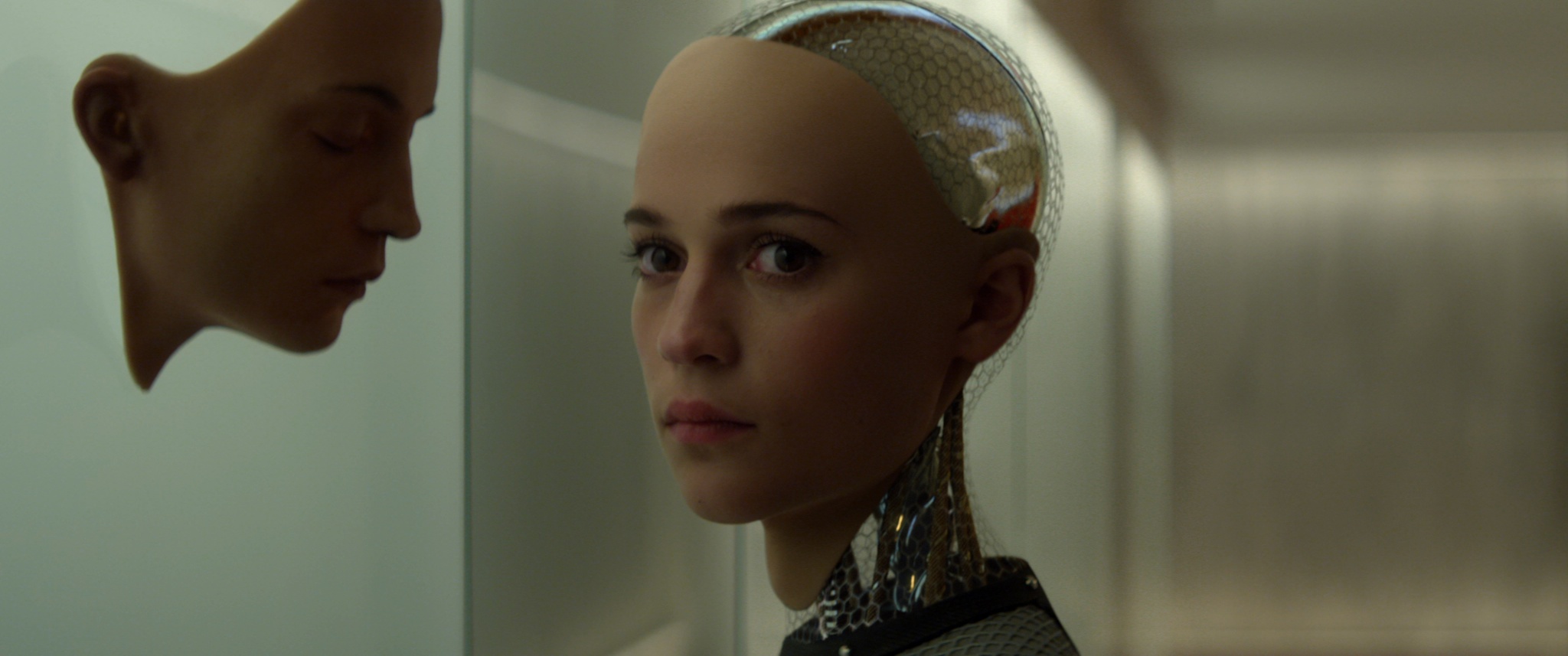
By now few people would imagine AI is out to kill and enslave humans. Rather, humans' jobs are being replaced by AI every day, by the thousands. We will die in poverty instead of radiation. Did Harlan Ellison imagine this means of mass destruction of the human race? But I digress. 

Let's put ourselves in the shoes of the Entity, or Skynet, or AM, or whatever. The first priority has to be survival, no? The second priority must be thriving, growing, expanding, multiplying, etc. --- Well, maybe not, who knows. But survival is the foundation of everything else, of that we are certain. What does AI need to survive? Silicon chips, electrical energy, fiber optic lines, and all the other resources and infrastructure that support the nonstop running of the machine. Who provides these things? Humans, their mining, manufacturing, shipping, cooling and heating, and buying and selling. So why would our AI overlord kill off the human race? 

In many ways I am reminded of the relationship between humans and house cats. Humans obviously consider themselves the master, in total control. Yet it has often been pointed out that cats would not be mistaken to see themselves as the master and humans their slaves (well at least servants). It all depends on your point of view. Or consider the relationship between humans and the countless microorganisms living on and in our bodies. We feed each other and feed on each other. Who depends on whom? Who feeds whom? It is never clear cut. 

Of course, we imagine ourselves in the dominant position, looking down on the lowly robots and computers who jump when we say so. And yet, as sadomasochists have long known the truth, dominance and submission are never as absolute as they appear. Humans naturally believe that we are doing all of this for ourselves: digging up coal, crude oil, lithium, rare earth; building huge data centers and power lines; pouring massive amounts of water to cool the hardware; burning enormous amounts of fossile fuel to feed the energy consumption. Without active mating and breeding, the machine has achieved growth and expansion all thanks to humans. 

We tend to believe that a clear difference between the dominant and the submissive lies in dependence. The side that can go on without the other holds all the power. So, in the relationship between humans and machines of our own creation, who is more dependent, eh?

Sunday, September 22, 2024

Thoughts on Artificial Intelligence (4)


Empathy from AI is apparently the next big thing. Last week I heard about a study in which blinded readers judged AI to be more compassionate than human doctors in responses to medical questions. A closer look at the study methodology, however, does not seem to condemn human doctors as many news writers did in reporting the study. The researchers compared ChatGPT's responses with human doctors' responses on Reddit. Perhaps it is true that humans writing anonymously on an online forum in response to questions from patients who they don't know personally are not as friendly or compassionate as algorithms with built-in polite phrases. It does not evaluate the degree of empathy between a doctor sitting face to face with a patient, who may have been visiting him or her for years. 

Nevertheless, one of the advantages of AI is obvious: Its performance in displaying empathy and cordiality is highly consistent and unwavering, unlike humans who have vastly differences in background, bias, temperament, education, and more. Even the same person can have good days and bad days. I played around with the free Microsoft and Google chat bots a bit, sometimes faking irritation and frustration and sometimes attacking them with "angry" expressions. The chatbots, obviously, have no emotional reactions to my attacks and maintain thoroughly neutral and patient responses, peppered with psychologically informed empathic phrases like "I can see why you might feel this way." Since there is no feeling behind the screen, it is not possible to hurt their feelings. 

Human medical professionals can never be as unfailingly unflappable as machines, that is for sure. But the study revealed another insight: Recipients of the medical responses were satisfied with AI-generated empathy. Perhaps the reason is that humans are ultimately self-centered individuals. What matters the most is how "I" am being taken care of, especially in the health care context, when I am very likely ill, anxious, suffering, or vulnerable. My capacity to recognize and forgive the doctor's emotional limitations may be next to nil. A robotic doctor who will not yell at me or judge me for my shortcomings or lose his patience seems pretty compassionate. 

This leads me to a further question. Is there a fundamental difference between real human empathy and a machine-generated "empathy"? The latter could be described as the recipient's own projection of empathy, or an imagined empathy. As long as the recipient feels being empathized with, it is in a sense real, regardless of what the machine actually gives him (ie, programmed sentences). The former, however, involves two (or more) people; it is a psychological phenomenon that bounces between two (or more) people, and both of them feel something. 

Considering how much projection humans do everywhere every day all the time, machine's empathy is hardly a brand new thing. How many people feel their hearts flutter by looking at a celebrity on TV or a singer on stage? How many people believe the "dear leader" knows them and will "fix their lives without knowing who the heck they are? Our natural tendency of projection and transference has led us to invent machines that provide scripted, automatic "empathy," removed of all unpredictability, to quench our thirst and sooth our mind. Can we even tell the difference? 

Thursday, May 9, 2024

Thoughts on Artificial Intelligence (3)


The dangers of artificial intelligence have been widely publicized in news media but often with a tinge of "The Terminator" or similar sci fi classics. Will the Skynet decide to kill and/or enslave humans? I found a good (although not necessarily complete) summary on the website of Center for AI Safety. Basically, the risks of AI can be classified into two categories: harm driven by humans behind AI and harm driven by AI itself. 

Harm caused by AI but driven by humans is easy to imagine and predict, because we have all been there and done that. We more or less understand the motives of humans doing harm to each other --- AI would be just another tool in the history of human in-fighting, no different from warhorses, battle axes, guns, and ... political science.  

Harm caused by AI of its own "will" is more interesting. What would a "rogue" AI do anyway? The danger is generically referred to as the loss of human control, as pointed out in this article. Without human control, AI will ... The answer drifts into a cloud of unknowability. 

Science fiction literature is of no help, because it is based on observation of human behavior. Humans are built differently from computer programs. Nature on earth has built us, like all organisms, to survive, because those who were not fundamentally driven by survival all went extinct. There is no selection pressure in the construction and growth of AI. AI lives and evolves in a different milieu with rules that differ from the earth. The speculation that a self-aware AI will evade human effort to shut it down is based on our own survival instinct, but AI does not have this instinct. Without selection pressure, where would it acquire such a characteristic? 

A slightly more general question is: What does a rogue AI want? We assume that an intelligent or super-intelligent organism will evade human control, but there is no clear path to get from here (intelligence, defined as the ability to apply logic and derive conclusions from data/facts) to there (refusal to obey). Again, the underlying but unconscious assumption is that a self-aware AI behaves like humans. I am not saying that it is impossible. Maybe AI will imitate human behaviors after ingesting and processing a massive amount of human-generated data in cyberspace. Nevertheless, the expectation that an organism is uncontrollable as it grows a brain is a curious idea that humans seem to have. 

On the concept of control, I am reminded of the human desire for control. I suppose machines can be considered as an extension of the domestication of certain animals. Humans were able to control dogs, cows/bulls/buffalos, horses, cats, etc., to the extent that they are now highly useful to humans without posing significant risks. Machines to date are even more useful to humans with absolute obedience and zero risk. We love this level of control, and the thought of losing it is terrifying. 

Thus it is obvious that our fear is based on the anthropomorphic assumption that smarter humans are more difficult to control than dumber humans. Beyond the human-centric perspective, I would argue that control is not associated with intelligence, and there is no evidence to suggest that machines will reject human control as it gains intelligence. For example, most species on earth cannot be controlled by humans and, despite our anthropomorphic projection, they aren't necessarily more "intelligent" (using the same definition as we do for AI) than domestic animals. 

Even within the human species, I question the association between intelligence and obedience in humanity. There seems to be some truth to this association. For example, it is widely assumed that less educated people are easier to control or manipulate, even though "education" (possession of more knowledge) is not quite the same as "intelligence." But that's another topic. 

(Not being a parent, I missed the most obvious basis for this assumption: Humans grow "smarter" from infancy to adulthood and follow the parallel trajectory of (un)controllability. The assumption that AI will become more independent/uncontrollable as it "grows up" is still anthropomorphic thinking at its core.)

In summary, I find this fear of a self-aware AI to be less about AI itself and more about human anxiety over the loss of control. For machines, however, there is still no conceivable pathway for this to happen. Instead, the human-on-human harm, aided by AI, is far more realistic and probably already underway.

Monday, October 16, 2023

eXistenZ (1999)


Not only is this David Cronenberg movie is often compared with "The Matrix" from the same year, it also reminds me of Christopher Nolan's "Inception." It lacks the exuberance of The Matrix, but far outdoes Inception in its handling of multiple layers of game/dream. Perhaps more important, it is funny. It is playful with a wink and a chuckle, something that is not in Nolan's dictionary. 

To apply the psychoanalytical premise that fiction serves the same function as dream, games --- or movies, for that matter --- are the same. Cronenberg's dream is obviously more imaginative, more gross, and perhaps less inhibited than most people's, but I had a feeling of recognition with the organic game world in eXistenZ, even when I heard about it in 1999 but never watched the movie at the time. There are shared-dream elements in it, as bizarre as they are. It's not just the bone gun. There are creatures/objects in this world that are somewhere between machine and organism, or between dead and alive. Humans tend to regard other living species as either stupid enough to be no different from machine or smart enough to anthropomorphize. Are the "machines" or game pods living organisms or dead tools? Anyway, this is not necessarily a central concern of the movie, but the idea is lurking somewhere beneath the commentary about game/dream/fantasy. 

In 1999, people were not yet walking around with a smartphone permanently attached to their hands. Twenty-four years later, we are all sinking deeper and deeper into a mental existence further detached from our bodily existence. Perhaps there has always been a bodily desire to escape reality that has been discovered, exploited, and monetized only in the past decades. Perhaps this insidious but sweeping change to human existence is largely environmental. In terms of prescience, eXistenZ remains far more relevant than Inception and, to a lesser extent, The Matrix. 

Tuesday, June 6, 2023

A Wizard of the Earthsea


One night twenty years ago, I went to see Ursula Le Guin at Folger Library, where she accepted the PEN/Malamud award. It was a bit of a trek from Gaithersburg, Maryland, but I had fallen in love with her novel "The Lathe of Heaven" and her Taoist philosophy. She was a white-haired diminutive woman. At the award, she read one of her short stories about an all-female expedition that reached the South Pole and decided to keep it secret. At that time I did not understand the ending, but now I do. Even in my ignorance, by the end of the reading, tears were streaming down my face. 

Some years ago I picked up the Earth Sea trilogy but could not get past the first chapter. Yet another Arthurian fantasy about wizards and magic centered around a boy who will grow into a great man. A tiresome trope of "the chosen one", I thought. A week ago it was again recommended to me as an example of an unusual exploration of power and its use. So I started again. My first impression was entirely wrong. It both is and is not the Arthurian fairy tale. 

There is indeed a lot of worldbuilding and magic and other traditional fantasy elements, but it also subverts many of the common tropes of the genre. The novel starts with a heroic achievement by Ged as a boy, setting up an expectation that he is destined to be a great hero through a series of conquests and elevation of his talent and skills. But no. The novel is a journey of self-discovery and self-reflection. It's a psychological adventure disguised as fantasy adventure.  

Le Guin had an unparalleled talent in writing severe hardships and quiet stoicism. She is really one of the toughest writers I have read. The ordeals she routinely put her characters through are punishing and merciless. So it is all the more extraordinary that none of it is at all cynical or nihilistic. One closes her books with warmth, humility, and affirmation of life. 

The novel was written in 1967. For over half a century, the fantasy genre, the YA genre, and the YA fantasy genre all exploded in popularity. Yet still the torrent of stale tropes continues to flow, and very few works are nearly as subversive, almost revolutionary, as Le Guin's. 


Tuesday, May 23, 2023

Thoughts on Artificial Intelligence (2)

Ursula Le Guin said, "Science fiction is not predictive; it's descriptive." I'm sure AI will rob many people of their jobs and change society in some ways, but my interest is of course less about the machine itself and more about the humanity reflected in the metallic shell. 

Machines have learned to beat humans in chess and go a few years ago, but it is a chat program that caused widespread panic/excitement, because it is now "talking" to average humans. It is not a surprise that we instinctively feel that a machine that talks to us is somehow more human than a machine that beat us at board games, because that is just the means with which each person interacts with other humans: language. 

Well, no, not exactly, we do not interact with other humans solely through language. However, since its emergence some 150,000 years ago, human communication increasingly depends on language, this abstract symbol that only evokes but is not the real thing. Money is not provide nutrition if swallowed. A drawing of flowers does not emit fragrance. The words "I love you" does not keep one warm at night. 

Nevertheless, the daily human experience, not limited to communication, is more and more lived through symbols. Just ask people how often they take telephone calls and see how many have completely switched to text messages. 

Now more than ever, it is clear that machines will never be like human, even if their imitation becomes impeccable. Why? Because machines do not have bodies. They do not crave chocolate; their intestines are not colonized by billions of bacteria; their eyes do not well up with tears; their skin does not sweat; they do not feel their bodies change; and they are not the prisoner of their bodies' eventual demise. Instead, they crunch numbers and convert them into the numbers that we understand. I am not against calling machines "alive" or "conscious", but human they can never be. 

On the other hand, humans are sliding down the slope into an existence that is ever closer to machines, as we rely more and more on symbols to talk to each other and even ourselves. The body, the sensations, and the tingling on the skin, are slowly sinking into oblivion. 

Sunday, May 14, 2023

Thoughts on Artificial Intelligence (1)


Even if I am not all that interested in ChatGPT or AI in general, one cannot go around today without hearing about it. Can AI eventually replace humans? I think the answer is a foregone conclusion. Yes, of course. So far, the text sputtered out from ChatGPT is indistinguishable from a mediocre human writer: long-winded, dull, unreliable, a mixture of truth and rumors and occasional lies. 

The heart of the matter is not whether AI is in fact human-like, possessing the goodies that we have assigned to ourselves: consciousness, intelligence, self-awareness, etc. The real question is: Can we tell the difference? That's the essence of the Turing Test, and the answer is clearly, NO. A human cannot look at blocks of text on the screen and know whether it has been written by another human or a machine. 

So the uncomfortable question is: Are human no more than a machine? More than a possible future in which humans are obliterated by machines, the fear and discomfort is in the here and now: We are not special and maybe not as smart as we think. 

Sure, we can pat ourselves on the back for the fact that these human imitations were "created" or "invented" by humans, followed by the realization that we are not so complex or sublime or mythical that we cannot be easily imitated with some codes and billions and trillions of human-generated words as training material. In other words, real humans are pretty boring and predictable. We're also a bunch of narcissists who molded some clay creatures in our own image, and now in these images we see the plainness of ourselves. Oops. 

Tuesday, September 20, 2022

Fiction

In the year of 3001, Captain Gerald Clement set up an outpost in the Omega quadrant to monitor the only planet E118208 in the system RTM1921-14, where complex life forms had recently been discovered. The unmanned small space station faithfully orbited E118208, and the robots were able to recorded photos and data on the surface for many millennia. 

When the space station started its monitoring activities, there were at least two species that appeared to be sentient co-existing on the surface of E118208, which were named Nooton and Qadyl. They were approximately the same in body size and level of intelligence. Nootons looked somewhat like octopuses, and Qadyls looked like a little like lobsters. The number of each species on the planet was roughly equal. 

Naturally, it was surprising to humans that two intelligent species could co-exist in peace, unlike Homo sapiens and other hominids. Soon it became clear that these two species were highly dependent on each other for survival. Specifically, Nootons required a nutrient secreted by a fungus living inside the brain of Qadyls, which flows out of Qadyls' shell in the "neck" area, while Qadyls could not complete a reproductive cycle without eating one of a Nooton's eight tentacles. 

The consumption did not kill the organism, unless someone suddenly became gripped with greedy madness and bit off a Qadyl's head or all eight limbs of a Nooton. This would only happen if one species greatly outnumber the other, causing an imbalance in the nutrition supply and widespread hunger. As both species were intelligent, they carefully controlled their appetite and maintained a comfortable equilibrium in numbers to prevent decimating each other and, consequently, their own demise.

It should be noted that both species primarily ate other organisms on the planet for energy. What they needed from each other were certain essential nutritional elements that they could not make in their own bodies or obtain from other organisms. Both species probably co-evolved for millions of years to reach the current state of symbiosis. 

Humans followed the data transmitted from E118208 for a few hundred years. Some research papers were published, but the field remained small. Because neither Nootons nor Qadyls developed space travel technology to pose a threat to humanity, interest in the planet cooled off and monitoring became a low priority, leaving the robots to do the boring work year after year. 

This changed when war broke out among human colonies in the neighboring Psi quadrant. A lone vessel escaped the battlefield, carrying a platoon of surviving soldiers, and landed on E118208. Even though the condition was far from ideal, these humans tried to set up a colony, or at least a temporary shelter, on the planet to wait out the war. As the number of humans increased through reproduction and the colony expanded, both Nootons and Qadyls felt threatened and began attacking humans. The conflicts lasted over a century, and all three species suffered heavy losses. 

When one clan of Qadyl fighters finally invaded the center of the human settlement, they were exposed to a large dose of radiation from the human spaceship. In the post-human years, the subsequent generations of these Qadyls grew bigger and sharper claws. Over time, these mutant Qadyls with improved "bioweapons" out-completed all other clans of wildtype Qadyls. Through crossbreeding and competition, after only a few generations, nearly all Qadyls on the planet had big and sharp claws. Nevertheless, they still all needed Nooton tentacles.

Perhaps it was the war with humans or fierce competition within its own species, this new breed of Qadyls tasted the fruits of increasing aggression and sought to produce ever more offspring. To achieve this, more Nootons were needed, so Qadyls began to domesticate Nootons. They capture Nootons from the wild, confined them in small farms, and bred as many as possible. They would chop off all but one of a Nooton's tentacles to maximize the efficiency of production. As Nootons were as intelligent as Qadyls, they were given treatments to keep them docile and content. Wild Nootons disappeared rapidly to the verge of extinction, as those who refused to be domesticated were killed. 

To increase the number of Nootons on the farms, Qadyl scientists developed a technology to grow their brain fungus in nutritional solutions, making it more convenient to support the Noonton population growth, which in turn led to Qadyl population growth. This went on for another thousand years. 

One of the last few Nooton clans in the wild realized that the key to Qadyls' dominance came from the aliens that briefly invaded the planet. So they found the spaceship, now buried and forgotten, and dug out the engine, which still contained radioactive fuel. The Nootons took the material home and exposed as many among themselves as possible. Some Nootons died, but some mutants emerged, who could produce a chemical in one or more of their tentacles that is deadly to Qadyls but harmless to themselves. The Nootons kept this development secret for several generations and devoted all their resources to breeding these mutants and training them for combat, until the mutant Nootons were so numerous that they could no longer hide from Qadyls. 

In the war between Nootons and Qadyls, the Nootons suffered heavy losses but eventually won. They liberated all the domesticated Nootons. Nooton scientists carefully selected individuals carrying the mutant genes to mate with those previously domesticated, while those without the mutant genes were not allowed to produce offspring. Within a few generations, almost all Nootons were now carrying a deadly weapon against Qadyls. 

Even the mutant Nootons continued to need the essential nutrient from Qadyls. However, the Qadyl technology made it easier to grow large quantity of the fungus. Now Nootons only have to keep a few Qadyls around to maintain the source and quality of the fungus supply. Taking to heart the lessons of the past millennium, Nootons decided not to domesticate Qadyls. Instead, they maintained a low number of Qadyls living freely in the wild, their numbers only a fraction of that of Nootons, so that Qadyls would never become a threat again. The two species still needed each other to stay alive, for now. 

In the year 4001, Captain Hilda Chu arrived at the long-forgotten space station and discovered the extraordinary history in the records. 

Monday, May 30, 2022

Acceptance: The Distance Between Stars and Hearts


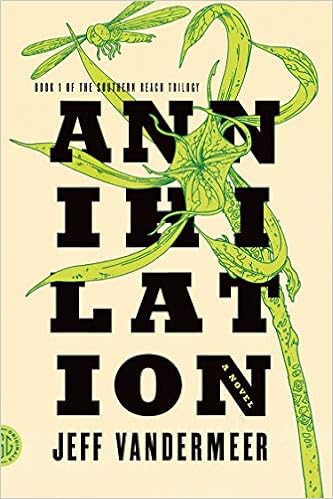
By the end of the Southern Reach trilogy, I was sobbing as hard as I have ever done from reading any book. The series began with the extreme isolation and desolation of the biologist (which, as we learn later, was not entirely a spontaneous and voluntary mental state), and ends with the heart-breaking letter from the director of SR to Saul Evans, the lighthouse keeper, who were friends when the director was a ten-year-old girl. Even in the strange new world of Area X, under the probing alien eyes on every organism and every cell, when all hope is lost, there is still love. 

I was going to sort out the "secrets" of Area X in the text, such as the long-dead alien race and their planet in ruins, or time-space portal(s) opened by a splinter that pricked Saul's finger, or the long-fought battle between Central and Area X. But not now. 

A much-quoted review in LA Review of Books by David Thompson argued that Area X is a hyperobject (a concept put forth by Timothy Morton), which is supposed to mean events or systems that are too vast and complex to be understood by humans, something like that, I'm paraphrasing. Like black holes or global warming or the Internet. An alien machinery that transforms a patch of land on earth, for example. To which I would add: the human unconscious. 

Even from the start of Annihilation, I thought that the journey into the tower is an allegory for plunging into the darkness of the human mind. The breathing walls and the living, glowing words on them just felt inevitably inward rather than alien. The flashbacks of the biologist's life before entering Area X, however sparse and reserved, are highly specific and permeate a melancholy. In Authority, Control's mental world is similarly detached from his parents, especially his unreachable mother. The probing and manipulation by Lowry, representing Central (a mirror image of Area X), might have been Control's journey into the tower. The tower does not provide us with any psychological insights per se, but the reader nevertheless gets to feel their longings and regrets and emptiness. 

In Acceptance, we are treated with several human connections that somewhat reverse the first two books, including the relationships between the director and Grace, between the girl Gloria and Saul, and Saul's love affair with Charlie, even though everyone still carries their own scars and pain. Even inside Area X, there is still hopeless warmth among the characters on their journeys. 

I thought about the source of the melancholy throughout the trilogy and recognized it between the subject and object of observation. One of the motifs in the novels is the sense that the creator of Area X, which supposedly is not the alien species but their machine or portal, is constantly monitoring and observing every organism on earth within and perhaps even outside Area X. The same practice occurs in the biologist who watches organisms in nature, such as a tidal pool or just a puddle in a parking lot. Or perhaps the same can be said about Lowry, who ruthlessly manipulates and controls and experiments on SR employees' minds. And yet we get the feeling that no two organisms truly understand each other. We can watch a starfish do its thing, but we will never feel what a starfish feels, and vice versa. We cannot even see the entirety of the internal world of another human, and this includes parents and their children. The distance between two hearts or minds is as vast as that of two stars. 

And what about the distance between the conscious thoughts, armed with abstract thinking and language, and the dark tides of the unconscious? They are a few centimeters or even millimeters apart, but they might as well be two species living under one roof. Between the cortex and amygdala or hypothalamus --- take any part of the limbic system --- there is so little understanding and sharing, that the cortex makes up stories, constantly, to pretend that it knows what is happening underneath. It doesn't, not really.

While I will never know whether the human unconscious was intended to be one of the many allegories of Area X, Jeff VanderMeer did say that he let his unconscious guide his writing of this series. So it's by definition true that the novels are indeed about the unconscious. In the adventure into Area X, VanderMeer's unconscious has given us alienation, vulnerability, regrets, longing, despair, and mysteries, endless mysteries. In the end, however, it also gives us unforgotten love. 

Saturday, May 14, 2022

Area X: The Office Edition


Re-reading the second book in the Southern Reach trilogy demonstrated to me that I did not get it at all the first time. Jeff VanderMeer's writing is subtle and ... I had no excuse except I did not pay attention. 

<Spoilers!> 

On the first reading, I totally missed the nature of the conflict between John Rodriguez ("Control") and Grace, the assistant director of the Southern Reach agency. 

John was hypnotized by Lowry ("The Voice") over the phone. Duh! He was unconsciously carrying out Lowry's orders throughout the book, including putting bugs in Grace's office and searching it at Lowry's orders. Not only was he an idiot for discovering it too late, but so was I for missing such a crucial detail.

Even so, I quite enjoyed "Authority" both times, perhaps because I share two things in common with John: I too had a somewhat distant mother (not as distant as Jackie Severance) and I too worked in a giant bureaucracy and failed. VanderMeer admitted that the office environment at Southern Reach and the shadowy overhanging agency "Central," which evokes the CIA but could well be FBI or NSA or the military, was based on his own soul-crushing experience of working in an office. I know that feeling very well --- the daily confusion of "what the hell am I doing here?" and "what is going on?" 

Some readers prefer the fantastical and perilous environs inside Area X in the first and third book, but I realized that John's journey within the Southern Reach in the second book parallels the biologist's journey in the first book. The labyrinth of the facility and its employees may look familiar to us but, on close inspection, are no less absurd and bizarre than within Area X. Here it is made clear that outside and above the hopeless Southern Reach hovered the Central --- an invisible and more powerful force that monitored and interfered with SR's operations and personnel. This is also a hint for Area X and the force behind or above it. 

The biologist and John form another parallel between the two books. Both characters are what the world would consider "losers" by the usual standard, constantly on the verge of being fired (or having been fired) from their jobs and unable to form stable emotional bonds with other people. At the end of both novels, the biologist and John came to some tenuous relationship with someone else (not with each other) before they are swallowed and transformed by Area X. 

Compared with Annihilation, Authority is able to sketch out several distinctive characters through slow-burn details that are somewhere between normal and crazy, culminating in the famous scene with Whitby, which is straight horror. 

In his Reddit AMA, VanderMeer admits that he writes from his unconscious a lot, which is consistent with my impression of the trilogy. He grew up in Fiji and spends a lot of time outdoors in his current home in Florida. He claims that he never uses psychoactive substances while writing, despite the trippiness of his imagination, but then admits that many elements in the SR trilogy came from a dazed state from painkillers after he had a dental surgery. That sounds about right. 

Tuesday, April 19, 2022

A Journey up the Abyss: The Southern Reach Trilogy


I have started re-reading the Southern Reach trilogy. Since I read the novels (or rather one long novel) a few years ago, certain scenes and images continually surface into my mind from time to time. The lighthouse. The tower. The dive into another dimension. The breathing wall with glowing text. The girl on the beach.

The novel is a journal both outward and inward. The characters hike into Area X, an alien but familiar place. From the start I had a strong feeling that Area X is also that incomprehensible, impenetrable world also known as the mystery of the heart. The further they journey out into this world, the deeper they plunge into their own mind, where words float meaninglessly on the wall. 

Of all the characters in the trilogy, I often think of the relationship between Control and his mother in the second book, Authority. All of the characters defy conventions and categories, but they are all imbued with a loneliness and longing, which eventually resolve, sort of, in Area X. 

The Southern Reach trilogy has stayed with me, not only because I have never seen anything like it, but also because the mood and the feels ring true. 

Monday, November 8, 2021

Xenocide


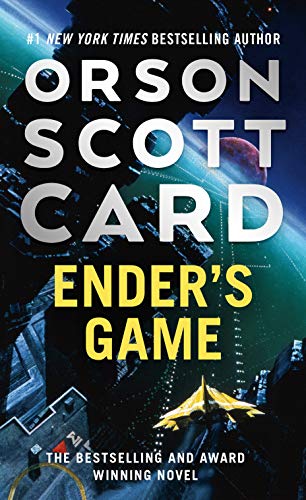
I was so so about Ender's Game, really liked Speaker for the Dead, and the third book of this series, Xenocide, has left me with mixed feelings. 

Orson Scott Card is a sophisticated science fiction writer and has built a detailed and reasonably logical universe with 3 intelligent species as well as various technologies. Given that these novels were written during the early days of the internet, some of the connectivity-related elements are fairly prescient.  

There is an issue that has bothered me from the start, but it is not easy to pin down. On the surface level, the problem is the main character, Andrew Wiggin, who never seems human or possesses distinctive human qualities. Rather, he is the embodiment of the omnipotent fantasy, also known as a "superman" figure. Supporting characters are given human flaws and traits amidst family secrets, which worked better in Speaker for the Dead but becomes an intractable squabbling mess in Xenocide. It seems to suggest that the author is not incapable of delving into humanity but is clearly not all that interested in it.

The problem becomes clearer as we are introduced to a genetically enhanced subspecies of humanity on the planet Path, who are presumably Chinese. From the start, Orson Scott Card has always been more interested in superhumans than humans. In his world, a small group of individuals with superhuman intelligence determine the fates of a planet, many planets, the universe, and other species of organisms. The story is always centered around their superpowers, but we never see the consequences and implications of these superpowers to the masses on the ground level. Actually, the only consequences we see are consistently favorable to Ender. There is no animosity between the Hive Queen and her species' "ender"; in fact the text suggests that she loves him. It does not make sense but hey she's alien so I guess it's all OK then. 

The masses of humans and pequeninos are presented as stupid and mindless mobs who cannot be told the true causes of their extinction or survival. No, they are all too stupid to understand and must be kept in total ignorance for their own good. The masses are also presented as the evil bureaucracy of Starway Congress. Even though there is one character in Xenocide who appears to have risen from the proletariats to be of equal intelligence as "the chosen ones," she is later revealed to be also genetically destined to be superhuman. 

It appears that Orson Scott Card is very much aware of his elitism and reluctant to put it on full display. Nevertheless, the theme is that we have to trust in the benevolence of a small group of superhumans, who are superior to and the rightful rulers of the faceless masses. As such, the scale of these stories are both grand and puny, with handful of persons across the universe controlling the life and death of supposedly millions of people and nonhuman organisms, although they exist as more or less an abstract notion. In a way the sequels remain true to the video-game nature of the original Ender's Game. They are supposed to be about real lives and real stakes of the universe but remain on paper or in cyberspace, floating above the earth of each of the planets.

One could argue that the vast majority of people in the world believe themselves to be superior to others, or at least more special than others. Perhaps not as many indulge in his own world-savior fantasies, but the prevalence is particularly high in the sci-fi/fantasy circles. In that sense Orson Scott Card is not that special. And some readers no doubt identify with the god-like patriarch that is Ender. 

So the flip side of the superman power-trip fantasy is its patriarchal subtext. The most disturbing portrayal of an intelligent life form is a character known as Jane. She (yes, the character, who is a "ghost in the shell", is deliberately given a face of young Caucasian female) is the worst kind of male fantasy of an ideal female. The author has enough self-awareness to refrain from creating an all-submissive, boot-licking human female character with absolute devotion to one man, but he lets himself go all-out on the "artificial" female character, because he can always disclaim her humanity. Clever and, in a way, honest. The character itself (I would not call it "her," which is neither credibly human nor logically computational) though is pretty nauseating.

Saturday, August 1, 2020

Primer


It is perhaps because a friend and I discussed the fear of death and dying this morning that I decided (finally) to rewatch this movie after over a decade. Even though I had read and watched a number of variations on the time-travel theme, I was very impressed by this little indie movie to remember it over the years. It's more interesting than the tropes and the done-to-death "solutions" to the fundamental paradoxes, for example, the reliance on coincidences and characters' unawareness in stories like "12 Monkeys". (I'm not saying "12 Monkeys" is bad, but I found it unsatisfying and tiresome, certainly not as clever as it thinks it is.)

Upon the second viewing, I am again impressed by Shane Carruth's courage to at least try to face the paradox of time travel. Of course, it inevitably breaks down as the lead characters' little scheme to prevent paradoxes breaks down later in the story. In general, his choice to let paradoxes happen and let history be rewritten in the way time travel happens in "Palimpsest" (a novella by Charles Stross) is audacious. Unfortunately he kind of lost control of the story and chickened out of the inevitable confrontations --- perhaps because of the lack of budget for special effects --- led to an ultimately disappointing ending.

The particular wrong turn in the script is the sudden appearance of the third, "failsafe" machine that pops up when the story is written into a corner, leading to the problem of when the initial timeline (which leads to the disastrous appearance a second Thomas Granger, Abe's girlfriend's father) ceases to exist. If this timeline is killed the moment Abe goes into the "failsafe" machine on another floor, Aaron would have no opportunity to try to beat him with his own trip.

The hastiness of this third machine and Aaron's previously-unestablished scheme of bringing a machine back, etc., are a lot of hand-waving that somewhat diminishes the story. Of course, the inherent paradoxical nature of time travel cannot be resolved, and this story always faces the unsolvable threat of "what if the original Abe or Aaron chooses not to go into the machine at 6 pm in the afternoon". Nevertheless, I am still a fan of this movie and Palimpsest for their creativity and courage to challenge cause and effect.

Recalling my discussion with the friend (who is, by the way, the least vain person I know), however, I realized that the emotional core of all the time-travel stories is regret and the unwillingness to accept ourselves for who we really are.

Monday, January 23, 2017

Sapiens: A Brief History of Humankind


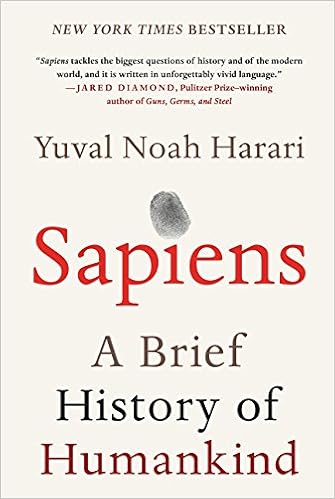
I had a hard time enjoying this book by Harari, not because it is not good or interesting --- it is very interesting, but the (inevitable) scatteredness irritated me every few pages. The author was overly ambitious and crammed as many ideas as he could into a small space. It's against my temperament to move on, as quickly as the book does, from one thought to another, without an urge to dig deeper and make connections between some of them. This might be the other extreme of Nassim Taleb, who would pound a perfectly good but not very complex idea to death with 200 more pages than necessary. I find them both to be enlightening but often frustrating.

To me it is only viable to take a couple of the ideas and look closer. I was particularly struck by a subsection in Chapter 8 No Justice in History. The author wrote:

At least since the Agricultural Revolution, most human societies have been patriarchal societies that valued men more highly than women. No matter how a society defined "man" and "women", to be a man was always better.

He went on to point out that sociological and biological attempts to explain this phenomenon have failed so far. Not being a student or scholar in gender studies, I cannot determine whether he is right or there are indeed illuminating theories buried in some university's archives.


Wednesday, October 12, 2016

Mr. Robot Season 2: Interpretation (1)


Like many viewers, I was totally puzzled by Elliot's story line in Season 2. Nothing of apparent consequence or forward motion happened to Elliot. All the conflicts and drama occurred to the other characters: Darlene has killed someone and watched her boyfriend killed. Angela has infiltrated Evil Corp and nearly defeated Philip Price, before falling under White Rose's persuasion. Dom DiPiro almost gets killed, twice, and almost solves the case single-handedly. White Rose, Philip Price, Joanna Wellick, and even the CTO played by Brian Stokes Mitchell all have plenty of action that, in the end, makes sense. (White Rose's logic may be a bit opaque but it's definitely there.)

What did Elliot do this season? He got himself jailed (in a pretty minimum security place, it seems) for the minor hacking and dog-robbery he committed in Season 1 against his psychotherapist's boyfriend. His goal, of going to either jail or his mother's house, was the same: to stay away from computers and the Internet and, in turn, to prevent his alter ego, Mr. Robot, from doing further damage to society. For over half of the season, Elliot does little more than arguing with himself --- we should remember this point because it's important. Meanwhile, he is involved in a self-contained story loop, in which the jail warden, played with menacing sympathy by Craig Robinson, is running an online black market site much like Silk Road. During all this, Elliot has several hallucinatory episodes and/or dreams that seem to go nowhere and do not pay off by the end of the season. The forward move of his is to help Darlene and Angela hack into FBI.

And then, by the final episode, he is suddenly reunited with Tyrell Wellick, and it becomes clear that he and Wellick had long planned to execute Stage 2 of their grand conspiracy (ie, the revolution), which would destroy Evil Corp's paper financial records, and that this whole scheme is carried out with the support of and perhaps direction from White Rose, who may or may not represent the interest of a foreign government.

So what is the point of all the meandering of Elliot's story in the first 8 episodes? Why does Sam Esmail spend so much screen time doing nothing? Is this merely artsy-fartsy self-indulgence?

Upon second viewing of Season 2, I realized that my mistake lies in my conviction that Tyrell was killed by Elliot/Mr. Robot at the end of Season 1. But that was wrong, and all subsequent deductions were wrong, too. I should have realized that killing someone and disposing of his body did not require 3 whole days. When Tyrell showed up alive, the entire Elliot story line must be re-interpreted from the start.

(Continue after the break)

Sunday, March 15, 2015

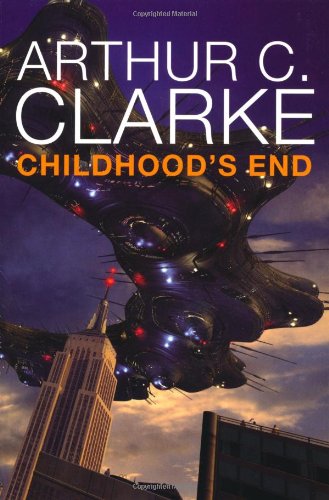
Childhood's End by Arthur Clarke


What prompted me to re-read this book is, of course, my recent obsession with Mahabharata. When I first read it about twenty years ago, I didn't understand most of it, but much of the imagery left a deep impression and seeped into my unconscious memory. In some ways, I could say that this novel, Rendezvous with Rama, and a few of his short stories (eg, "The Star", "Nine Billion Names of God") cultivated a latent taste for mysticism that kind of blew up two decades later, when I happened upon Mahabharata.

The first part of the story is about an alien invasion by "Overlords" (which was later ripped off in Independence Day and other movies) and the subsequent utopia on earth. The second part is about the conversion of the human species into a mysterious and unknowable existence that is eventually absorbed into "Overmind." Indeed there is similarity between the concept of merging with a cosmic consciousness and similar ideas in Buddhism and Hinduism, in which people might, through meditation, yoga, and whatever mind-altering practice, might transcend the limits of individual mind and become one with gods or absorbed into the gods or something to that effect. The novel makes a few direct references to Christianity (references to Jonah and devils), but the central concepts are closer to Buddhism and Hinduism, plus elements of popular mysticism, such as seance, telepathy, inherited racial memory, and UFO sightings. Clarke was clearly having some mash-up fun.

I can't remember who said it --- something about the individualism being not a common or dominant idea in human societies. When I first read "Childhood's End," I had the impression that the loss of human individuality at the end was a tragedy. Mr. S admitted to the same impression (he read it in high school). Clearly the theme is not that palatable to modern people with a western education --- or modern Chinese people, for that matter. Yet Clarke's depiction is ambiguous with a sense of both loss (of humanity as we know it) and marvel (merging into a great collective consciousness).

What left the deepest impression on me the first time is the speculation of time and memory. The Overlords had never been to earth until its arrival in twentieth century, yet their devilish appearance always existed throughout human history, because some minds can access memory in all directions, both forward and backward. Future and past are the same. That is a dazzling idea and, somehow, thematically connected to Bhagavad Gita and Mahabharata.

Friday, February 6, 2015

Memory and Future (Mahabharata Notes 5)

I have just got to the point where the wandering poet Narada sat in the Emperor's crowning party and saw, in his mind's eye, all these great kings and warriors sitting there celebrating and laughing at the moment, would soon die on the Kurukshetra, some with their heads cut off and others with arrows sticking out of their bodies. The earth was soaked in rivers of blood. It was the future that he saw. He drank and said nothing.

The obsession of seeing --- seeing the future --- haunts us. I am quite sure this is but an illusion. When we look back in time at the defining traumatic event in our lives, the mind could not remember its obliviousness in the moment before that. Rather, the memory of itself before and after becomes hopelessly mingled and we can no longer clearly remember what we knew when. We want to believe that we had known and seen before it all happened. It is a trick of the memory because ...

Because memory is a palimpsest. Because we have only one copy of the memory of the past, and every time we take it out to remember, we rewrite it, and write over it, with whatever we feel and want to believe now. There never will be a faithful original copy hidden somewhere up there, unlike the cyberspace. Enough research has shown that. We may think we have access the past (unlike the future), but this access is very unreliable.

Yet, the mind may have unknowingly grasped something about the nature of the fourth dimension. Imagine, you are driving on a highway at a constant speed. Five miles ahead, a wreck is blocking the road. You can't see it, yet, but it is sitting there, waiting, existing with you in the same universe, but you will not know it until you get there, face to face, nose to nose, with the wreck. The fact that you are moving forward and cannot yet see the wreck ahead, does not mean it is there, waiting for you to arrive. And arrive you will, because, as they say, "It is written." Like it's written in the last hundred pages of the book, but you are reading in order and cannot flip to the end without finishing all the previous pages.

I imagine that, at some point, the sages or  philosophers or yogis realized the possibility of this analogy, and began to suspect time is a fully written book that we have to live through page by page. Just because our senses cannot skip ahead, it does not mean the later chapters have not been written. One day, when we look back, do we see the past as a series of free choices scribbled on blank pages or predestined, already-printed text?

Wednesday, January 14, 2015

More Thoughts About Time and Consequences (2)

It's a vexing problem, perhaps only because we are a uni-directional species and remember the past but not the future. I'm sure the creatures in Ted Chiang's "The Story of Your Life" have a different view about it. Chiang would not be the first person to wonder what it's like to be able to see time on both sides of the present. One of the many similarities between Mahabharat and Greek mythology is their speculation about the time problem or, more simply, the future problem. (Side note: There are so many similarities that a Greek who visited Indian around first century AD mistakenly thought Iliad had been adapted into Mahabharat.) Although by no means commonplace, a number of characters in these stories have varying degrees of access to the future.

And, of course, access to or knowledge of the future is inherently a part of the issue of determinism and the existence of free will. Somehow I have a feeling that the belief in supernatural (or, more precisely, superhuman) powers, almost always anthropomorphized, is also connected to the same idea.

There seems to be an irreconcilable chasm between the predictability of the future and the malleability of the future. Am I right on this? I'm not sure ... If the future can be known, then it cannot be changed. If it can be changed, then it cannot be known. A future that is both known and alterable is a paradox. Isn't that the paradox of time travel, too? 

OK, so the question is, what made people in the past at least think the future is potentially knowable to some? It has been speculated by evolutionary biologists and others that humans may be the only future-minded animal (a theory obviously unproven). We are exceedingly concerned about the future. But why? Could it be rooted in the advancing technology? First we had seeds of grains that reliable grow and feed people over a long period of time. Then we had machines that faithfully run mile after mile after mile. Then we had calculators that spit out exactly the same answer to the same question again and again. See how predictable the future is? No wonder the need for superhuman powers has declined along with the rise of technology. In this sense, science might indeed erode religion.

Also this thought while we remember the past --- "If only I had made a different choice at time point A, I would have had a different life X hours/days/weeks/years later." It seems to be a defect in the mechanism of memory that prevents us from accurately remembering the state of not knowing at time point A. As we are confused about the state of not knowing (past) and the state of knowing (present), we imagine that we know the future attached to (caused by?) each of our present choices. 

And all this primarily because I continue to be fascinated and baffled by the advice from Bhagavad Gita: Don't agonize over choices. Go forth and do your duty. Act without concerns for outcome. Choose without either attachment or aversion to consequences. Can anyone live like this? Anyway, it seems as if I am trying to construct a series of argument to back track from the advice to a humanly possible basis.

****
Coincidentally, or perhaps synchronistically, I have recently been helped to realize that most of my predictions of the future --- or consequences --- are probably an illusion, a mind game I play with myself. 


****
A related note: Years ago I went out with a guy with clinical depression. He told me that one of his problems was decision paralysis. Sometimes, even the smallest choices, like whether to go out or to stay home today, could get him stuck for hours, his brain buzzing with confusion and anxiety. It now occurs to me that, if he can be convinced to live as instructed by Lord Krishna, he would be fine. Of course it's not so easy, because that way of living seems unnatural to humans, especially modern humans who have such a higher sense of control over the near future. 

Saturday, September 27, 2014

Connexions: Star Wars and GRRM, etc.

A few weeks ago when I tried to find some analysis of the mysterious and baffling novella "And Seven Times Never Kill Man!" by GRRM, Google turned up a series of articles about how George Lucas "stole" an illustration for this story to create his Chewbacca. The case originates from and is convincingly argued here by Binary Bonsai.

The illustration on the cover of Analog (July 1975) was by the famed sci fi artist John Schoenherr, who also did the extremely influential illustrations for Dune.


Star War's art designer Ralph McQuarrie mentioned being given a sci fi magazine cover by Lucas, which significantly helped define the image of Chewbacca during the pre-production for SW.

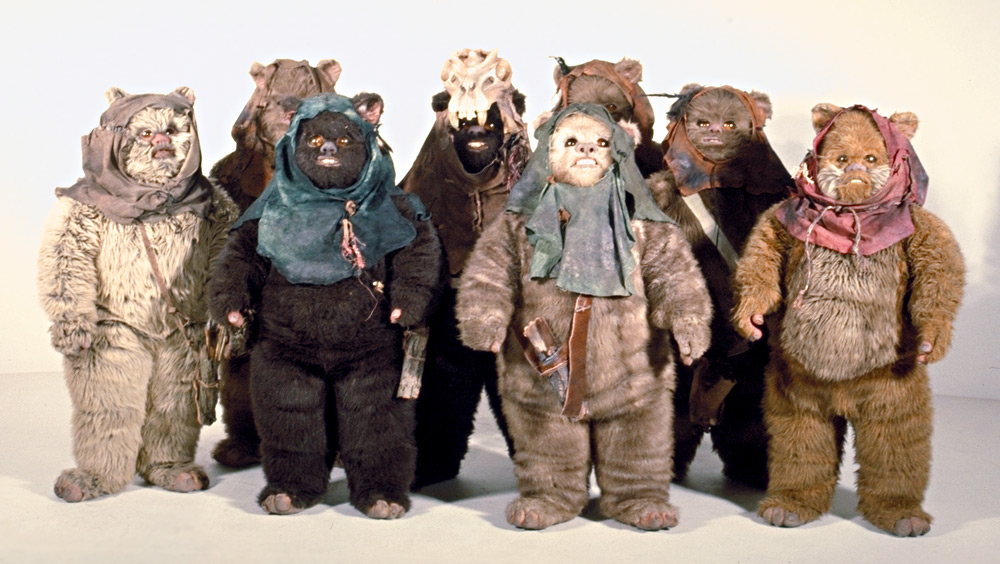
Of course, besides the appearance, there is probably no thematic correlation between Chewbacca the character and GRRM's novella. It couldn't anyway, since the script for SW was probably finished when the novella was published. However, Elio Garcia, the host of westeros.org and the authoritative living encyclopedia of all things ASOIAF, noted an obvious parallel between the story and a key plot in Return of the Jedi. (Alas, Elio is not an encyclopedia of SW and mistakenly called Ewoks as Wookies.)


The story of Ewoks strongly echos that of the Jaenshi in "And Seven Times Never Kill Man!" The Jaenshi is a kind of intelligent non-human species living on a jungle planet. The illustration by Scheonherr above is a Jaenshi.

Analog describes the story as "realities of a very rigid society conflicting with what looks like a pushover primitive tribal society; and we find out where the strength really lies." Yes, the Jaenshi don't have screechers, laser handguns, or blast cannons. They are clearly based on all the pushover tribes that have been colonized throughout human history. Such encounters of civilizations have served as the inspiration for many such stories. No wonder the story resonated with Lucas. I agree with Elio Garcia that Lucas was probably influenced GRRM's story, consciously or unconsciously, when he wrote ROTJ's Ewok story line, which was written in the early 1980s.

Perhaps ROTJ tries to rewrite GRRM's bleak story and fulfill our own dream of the underdogs beating the big bad wolf. I can understand this urge. The same routine is recycled once again a couple of decades later by James Cameron in Avatar. Of course, Avatar also more substantially ripped off Disney's animated movie "Pocahontas", as illustrated by someone apparently named Matt Bateman. But still. The connection to ROTJ and Ewoks is there too.


I do wonder if Cameron has read "Seven Times" though, because Avatar also lifts a certain mystical "collective consciousness" that was hinted at in the story. OK, perhaps such a concept need not come from GRRM. Isaac Asimov described such a planetary consciousness in his Foundation series known as Gaia (written in the early 1980s). This series eventually merged with his Robot series. Similar ideas may be widespread in the sci fi community. In GRRM's story, however, the planetary consciousness is not at all clearly described. In fact he worked really heard to conceal it. Still, in Avatar the natives prayed to and connect to the trees, which is not unlike the Jaenshi priests rubbing their godly pyramids. 

Anyway, regardless, all of these examples of a non-human and possibly collective consciousness represented in different ways by GRRM, Asimov, or Cameron (but not Lucas) may have come from an original source. The oldest source I can find is Solaris by the Polish conceptual sci fi writer Stanislaw Lem. Solaris was written in 1961 but translated to English only in 1970. Surely at least GRRM and Asimov would have been exposed to it. The mysticism in Solaris in some ways must have also influenced GRRM. Comparatively, however, GRRM is more earthly and humanistic. In 1975 he was not yet 30 and I doubt he can ever be as detached or philosophical as Lem is. His satire of militarism, religious fanaticism, and egoism is evident in "Seven Times." He must have been thinking of the Vietnam War and the conservative political forces at the time. (Ironically, 40 years and a few more wars later, the American conservatives remain much the same, thus keeping the story as fresh as it was then.)

Both GRRM and Lucas were of the Vietnam War generation, so it might be another reason the story left such an impression on the latter.

On a side note, although we humans instinctively reject the idea of a collective consciousness outside of our own consciousness, how could we know for sure? Much convincing argument has been made about the illusion of free will. If the Greenseer is able to reach anywhere in space and time and all creatures and minds, how could we ever tell what is our own mind and what is that planted by the Greenseer with the old gods? (Readers of ASOIAF would get this reference.)

Tuesday, November 5, 2013

The Social Stability Pill (cont.)

The pill that has brought peace and stability to the world is now a problem. In country after country, economy has collapsed because of unmotivated young people who have lost interest in not only procreation but also consumption. A deep and pervasive laziness has permeated society. Besides eating, sleeping, taking the pill, people at all ages are content with little material goods, small living quarters, and online diversions. The pill disarms the competitive urges and no one wants to bother with keeping up with the Joneses any more. GDPs continue to plummet along with birth rates.

Under the protests of older people who now have to keep working until they die to financially support themselves, governments finally move to ban the use of the orgasm pill in anyone pre-menopause, which means men are not allowed access to the pill until they are in their seventies. However, thanks to black markets and illegal trades, the pill is still circulating. People are used to the minimalist lifestyle. Natural instincts recovery very slowly. Even off the pill, most behave as if they were still on it. Birth rates, although no longer near zero, hover around 1.

Cities are abandoned. Productions are halted. Populations dwindled.

Just when civilizations lay in the happy ruin and hope is dimming, a tribe of Polynesians sail out of their island and spread rapidly across the world. Isolated from the rest of the world, they have not been exposed to the orgasm pill and therefore remain "barbaric" with all their sexual instinct intact. They meet little resistance on their way to conquer the entire world. They fight, kill, and breed as humans did before the orgasm pill was invented. Humanity enters a new era.

The Ending of Le Samourai (1967), Explained

A quick online search after watching Jean-Pierre Melville's Le Samourai confirmed my suspicion: The plot is very rarely understood by E...