Search This Blog

Showing posts with label mythology. Show all posts

Thursday, November 27, 2025

The 3 Gunas (Mahabharata notes #20)


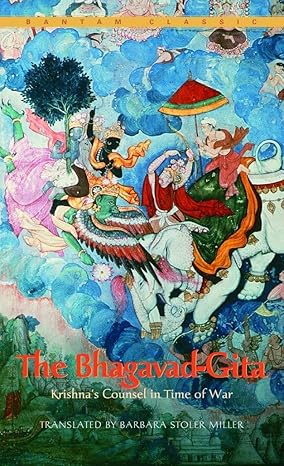
After reading snatches of the Bhagavad Gita over the years, I finally decided to read the whole thing through via Barbara Stoler Miller's translation. Most of the process was a slog, but slog cannot be avoided or skipped, and finally it proves absolutely necessary. When I got to the final chapter last night, at least one understanding broke through my stubborn presumption. 

One can never pin down the meaning of old Sanskrit words, but it is generally accepted that the 3 gunas are sattva, rajas, and tamas and that each word more or less means harmony/light, passion/energy, darkness/intertia, respectively. There are a lot of explanations about how each guna manifests in a person's behaviors or life, and I encountered some of the explanations in Yoga Sutras of Patanjali, suggesting that this theoretical framwork is a persistent element in Hinduism. In the Gita, sattva is most often associated with action with attachment to duty and detachment from outcome; rajas is associated with desire and greed, ie, action with attachment to outcome; and tamas is associated with inaction, laziness, avoidance. 

Born into and living in a judgmental world, I was hardly even aware of the morality-based color that imposes value onto the foreign concept. Tamas is bad, rajas is better, and sattva is the best, and humans should attempt to climb from the lowest rung (tamas) to the highest (sattva), from ignorance to enlightenment. 

There is nothing in the Gita that explicitly dispels this understanding, but when I got to the end it suddenly dawned on me how wrong my presumption was. The 3 gunas are not 3 rungs on a ladder toward heaven. They are 3 coexising elements. All 3 gunas coexist in ... me, a person, all the time. I can no more eliminate tamas than be 100% filled with sattva. That's not how it works. All 3 gunas make up a person (or the world, but for now I'm just focusing on psychology), and we are all composed of dark inertia, desire, and the ability to be illuminated. 

(I was going to question the last part but, hey, why then am I writing this?)

As we steadily march toward winter solstice, tamas swells inside the body, weighing heavily on our eyelids. It is not bad or good. It is merely nature. 

Friday, November 4, 2022

Karma (Yoga Sutra Notes #2)

A while ago I wrote about how wars may come and go, but conflicts and hatred do not go away, and no one changes their mind, after watching an episode of La Guerra E Finita. After learning the original concept of karma, it appears that, again, the ancient Indians had thought about it before. Maybe they had thought about everything. 

I am not sure whether the common understanding of karma could be credited to the Buddhist definition of karma, ie, a moralistic understanding of good and bad, reward and punishment. Indeed, I have heard many times that one's suffering and misfortune in the current life is the result (or perhaps "payment") of having done wrong in the past life, like eating meat or harming people, while good fortune is a reward for having done good things in the past life, like being vegetarian. The idea is to encourage (?) people to do good in the current life to ensure a better life next time, lest one comes back as a worm or a donkey or something. 

But the definition of karma in the Yoga Sutras or the Sankya school of philosophy is apparently not so judgmental or ... shall we say, Pavlovian. According to the commentaries collected in the book, karma refers to the endless chain of events that is linked by consequence. One action leads to the next, and the next to the next, and on and on. The Indian mythology is less interested in the origin of everything, when and how the world was created (although there is no lack of origin myths there) than in the perpetuation of change and flutters. What we are doing now has an endless chain of cause and effect before and after us. One could argue, for example, that in 1787, the colonies failed to reach an agreement to abolish slavery or, perhaps more precisely, agreed to preserve slavery as a union, and that occurrence has created an endless chain of consequences that stretches into today and may never end ... until climate change redraws the world map, maybe.

This is a way of looking at any history, from macro to personal, as a continuum that extends beyond major historical events or one's own lifespan. The idea of reincarnation, or samsara, seems scientifically absurd, unless you view it as a metaphor to describe the continuity running through generations. Indeed, the action of one generation reverberates into the next generation, and the next generation into the next, and so on, vastly overwhelming the random de novo mutations. This is karma, and it is a much more accurate description of reality than the "big story"-based theory of humanity in time.

It seems to me that the episodic and event-based view of history (again, it could be either macro or personal) is easier to create and easier to digest for the vast majority of us near-sighted and feeble-minded average people. I don't know what it was about the ancient Indian thinkers that allowed them to come up with such astute and profound insight into the human existence. Maybe wisdom passed down from aliens? (I kid! I kid!)

Being educated in the feeble-minded non-Indian cultures, I have spent much energy and effort in my life to understand how and why we got to this place and where we originally came from (thanks, Jared Diamond!), as if understanding the series of logical links that make me who and where I am can free me from the chain (pun intended but all credits to the Indians) of karma. But the Indians were right: In the subjective experience of an individual, there is no beginning and no end, only a series of consequences within the limits of one life. The ripples of all the karma that led to my life are practically unknowable to me, and so are the ripples of all the karma I am generating, flowing into the future and beyond, mixed with countless other ripples.

The Yoga Sutras contains some vague advice about diminishing the effect of karma within this life and for the next life, such as eating vegetarian food and being nice, or you can devote your life to worshipping a god (but it didn't specify which one, Shiva? Vishnu? Parvati?), which are hardly as specific or didactic as the "donate money now or you come back as a fly" school of persuasion. Rather, the emphasis is on the practice of yoga. This practice of yoga, which Patanjali talks about over and over, is to recognize and experience how the body and mind, thoughts and feelings, the whole lot, is a shell, and even when you shed all of them, there still exists a white light of one's essence, a singular life force completely independent of the shell, that glows on its own energy. (Interestingly, Buddhism does not believe in purusa, but I don't know the details.) What does that mean? I have no idea, but I like it.

Tuesday, September 27, 2022

Citta: The Brain (Yoga Sutras Notes #1)


In this book, Bryant translated and collected major commentaries and explanations of the famously brief and sometimes cryptic sutras by Patanjali. I especially find his approach of mixing certain Sanskrit keywords in the text to be instructive. In these instances, the non-interchangeability between Sanskrit concepts and their (supposedly) corresponding English words is palpable. Despite sharing the Indo-European roots, the non-translatability is probably due to the massive distance in time. 

It is hard to overstate the vast theoretical context behind the brevity of this manual. I am crawling my way through it slowly, and every few pages I am surprised by the deep insight into human psychology that was gleamed by the ancient Indian scholars and practitioners. I am in awe of these insights, not necessarily as a source of mysticism or exotic wisdom, but rather by the exhaustive and sophisticated examination of ... neurological patterns of the human mind. 

Take for example the concept of citta, which refers to an organ that provides three types of functions: buddhi (roughly translated as intelligence), ahankara (the sense of self, I-ness, ego), and manas (the part of the mind that performs thinking and sensory processing). 

Looking at these three components, one cannot help but be struck by their accuracy in describing some of the major activities of the brain. In the most basic aspect, it is now well established that one of the major functions of the brain is to centrally process and interpret the excitatory signals transmitted from the peripheral nerves (ie, manas), which allows humans to perceive and react to the environment. This neurological discovery in modern medical science was fairly recent and based on the anatomical exploration and understanding of the nervous system. The definition of buddhi, which emphasizes discernment and judgment, largely matches what is referred to as the executive function in neuroscience, which is carried out by the prefrontal cortex. 

Of course, I am by no means saying the ancient Indian theory of the brain is complete or comparable to modern neuroscience. Several other types of brain functions that we now know are not described in this theoretical system, such as the emotional and instinctive activities in the limbic system and the structure and activities related to learning and memory (the hippocampus and more). Their technologies and research framework did not allow the ancients to realize that major bodily functions, such as body temperature, breathing, and heart rate, are linked to the brain stem. Nevertheless, I am greatly impressed by how far they had gone using only direct and empirical observations of the mind. The power of their self observation is astounding and unparalleled. (Perhaps this is in some ways related to the pursuit of "detachment", but that's a topic for another day.) 

The examination of the sense of self is particularly fascinating and sophisticated. Recently I am intermittently reading a book by the German psychiatrist Fritz Simon, in which he explains how every concept is defined by what is inside versus outside a border (ie, what it is versus what it is not). It is a difficult and abstract concept that I have a hard time grasping and have never seen described in basic psychological theories. Yet the ancient Indians realized that the human mind (or what is now widely referred to as "consciousness", a fashionable and self-aggrandizing buzzword since the 2000s) is self-referential. 

Another eerily accurate insight is that the brain's existence is proven through its constant activities, defined as vrttis. The ancient Indians asserted that our endless thoughts, feelings, reactions, dreams, and spontaneous, internally generated sensations, are the manifestations of a physical organ that is alive and working. This insight alone outstrips Descartes by hundreds or a thousand years. The Indian philosophers explained it in an elegant analogy: Citta is the sea, and vrttis is the waves.

Thursday, March 4, 2021

The Trickster God


I cannot think of another mythological figure more complex and fascinating than Krishna. He is beloved, but why is he beloved? There are tricksters in various mythologies, one of the most famous being Loki. However, being deceptive and "tricky" is usually not an elevated trait for gods and runs the risk of being dismissed as a minor clown. 

I remain convinced that Krishna was not among the original characters in earlier versions of the Mahabharata. His role in the epic is that of a peripheral presence. His story is documented primarily in the appended Harivamsa. 

The complexity in this character is reflected in his color, the black, which contains all colors and all shades of humanity, including the idea of deception and illusion. 

Deception is a human trait that causes some degree of revulsion and disgust, and relatively modern and prescriptive religions are understandably reluctant to condone, much less exemplify, such an element. Yet it is elemental to humanity and induces a thrill and a recognition when we witness Krishna's tricks (for some, the thrill might lead to a moral outrage rather than admiration). 

How they made him both extremely human and thoroughly above humanity, both contradictory and harmonious, continues to puzzle the mind. It is a feat I have not seen in any other myth or religion. It might not be a cure but certainly a therapy for the dichotomized worldview brought on by monotheistic religions that lately came to dominate human societies. 

Friday, June 17, 2016

A Unifying Theory: ASOIAF

While the Game of Thrones TV series have turned into fan fiction of the ASOIAF novels (or, as some may say, parody), this fan fiction has the advantage of having learned the grand finale from GRRM himself. The main characters' fates and big story arcs will likely to be generally consistent. For example, Jon Snow has been resurrected. Arya Stark is heading back to Westeros. Cersei Lannister will blow up King's Landing with wildfire. Daenerys Targaryen has tamed Drogon. Looming events include the dominance of Littlefinger Petyr Baelish and the Others and their zombies swarming over the Wall.

In the two novels plus 11 chapters released to date, a trend that is more pronounced than geographical convergence might be the spiritual "homecoming" of major characters. Daenerys has changed her principle from "If I look back I am lost" to re-examining her past. Jon Snow was about to ride to Winterfell before getting stabbed by Bowen Marsh and co. Tyrion, oddly enough, connects to home by selling it off to Brown Ben Plumm and his Second Sons army.

The human Arya may not be heading home up to the chapter "Mercy," but her constant warging into Nymeria suggests that her spirit may have already returned. Most notable, Bran's "return" reaches into the past of not only his family but the entire history of First Men and Children of the Forest, native populations of the ancient and mythical North. This, perhaps, is the grand and ultimate homecoming that the story is heading toward.

Thus we are faced with a question: What is home? What is the origin or true identity? Here another pattern emerges. Some of the main characters are not human but rather beasts. Below are the definite cases:

Monday, May 16, 2016

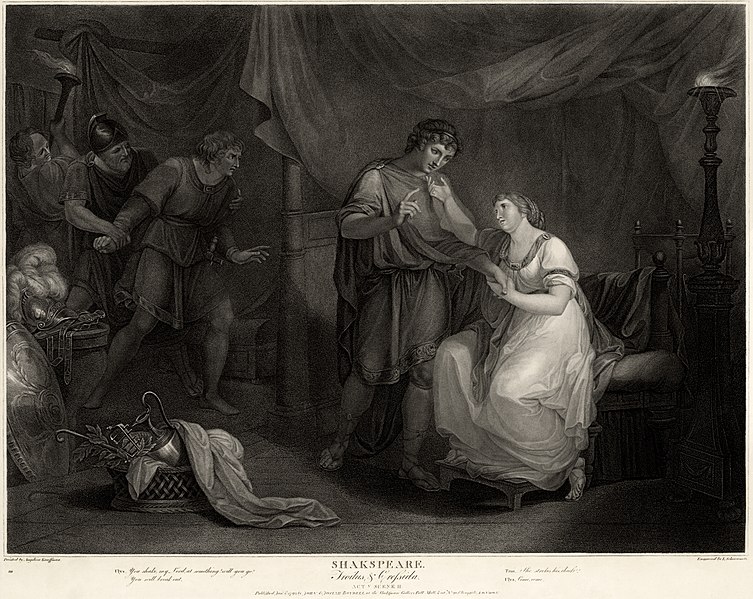
Troilus and Cressida


It's an odd play, even more of a "problem" than "Measure for Measure." If it weren't written four hundred years ago, one could safely file it under absurdism or postmodernism. Troilus and Cressida defies any conventional classification.

Just when I thought I knew Shakespeare, sort of, I realize I don't. Not at all.

It's a vicious takedown of the heroic and romantic mythologies. He is saying that, the truth of heroism is jealousy and stupidity, and the truth of romantic love is inconstancy and self-interest. It's unusually obscene and sexually explicit. It's roiling with a rage underneath all the bawdy jokes. It's unlike any other Shakespearean play, although the sneering view on war here could have come out of Falstaff's mouth.

How do the two strands of plot connect with each other? One is how two unwilling warriors, Achilles and Hector, finally come to a deadly confrontation. The other is a cynical revision of Romeo and Juliet. I don't know, but I feel in my gut that they do connect in some way.

Come to think of it, it's kind of funny how Shakespeare approached the classics, compared with, say, T. S. Eliot. Good ol' Willie obviously didn't worship the classics as the grandiose foundation of English literature. Rather, he trampled and shat all over the lofty ideals and glory. What a guy.

Friday, May 13, 2016

Greek References in ASOIAF

It so happens that I'm reading Troilus and Cressida lately --- I've never thought Greek tragedy could be done as farce --- while the Game of Thrones series just put on a flashback segment depicting the Tower of Joy.

Game of Thrones, S6E3, Tower of Joy.

The homage hits me between the eyes. I'm wondering why it took me so long to see the connection.

George RR Martin's references to Greek mythology are not nearly as abundant or apparent as those to Nordic mythology, the Wars of Roses, and Shakespeare, and they are hidden much deeper. So when I recognize one it is a bit of a shock.

I wrote about Deianira, wife of Hercules, being the inspiration for Daenerys Targaryen for the History Behind GoT site. Then, in Season 5 of the TV series, a plot is transparently lifted from Agamemnon's sacrifice of his daughter Iphigenia. I am not convinced that GRRM would choose to sail so close to the source material himself, but, alas, the TV series has given it away.

It is then all the more puzzling why I did not think of Lyanna Stark as the face that launched a thousand ships. Maybe because the warring factions fought on land? Obviously, men fighting over women is nothing new or unique to the Trojan war. Heck, even the Chinese history books are filled with stories like this. But something in Lyanna's story matches Helen's.

Even now, after 5 books and 5.5 TV seasons, after multiple characters have mentioned Lyanna over and again in their thoughts and their dialog, we still have no idea what happened from her perspective. The questions about Lyanna are almost exactly the same as those about Helen. Was she abducted or seduced? Was she raped or in love? Did she go willingly? Why? Did she regret it? Shakespeare and most interpretations believe Helen eloped with Paris out of love, and that is the sentiment of most ASOIAF readers on Lyanna as well. But we never get to hear it from the woman herself.

What links Lyanna to Helen of Troy is not their role in the Trojan war or Robert Rebellion, that the desire to take them in possession spiraled out of control and led to the slaughter of thousands. Rather, it's how they are both at the center of the myths and completely invisible. I don't know if GRRM is going to eventually reveal the true face of that face or stick to the homage and critique of the original myth and hide it to the end.

Sunday, April 10, 2016

War as Human Sacrifice (1): Early GRRM and mythology

In a recent conversation with a friend about A Song of Ice and Fire / Game of Thrones, the idea of war as a ritual of human sacrifice was raised. As soon as I heard this idea, my brain itched. I have seen or heard of it before, but where?

Seven Times Never Kill Men

This novella is one of the few works in which George R.R. Martin has mentioned the god of war Bakkalon. Unlike "Soldier" of the Seven Gods, Bakkalon takes on the striking image of a pale child. An odd image, unless you connect it with the theme of war as a form of human sacrifice, particularly of the young. Some how, war --- or violent conflict since the dawn of humanity --- always revolves around the young.

The human warriors in the novella, known as the Steel Angels (sounds like the name of a biker gang), worship Bakkalon with fervor. They have invaded an alien planet by slaughtering the natives, a peaceful species of furry animals called Jaenshi.

The Jaenshi probably look like Ewoks of Return of the Jedi, because George Lucas was apparently inspired by this story when he wrote the screenplay and even gave the original illustration to his character designer as a model for Chewbacca. Jaenshi children are cut open and hung on the walls of Steel Angels' stronghold.

Published in 1975, the parallel to the Vietnam war is unmistakable. Unlike the Viet Cong, however, the Jaenshi seem utterly incapable of picking up weapons to defend their homeland. Instead they huddle around and worship their own god, who seems equally indifferent to their death and suffering. Only a handful reluctantly follow a human leader who tries to organize an armed resistance.

Meanwhile, the Jaenshi god begins to appear in the dreams of the prophet of Steel Angels. He sends out a platoon of Steel Angels to seize the god's statue and bring it back to their camp. The feeble rebellion was swiftly crushed, unlike the bloodless, romantic battle in Return of the Jedi. The violent aggressors win. Or do they? A year later, we are told, Steel Angels have begun to sacrifice their own children on the wall ...

The symbolism is a bit more explicit in this story than it is in ASOIAF, but in ASOIAF the idea is subtly pervasive. Children are fed to the god of war. Even the (apparently?) winning side cannot escape this bloody human sacrifice. The children of Tywin Lannister and Cersei, Roose Bolton's son, and Walder Frey's hundred offspring, they are hardly luckier than the Stark children. And there are the commonfolk orphans, associated with Brotherhood Without Banners, who are attacked by the Brave Companions in AFFC.

In Seven Times, GRRM does not make clear to which god the human children were sacrificed, Bakkalon or the Jaenshi god. In parallel, who's to say for what the American young men fought in Vietnam? It might be the indifferent universe (for getting drafted, for example), or the military industrial complex, or the anti-communist, freedom-and-democracy idealism. To which god were they offered? That is a central question that continues to haunt the Vietnam generation, GRRM included.

Mahabharata

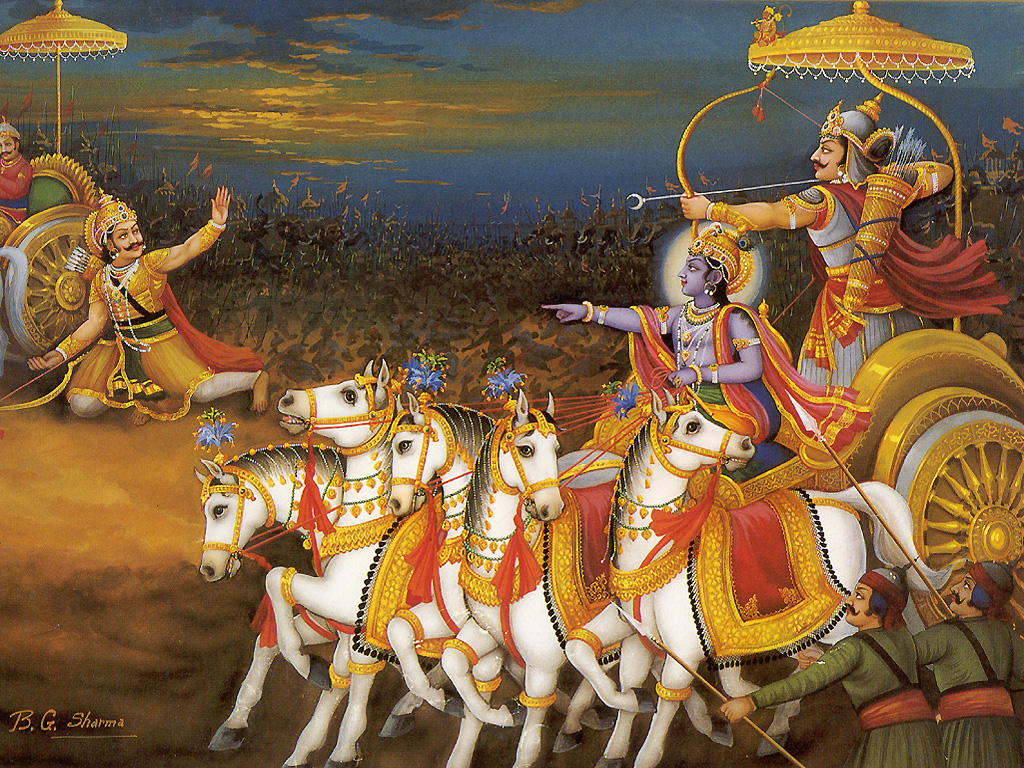
I finally scratched the itch in my brain and remembered where I had heard of this war-as-sacrifice idea before. The battlefield of Kurukshetra, on which millions of warriors across ancient India came to fight and die, has been interpreted by many literary critics and historians as an alter of human sacrifice for the gods.

In a society like ancient India and Sparta (and possibly the Persian empire), the warrior class is destined to die on the battlefield. It is the duty they are born into, assigned by society. The ultimate and perfect warrior in the epic, Bhishma, explains that Kshatriyas must attain his honor and glory through killing and being killed on the battlefield. The poem repeatedly asserts that anyone who dies on Kurukshetra goes directly to heaven.

The super-massacre on Kurukshetra described in the poem is both viscerally exciting and highly ritualized. It is both realistic and symbolic, particularly with the mythical meaning of war and death intertwined in the story. The conflict is not only the culmination of a family battle over the throne. In the multi-layered epic, it is also a war between the gods in heaven and the asuras underground, which is very likely a representation of historical conflicts between the invading Aryans and native tribes in India. Philosophically, the war symbolizes dharma and adharma (not the same as the Christian good versus evil), as explained in Bhagavad Gita.

The war, described as daily battles with arbitrary rules of conduct for both sides (not unlike the Trojan War in Homer's poem), seems highly ritualized. Aren't killings just killings? Yet modern warfare between nation-states is different in execution from violent conflicts in primitive societies (see Jared Diamond's The World Until Tomorrow). Even though modern wars are as much about resources and territories as ever, the way they are conducted is relatively confined. Indiscriminate and random killings are no longer accepted by civilized societies --- No, they only send young men to shoot and stab each other in a confined area, very much like Kurukshetra.

With the disappearance of mandatory draft (or conscription) and increasing use of remote weapons (drones, missiles), war is becoming ever more abstract to us. Except, somewhere in the world, blood of the young is still spilled by the bucket and we are usually not very clear why. The practical goals and intent of wars are ever more difficult to discern. The meaning and goals of violent conflicts, such as those purportedly for religion and ideology, are becoming increasingly psychological rather than material. I wonder how an alien observer studying humans would make sense of our warfare. Would they interpret it as a ritual in which we compulsively engage, a destruction we instinctively inflict on ourselves?

But I digress. The battlefield as an alter on which the blood of young men is sacrificed to gods is not an uncommon concept in the realm of Hinduism-Buddhism. Again I am astonished by how the ancient Hindus were able to get straight to the heart of the matter.
Monday, February 8, 2016

Golden State Warriors

According to NBA schedule, the match between GSW and Washington Wizards on February 3 was the last (only?) game of the 2015-2016 season to have GSW in the Verizon Center. Thus it was no surprise that the ticket prices reached a height for the Wizards franchise not seen in the past 6 years, surpassing even the Eastern Conference semifinals in the past 2 seasons. When Mr. S and I arrived at the arena before the door opened, the lines were swarming 7th Ave between F and G Streets.

"Everyone's a Warriors fan now," said the middle-aged man in the seat to my right. "It's like a teabag. Just dip it in hot water and you get tea, every time." Hmm ... He was no new fan, as he lives in Marine County, across the Bay from Oakland. 

I'm one of those freshly brewed Warriors fan, swept onto the Stephen Curry bandwagon only a couple of months ago, after over a decade of indifference to  NBA. I did watch the televised playoffs for a few years in the 1990s, when Michael Jordan was approaching his first retirement. Perhaps it was the resignation in a sports commentator's voice I heard on NPR, when he talked about Curry. The tone brought up the memory of how people were talking about Jordan, implying something like, "Here comes a mad genius. What can anyone do but lie down and be trampled?" 

And trample he did. In the game against Wizards, Curry scored 51 points. I must say that Wizards fought hard and played especially well. John Wall scored 41 points. Nene almost hit every free throw. GSW nevertheless won by 13 points in the end, but the match was, at one point, only a 2-point game. It was in the middle of second quarter, I said to the man from California, "If something should happen to Curry, where would the Warriors be?" He thought about it and agreed, "Yeah, they'd be a middling team." 

Beyond marveling at the impossible speed of the play --- I tried to catch a glimpse of formations and ball movement, but the only thing I saw was a few picks and rolls --- I wondered about what is the so-called "star quality." What is the quality that makes a team build their strategy around one player, so that he makes or breaks their success over a whole season, or several seasons? How does this shape the interpersonal dynamics and motivations of the non-star players in a team setting? Do they envy him and resent him while also depending on him? I used to think that individual sports, like figure skating and tennis, are more psychological than team sports, like football (soccer and basketball). But I might be wrong there. 

The Californian man said, "The other guard, Klay [Thompson], is actually as good as Steph, he just doesn't believe it." 

I was reminded of Scottie Pippen. All those years ago I had a very low opinion of Pippen. I thought Jordan was hitting all the crucial jumpshots and layups in the last quarter, while Pippen was missing them. He was just riding on Jordan's coattail. Only now I saw my error. There can never be two Jordans in one team. Why? I don't know. It was no small feat for Pippen to remain a good player, steady and uncomplaining at Jordan's side. 

At the next game, Curry shot rather poorly and scored only 26 points. Oklahoma City Thunder nearly won the match. Near the end, the teams were tied at 104. And yet, Curry either scored or assisted and was responsible for a string of successful offense efforts in the final few minutes. GSW won 116-108, despite Kevin Durant's 40 points. What makes a player so ... clutch? So deadly that his teammates mentally rely on him? I am convinced this is more than physical talent and superhuman effort. A key ingredient must be psychological.

Stars like Jordan and Reggie Miller and Kobe Bryant, now Curry, have been described as "cold-blooded" or having "killer instinct." It is not that they lack mercy while mere mortals are unconsciously reluctant to defeat the rivals. Rather, the mere mortals are inhibited by something other than mercy --- perhaps an anticipation of victory and all its spoils and associated fear of losing all those by one's own failure. I think the ancient Indians had it right --- only when one detaches himself from the fruit of his action, be it bitter or sweet, can he find the courage and focus to do what he must do now. And the effect may be even stronger on others around him.  

Tuesday, December 22, 2015

And Seven Times Never Kill Man


After someone made the connection between Chewbacca (and subsequent the Ewoks) and the George RR Martin's novella "And Seven Times Never Kill Man," I went back to re-read the story. It became clear that both Georges were metaphorically commenting on the Vietnam War in their depiction of a jungle war, in which the technologically more dominant and more powerful side is defeated by a weaker tribe.  


Needless to say, GRRM was vastly, vastly more interesting. Lucas catered to what people want to believe, derived from wishful thinking; and Martin went by his astute observation of history. 

What is mind tickling, however, is how Martin's vision based on one particular war panned out in many future wars, in which the military victories of the mighty empire over small insignificant tribes set off an insidious slow incineration from within the empire ... until they too begin to sacrifice their children to the pale god of war Bakkalon. 

Martin's predictive power is spectacular. 

Tuesday, May 5, 2015

Theological Subversiveness in Mahabharata (Notes #17)

I suppose one should not be surprised by the mess of stories, mythologies, cults, and messages that were crammed into Mahabharata over centuries of telling and retelling. Many of the lessons and points conflict with and even contradict each other, down to the basic definition of "dharma." Fine. There is something in the Indian history and culture that drove the exacting English colonialists crazy, because one can never seem to get a straight answer to any question about India. Any simple question, like, What is dharma? What is maya? What is sin?, can lead to a lifetime of research and philosophical argument with no end in sight.

Be that as it may, I want to sort out a few signs of direct theological antagonism in the epic, particularly in the Bhagavad Gita.

The most striking message in the Gita is to act without expectations of rewards, ie, the karma yoga. This is in opposition to the traditional Indian mythology based on asceticism, which is full of anecdotes of someone getting his wish granted by a god, big or small, by starving himself, chanting the god's name a million times, and standing on his toe for a few years, known as tapasya. If you're a well pampered king who doesn't want to go through that self-torturing routine, you can hire a team of Brahmins to do the praying for you and throw in a lot of good stuff (eg, milk, ghee, flowers) in the ceremony. Voila! You get your wish granted. It is such a straightforward even exchange between the gods and men and universal to nearly all ancient cultures on earth. I offer/sacrifice something precious to the gods, and the gods give me what I want. Simple and instinctive. Yet the Gita says, you should not even expect a reward for your sacrifice to the god. Forget it.

Well, that's an unpleasant gift, isn't it? Even though it is more realistic and empirically true, telling people that they cannot bargain with (and therefore control) fate/gods/fortune is contrary to our hopes and dreams. Such realism can't win any followers. So we are thrown a bone. Yes, there is a reward, which is moksha. Who needs earthly rewards (eg, wealth, happiness, long life, death to your enemies) when you can achieve the ultimate joy of being released from the cycles of life and death, heaven and hell.


Thursday, April 9, 2015

Bhagavad Gita and Figure Skating (Mahabharata Notes #16)

The phenomenon of "choking" in competitive sports is well known. It refers to those high-stake moments when a competitor performs far below his normal ability, as if he has forgotten to be himself. Choking is particularly in sports that require highly precise techniques, such as figure skating. After years of watching skating live, it's become clear to me that, in an important competition, figure skaters routinely achieve no more than 70% of the highest level of difficulty they are capable of in practice. This level can drop further if the skater is temperamentally sensitive to the psychological pressure. For skaters often called "headcases," he might fail on techniques in a critical championship that he would succeed with 90% certainty in practice. Why? Perhaps the reason is that figure skating is exquisitely affected by the skater's mind. I have done a little bit of recreational swimming, running, and skating, and found that skating demands the most attention and concentration. Therefore, when the brain is wandering toward the thoughts of winning and losing, it is so easy to lose focus, which destroys one's technique.

The fact that many of my favorite skaters are prone to "choking" has vexed me for years and led me to wonder years why the mind fails them. Do they unconsciously sabotage their own success? Or does the chance of choking increase with how badly one wants to win? If so, how does one suppress the desire to win for a few minutes in order to focus on just the skating?

This is why, when I first read one of the themes in Bhagavad Gita, "detach from the fruits of your action," I immediately felt a tingling inside my skull. There is something profound and subtle about this seemingly paradoxical about the advice.

And this phenomenon is not limited to sports, for in life the wish to have something does not often lead to choices toward its realization. Thinking about what you want may spur you on sometimes and paralyzes you other times. The problem of self-defeating behaviors is complicated and difficult to remedy.

Monday, March 30, 2015

A Mutual Frustration (Mahabharata Notes #15)

Before the Kurukshetra war commenced, Queen Kunti, the mother of the Pandavas, came to Karna, the dearest friend of Duryodhan, the crown prince of the Kauravas, and a most formidable kshatriya in the land. She came to Karna at mid-day, immediately after he performed a daily prayer to the sun god Surya, to make a favor of him, because Karna never refused a favor asked of him on such an occasion. Not long ago, Karna had granted a boon asked of him by the god Indra, the father of Arjuna his arch-enemy, and given up his own magical armor, effectively giving away his own safety and life, in the upcoming war.

Yet, this time, the absurdly generous Karna who never refused anything asked of him upon his sun-worship ritual, refused the strange but strangely familiar lady who came to ask for a boon.

Karna was Kunti's first and illegitimate son with the sun god. One could easily imagine a realistic version of this scenario: An aristocratic young woman got herself pregnant at fourteen in a moment of indiscretion. When she gave birth to a boy, shame, panic, and fear of disgrace induced her to throw the infant away. The child grew up in a lower class family, ignorant of his origins, and suffered terribly for his mother's moment of weakness and selfishness. On the other hand, his mother went on to a respectable life, a suitable marriage, and five sons born within wedlock, seemingly suffering no consequence for her abandonment. Now, her five legitimate sons were about to fight their bastard brother in a life-or-death battle, while none of the six brothers knew of this looming family train wreck.

Mother Kunti's motive for approaching her first-born with the truth in this critical juncture may be interpreted as an attempt to dissuade Karna from endangering her other sons. Her request to Karna could be boiled down to this: "You are by blood the brother of your best friend's enemies. I ask you to leave the Kauravas' side for the Pandavas' side."

One could argue that Kunti loved her legitimate sons more than her first-born, because she went to Karna rather than the Pandavas with the secret. If she had told the Pandavas, the war would have dissolved into their instant defeat (at least in her mind). Instead she wanted to dissolve the war with their victory. Yet another component of her wish is to ensure the survival and unification of all six of her sons, because the pending conflict presented a threat to Karna as well, considering that he was at least outnumbered five to one. In other words, what she wanted was to "have it all," not just for herself but for her sons.

Karna clearly understood her intentions, both the spoken and unspoken aspects. As a son who had lived with his mother's rejection all his life, he chose revenge over forgiveness. She had not given him what he had wanted, so now he would not give her what she wanted. After denying her request, he granted her something different from what she asked for: "I would not kill any of your other sons, but I will battle Arjuna to the death. Either him or me, but one of us will surely die. So that in the end you will still have five sons." It is as if he was directly denying his mother's unspoken demand --- You can't have six sons and will only have five. His revenge is to turn the table completely on her: You had not wanted six, and now you cannot have six.

One could, of course, argue that Karna rejected Kunti's request because he loved his sworn brother (ie, Duryodhan) more than newly discovered birth brothers, who indeed had had a few run-ins with him previously. Yet, if Karna were so deeply invested in the victory of the Kauravas' cause, he seemed to have a funny way of showing it, by giving away his invincible armor and earrings so easily and by spontaneously promising Kunti to never harm four of the Pandavas. Therefore, his loyalty to Duryodhan seems but an excuse, yet his revenge to frustrate the mother who had disappointed and frustrated him rings true.

(This rather crude analysis is inspired by Adam Phillips' essay "On Frustration" in his book "Missing Out." In the essay he pointed out the symmetry between King Lear and Cordelia, who both withhold something from each other. The same can be said of Kunti and Karna. Phillips wrote, "All love stories are frustration stories. As are all stories about parents and children, which are also love stories.")

Sunday, March 15, 2015

Childhood's End by Arthur Clarke


What prompted me to re-read this book is, of course, my recent obsession with Mahabharata. When I first read it about twenty years ago, I didn't understand most of it, but much of the imagery left a deep impression and seeped into my unconscious memory. In some ways, I could say that this novel, Rendezvous with Rama, and a few of his short stories (eg, "The Star", "Nine Billion Names of God") cultivated a latent taste for mysticism that kind of blew up two decades later, when I happened upon Mahabharata.

The first part of the story is about an alien invasion by "Overlords" (which was later ripped off in Independence Day and other movies) and the subsequent utopia on earth. The second part is about the conversion of the human species into a mysterious and unknowable existence that is eventually absorbed into "Overmind." Indeed there is similarity between the concept of merging with a cosmic consciousness and similar ideas in Buddhism and Hinduism, in which people might, through meditation, yoga, and whatever mind-altering practice, might transcend the limits of individual mind and become one with gods or absorbed into the gods or something to that effect. The novel makes a few direct references to Christianity (references to Jonah and devils), but the central concepts are closer to Buddhism and Hinduism, plus elements of popular mysticism, such as seance, telepathy, inherited racial memory, and UFO sightings. Clarke was clearly having some mash-up fun.

I can't remember who said it --- something about the individualism being not a common or dominant idea in human societies. When I first read "Childhood's End," I had the impression that the loss of human individuality at the end was a tragedy. Mr. S admitted to the same impression (he read it in high school). Clearly the theme is not that palatable to modern people with a western education --- or modern Chinese people, for that matter. Yet Clarke's depiction is ambiguous with a sense of both loss (of humanity as we know it) and marvel (merging into a great collective consciousness).

What left the deepest impression on me the first time is the speculation of time and memory. The Overlords had never been to earth until its arrival in twentieth century, yet their devilish appearance always existed throughout human history, because some minds can access memory in all directions, both forward and backward. Future and past are the same. That is a dazzling idea and, somehow, thematically connected to Bhagavad Gita and Mahabharata.

Monday, March 9, 2015

Maya: Illusion and Reality (Mahabharata Notes #14)

At least one of the meanings of maya is simply "illusion." In the battle scenes in Mahabharata, maya is often a supernatural weapon used by a few characters to create a distortion of reality --- fog, rain, cold, darkness, demonic figures, etc., that do not actually exist --- to disarm the enemy and create fear and chaos. In fact it sounds a lot like some sort of psychological warfare.

Yet maya is far more complicated than illusion. Its entry in Wikipedia seems to suggest that the evolution of its meaning, coupled with atman, is linked to the pair purusha and prakrti. Yeah, Wikipedia. Obviously I have not read through the relevant vedas and puranas and upanishads to begin to understand these ideas. But, at least, my absurdly superficial glimpse at these abstract concepts is enough to demonstrate how sophisticated the philosophical theories were in Hinduism.

Anyway, not being qualified to discuss these concepts does not deter me from contemplating something along these lines. At some point, maya came to mean the material, external existence, ie, the body or prakrti, that houses and conceals the eternal driving force of life or spirit, ie, the soul or purusha. The theory is that, although the body and its senses seem to be real, they are temporary and constantly changing and subject to inevitable decay. Here, obviously, the Hindu philosophers incorporated time into their observation of the physical world --- All senses pass, including agony and ecstasy, and therefore are elusive over time. Even life itself passes so quickly. Therefore, the need for a life force that permeates the universe and animates things that cannot disappear or diminish is irresistible. And they are not wrong, because energy does fit the concept of purusha and obeys the first law of thermodynamics.

Nevertheless I have been thinking of something that seems to be the opposite: One's perception and thoughts are subjective, conjured by the mind, and unreal, but the body at least somewhat able to get a more concrete and reliable picture of the world around oneself through the senses. Another way of looking at the distinction between the real and unreal is what is actually going on within one's senses and what is not. For example, the room temperature is 75 F and the time is night and I am lying on the couch typing on my laptop --- that's tangible reality. I'm thinking about the work to do tomorrow and reading some babbling on Twitter --- that's not tangible reality, even if the babbling might be someone else's reality. The novel I'm reading is all in my mind, and so is the contemplation of whether I will finish a couple of documents by the end of next week, because none of these exists outside of the electrochemical reactions in my brain. On the other hand, that I am thirsty or hungry is real enough, for the sensations are connected to my blood concentrations of sodium or glucose, not just in the brain. How real is reading fiction, nonfiction, news, and someone else's opinions and editorials?


Wednesday, March 4, 2015

Pluralism and Contradictions (Mahabharata Notes #13)

There are a lot of oddities and inconsistencies in Mahabharata, even in the shortened version (a "modern rendering") I read, in which the author no doubt excised a lot extraneous details and sidetracks from the original versions (yes, plural) of the massive poem. For example, it is described that Arjuna was the son of the deva (god) Indra. There is an interlude in the middle of the story that Arjuna was brought to Indra's heavenly abode. Yet it is also repeatedly claimed that Arjuna is one of the holy twins, Nara and Narayan, who are avatars of Vishnu, one of the trimurti (the three-form gods that are at the top of Hindu deities). Arjuna is the human incarnate of the twins Nara (Krishna is the godly one of the pair Narayan). Just who the hell is he related to, Indra or Vishnu? Another example is the character Ashwatthama, who is supposed to be a partial incarnate of Shiva, another of the trimurti. Ashwatthama fought on the opposite side to the Pandavas against Arjuna and, after the death of his father in the war, nearly caused the termination of their family line. Yet, before the war, Shiva gave Arjuna a deadly supernatural weapon and the blessing to win the war. The rishi Vyasa, who knew everything in the story, told Arjuna that on the battlefield he was led by the invisible Shiva and triumph followed him wherever he pointed his arrows because of this. It is like Shiva blessed his own enemy to defeat a part of himself. Which side exactly is he on? In the end, while the Pandavas seemed to have decisively won the war, they went to heaven and saw all of their enemies returning to their eternal godly forms, happy and content. All the old grudges and hatred and blood feud and even arguments over dharma versus adharma seemed to be washed away by the tide of time. The Pandavas are deemed the good guys, but they nevertheless have to go to hell, even if temporarily. It's enough to drive one crazy.

This kind of delicate and complicated logic, which teeters on the edge between perfect sense and complete nonsense, tickles the mind. One might easily dismiss the phenomenon as the result of centuries of meddling by generations of storytellers. They must have inserted various stories and ideas over time, leaving a big pile of mess. Yet that is not quite true, as the massive story is also filled with meticulous details and characters that remain surprisingly consistent and logical from the beginning to the end. There seems to be method to all this madness. 

(This post is long. I'm going to start using the "Read More" function.)

Monday, March 2, 2015

Nazi and the Gita (Mahabharata Notes #12)

Well, it looks like synchronicity, or coincidence, or my premonition (just kidding), as one of my random thoughts connecting Hitler and Bhagavad Git turned out to be true. Apparently some Nazis did love the Gita. Apparently, ancient Indian mythology and philosophy were a big deal among German intellectuals in the 19th century and subsequently garnered some fans in Nazi leadership. Apparently, it is no accident that Nazis chose the swastika as their symbol and identified themselves as Aryans, which seems to stretch one's imagination if we were to compare the appearances of Indians, however light-skinned they are, with the ideal looks touted by white supremacists. One has to wonder if they asked real Indians whether such re-appropriation of their religion and philosophy was acceptable. Somehow I doubt it.

Perhaps one should not be too surprised. Didn't we all read Herman Hesse's fictional biography of Buddha? Didn't we hear that Schopenhauer was a fan as well? So Hinduism was no doubt pretty fashionable in Germany back then. Here is a fairly substantive article about one of the prominent Gita fans: Heinrich Himmler. He identified the military expansion and aggression of the Third Reich with the martial values and beliefs of kshatriyas (the warrior caste) in Hinduism. According to Himmler, Hitler is Krishna reincarnate (perhaps figuratively) to bring dharma, ie, Nazism, to the world. Funny how mercy and family and the revolving wheel of life and death, and all the other stuff in Hinduism and Buddhism never made it into Nazism, for whom death is just death. You can't blame me for not seeing the connection before.

Nevertheless one does have to wonder whether Herr Himmler actually read Mahabharata. If he had, he might think twice about comparing themselves to kshatriyas, the ancient warrior caste. It does seem to me that he had no idea what happened to kshatriyas in Kurukshetra and what Krishna was sent into the world for. In fact, Krishna was no leader or savior of kshatriyas at all; rather, his true purpose was to wipe out all the kshatriya kings and soldiers in this deadly conflict and leave a world "unburdened" by kshatriyas at the start of the Kali Yuga. If we were to follow this train of logic, hmm, what did happen to Nazi armies in the Kurukshetra of our time? I am not a superstitious person, so I will not say all this is some weird, time-warping phenomenon. But the irony is killing me.

Anyway, what is unexpected in this odd pairing is not that Nazis found inspiration from the Gita (a possibility that even I "foresaw"), but rather that they looked to the Gita at all. I always assumed that they pursued their mission with absolute conviction of their own righteousness and needed no confirmation from anyone, least of all some foreign religious text. Only those with doubts need the Gita to inspire them and spur them into action, no? Might Himmler have doubts about what he was doing, like Arjuna, and feel as if he needed some moral and philosophical support? Taking this thought one step further, we may have to contemplate the possibility that Himmler and other Nazis were indeed human, too.

Saturday, February 28, 2015

Evil and sin (Mahabharata Notes #11)

Despite the claim that "this is a battle between good and evil" and scary omens that show up from time to time (jackals and wolves howling in the streets, birds flying in the middle of the night, other abnormal natural phenomena), it slowly dawned on me that my frame of reference for words translated as "sin" or "evil" is built upon Christianity, which does not quite fit the context of Indian mythology.

For one thing, the concept of hell (naraka) is more like the purgatory in Catholicism. No one is condemned to torture and misery forever. Sinners pay for their sins by serving time in naraka, and get released afterward. The worst punishment is to reincarnate into earthly creatures life after life after life for a few thousand years, until one reaches enlightenment. But the prison sentence is always finite.

This system cleverly solves a common logic problem in the permanent and dichotomous (heaven or hell) scheme in Christianity. Even the virtuous and pious people are not perfect and commit sin sometimes. Catholicism tries to deal with it by the confession-and-absolution ritual. Protestants just stick with the simple "believers go to heaven, nonbelievers hell" rule of thumb. Simple but unsatisfying. In the Hindu system, even the pious and virtuous have to take responsibility for their life on earth. At the end of Mahabharata (I've finally finished it!), it is explained that all kshatriya kings have to make a round in hell to atone for all the killings they undertake in life, even if they were executed at the direct order of god (or his avatar). Nobody is immune. Everyone has to pay. And then they can go to heaven.

The transient nature of both life and death and even afterlife in this system somehow washes away the vehemence of judgment, leaving everyone and everything in different shades of gray (a lot more than fifty). Morality is still important, but not rigid or obsessive. Certifiable villains die heroically on the battlefield and go to warriors' heaven. In general, a flexible and relaxed attitude pervades this world, giving less soil for the growth of hatred and paranoia -- less but not none, for hatred and paranoia are in our nature, aren't they? Cannot be helped.

There is a kind of mercy in this that I did not quite see in my limited encounter with Christianity. In this world, the gods claim to inhabit everything and energize everything in the universe, including sinners and evil ones, and even sages accept death, suffering, injustice, and pain as inevitable tides of time. There is no promise to permanently eliminate any of these by simply being virtuous or a believer. Therefore, I the audience feel like I am treated like an intelligent person with my own eyes, and reality of the world is respected rather than denied.

It is funny (not funny haha but funny weird) that a lack of a severe and judgmental religion has never prevented countless Chinese people from developing a severely moralistic perspective. Perhaps moral dichotomy is something inherent in human society, while tolerance, complexity, and mercy are the exception. 

Wednesday, February 25, 2015

Karna: The Mondern Man (Mahabharata Notes #10)


The first part of Karna's life story --- being born to a princess and the sun god but abandoned and raised by a charioteer and his wife, thus not recognized for his right to be a kshatriya warrior --- is more modern than any other character in Mahabharata. Rising above his caste, based almost entirely on his talent and skills rather than birth, his success in life is singular in his time and society, but eerily similar to the Horatio Alger, hero of the modern American mythology. Nevertheless, the story also has some typical folklore elements: A hero with a hidden identity and mystery of his birth; he is separated from his real family from an early age and his nobility is revealed only later in life. 

Yet, during the prolonged climax of Mahabharata, ie, the 18-day battle of Kurukshetra, Karna's story takes a turn into the realm of modern fiction. No other character in this story --- perhaps none in any story of the ancient times --- is portrayed with the level of psychological complexity seen only in modern novels.

Karna's psychological struggles are two fold. First, his internal thoughts and external behaviors are incongruous. Before the war, Karna found out that his sworn enemies, the Pandava brothers, are his biological brothers. He promised their mother --- also his mother --- that he would spare four of the five brothers' lives. Throughout his involvement in the war, his heart is not in it. His hands slay the Pandava army and Arjuna's son, but his thoughts are in conflict with his action and he no longer hates his oblivious brothers. He is only motivated by honor and duty. Second, his mind is battling itself throughout the war. On the one hand, he yearns to belong to his biological family and their noble status, which could end his lifelong loneliness and misplacement. On the other hand, to do that means betraying his only friend Duryodhan, the Kaurava prince who leads the war against the Pandavas. The two urges are mutually exclusive. Karna cannot have it both ways. So his struggle is purely internal and directed at the self.

This never happens in ancient literature. The earliest psychological novels are generally considered to emerge in French literature in the 17th century. Madame de la Fayette's The Princess of Cleves is often cited as the earliest sample in this genre. From then on, the psychological turmoil of an individual has become the mainstream of European and modern literature, as novelists delve ever deeper into the dark, contradictory crevices of the human psyche.

This psychological focus is a bit like the (re-)discovery perspective in European art in the Renaissance, before which older paintings were "flat." Old literature, derived from folktales, mythology, and epic poems, is full of characters who are consistent in their internal and external presentations. Even when a character is lying, he is described as being fully aware of his intention to lie and its untruth. There is no hint of self deception or internal conflicts. He or she struggles with other characters, with society, with fate, but never with himself. The only internally conflicted character that predates Madame de la Fayette's novel that I can think of is Hamlet. Even Hamlet's internal conflicts (his reluctance to kill Uncle Claudius) are not as well defined as modern literature, and the tension between his thoughts and actions is not as taut as any 19th century Russian novel. Shakespeare still relied mostly on external rather than internal forces to steer him from the revenge he has to carry out.

Therefore it is astounding that Karna seems like a character written by a modern novelist who somehow managed to time-travel to the past and stick it into Mahabharata. There is nothing like it -- that I know of -- in Greek, Roman, or Nordic mythology. For some reason (unknown to me), Indian mythology and philosophy reached a level of psychological insight at a very early time that was absent in other ancient civilizations. It is no surprise that Buddhism seeped into modern psychology rapidly in the 20th century, much more so than the more popular Judeo-Christian religions.

Saturday, February 21, 2015

War is Drug (Mahabharata Notes #9)


After endless politics, conspiracies, gambling, threats, peace talk, and arguments, the war finally broke out on the field of Kurukshetra. Rivers of blood soaked the earth as the Pandavas and Kauravas tried to vanquish each other. People got shot full of arrows or their heads chopped off or trampled by war horses and elephants. By the end of Day Eight, the troops were too exhausted to collect and burn the piling corpses that had been once their comrades and brothers.

It is no accident that two of the most enduring and beloved epics of human history are about war: Mahabharata and Iliad. Just reading the battle scenes gets my blood roiling and adrenaline surging and I can barely put it down --- Me! A peaceful harmless little woman who can't give anyone a flu shot with a tiny needle. Throughout human history, war defines men, and women are complicit. We love and fear men who fight. In the grip of danger and fear, dopamine rushes out and time slows down, and everything becomes a hundred times more vivid than usual. Like the feeling I got seeing "The Hurt Locker," again it dawns on me that I am no different from the others. I am as susceptible to the appeal of death and violence as anyone.

In "War is a Force that Gives Us Meaning," Chris Hedges condemns society's myth-making machines and propaganda that glorify war and killing, all the while admitting its intoxicating effects.

The enduring attraction of war is this: Even with its destruction and carnage it can give us what we long for in life. It can give us purpose, meaning, a reason for living. Only when we are in the midst of conflict does the shallowness and vapidness of much of our lives become apparent. Trivia dominates our conversations and increasingly our airwaves. And war is an enticing elixir. It gives us resolve, a cause. It allows us to be noble. 

Nevertheless Steven Pinker is convinced that humanity is heading to a more peaceful world, because the rate of violent conflicts and deaths has been declining steadily over the past decades. Perhaps the simulation of war --- competitive sports, violent movies, reading war stories, and thrilling activities (eg, ski jumping, sky diving, extreme sports) --- is the only effective way to quench our thirst for danger and excitement and keep our darker urges at bay.

The Ending of Le Samourai (1967), Explained

A quick online search after watching Jean-Pierre Melville's Le Samourai confirmed my suspicion: The plot is very rarely understood by E...