Search This Blog

Showing posts with label brain. Show all posts

Tuesday, September 27, 2022

Citta: The Brain (Yoga Sutras Notes #1)


In this book, Bryant translated and collected major commentaries and explanations of the famously brief and sometimes cryptic sutras by Patanjali. I especially find his approach of mixing certain Sanskrit keywords in the text to be instructive. In these instances, the non-interchangeability between Sanskrit concepts and their (supposedly) corresponding English words is palpable. Despite sharing the Indo-European roots, the non-translatability is probably due to the massive distance in time. 

It is hard to overstate the vast theoretical context behind the brevity of this manual. I am crawling my way through it slowly, and every few pages I am surprised by the deep insight into human psychology that was gleamed by the ancient Indian scholars and practitioners. I am in awe of these insights, not necessarily as a source of mysticism or exotic wisdom, but rather by the exhaustive and sophisticated examination of ... neurological patterns of the human mind. 

Take for example the concept of citta, which refers to an organ that provides three types of functions: buddhi (roughly translated as intelligence), ahankara (the sense of self, I-ness, ego), and manas (the part of the mind that performs thinking and sensory processing). 

Looking at these three components, one cannot help but be struck by their accuracy in describing some of the major activities of the brain. In the most basic aspect, it is now well established that one of the major functions of the brain is to centrally process and interpret the excitatory signals transmitted from the peripheral nerves (ie, manas), which allows humans to perceive and react to the environment. This neurological discovery in modern medical science was fairly recent and based on the anatomical exploration and understanding of the nervous system. The definition of buddhi, which emphasizes discernment and judgment, largely matches what is referred to as the executive function in neuroscience, which is carried out by the prefrontal cortex. 

Of course, I am by no means saying the ancient Indian theory of the brain is complete or comparable to modern neuroscience. Several other types of brain functions that we now know are not described in this theoretical system, such as the emotional and instinctive activities in the limbic system and the structure and activities related to learning and memory (the hippocampus and more). Their technologies and research framework did not allow the ancients to realize that major bodily functions, such as body temperature, breathing, and heart rate, are linked to the brain stem. Nevertheless, I am greatly impressed by how far they had gone using only direct and empirical observations of the mind. The power of their self observation is astounding and unparalleled. (Perhaps this is in some ways related to the pursuit of "detachment", but that's a topic for another day.) 

The examination of the sense of self is particularly fascinating and sophisticated. Recently I am intermittently reading a book by the German psychiatrist Fritz Simon, in which he explains how every concept is defined by what is inside versus outside a border (ie, what it is versus what it is not). It is a difficult and abstract concept that I have a hard time grasping and have never seen described in basic psychological theories. Yet the ancient Indians realized that the human mind (or what is now widely referred to as "consciousness", a fashionable and self-aggrandizing buzzword since the 2000s) is self-referential. 

Another eerily accurate insight is that the brain's existence is proven through its constant activities, defined as vrttis. The ancient Indians asserted that our endless thoughts, feelings, reactions, dreams, and spontaneous, internally generated sensations, are the manifestations of a physical organ that is alive and working. This insight alone outstrips Descartes by hundreds or a thousand years. The Indian philosophers explained it in an elegant analogy: Citta is the sea, and vrttis is the waves.


Sunday, September 18, 2016

Overlap

Driving is an activity that has fascinated me from the start. I would be driving on the road, keeping a reasonable distance from the car in front of me, changing to the lane on my left, slowing down to make a right turn, or stopping and starting at a stop sign. All the while I wonder, why does not car crash into mine? Why does everyone drive with respect to others? Why do I? More baffling perhaps, how do we know? Why do we trust each other not to suddenly accelerate or decelerate or jerk to the left or right or blow through a stop sign or red light? Obviously, some people have done these things, but it is an amazing rarity in the larger context.

Yesterday, I was making a left turn. The oncoming traffic slowed and stopped for a pedestrian crossing. A gray Ford something drifted into the middle of the intersection, blocking my way. After a second and a half, the car pulled up closer to the SUV before it, leaving me enough room behind it to make the turn. I was struck by how this exchange between me and that driver, with whom I didn't even have eye contact through the glare on the windshield. It was only after I made the turn that it struck me. 

We read each other's mind. 

That person in that car saw me waiting in the left-turn lane and, for a moment, we were both thinking the same thought and knew it. "Please pull up a bit, so that I can pass." 

It would be presumptuous to say that this is a human ability. Just like I have always thought that it is presumptuous and narcissistic to assume that consciousness is unique to humans. 
********
A separate but related question. What would it be like if we didn't have language? 

Sure, we could still communicate, but not nearly as much. How much though --- if we had no language and had to smell each other instead? 

[Movie trailer voice] In a world, where people have no words to talk or write to each other, and have to use no verbal means to express needs, wants, demands, requests, orders, pleads, and desires.

Such a world would seem absurd and laughable to us now, but there must have been a time when humans lived without language, a time when we "talked" to each other with our eyes, faces, hands, body, and, if we're desperate, a grunt or two. What was it like?

Perhaps, when thoughts got too complicated to express with looks and gestures, someone drew a picture.

Abstract thoughts and symbols are always considered a human specialty, but there is no genetic codes for them. It's not a physiological characteristic like the opposing thumb or upright walking. They are an ethereal ability that may not develop without early learning. There is nothing written in our body to guarantee that we can think in symbols for real and imagined objects and actions and emotions and ... an intangible thing known as causation.

And yet, I have a suspicion that language also broke something in us. A crack opened between thoughts and feelings, between knowledge and experience, between learning and instinct.

Without complicated sounds and symbols, we can tell each other how to make cars and agree on laws and morals, and we can also, more easily, lie to each other. 

Thursday, November 26, 2015

The World Until Yesterday: Notes #3

After discussing subjects of social structures --- children, elderly, conflicts and war, and tribal boundary and travel --- Jared Diamond made a thesis on risks of daily life. Here he made only a passing mention of an observation that struck a cord with me: People in pre-literate societies talked a lot. They talked all the time about everything and all the time with each other. Given the limits of their daily life and tribal size, they inevitably have to repeat things over and over in conversation. Diamond notes that most anthropologists are initially surprised by just how much chatter goes on in a traditional society. People drift in and out of sleep at night and talk with each other intermittently, unlike we in modern societies who sleep through the night in one block (which is well established as a phenomenon since only the industrial revolution). In one instance, he heard two New Guineans talking for an hour about a pile of sweet potatoes.

Why do people talk so much? Diamond gives several reasons: 1) They can't write things down and go back to the records, so talking and repeating verbally can help them remember stuff. 2) They have no modern diversions like books, movies, TV, the Internet. 3) Incessant gossip is critical for their safety. 

The last part is critical because information can mean life and death --- Someone spotted fruits for foraging some distance southwest of the camp; someone spotted lion tracks nearby; someone got killed by a fallen tree in the woods yesterday; someone has fallen ill with suspected witchcraft; etc. Now it's become apparent that we moderns are no different. The exchange of information is critical too for our survival. The difference is that we don't have to get most of the useful information from talking to others all the time and try to remember by constantly repeating it. We can learn from books, newspapers, TV, YouTube, and the all-mighty Google. We can write things down and look them up later. 

This is an astounding realization, for I just never realized how much humans survive on sharing information

I have been wondering for quite a while lately about why we seem to have the tendency to be "addicted" to the Internet and uncontrollably reach for our Smart Phones every idle moment, despite the sense of stress and anxiety and being overwhelmed. No doubt, we are naturally predisposed to collect and share information, and the predisposition --- be it genetic, epigenetic, or some yet unknown mechanism that is vaguely known as "instinct" --- is too simple to distinguish useful information (eg, how to make fire and track animals) and useless information (eg, what shit came out of Donald Trump's mouth today). We are the species that gossip. 

----------------------

This realization brings up the question of the Jungian concept of "collective unconscious." I used to dismiss it and things like "ancient memory" that passes down generations as pseudoscience, but now I'm not sure. These instincts --- whatever the biological mechanism --- are real, such as the instinct to gossip, the fear of snakes or spiders, and the irresistible charm of fireplace. Where did they come from and how did they transmit over time? I don't know, and I find a genetic basis to be very unlikely. 


Saturday, June 27, 2015

The Dolezal Case and Outsiders

One can never tell exactly what motivated Rachel Dolezal to pretend to be a black woman. Besides all the complexes and embarrassment that she has provoked in many Americans, black and white and, oddly, transgendered people and their advocates (fascinating how they got mixed up in all this), there is a kernel of recognition of a common --- perhaps even universal --- phenomenon. Here is a person who at some point feels that she does not belong in her environment and wants to find the sense of belonging elsewhere. She wanted to find the sense of belonging among black people, for whatever reason, and was willing to pile on lie after lie to get it. Is that so strange?

Coincidentally, I saw a documentary about Broadway musicals a few weeks ago. The short version is that nearly all notable Broadway musicals were written by Jews (except Cole Porter). They wanted to talk about their feelings of being outsiders in the American society, but in the musicals they chose to express it through other outsiders rather than Jewishness. Hence we got "West Side Story" with Puerto Ricans, "South Pacific" with Polynesians, "Showboat" with blacks, even "The King and I" with reversed roles between whites and Asians. And the kicker is that everyone loves them. Not only the immigrants who all see themselves in the disguised Jews, but even the dominant white audience find themselves in the stories of outsiders. This sense of being excluded from other people and therefore alone in the cold outside has to be a feeling that is universally appealing.

The stories of social outcasts and outsiders are the mainstream of literature and other forms of narratives. That is the irony. If the majority feels alone, are they alone in their likeness, or are they alike in their loneliness?

I wonder if there are people who never feel a sense of isolation and loneliness from time to time. Extroverts? Bullies? Psychopaths? It seems obvious that they are either nonexistent or definitely in the minority. For most of us, what would it take to rid oneself of the sense of being alone in the universe once and for all? Maybe nothing. Maybe that is just one of the permanent human conditions that we want to escape but have to live with, like the inevitability of birth and death.

Another phenomenon that had baffled me until I understood the universality of loneliness is fandom. Average people identifying with famous people in various fields and projecting themselves onto these strangers. People feel such a deep connection and kinship with flickering images or words of the page or glimpses from faded pictures. In the fans' mind, the self and the idol merge into a strange entity that is neither the same nor separate. The idol's success feels sweeter than the fan's own success, and the idol's failure more bitter. The animosity between two opposing camps of fans can be intensely vicious, despite the lack of real conflicts or harm to the celebrities in question. Anyone with exposure to figure skating would be familiar with the venomous and vehement battles between fans of Yuna Kim and Mao Asada, or Michelle Kwan and Tara Lipinski, or Plushenko and Lysacek. I am not immune to this type of sentiment, even though I never understood why.

Now I think I do. Public celebrities serve as a conduit for our need to escape the feeling of being alone outside the crowd. Their function is two fold. In their public glamor and glory, we boost our own sense of worth through projection. In sharing our adoration with other fans we get a sense of togetherness and belonging to a larger group. What wouldn't we do to come inside, away from the cold, even if for a moment of hallucination and self deception, like the little Matchgirl in the Hans Christian Andersen story. Note that Andersen was a very typical outsider and, with his stories about being the outsider, moved millions of readers.

Of course, the more realistic and less hallucinatory realm where one escape the loneliness is family. But family carries their own risk of disillusion. Knowing someone so closely and intimately can dispel the sense of belonging and heighten the feeling of difference. Fantasy togetherness with strangers, on the other hand, can be as perfect as your imagination can achieve.

Thus the space created by the Internet is most curious. The people you are sharing message with on the other side of email or Web site or group chat are real. You feel like you know them, but not too much to dispel the sense of belonging. If you know how to play this game, you can be as close as you want without being too close to be reminded that, in the end, we still each live out here.

Oh, and another irony. Every time I read about how lonely it is "at the top" for famous people (or superheroes in comics) --- being so famous that they cannot mix with ordinary people and have to keep to their sad loneliness as celebrities, I laugh. Isn't the point of being famous to be universally admired and never be left out (again)? Yet, somehow, by being "special" one might exclude oneself from the common experience of feeling alone and insignificant.

Sunday, May 3, 2015

The Palace

Last night I dreamed of the palace again. This has become a recurrent dream in recent months. The building is always somewhere nearby, in downtown DC or on the National Mall, behind one of the Smithsonian museums but easily. Or it might be just past Old Town Alexandria, between the red-brick buildings and the river. Or it was a ten-minute walk from home, across a field of waist-high grass and behind willow trees.

On the outside it is not gigantic but exquisitely complex. Topped with a golden dome, the deep blue frames and colored glass form intricate patterns. Whenever I visit it in a dream, it is always with someone --- family, friends, or just Sam, but never alone. It's a hidden gem that I show off to them. We have to first pass through a plain and ordinary building and a courtyard to see the grandeur of this palace.

At the sight of the dome and the glorious walls, a gentle gladness and calm excitement wash over me. We enter the palace and up the spiraling stairs. No royalty live here; it is an art museum, like National Gallery of Art. Let me show you all the good stuff, I say to my companions. It feels like home.

Monday, March 9, 2015

Maya: Illusion and Reality (Mahabharata Notes #14)

At least one of the meanings of maya is simply "illusion." In the battle scenes in Mahabharata, maya is often a supernatural weapon used by a few characters to create a distortion of reality --- fog, rain, cold, darkness, demonic figures, etc., that do not actually exist --- to disarm the enemy and create fear and chaos. In fact it sounds a lot like some sort of psychological warfare.

Yet maya is far more complicated than illusion. Its entry in Wikipedia seems to suggest that the evolution of its meaning, coupled with atman, is linked to the pair purusha and prakrti. Yeah, Wikipedia. Obviously I have not read through the relevant vedas and puranas and upanishads to begin to understand these ideas. But, at least, my absurdly superficial glimpse at these abstract concepts is enough to demonstrate how sophisticated the philosophical theories were in Hinduism.

Anyway, not being qualified to discuss these concepts does not deter me from contemplating something along these lines. At some point, maya came to mean the material, external existence, ie, the body or prakrti, that houses and conceals the eternal driving force of life or spirit, ie, the soul or purusha. The theory is that, although the body and its senses seem to be real, they are temporary and constantly changing and subject to inevitable decay. Here, obviously, the Hindu philosophers incorporated time into their observation of the physical world --- All senses pass, including agony and ecstasy, and therefore are elusive over time. Even life itself passes so quickly. Therefore, the need for a life force that permeates the universe and animates things that cannot disappear or diminish is irresistible. And they are not wrong, because energy does fit the concept of purusha and obeys the first law of thermodynamics.

Nevertheless I have been thinking of something that seems to be the opposite: One's perception and thoughts are subjective, conjured by the mind, and unreal, but the body at least somewhat able to get a more concrete and reliable picture of the world around oneself through the senses. Another way of looking at the distinction between the real and unreal is what is actually going on within one's senses and what is not. For example, the room temperature is 75 F and the time is night and I am lying on the couch typing on my laptop --- that's tangible reality. I'm thinking about the work to do tomorrow and reading some babbling on Twitter --- that's not tangible reality, even if the babbling might be someone else's reality. The novel I'm reading is all in my mind, and so is the contemplation of whether I will finish a couple of documents by the end of next week, because none of these exists outside of the electrochemical reactions in my brain. On the other hand, that I am thirsty or hungry is real enough, for the sensations are connected to my blood concentrations of sodium or glucose, not just in the brain. How real is reading fiction, nonfiction, news, and someone else's opinions and editorials?


Saturday, March 7, 2015

Note to Self: Books to Read

1. Fountain of Paradise and Songs of A Distant Earth
2. The Journalist and the Murderer
3. Missing Out: In Praise of the Unlived Life
4. Ramayana (maybe)

The start of a New Yorker's article about Adam Phillips' "Missing Out" had me laughing hysterically. I suppose it's not meant to be funny, and I don't know why it seems so to me.

Adam Phillips, Britain’s foremost psychoanalytic writer, dislikes the modern notion that we should all be out there fulfilling our potential, and this is the subject of his new book, “Missing Out: In Praise of the Unlived Life” (Farrar, Straus & Giroux). Instead of feeling that we should have a better life, he says, we should just live, as gratifyingly as possible, the life we have. Otherwise, we are setting ourselves up for bitterness. What makes us think that we could have been a contender? Yet, in the dark of night, we do think this, and grieve that it wasn’t possible. “And what was not possible all too easily becomes the story of our lives,” Phillips writes. “Our lived lives might become a protracted mourning for, or an endless trauma about, the lives we were unable to live.”

Friday, February 13, 2015

The Hard Problem

Tom Stoppard is tackling "the hard problem" of consciousness. The play has just opened on National Theatre in London last month. I have not seen any reviews and am curious to see it at some point.

The last time I saw his "Arcadia," in which he dramatized the Second Law of Thermodynamics, I did not love it. It was clever but kind of lacked emotional impact. Well, I guess it is too difficult to be touched and moved by the inevitable rise of entropy in a closed system ...

Oliver Burkeman at The Guardian recently wrote a fairly comprehensive introduction about the current debate among neuroscientists over "the hard problem." I dunno. From where I sit, there is no convincing logic or evidence to suggest that a physical and material consciousness is impossible. I don't understand this insistence that consciousness is immaterial. Why can't it be as material as the electrochemical signaling system that runs breathing and heartbeats, sends commands to muscle contractions, processes visual and other stimuli, and stores and retrieves memory, etc., etc., etc.? If we are to believe that memory is not elusive but rather material (and we have pretty good evidence now that it is), what makes you believe that consciousness is fundamentally different from memory?

The romantic notion that consciousness is immaterial and therefore unknowable is, in my opinion, just a reincarnation of our past romantic notion of the soul, which itself was a variation of beliefs in one or more supernatural powers (ie, gods) and an afterlife. We are just unwilling to let go of the immaterial concepts, so we transfer this wish from god to soul to consciousness, keeping the romance alive!

I don't know if Stoppard is going with the romantic or the kill-joy approach in "The Hard Problem."


Post Script: From a review of the play, I suppose I should adjust my expectations accordingly. Yeah, I know, I am being difficult here. Is it ever possible to be both scientific and emotionally appealing and resonating? Well ... the answer seems to be no. The truth is usually pretty unappealing to us.

Tuesday, January 6, 2015

Psychoanalysis: The Impossible Profession (by Janet Malcolm)

After repeatedly running into praises about Janet Malcolm, I checked out her early book "Psychoanalysis: The Impossible Profession" (1982). 

The best thing about the book is that it's a riveting read. I gobbled it up in two days (it's not long). I don't remember the last time a nonfiction book gripped my attention so. Her overview of Freud's major theories (along with their evolution) and certain branches of psychoanalysis in the 1950s to 1970s is very accessible while maintaining its accuracy. Anyone with superficial acquaintance of Freud's theories can follow it.

Besides the dry theoretical summaries and academic gossips, at least half of the book is told from the point of view of one mid-career, earnest, somewhat neurotic psychoanalyst in New York. The approach has both strengths and problems. The advantage is that the reader is given very intimate access to the mind and routines of an analyst, which is so often mysterious to and misunderstood by the layman, including most people who have been analyzed and everyone who has not been. The life of a modern psychoanalyst is not quite like the descriptions in Freud's books. It's an absorbing (addictive?) and somewhat voyeuristic peek as she turns the gaze around at analysts. She did not hide her simultaneous sympathy and skepticism toward the profession, and the ambivalence is reflected in the book title. Nevertheless my impression is that she thinks them heroic in a sense.

On the other hand, I couldn't help but suspect that her summary of both Freud and the post-Freud evolution of psychoanalysis was greatly simplistic and incomplete. It helps the text's readability and accessibility to keep the theoretical stuff short and light, but the loss of proportion and balance is inevitable. The book's credibility is further hampered by her reliance on one analyst's point of view and quotations. One! Even a look at her summary of academic theories tells us that psychoanalysis in New York alone is practiced in substantively different ways by different analysts, despite the stability of the setup and, of course, the couch. However, only the one analyst, whom she named Aaron Green, provided the first-person perspective, while other approaches and schools and dissidents were given little more than a passing mention.

Given the limited length, but despite the intermittent overviews and summaries, the book is really concerned about only one of a number of aspects in the structure of psychoanalysis: transference (including countertransference). Other major concepts are either mentioned in passing or left out altogether. This is not necessarily a bad thing, as long as the reader does not expect to get a comprehensive overview of psychoanalysis through this book. However, some disclaimer by the author to begin with would have been kind.

Nevertheless, what makes the book a great read was the astonishing honesty about psychoanalysis, especially its limitations and the limitations of its practitioners. It often cures neurosis but fails in some patients and some disorders, and sometimes the practitioners falter. It does not bring about a life of happily ever after, nor does it make a person wiser or better (whatever that means).

Finally, this caveat cannot be helped: The book was written more than three decades ago, and a lot has changed.

Thursday, November 6, 2014

A Theory of Laziness (2)

Similar to physical strength, there is variation in the attention reservoir between any two people and within one person over time. Some have more muscle; some have more endurance; some have less; some are weaker. Mental capacity is probably more complicated, and the rate of ego depletion or exhaustion may depend on the activity and effort. Some people may have more to begin with. A small minority of the population need substantially less sleep than the rest of us. Some people mentally lift more for longer than others.

Obviously, a person's strength peaks in youth and decline in the middle age. I suspect the same curves can be observed in the brain. Neuronal loss and brain mass shrinkage are natural aging process. Older adults' brain compensate for the loss to an extent by increasing processing efficiency. But the
decline is inevitable.

We already know that watching TV is less strenuous than reading, and reading is less strenuous than writing. Lying is more strenuous than telling the truth or omitting the truth, except for psychopaths. The energy expended by the brain in any task can be quantified by measuring the radioactively labeled glucose consumption and blood flow in the brain.

I suspect this is why, most of the time, we prefer reading/writing emails to writing a long, complicated article (like what I'm doing now). Organizing a collection of thoughts and ideas and sort out the logic and connections between them and put it all down into words is heavier lifting than responding to one question, one thought, on a single matter, one email at a time. I am feeling this difference right at the moment. I can spend hours reading and answering emails without fatigue, but writing an article or technical document exhausts me after a couple of hours.

So, is it any wonder that we would rather doodle on the Web and check and re-check emails every 15 minutes rather than do some real work for an hour? The same reason humans would rather watch TV than reading a book, even though neither has a very long history in evolution. The same reason most people love to hear stories but only a select few can tell stories, and making up stories is an even rarer talent.

A Theory of Laziness (1)

I am developing a theory about laziness.

The phenomenon of ego depletion has been observed. It describes the observable limitation of attention and self-control. A famous experiment showed that people are more likely to reach for a chocolate cake over fruit after a mental exercise.

Is mental capacity and its exhaustion analogous as physical strength?

To an extent, yes.

When I am well rested, I can run/swim/skate harder than when I am tired. I am tired when I have done a certain amount of physical activity. This is not so apparent in mental effort, because most mental activities during the day do not bring on a sore brain, just like walking around for a few minutes at a time, doing some very light housework, or driving the car would not cause sore muscle. However, the muscle gets sore quickly and reliably if I lift a couple of dumbbells up to my capacity. I have become aware that certain mental exertions can be similarly exhausting. For example, I was reviewing the statistical analysis plan of a study I just picked up yesterday afternoon. After spending almost two hours with full and deep attention on the document, I could not finish it. My reading and thinking speed slowed down considerably. I knew my brain was tired. I had to rest a bit, go on to some less strenuous work, and resume the mental "heavy lifting" today.

We instinctively prefer sitting to standing, standing to walking, walking to running. Without added reasons --- improving health, building muscle, losing weight --- we naturally choose resting to activity. Resting takes up less energy, obviously. The instinct likely came from the need for energy preservation during the long history of food/energy scarcity. Among all organs in the body, the brain is disproportionally energy expending. So it makes sense that our instinct also favors a state of inaction in the brain. Like physical objects, the body would return to the low-energy state as much as possible. It burns energy to do strenuous activity, mental or physical.

In other words, being lazy is a natural instinct. Without other factors, we would all be lazy if we can.

Of course, things are never so simple with the brain. 

Sunday, August 17, 2014

To See With Mine Own Eyes

The thought might have floated in the darkness of the unconscious for a while, but did not surface until I recently saw the exhibition that put together Andrew Wyeth's paintings that contained doors and windows. It occurred to me that, although he often painted with meticulous and delicate attention to realistic details of objects, his paintings are often awash with a monochrome palette: the cold, brown winter fields.

As I came out of NGA to a bright Washington summer afternoon, I became conscious of the messy, busy view of the streets. Before me a family on vacation crossed the streets, wearing T-shirts with mismatched colors: blue, bright red, flowery skirt and khaki shorts. The patch of blue sky was cut by crisscrossing telephone and electrical lines overhead and green leaves of trees. The buildings around us were predominantly of white marble, thanks to the neo-classical design for the city, with a few modern glass offices and red-brick colonials stuck in the mix. A bit like this below:

Then it dawned on me that no painting from any era is truly realistic. Reality does not have a unifying tone or a coordinated color scheme. Reality does not have a frame that cuts out any stray objects or lines that harm the sense of beauty in the picture.

Even the most realistic paintings or drawings are subjective. No landscape, cityscape, or portrait, no matter how photographic, reflects images in the real world. Even Trompe L'Oeil paintings, known for its stated intent to imitate real objects, are artificial and have a color scheme. Every piece of art has a scheme, a point of view, a tone, a frame. Yes, even Jackson Pollack or Fauvism had a tone and scheme in each piece. Even contrasting color schemes are still schemes. Even when you try to make it unrecognizable, it's recognizably human. No piece created by man is free from the point of view of a man.

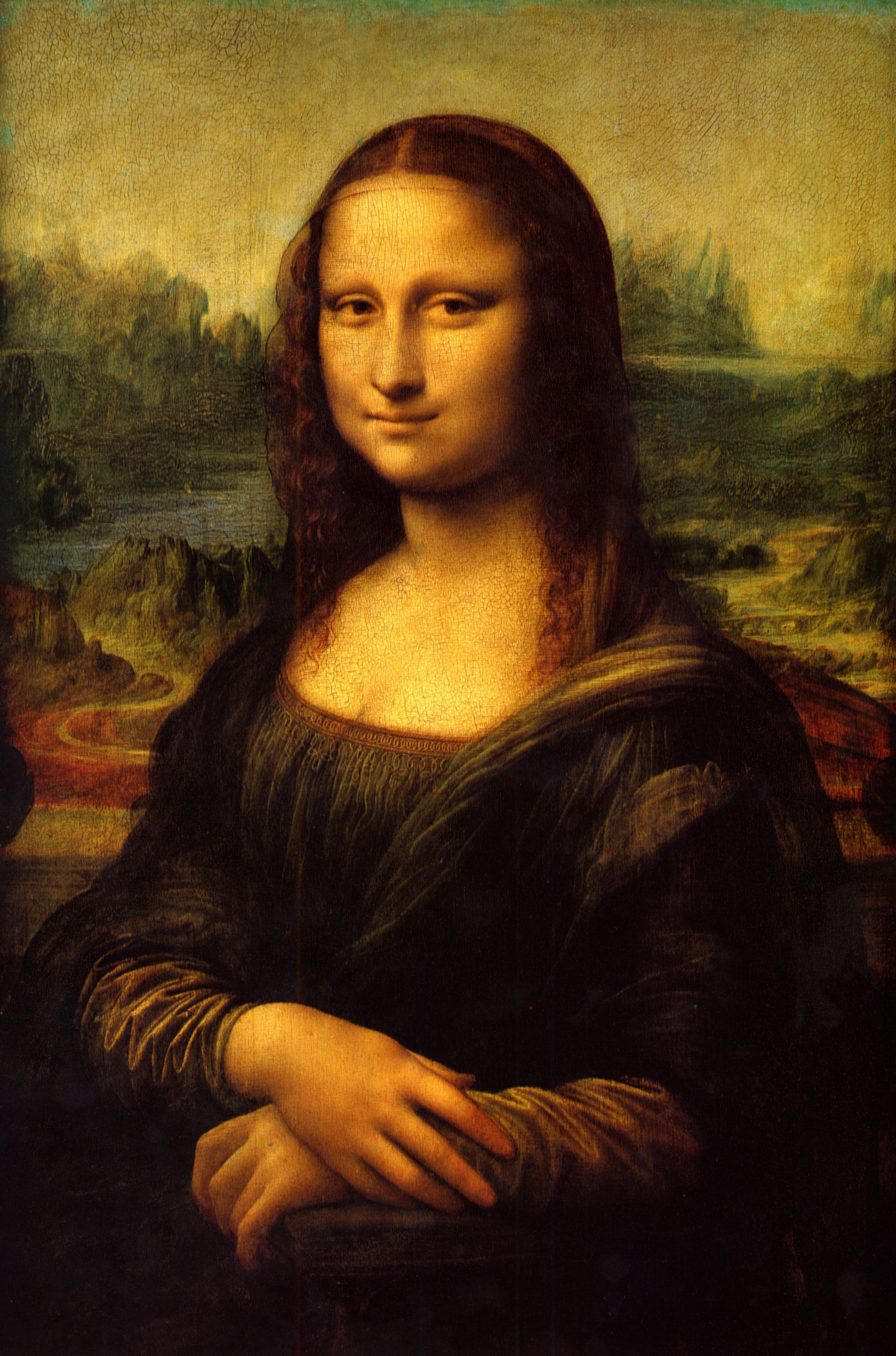
Impressionists would like to have us believe that subjectivity in art was invented by Paul Cezanne. A nice marketing ploy. But art has always been and will always be subjective. The unruly and unpredictable and unregulated real world just won't do. Can you really say Mona Lisa is objective just because we perceive the face as believably life like? Look, is the warm and harmonious color scheme real? Is the background landscape real? Where's she sitting that one could see this shrunken landscape behind her? Does the color of her forehead match that of an Italian woman? And who sits like that anyway, eh?


Inevitably, what is on the canvas is blatantly one person's mental image of what reality should look like. Art is never realistic. Art is always a representation. Art is always and forever seen through the mind, not the eye. This is why I don't think an alien species visiting the earth would ever "get" art. Humans as living organisms, yet, but the world seen through and distorted by the human mind ... what the heck is that?

So here's the rub. I have to conclude that there is a fundamental, irreconcilable difference between the world I see through artificial images (eg, paintings, photographs, movie and TV images, and images described with words) and actual images I see with my own eyes and process by my own mind. Because the mind is so adept at framing the visual input, trimming out the details it deems irrelevant or unimportant, and making up a message or theme of the abundant information, that we discard the most of the external input. As Sherlock Holmes pointed out, "You see, but you do not observe." Or we see only what we expect to see.

Prompted with the cue word of "waterlilies," what appears in your mind? To be honest, I have to search really hard in memory to dig out an image of real flowers and leaves in a real pond. Rather small and pale, not too impressive. More immediately accessible images are those of Monet's paintings --- I have certainly seen those more times and paid more attention. Yet, the waterlilies in Monet's paintings are images at least thrice processed: by his (not very acute) eyesight, by his mind's plan to frame and color them in a certain and harmonious way, and by his paintbrush. Ah, but then there are layers between me and the flowers that lay in front of the artist one day in his life --- the cultural judgment associated with Monet and his waterlilies and other known and unknown cultural preconceptions about all this.

The cud --- what does it taste like? And what about the real water lilies?

This is not to say that chewing others' cud is necessarily a bad thing. What I'm wondering is actually whether we know how much one sees and feels and believes is his own, derived from his own senses processing the tangible, concrete, material, real environment around him, and how much is pre-processed stuff from other people. The real world is, more than anything, indifferent to the themes and schemes, and the stories we tell ourselves.

I wonder.

See, the problem is, the memory of a picture of, say, a fish, or a video of fish swimming around, isn't terribly different from the memory of seeing a real fish swimming with my own eyes. The brain isn't particularly good at appreciating the real stuff. In fact, the pictures look better with their color coordination, simpler, more pleasing, more ... certain.

Saturday, August 9, 2014

Christopher Nolan's Dream

I first liked but later changed my mind about "Inception." If the story were set up as cyberpunk, and the characters entered a computer game instead of a dream, then all would have been well, and I would have loved the movie. Ah, but Nolan just had to make it a dream. That is the deadly mistake.

Although Freud might not be completely correct in all his interpretations of dreams, he was largely right in that dreams are symbols and representations of our unspoken wishes and desires. I find it rather funny (ironic, not haha) that Nolan creates a world that is nothing like dreams but then insists that it is a dream rather than a more logical device like the cyberspace or video game. 

Many have commented that it seems laughable and ridiculous that Nolan's dream has so many rules that 90% of the movie is explaining various rules. Real dreams have no rule at all. In fact it is the land of escape from consciousness, which always has to make up a story and make sense of every inexplicable accident in the world. Dream is the opposite of reason and rules. Therefore Nolan's consciousness-based dream is particularly meaningful. One could argue that he wants to enter the land of dreams (or access his unconscious), but has to reject it (perhaps out of fear). By insisting on creating order out of the lawless unconscious, one has to wonder what in the unconscious is he so terrified of. 

Someone once said (someone famous but I have forgotten who) that storytelling is dreaming. Indeed. Fictional stories are where the unconscious slips out, just like in dreams. As hard as he tries, Nolan cannot prevent his unconscious from seeping between the cracks. If he really wants to hide it, he should get out of the storytelling business altogether and become a priest or something. 

What is Nolan's dream that he is so afraid of? I don't know, but I observe that a common theme in his stories is the man causing the death of his wife. It has appeared at least three times in "Memento," "The Prestige," and "Inception." (I have not watched Batman series. Besides, it isn't originally his story.) More important, the theme of the man killing his wife is the driving motivation for the leading man in both "Memento" and "Inception." The importance in this theme lies in his awkward and unconvincing effort to dodge the man's guilt.

What a very odd motivation though. In archetypal stories, the man is driven by love/lust/pursuit of women, by revenge, by daddy issues, by the passage to adulthood (aka "Hero's Journey"). Sure, we know these stories by heart, over and over. But by the secret wish to kill his wife and associated guilt and denial? Geez, where did that come from? It is certainly a place not traveled by most people. 

Of course one cannot immediately interpret that as Nolan's own unconscious wish to kill his own spouse. More likely it can be traced to his parents' relationships with him and with each other. 

"Inception" suffers from the problem of over-intellectualization and over-rationalization, as demonstrated in the excessive and rigid rules and the overly realistic and literal visuals (gunfights, car chases, crossing snow, bombs, the way characters walk and run). Yet in his obsession with over-intellectualization and the rejection of truly dream-like imagery and fluidity, I see a repressed urge to dream real dreams and cut loose. The more you want to cut loose and let it all hang out, the more you have to wrap it up and wind it tight in layer upon layer of logic and rules. Wouldn't it be funny to hear Nolan's real dreams? They are probably extremely transparent. 

*********
On a side note, the best and most effective dreams on screen can be seen in the Hitchcock-directed, Dali-designed "Spellbound" (1945). That, my friend, is a real dream to see. 

Monday, August 4, 2014

Something from Nothing

The Sunday before last I happened to catch a rerun episode of Radiolab entitled "Who Am I?" It turned out to be the first episode of the first season of Radiolab, so the information in the program might be slightly outdated. Nevertheless I was utterly blow away by two concepts put forth in the program: 

1. The human brain is uniquely (?) capable of conjuring up images that do not exist in reality, like a red canary with purple stripes, through some process of dismantling and assembling realistic images in memory. 

2. The sense of an integrated, coherent self is such an abstract mental creation. It's not based on anything concrete or real. 

Both points blew my mind and continue to do so all these days later. I am still chewing on them. 


Sunday, April 27, 2014

Word on the Street Continued

Continuing with the thought on an insatiable appetite for random chatter on the "street" in the "neighborhood".

I wonder if this phenomenon is in any way related to a previous observation about a thirst for "knowledge" (discussed here).

Sharing knowledge and opinions through either oral gossip or written words is a fundamental human activity. A certain thought originated in another brain (for example, "the movie The Shining is an allegory of European colonialists' history of massacring Native Americans and the blood debt they since left." or "George RR Martin is wrong about ancient Romans not knowing who lived beyond the Hadrian Wall.") ends up in mine, although I'd never have come up with it in a thousand years spontaneously.

So, anyway, this sharing blurs the boundaries between other minds and my own. The world I take in using my senses in a given moment, firsthand experiences that leave a mark in my memory, and thoughts and digressions bubbling in the skull, products of introversion. These are mine, but the secondhand information that is pass into my brain one way or another is not processed in a different meat grinder. It is the same meat grinder that grinds my meat and their meat, and soon enough all the meat is mashed together and becomes indistinguishable from each other.

A simple illustration is this: I go to a restaurant or watch a movie/TV show or read a book. I form my immediate reaction toward it --- I like it. I don't like it. I'm ambivalent. I read a review published in Washington Post about the restaurant/movie/TV/book. Maybe two reviews. Maybe a review in WaPo, one in The New Yorker, and a bunch on Yelp. And then I chat with a friend and he or she gives me his or her take. I process all of this in my head. What is left? How much of my own direct, firsthand, instinctive impression is left the the blob of opinion/memory in my own head?

What are people saying about XXX? The urge to know is strong. That is what drives my uncontrollable curiosity. What do others think about "Game of Thrones", the gravitational wave discovered in background cosmic microwave images, the new Michael Lewis book, the political situation in Syria/UK/China/Washington, the wrinkles under my eyes? Perhaps more important, how do they feel about it?

Why do I want to know? Why do I NEED to know?

This is not a rant against sharing knowledge and feelings. Can you imagine everyone living on his own direct senses, experience, and ingenuity? He won't last a week in this world.

On the other hand, I want to understand better --- the grey blob in my skull, the crackling electrochemical activities, every moment different from the past and next --- how much of this is mine and how much is someone else's. I want to have a better grasp. If I am feeling the need to reduce and exclude others' thoughts from rushing in, maybe it's because turning off one faucet helps me see how much and what exactly is coming out of the other faucet, ie, mine.

Also, maybe I feel like the "other minds" faucet has been running a bit too fast and voluminous as to drown out the other faucet, because the "neighborhood" has expanded massively to any stranger living in a basement three thousand miles away with Internet access, and sharing gossip has become vastly easier by moving nothing but nine fingers (the left thumb has no use on the keyboard). Perhaps the "me" faucet has grown irritated with being drowned out.

Monday, April 7, 2014

Living in Others' Dreams, continued

When I read Oliver Burkeman's column this Sunday something clicked in my head. The subject of pursuing "the interesting" rather than "the truth" has to be related to in some way to the issue of living in other people's dreams instead of one's own dreams instead of a waking state.

Burkeman quoted Murray Davis to suggest that our pursuit of ideas is not motivated by a pursuit of truth but rather a pursuit of mental excitement. Or, more precisely, an escape from boredom.

I am as guilty as anyone in this escape. The mind is bored by ... what? Not working outdoors? Not hunting and gathering? Not struggling for survival every day and every moment? Not threatened by a thousand dangers of living in the wild? Not exhausted by constant physical exertion day after day? I'm not complaining, but the butt is indeed in the chair all day (like now), and the mind is indeed bored.

For a short while I got into the Chinese knock-off version of Quora known as 知乎。I could spend hours on it browsing various answers to various questions, most of which I could not give a toss or relate to my own life. It's positively addictive. Of course one could argue that this addiction has to do with the urge to know others, to learn, to understand, to peek into another mind. Whatever, but at one point I began to wonder about the meaning and purpose of acquiring knowledge.

In the world I grew up, the acquisition of knowledge is always good. The more the better. When I was small I had a knack for acquiring and retaining a variety of factoids from books I read. My father was proud of that, and a lot of people envied my "wide base of knowledge." Positive reinforcement might have given it a push, and now it is self perpetuating. This thirst for knowledge led me into a journalism job at one point, which I enjoyed a lot. I could have been at it still, despite sometimes wondering about the point of it.

I occasionally read the blog Farnam Street by a Canadian economist (or maybe a trader, I'm not clear on the difference). He reads several books a week, mostly nonfiction, and posts thoughts about them daily, usually quoting blocks of text from each book. The volume of his reading is very large. The tag line in his email newsletter is "Do you want to get smarter?" It's another big subject altogether about whether knowledge makes one smarter.

I'm not knocking this lifestyle of constantly trying to absorb a lot of knowledge and living in other people's dreams. That is how I have lived for most of my life. The proliferation of TED Talk is an indication that I am not alone in this. Of course, the mind's thrills do not have to come from TED Talk type of knowledge. It could also be knowledge of how your family and friends are living, what they had for lunch, what movies they saw, and how big their babies are now, via Facebook and WeChat and whatever. Or knowledge of how your favorite celebrities are living.

This is also a part of the issue of the separation of mind and body. The mind pursues thrills that the body cannot provide (unless you're an extreme sport practitioner). So it goes elsewhere and, in today's world, finds thrills easily in movies, computer games, and the Web. Not even books any more for the thrills come too slowly from the pages.

Skating is the only time when the mind cannot detach itself from the body. Running is only partially so. What is real experience of my own? If the mind does not register the body's experience, is it real? If the mind gets its thrills without the body's involvement, is it real? Are we all living in day dreams all day long? Worse, are we all living in other people's day dreams all day long? The problem is, at least in today's world, it is so easy for the mind to find endless thrills, and the body only gets in the way. The real thrills brought about by the body, like the sunset mentioned in Burkeman's article, can't compete with a blip on the screen.

Monday, March 31, 2014

Living in Each Other's Dreams

The weather was atrocious today. Nevertheless I dragged Mr. S out to lunch at a fancy Thai restaurant we used to visit a lot but had not been back to for a year. On our way home the wind picked up and the rain turned into little ice pellets bouncing off the car's windows and hood. After some grumbling about the foot-dragging winter, we got into a discussion about an article reporting on research about ... well, the subject is not important, but I began to argue that the abstract representation of something that induces a projected, simulated experience in a person's head is not the same as actually having a real experience.

Then it occurred to me that this is an issue that has plagued my mind recently. When we watch a movie, when we read a book (especially but not limited to fiction), when we watch TV (including reality TV), are we not living in a simulated experience and feel emotions induced by a representation of experience that is NOT REAL to ourselves? Of course one could trace this back to storytelling by the fire pit ("Once upon a time...") and the drawings of hunting scenes on cave walls. When people listen to or watch (or both) an abstract representation of other people's adventure, they feel as if they were going through the same adventure and experience a part of the same feelings, emotions, and thrills (etc., etc.), all in the safety of their own caves or living room.

I'm sure someone --- probably a philosopher or a psychologist --- has described this odd phenomenon. Humans can experience something without actually doing anything for real. The fake experience, induced by abstract representation of others' actions and experiences, can induce a sense of actually being there and doing it. Sometimes it can feel very real.

So the line between reality and induced armchair experience is blurred. An extremely ambiguous example is playing computer/virtual reality games. You are doing something for real, but most of it is fake. The threat is fake, but the adrenaline rush is real. A number of recent experiments show that the brain cannot tell the difference between reality and fake reality, and a clever VR trick can even create an out-of-body experience for real. 

Now that we don't NEED to do much of anything in daily life any more, do we need real experience any more? We don't have to craft our own table and chair from wood, build our huts from clay and straw, cook our meal on fire, and harvest our own grains any more. If we want to know what it feels like to make things, we can watch programs on HGTV or the Food Network. We don't have to actually make things.

I remember the stirring fascination I felt watching the TV program "Alone in the Wilderness", in which a man made a living alone in Alaskan forest, building his own house, carving his own boat, catching his own fish. Also the Swiss novel "Heidi," which describes, in meticulous and credible details, the mountain life ranging from milking the cow to herding goats. Importantly, "Heidi" suggests that doing these things are so easy that even children can handle them. --- And so can you! But you don't need to bother. You can get all your satisfaction from projecting your mind into these people on the pages or on the screen.

Pushing the life a little farther, one could argue that many other experiences can be felt without doing anything. Can we eventually simulate all experiences, including the most instinctive pleasures, such as, uh, the tingling of smelling the woods on a clear autumn morning? All without moving your butt out of the chair!

Living someone else's experience through an abstract representation or a vivid medium is like living in a dream, a dream shared by me and the other person, because there is an eerie sense of both being and being surprised in either case. When I wake up in the morning and read the twitter feed or emails of news of the world I have missed in my sleep, it is not unlike walking straight into another dream. Throughout the day I share my friends' and colleagues' experiences through emails and messages, and the world's collective experiences through news and Web sites. In fact I have not left my chair, and my hands have not created anything tangible besides an electronic copy of some words and numbers that exists inside the machine.

Note that "someone else's experience" could be merely someone else's made-up experience, like fiction. In such cases, the author is dreaming and I enter his or her dream. The difference is the author has more control and spends more effort. I'm just a lazy consumer of the dream created by the author and deservedly have less control.

The question is this: If there is no difference between real and simulated experience, if we get the same emotions and reactions from nonreal representation of life, why live for real? Why do things for real? Why touch and hold real objects? Why eat real food? Why love real people? Why make anything real? How much of my life is real and how much is a dream created by others and shared by me?

Why not stay in the continuous, endless dream? 

Thursday, October 24, 2013

Again, Something versus Nothing

Perhaps this is what Jung referred to as synchronicity. A few days after I wrote the blog entry about what I think about the question "Why is there something rather than nothing?", Oliver Burkeman published a rather amusing feature in Guardian on an amateur philosopher who claims to have solved the mystery of universe. This jewelry dealer and philosopher's answer is --- potential.

Whatever. I don't intend to discuss this philosophy. I just remembered a radio interview I heard some time ago with a female physics professor and researcher. She said something to the effect of "Yes there is a defined size to our universe and it is approximately 13.6 billion years old." Her point was that our universe is an enclosed system, like the inside of a ball. Also she said that it was pointless to ask what was there BEFORE the Big Bang, because "before" is a concept of time, and time did not exist outside of our universe, which was created by the Big Bang. If I understand correctly, she meant that time in itself is a product of the Big Bang, just like the 3 dimensional space itself, which is expanding as we speak. Time as we know it is just like space that exists only within the confines of our universe. Therefore there is no BEFORE the Big Bang because there was no TIME outside of the Big Bang.

Imagine a supernatural being who exists outside of our universe looking in, the same way as we, creatures of 3 dimensions, looking at an ant who lives in a 2-dimensional world. It seems obvious, isn't it, that time does not have to be infinite. It can be a line and a creature not actually ON the line can see any point on the line, but a creature living on the line can only see that particular point he is standing on? It is only the human memory that allows us to see a minute distance behind us on this line but not most of it. To organisms without memory, they live on a point, although not the same point from one instance to another, on this line.

But memory is but an illusion, not reality. It's a recording of the moment "then," which stands at some point behind "now" but it is not really "then." An analogy is that a photograph is merely a picture that depicts the image of a moment in the past, but what you are seeing now (when you look at the photograph) is the photograph, not the past itself. There is no contradiction of past and present existing together.

Anyway, so, what I'm trying to say is that humans often fall into the trap of being unable to distinguish the self, in the form of consciousness, and everything else that is not the self, including the molecular and chemical processes that enable consciousness. It is incredibly self-centered and grandiose and delusional, yes, but what else would you expect from the consciousness, especially that of men and especially that of men like Thomas Nagel (who believes that consciousness is the basis for the existence of the universe)? People do believe they are the center of the universe and they can't be reasoned out of it.

Imagine though that you were a supernatural being living outside of this 4-dimensional universe and time is but a thread laid out in front of you and means no mystery to you. You watch the little creatures crawling on the thread, blind to what lies before or behind them, yet, against all reality, they believe the electrochemical flutters in their head causes the universe to exist. Wouldn't you laugh your ass off, assuming you laugh? I vaguely remember Chuang Tzu saying something to this effect. Hmm, why do you need Nagel when you already have Chuang Tzu?

Tuesday, January 15, 2013

The Invisible Plague


You know it is a book by a non-professional writer when, by the end, you get no "closure." Dr. Torrey has made a pretty convincing case for his theory that the prevalence of insanity --- namely severe mental illnesses involving psychosis, particularly schizophrenia and bipolar disorders with psychotic features --- has been rising slowly but steadily in the past three centuries. Chapter after chapter, he cited historical evidence ranging from hospital records and case documents to artistic depiction and public fascination with insanity to prove that, in four countries with fairly credible historical records (England, Ireland, Canada, US), the rate of insanity has risen from about 1 in 1,000 adults, equivalent to about 0.5 per 1,000 total population, in early eighteenth century to about 5 per 1,000 total population now.

I had never heard of this claim until I met him recently for the story about toxoplasma. OK, so I'm neither a physician nor a historian, but I consider myself better read in medicine and psychiatry than most lay people. This smells like fringe stuff. Yet, he certainly does not sound like a fringe-minded person. In fact, the book is extensively and meticulously referenced and appears to lack over-generalization and over-arching conclusions that I've become sensitized to in recent years (thanks to some very popular "scientific" writers).

One of the deductions that sort of convinced me is this: We all know that certain diseases can cause psychosis ---- syphilis, leprosy, and various other infections that enter the brain; malnutrition (especially severe vitamin B deficiency); traumatic brain injury (e.g., James Hadfield who attempted to assassinate King George III got his brain injury in a war); brain tumors; etc. Even an idiot (another word forbidden not only by psychiatrists but also by respectable media) knows that infections, malnutrition, and brain injury from wars have significantly declined in the past 300 years, certainly in the past 60 years. Yet, the incidence and prevalence of insanity have not benefited from the general improvement in our living condition. Hmm.

Torrey noted only in an appendix that the rise of the insanity epidemic since mid-eighteenth century coincides with the widespread practice of adopting cats as pets. He fully acknowledged that this epidemic temporally aligns with industrialization and urbanization (except in Ireland). A decade after the book's publication, he seems more convinced now that cats have something to do with it after all.

So what's the answer? What the hell causes insanity and continues to cause insanity to this day? All I can say is nobody knows. The availability of drugs to treat this and that mental disorder might give the public a feeling that doctors know what they are doing, but in reality ...

Sunday, January 13, 2013

Insane

A funny thing happened, which I must record.

Last week I wrote a piece for a newspaper with psychiatrists as the intended readers. I suggested a title of "infectious insanity," which, I admit, was a bit tongue in cheek. I was informed that the editor would never allow such irreverence. Apparently, the field of psychiatry is squeamish about words like insane or mad.

Of course, psychiatrists have reasons to artificially restrict their vocabulary, just like lawyers and computer programmers have their own. To a writer, however, the self-imposed limitation seems amusing.

The underlying assumption is that, by controlling and changing public vocabulary, one can manipulate how people think. This theory is undoubtedly widely held by not only psychiatrists. For governments and other propagandists, I think the effect of language manipulation has long been proven.

Nevertheless, it's ironic that psychiatrists should be as tight-assed and stiff-upper-lipped as the office of propaganda. What is a better means to loosen people's fear and hatred (in another word, "stigma") of lunacy? To illustrate and convince them that insanity is but a disease and has nothing to do with morality? Or to subliminally distance the thought of mental illness from a negative instinct or feeling?

Of all people, one would expect psychiatrists to have more courage than the average Joe to stare the truth in the face and not fear words or feeling and to have more sense than to exact change through avoidance and suppression. At least, that is the theory. Reality, however, is no theory. 

The Ending of Le Samourai (1967), Explained

A quick online search after watching Jean-Pierre Melville's Le Samourai confirmed my suspicion: The plot is very rarely understood by E...