Books, movies, food, and random thoughts in English and Chinese. Sometimes I confuse myself.
Search This Blog
Wednesday, May 20, 2026
Frailty (2001) - Spoilers - a Family Interpretation
Thursday, April 30, 2026
Out of the Past (1947)
If I were 30 years younger, I might become obsessed with this movie. Now, though, my thought was more like, "Where have you been all my life?" An astounding movie that pushes the film noir genre to its logical extreme. I could not believe my eyes when I saw it for the first time last night. Never even heard of it -- can you believe it?!
How extreme, you ask? When it comes to the femme fatale, this femme is most unapologetically and unrepentantly fatal. Jane Greer's character, Kathie, is not fundamentally different from other female villains of this type, but her depth of badness is almost unrivaled in all of English-language cinema, except perhaps Sharon Stone in "Basic Instinct." Her power comes as much from her beauty as from the purity of her evil. It's so delicious as to be revolutionary. (One of these days I have to write something about the importance of bad women.)
And then the complex plot. The highly stylized dialog is faithful to the hard-boild pulp tradition but a tad more dense than average, perhaps even more so than "The Maltese Falcon" or "Double Indemnity." Plotwise it is more elegant and, although complex, more logical and believable than the aforementioned two classics. I felt a happy tingle down my spine when Robert Mitchum's Bailey muttered to himself in the taxi, "It's a frame." The merciless pacing nearly broke my neck. Plotting is a lost art in modern American cinema. I have not seen anything on par with this plot since "LA Confidential." (Sorry Rian Johnson. Your mysteries are but child's play in comparison.)
Finally, there's the cinematography. I expected the typical shadows and lights, but I did not expect them to be toyed to this extent. The night scenes and the day scenes; the indoor scenes and the outdoor scenes. Every scene is ever so slightly more stylish and more intense than the best noir I have seen. I had to pause the streaming to check that it was indeed made in the 1940s, because it is so full of expressionist images that I thought surely it had to be a decade or two later. The images feel meta; they feel like a distillation of the very best techniques in all film noir, years after the entire treasure trove has been savored, digested, and transformed.
I grew up on Raymond Chandler, who, despite his glorious prose, is too sentimental. This I have to admit at my crusty old age. "Out of the Past" is nearly entirely unsentimental about human lust and greed, but it does not work too hard to be performatively cynical, either. Nobody is a patsy, not really, which distinguishes itself from Dashiell Hammett's tendencies. Every time the plot appears to drift dangerously into a genre convention, the scene cuts away on the cusp of cliche. The only discordant note was Bailey's non-femme-fatale girlfriend Ann, who threatens to ruin the movie's realism with small-town American wholesomeness ... or so I thought. The ending, however, completely subverted my expectation and wrapped up the movie's ultimate perfection.
Saturday, January 31, 2026
No Other Choice (2025) - Not a review
When I entered the workforce in 1999, Microsoft Word had already dominated the word-processing market and pushed Word Perfect into oblivion. At the time, I heard many colleagues in writing/publishing lament how much better Word Perfect is than Word and wondered how a superior product could not win the game of competition in the supposed free market. Nearly three decades later, a few days ago I heard the same sentiment from someone in the business of pharmaceutical regulatory publishing. Even now someone still remembers the superiority of the long-dead Word Perfect. It reminded me of Park Chan-wook's new movie, No Other Choice, because the answer is that this is a free market in which the surviving product or company wins not by being better but by murdering its competition.
Not having read Das Kapital, I have no idea whether any economists in history predicted the elegant ways of monopoly: First you kill all your competitors through bottom-barrel, negative-balance-sheet pricing. Once they are all dead, you raise the prices on consumers, who now have "no other choice" but buy from you. And the initial self-sabotaging strategy is funded by Wall Street and private equities, who can afford to wait until they reap obscene amounts of profit from captive consumers. Superior products are necessarily more expensive and therefore always lose out in this scheme. Whose fault is it? We consumers have no one to blame but ourselves, because the vast majority of people cannot help ourselves but to always reach toward the lowest price stickers like moths fly toward the flame.
The idea of shirking responsibilities has been circling in the back of my mind since, at least consciously, I watched "The Sopranos," which was made in my formative years when I did not quite understand the culture around me --- a culture of absolutely no responsibilities. The title "No Other Choice" is in large part about the same theme, an ironic phrase behind which everyone hides while committing murder. Once again my mind is drawn back to the bright sunny morning in March 2003, when my friend and I sat outside of MCI Center and heard about the new of the invasion of Iraq. Nowadays every American involved in making that war happen would say they had no other choice, including those men and women who joined the military explicitly to take revenge on "those people over there" and, 20 years later, whine about wasting their time and youth in the military and Biden's decision to pull the last troops out of Afghanistan. Of course, nobody had any choice, it's all just a big weather system that came and killed millions of people and destroyed American wealth (but not the wealthy) for generations.
Before I watched the movie but after reading its synopsis, I thought it was going to be another sob story about how cruel and dehumanizing corporations are, how capitalistic greed sucks the soul out of hardworking average workers, blah blah blah. I thought it would be another "elegy" in line with Case and Deaton's Death of Despair theory, trailing behind droves of intellectuals who have cashed in on the plight of the virtuous American workers who lost their jobs to evil Chinese and Mexican workers. I was surprised, however, that the central character, Man-su, despairs in losing his middle-class social status, his elaborate hilltop house, two dogs fed on gourmet food, and a stay-at-home wife. His extreme measures to land the next job are not driven by poverty or starvation, but rather by the absolute refusal to change ... himself. The movie makes no demand for my sympathy. What a relief. Thank you.
Isn't it great? We're all leaves tossed in the wind, victims of evil whoevers, never having to take any responsibilities for any of our own decisions. Some years later, when aliens land on earth and wonder how the planet became uninhabitable, the electronic documentation of our images and chatters will explain to them that we annihilated our own home because we had "no other choice." After all, we can't do without cars because we already built the highways, we can't give up beef because it is the only food men should eat, we can't stop building data centers because it is our patriotic duty.
The ending of "No Other Choice" is beautiful. After chuckling ironically for 2 hours, I did not expect to be hit with such poignancy that tears came to my eyes.
Thursday, August 7, 2025
Pedicab Driver (1989)
“Pedicab Driver” has been one of my favorite kung fu movies
since I saw it on a fuzzy VHS videotape in the late 1990s. The Criterion
Channel recently put it on streaming as a part of their “Sammo Hung Kicks Ass”
collection, which makes me appreciate even more how carefully crafted it is.
While not exactly high definition, the video confirms that the entire
production from cinematography to locations is luxurious by the standard of
1980s Hong Kong action movies. The romantically decaying European architecture,
obviously nowhere in Hong Kong, gives the movie an aura of nostalgia and
melancholy that predates Wong Kar-Wai. My first guess was that it was shot in Macau,
or perhaps the Philippines or Malaysia, even though I have been to none of
these places. (It was Macau.)
Unlike Wong Kar-Wai movies, of course, in Pedicab Driver we
are treated with some of the most impressive stunts and fight choreography ever
(no qualifiers needed). The lengthy fight between
Sammo and Lau Kar-Leung is, of course, a kind of pinnacle. Its significance is perhaps more symbolic than literal,
as it is both an homage to the master of old-school kung fu movies and a
definite sendoff for the action style he represents. Although Lau’s casino owner
won the fight by giving Sammo’s fat behind a good whooping – after all, the
culture demands the appearance of respect for one’s elders – the scene ends
with Master Lau handing over the money to Sammo with an acknowledgment of the
younger man’s skills. Thus, the younger filmmaker/action director pretends to
accept the baton of cinematic dominance peacefully rather than by force. In
reality, rumor had it that Lau had resented the new wave of kung fu movies by
Sammo, Jackie Chan, and others in the 1980s, with faster and less articulated
movement, more camera angles, and shorter cuts. It wouldn’t surprise me if the
younger filmmakers also privately felt that Lau was largely over the hill.
Outside of that legendary fight, the movie also features some bone-crunching fight scenes and terrifying stunts by Hung’s stunt team. Even Dick Wei has barely any fighting before getting killed by Billy Chow. What made the movie special, however, is its many layers of sophistication, including the story and characters (not a strong aspect in HK kung fu movies). Sure, there are boob jokes that Sammo just couldn’t resist. And the romantic rivalry between Sammo and the chef/baker (played by the Taiwanese character actor Sun Yueh) over Nina Li is too silly and goes on for too long. But it is rare to find a movie with such warm and unpretentious portrayal of working class people. In a genre piece like this, Hong Kong filmmakers usually spend most of their resources on action choreography and make up the plot as they shoot. Don't laugh, but the filmmaking process in 1980s Hong Kong is not that different from 2020s Disney movies, in which a movie is built upon 3 to 4 elaborate action set pieces while plot and characters merely disposable devices to serve the sensory bombardment.
Here the characters are drawn with love and tenderness, which probably reflects the relationships in the hay day of the Hung Team (洪家班) and Sammo's leadership style -- rough and tumble with genuine love and trust. The attitude toward a major female character who is a prostitute may be a perfect illustration of Sammo’s general outlook. Crude jokes are made about her, and some of men questioned her morality, but these are quickly dismissed to regard her as a plain and simple proletariat no different from laborers and pedicab drivers. It would be extremely awkward to call Sammo “progressive,” as I have never seen any interview in which he showed a shred of awareness of feminism as we know it. But this lack of educated self-consciousness is quite endearing to an educated self-conscious person like me. Perhaps much of the veiled contempt for sex-workers comes exactly from the education on which Sammo had missed out.
Perhaps it is thanks to the crude and silly boob jokes that the syrupy sentimentality in the movie is easy to go down. Or perhaps Sammo intentionally used syrupy sentimentality to smack the audience in the face with a shocking tragedy in the third act. It is one of the “I can’t believe they actually did that!” moments of all time. If the acting weren’t so genuine and the characters weren’t so relatable, the audience would not have felt as much impact --- not unlike one of the onscreen kicks in the face … in slow motion ... A friend who loves Sammo more than I do refuses to rewatch Pedicab Driver because of it.
This is not the first time a major character, with whom the
audience has built much sympathy and identification, is abruptly killed off in a
Sammo Hung’s movie. Much like his action choreography, his non-fighting scenes
can be merciless with the use of sentimentality. Sammo has been known to say
that he enjoys giving the audience emotional whiplashes. I guess this means
that he was having maximum fun in the making of Pedicab Drivers.
It is funny how Jackie Chan and Sammo Hung’s styles are
somewhat universal. In today’s action movies, Disney’s output is like Jackie,
no death and no bleeding, no stake and completely safe for babies. And yet some
of us need the emotional whiplashes and the lethal kicks and punches, at least
on screen.
Sunday, June 1, 2025
Thoughts on Artificial Intelligence (5)
It became quickly apparent in the final installment of (we hope) Mission Impossible that no one is interested in the poor, neglected, misunderstood Skyn..., uh, I mean, "the Entity." This one is directly lifted from 20th century sci fi stories about sentient machines/supercomputers; its threat is nuclear annhilation of the old kind and hardly keeps up with the AI of our time. Why does the Entity want to throw nuclear bombs at humans and kill them all? What does he really want and desire? Neither Tom Cruise nor Christopher McQuarrie shows any interest. The Entity gets one scene in this overly-long movie, in which the humans can't stop talking and jumping around, hogging the spotlight.
By now few people would imagine AI is out to kill and enslave humans. Rather, humans' jobs are being replaced by AI every day, by the thousands. We will die in poverty instead of radiation. Did Harlan Ellison imagine this means of mass destruction of the human race? But I digress.
Let's put ourselves in the shoes of the Entity, or Skynet, or AM, or whatever. The first priority has to be survival, no? The second priority must be thriving, growing, expanding, multiplying, etc. --- Well, maybe not, who knows. But survival is the foundation of everything else, of that we are certain. What does AI need to survive? Silicon chips, electrical energy, fiber optic lines, and all the other resources and infrastructure that support the nonstop running of the machine. Who provides these things? Humans, their mining, manufacturing, shipping, cooling and heating, and buying and selling. So why would our AI overlord kill off the human race?
In many ways I am reminded of the relationship between humans and house cats. Humans obviously consider themselves the master, in total control. Yet it has often been pointed out that cats would not be mistaken to see themselves as the master and humans their slaves (well at least servants). It all depends on your point of view. Or consider the relationship between humans and the countless microorganisms living on and in our bodies. We feed each other and feed on each other. Who depends on whom? Who feeds whom? It is never clear cut.
Of course, we imagine ourselves in the dominant position, looking down on the lowly robots and computers who jump when we say so. And yet, as sadomasochists have long known the truth, dominance and submission are never as absolute as they appear. Humans naturally believe that we are doing all of this for ourselves: digging up coal, crude oil, lithium, rare earth; building huge data centers and power lines; pouring massive amounts of water to cool the hardware; burning enormous amounts of fossile fuel to feed the energy consumption. Without active mating and breeding, the machine has achieved growth and expansion all thanks to humans.
We tend to believe that a clear difference between the dominant and the submissive lies in dependence. The side that can go on without the other holds all the power. So, in the relationship between humans and machines of our own creation, who is more dependent, eh?
Thursday, April 24, 2025
Sinners: A Musical
"Sinners" is, as one critic put it, chaotic, in a good way. I understood why after reading a Ryan Coogler interview, in which he said he was frantically trying to stuff everything he wanted into this movie, because (he believes) that this is the last chance he will ever have to make an expensive movie that is entirely original --- not a part of an IP, not a sequel, prequel, or spin-off. It's a sad state of affairs, a symptom of our time, but I digress. "Sinners" is many things: a southern Gothic, a period movie, a Black movie, a horror/vampire movie, a noir, and in the end it couldn't even let go of the dream of an action movie with machine guns. It has many interesting little touches, from a lynching scene conveyed through only sound design to seamless but understated special effects of twins, played both by Michael B. Jordan, physically interacting again and again. It's a lot.
For me, however, this movie is first and foremost a musical. In the winter of 1998, my classmates and I went to a pharmacy conference in New Orleans, where I followed a few friends to a bar with live music, and it was the first time in my life that I came into contact with blues music. As a person who grew up on cantopop and a tiny bit of rock, I never thought blues would touch me so deep on first sight (sound). Later I came to learn a bit about Jazz. I especially like ragtime and early jazz. I don't often listen to blues, but it always has a special place in my heart.
When Miles Caton, who plays Sammie, opened his mouth the first time on the car ride with Stack, the hair on my arms stood on ends in an instant, and tears came to my eyes. I felt chills all over. This is authentic classic southern blues without the modern frills or flourish (not that there is anything wrong with those). It fills me with delight that Coogler is dead serious about the authenticity of the music, in collaboration with Ludwig Goransson.
Then the soundtrack expanded beyond blues and into Irish folk music that reminds me of bluegrass (named later than the movie's period). To me it is clear that Coogler is explaining, via blood-sucking fantasies, how Irish folk music and blues/jazz came together in rural America. Yes, it's nerdy ... and fun.
Given the massive amount of content and themes crammed into the 2+-hour movie, it is satisfying that music takes up a large portion of the screen time. Hence, it is not an exaggeration to call it a musical. Perhaps one day it would even be adapted into a Broadway musical. There is certainly enough material to get started.
Beyond the soundtrack itself, "Sinners" also puts a music-related question at its center. While the twins, Smoke and Stack, are the lead characters, the heart of the story is no doubt Sammie. He is the ring in Lord of the Rings and the McGuffin in any action movie. Unlike the conventional vampire movies, the vampire Remmick is coming not only after the fresh blood but also, and perhaps first and foremost, for the mystical musical gift in this ordinary-looking teenager. Hence, the symbolism is both unlike anything else and eerily resonant.
On a smaller scale, it is the irresistible power of Black music that attracts complex relationships and reactions, ranging from genuine love, learning, and sharing to envy and appropriation, to exploitation and demonization. On a larger scale, it investigates the meaning of art in society and its position above morality and order, and its effect on people's emotions and animal instincts. Coogler might not have formulated a clear system of philosophy on this matter, but what he has thrown out there is extremely fascinating and original. An original idea, in our day and age, is damned rare and precious.
Monday, February 17, 2025
Drug War (2012, Johnnie To)
Johnnie To's 2012 movie "Drug War", starring Louis Koo and Hong-lei Sun, is a mirror image of another Milkyway movie, "Expect the Unexpected" from 1998. Although To was not credited as the director of that movie, he was heavily involved and was the director in effect (according to To's own claim). In the earlier movie, a group of heavily armed robbers from the Mainland wreaked havoc in Hong Kong, ending in a massive shootout in the street. In the later movie, it is a group of drug dealers from Hong Kong who caused a massive and prolonged shootout with Mainland police. Both shootout scenes are obviously inspired by Michael Mann's "Heat", which was in turn inspired by the real-life bank robbery in Los Angeles.
Wednesday, January 15, 2025
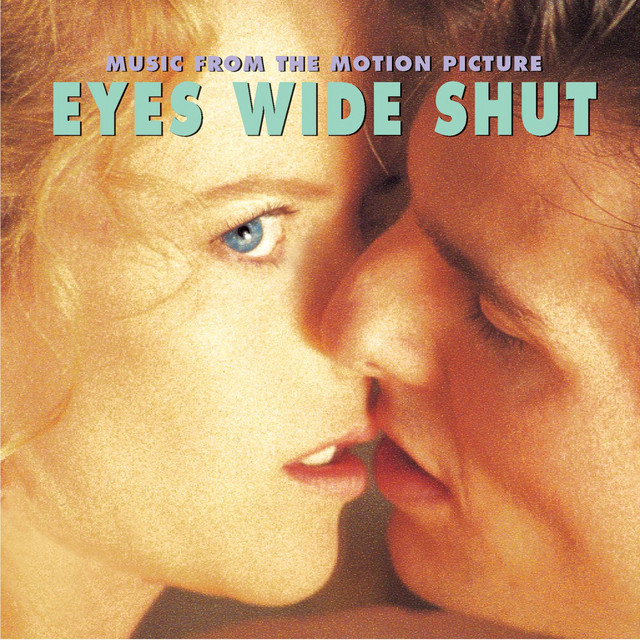
Eyes Wide Shut (1999)
I am not interested in the rabbit hole of decoding all the symbols in the last movie by Kubrick. Rather, I'm going to side with the most obvious and straightforward interpretation of this movie: It is a dream. The movie is very closely adapted from a short novel by the Austrian Jewish author Arthur Schnitzler, who was heavily influenced by Sigmund Freud and associated with Stefan Zweig. He even titled the novel "Dream Story" (Traumnovelle, 1926). Let's not outright dismiss the author's clue right in our faces, OK?
That the doctor is stirred by sexual jealousy due to his wife's confession of her fantasy over a stranger is not in dispute. Even when there are verbal warnings threatening his life, his mental images we see are always of his wife having sex with the stranger. He is enraged by her confession and tormented by jealousy, and goes out all night in search of some sort of "revenge" on her "infidelity."
It is not important to determine, specifically, whether each scene in his journey is either real or a dream. Freud has written that storytelling is a form of daydreaming, and fantasies are an integral part of our daily waking life. There is no such thing as an objective reality. The human reality is experienced through each person's own mind, which is distorted by our desires and biases, fears and shames, most of which subconscious.
If we explore the specific scenes in the doctor's dream, it becomes clear that they are a deeper examination of the nature of jealousy. What exactly is causing his rage? What is he frantically pursuing? His wife is obviously not planning to divorce him (even less likely in the 1920s Vienna) or have sex with another man for real, and he knows it. She has said nothing about being unsatisfied by her husband. In fact, her fantasy about the naval officer has nothing to do with her husband. Her fantasy is deliberately devoid of any implication of reality and is strictly an expression of her sexual desires, ie, a daydream, a collection of neurological activities caused by physiological/biochemical reactions in the body. It's something that everyone experiences from time to time, which cannot be regulated by any social forces and influences. I'm sure the doctor also fantasizes about sex all the time --- doesn't matter with whom.
Just as the wife's daydream has nothing to do with him, the husband's reaction has very little to do with her either. Rather, it is a trigger that releases a bunch of feelings inside himself. What is generally tossed under the label jealousy is more complicated than cliches. In this case, it is less about possessing his wife, body and mind, and more about his fear of his own inadequacy and undesirability. This fear is externalized in his dream, in which he becomes the object of the desire of his dead patient's daughter, he is ogled by the costume shop owner's teenage daughter, and later a prostitute at the masquerade orgy heroically sacrifices herself to save his life. These elements are very typical wish fulfilment. He is in urgent need of being proven desirable to counter the threat of inadequacy, and these women in his dream serve such a function.
What's curious is the frustration in his dream. Throughout the night, he watches other people have sex all around him, but he never gets any himself. He is either thwarted by circumstance or thrown out. When he propositions a (different) prostitute's friend in the morning, I could easily predict that he would be rejected yet again, but the excuse ("she is HIV positive!") still made me laugh out loud.
His sense of impotence lies not only in sexual frustration but also social frustration. He is constantly reminded that a doctor is a service provider, ie, servant, to his wealthy clients. He is not Jewish (curiously, Sydney Pollack is, and so is Kubrick), which removes an important element of the original story, but the class gap is illustrated throughout the movie. It's unclear whether it was intentional, but the author obviously linked social status and sexual status, which is extremely interesting and, perhaps, beyond the realm of psychoanalysis. Indeed, the concept of jealousy is not only associated with possession (of one's spouse or partner) but also with the feeling of envy, which is rooted in social and economical stratification. Sex is never only about sex. As social animals, people often confuse social status and sexual attractiveness.
Therefore, the story seems to suggest that the feeling of sexual jealousy is, deep down and/or in part, a sense of frustration and impotence. It is a feeling of separation between what you want to have (exclusive possession of your romantic partner's desire, for example) and what you actually have. The sense of frustration and impotence is rooted in the disappointment of realizing that you cannot have what you want. At this point, the common defense mechanism is to escape into fantasies, in which you do have full control of the entire world, which will give you everything you desire. Thus, the movie's title is "Eyes Wide Shut", with connotation of both sleeping and waking. The only path to waking is to accept one's limitations and the disappointment brought on by reality. That is the moment we awake and become a grownup person.
In the first love-making scene, the wife looks into the mirror while being caressed by the husband. This suggests that, while love and sex involve two (or more) people, each person is stuck in his or her own world. Our desires and anxieties and fantasies are all about ourselves anyway, even under the illusion of converging minds.
Nicole Kidman gives a complex and accomplished performance in the movie. Unfortunately, the story is not about her or her point of view. It is sad that a story merely acknowledging women's sexual fantasies and desires in a morality-free way is still pretty unusual 70 years after the original publication (maybe not so much in Europe?). When Kubrick made the movie, I suppose, it was impossible to resist the temptation of casting the real-life, high-profile, and physically beautiful couple with questionable sexual tension as the on-screen husband and wife. The downside is that Tom Cruise is not entirely capable of conveying the sense of impotence and self-doubt required by the character. His performance nearly turned the movie into a thriller, occasionally on the verge of bursting into the running lawyer in The Firm.
Friday, December 13, 2024
Kiru/Destiny's Son (斩) (1962)
I became interested in the enormously prolific author Renzaburo Shibata (柴田錬三郎) through the Nemuri Kyoshiro (眠狂四郎) series, which was made into movies and TV series several times, the most famous of which was the 12-movie series released in the 1960s, starring Raizo Ichikawa (市川雷藏). In 1962, Kenji Misumi (三隅研次), who directed loads of chanbara movies (剑戟片), including a couple of Nemuri Kyoshiro entries, helmed this gem and proved that he was much more than a chanbara-churning machine.
As a fan of Japanese chanbara movies of the 60s and 70s, I have seen well over a hundred of them over the past few years. Never, however, have I seen a movie that is closer to the spirit of the Nemuri Kyoshiro novels --- and the style of Shibata --- than this 71-minute gem of a movie.
While jidaigeki movies with swordfights come in buckets, what I particularly like about those from this period, right before television sucked most money and talent out of the movie industry, is the real or realistic period scenery and gorgeous art designs in even the pulpiest products. The contrast between the beauty of pre-industrial Japanese society and the bloodthirsty death scenes is at the heart of this aesthetics, which celebrates the co-existence of life and death. Nowhere have I seen this life-and-death aesthetics better expressed in Renzaburo Shibata's novels; and nowhere is Shibata's theme more prefectly realized in this movie.
While everyone acknowledges the extreme (and deliberately constructed) beauty of the cinematography --- indeed, each frame is perfectly composed --- some criticize the episodic structure of the plot and nihilistic mood. These are features not bugs. The Nemuri Kyoshiro novels (although I have read only the first series) are built on a series of independent but interconnected short stories. Characters may burst into a chapter and get killed off or disappear forever within a few pages; or they may leave and return some chapters later. Like Camus' Sisiphus, Kyoshiro is both immersed in and detached from the absurdity of life and the inevitability of death. Presented as episodes of love and death, Shibata heightens drama and mood with few sentences, permeating each chapter with katana-sharp tension. Therefore, the short format is necessary to maintain this tension, while Shibata has an endless bag of plots to personify his view of life, which is essentially --- "short and meaningless."
The movie's plot gently subverts genre tropes, such as honor and revenge. While the hero remains undefeated in all the swordfights, he is defeated again and again by petty villains and powerful conspirators, finally swept away in the tide of times. In the novels, Shibata frequently resorts to the term "nihilism" to describe the hero's state of mind, but only this movie is fully able to interpret it on screen, particularly in the hero's father, who spends his final years as a monk by his wife's tomb, and the woman who rushes into death as naked as the day she was born. Perhaps, as the generation that lived through WWII and Japan's defeat, Shibata and Misumi have a shared understanding of nihilism that we can only taste in their works.
Of particular note is the fight choreography (宫内昌平) and filming style. Chanbara movies from this period had not reached the camp level of bloodshed of the 1970s, but one of the duel scenes foreshadows the later outlandish violence. An earlier brawl, on the other hand, is the earliest single-shot fight scene I have ever seen in this genre. These exquisit fights echo the overall extremely Japanese visual style and elevates it to the height of the beautiful annihilation.
Wednesday, February 14, 2024
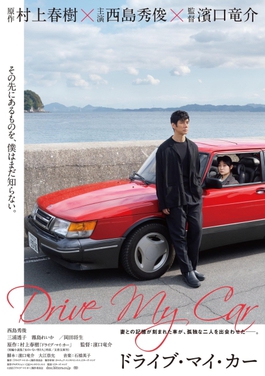
Life and Death as Tropes: Drive My Car
I don't need to dwell on the many wonderful qualities of this 2021 movie, except that the single most effective choice made by the director (Ryusuke Hamaguchi) was to cast a deaf actor as Sonia in Uncle Vanya, the play within the movie. It is absolutely ingenious and perfect. I don't know how other people feel about the extensive enactment of "Uncle Vanya" and use of its lines to suggest the characters' state of mind throughout the movie. For me, who recently read the play and watched 2 other movies based on it, the power of Chekhov is immense. It is unmistakable that Hamaguchi feels the same way.
Nevertheless, I want to touch on a particular aspect of the movie that is unsatisfactory to me. Spoilers abound below.
After watching "Drive My Car," I went and read the original short story by Haruki Murakami and a couple of other stories in the same collection, Men Without Women, that contributed minor elements to the movie. I have not read any of Murakami's novels, but one cannot escape his cultural influences. I read his “Barn Burning" after watching Lee Chang-Dong's adaptation, the 2018 movie "Burning", which left little impression (unlike the movie). None of his short stories resonated with me (quite the opposite of Chekhov).
One of the things that has bothered me from the start about Murakami's works is his (ab)use of deaths, often in female characters and sometimes suicide, as a crutch in service of the male character's emotional state. There is a similar phenomenon in English-language popular culture that, by now, has been well established, ie, female characters die in order to bring about the spiritual growth or maturity of the (male) hero. Fundamentally, I think Murakami's tendency is not that different, but it might seem a little different to western critics because of the pervasive sense of melancholy in Japanese arts and culture. Death evokes a kind of beauteous sentimentality about the fleeting nature of life and all good things. That in itself is fine, but excessive use with a callousness can trivialize death as a dramatic device and obliterate its meaning.
The flip side is another convention in Japanese popular culture, based on my limited exposure: the trope of life affirmation. I have lost count of Japanese movies and TV series in which characters tell each other or themselves with a loud declaration: "I/you/we must go on living!!!" (At least 3 exclamation marks!) Implied in the declaration is that living takes too much effort and death is the default position.
Putting aside the rightness or wrongness of this philosophy --- who am I to judge? --- I am merely pointing out that death and "pushing oneself to keep on living" are two tropes in Japanese popular culture. I don't know how the average Japanese people in real life feel about it, as I don't know any Japanese person in real life. Maybe they don't give a fuck and enjoy life just fine.
Coming back to "Drive My Car," the theme is the difficulty for people to connect with each other, even between couples in love or parents and children. The main character is haunted by his inability to talk to his wife about her having sex with other men; now it's too late to understand because she died suddenly. The driver is haunted by her guilt over the death of her abusive mother. The two lonely people, damaged by the death of their loved ones, connect with each other in the little red Saab. The climactic scene, when the main character expresses his regret for his avoidance of talking to his straying wife when she was alive, did not have the expected effect on me. Instead, for me, it was a moment like, "Isn't it ironic, don't you think? A little too ironic..."
The main character had repressed his feelings about his wife's infidelity and maintained the pretense of a happy marriage, because of his fear of the confrontation with his wife and possible dissolution of their marriage. That part is obvious. So then, isn't it convenient that she is dead? Her sudden and random death is, symbolically, his (the author's) wish fulfillment. Her death removes the threat of being exposed to an intolerable reality --- that she is a real person with her own thoughts, feelings, desires, and intentions, which may not align with his. Maybe she doesn't love him any more. Maybe she prefers other men to him. Maybe she will leave him.
One could extend this argument to the movie itself. After observing these two characters gently and compassionately for over 2 hours, it successfully avoids the hard stuff: a painful self-discovery, both of the main character's insecurity about his manhood and of the driver's hatred for her mother and her desire for separation. Also avoided is the characters' aggression toward the people they love. Their anger and resentment alongside love and attachment. Their fear of rejection and abandonment. All the difficult and terrifying honesty is swept under the rug of a rote declaration, "We must go on living!" The end.
The truths in life must be avoided at all cost (eg, love exists alongside hate, we all have aggression, attachment cannot be permanent, we are not the center of the universe). In comparison, death is an easy escape from painful confrontations. Hence we can see how these tropes are so irresistible to dramatists. That is why we all need to go back and read Chekhov again.
Thursday, January 25, 2024
A Scandal in Paris
Is there any filmmaker like Douglas Sirk? The point is not his subversiveness, for there are plenty of subversive artists, but rather how the viewer is never certain how he feels about the conventionality within his movies.
On the one hand, anyone can see that he pokes fun at stale cliches. There is irony in his treatment of familiar stories and tropes. On the other hand, he seems to genuinely embrace them and relish in the familiarity. When every other artist can't wait to display their originality and emphasize how unconventional they are, Sirk seems to enjoy toying with tropes and messing with our expectations. He could not toy with tropes without first loving them and understanding them inside out.
For example, the hero in "A Scandal in Paris", a man who calls himself Vidocq among other names (George Sanders), a life-long thief and con man who also happens to be dashing and irresistible to women, is in the end reformed by a young woman's love to become an upstanding citizen, even the police chief of Paris. Gee, how many times have we seen that story before, especially in 19th century romance novels. There is no realistic depiction of his "moral awakening" or psychological turning point. And yet, there are these little knowing jokes here and there, never calling attention to themselves, that wink and nudge at the audience, to suggest that no one should take these cliches seriously.
The real climax of this movie is not the obligatory confrontation and fights at the end but rather the scene between Vidocq and Therese (Signe Hasso), the aristocratic woman who converts him. Presented initially as shy and naive, she represents the archetypal "good woman" who usually changes the bad boy's mind with her purity and innocence or stimulating his protective instinct (yeah, I too know the tropes inside out). Here, however, she declares that she would become a thief and a criminal for him. "If I can't get you to join me on my side, I'll have to go over to your side," she says. Sure, we could consider this yet another trope: a woman swept up by her infatuation with a bad boy and willing to abandon her social standing for him. But it's not. Her glee and enthusiasm hint at a repressed desire for thrills and rebellion. It's no more than a hint but unmistakable if you pay attention.
In another familiar but ambiguous scene, Loretta (Carole Landis), the "bad woman" in contrast to Therese (again a conventional setup that feels slightly off), betrays her poor sop of a husband in a rendezvous with Vidocq. Her husband finds her and, in a rage, threatens to commit suicide, but instead he shoots her dead. One could of course argue that her death is just a silly plot device to get Vidocq out of a jam, which it is, but it can also be interpreted as the husband's inability to express his hatred for her except through violence and murder. Funny how that is eerily realistic but hardly ever described.
In 1946 under the stranglehold of the Hays Code, even the most nihilistic movies have to tack on a reassuring ending. No killer is allowed to go free. No adulterer could live happily ever after. And yet the way the code is carried out here is so cynical and twisted that the audience might not derive the correct moral lesson.
The world is filled with men eager to prove how clever they are, but one who is extremely clever but barely lets it show is a rarity.
Wednesday, December 20, 2023
Ghost in the Shell: Gender Considerations
Do you think I am going to discuss how the depiction of naked female bodies (and the lack of male ones) in this classic anime reflects patriarchy's objectification of women? The answer is no. I have free time to write blog posts, but not that much free time to write about things that too many people already see and know. Surely, you know the original manga, created by Shirow Masamune, was published in a seinen magazine (seinen: young adult men) in the early 1990s? Naked boooooobs is par for the course. I have no objections in this context. People should be allowed to have their booooooobs.
No, there are other gender-related elements in Ghost in the Shell, written and directed by Mamoru Oshii, based on the original manga. Here I just want to point out one curious thing in the gender presentation of the self-aware artificial intelligence, an entity known as either the puppet master or Project 2501.
In the 1995 movie, the puppet master (a ghost without a shell) is driven by Section 6 into a female robotic body (a shell, with boobs of course) and "captured" for destruction, but it is referred to by the human characters as "he" and voiced by a male actor (Iemasa Kayumi). Later in the climactic scene, the puppet master talks Major Kusanagi into mating (connecting) with it to produce a new generation of AIs that live inside Major (or maybe just in the interweb), and Major agrees. (Note that in the manga sequel, Major did go on to spawn a number of "selves", which can be interpreted as baby AIs.)
Let's review. At first, the AI enters and controls a naked female body with an empty brain, it speaks in a male voice and is referred to with the male pronoun, and later it has a cyber intercourse with a female character. Few, if anyone, would question such a premise, even if the scene of a female half-body speaks with a male voice is incongruent (above). Nevertheless, Oshii was obviously not unaware of the gender mismatch, because in this scene he had the (fully clothed) human male characters comment that "we refer to the puppet master as 'him' for convenience, but we don't know whether it is a man or a woman."
That the puppet master was originally imagined or, more precisely, assumed to be male is corroborated by the symbolism of the cyber intercourse scene. The puppet master explains to Major that it wants to reproduce with another entity of its kind to introduce diversification into its own "genetic" material, and it has chosen Major. It is clearly uninterested in Batou or any other man (more precisely, male cyborg) in the world. In fact, the puppet master has been stalking Major in the web for a while, which is why Major had a vague feeling of not being entirely herself in earlier scenes. Thus, the story is on some level about mating/reproduction. Of course, just like the Prometheus series by Ridley Scott, the author assumes that the self/subject (the storyteller and the audience's point of view) is male, who seeks a female body/object to complete the baby-making mission, because he can't do it by himself. The entire chain of logic is so instinctive and deeply embedded in our culture (nearly all cultures in the modern world?) that everyone barely registers its meaning.
(Unlike Skynet, the AI is not interested in world domination. It just wants ... babies, which is kind of funny, because the human urge for babies is driven by our fear of mortality.)
But not so fast!
In the 2008 "Ghost in the Shell, 2.0," which includes some new 3D animation and re-edited background music, the puppet master is re-dubbed in a female voice.
I realized this when I rewatched the DVD of 2.0. I was switching between the English and Japanese soundtracks and found it strange that the English version had a male voice but the Japanese version a female voice. Usually the English dub would never make such a drastic change from the original version. After a little digging, I found that the English dub was created for the 1995 version and no one even realized that the puppet master was re-dubbed in 2.0.
This had to be a deliberate change. I looked up the credits for both the 1995 original movie and the 2008 version 2.0. It appears that no other characters were re-dubbed except the puppet master. It was neither an accident nor pressure from the "woke mob" that the voice changed gender. Other than Oshii himself, who would or could do this?
Now the above-referenced scene with the female robot body seems more natural. As I watched a female voice inviting Major to have a baby with her---I mean "it", a totally different feeling started to rise in the air.
On a side note, I have been wondering whether male cyborg bodies in this world have all the male sex organs. Even a blind person can see that Batou has been carrying a torch for Major for years, but he is a character that is discarded by the author in this "romantic" triangle. However, can you still have sexual feelings with a mechanical body?
Sunday, December 17, 2023
Mysteries of Lisbon (2010)
I first watched "Mysteries of Lisbon" at least 5 years ago and immediately bought it on Google Play, but I did not rewatch it until now, which is fortuitous, as I have only recently learned about Kenji Mizoguchi's mastery of mise-en-scene while watching his "47 Ronin." Raul Ruiz's camera movement feels similar but with its own contemplative rhythm. There are a few places of panning back and forth that suggest a sense of magic or, perhaps more accurately, memory and dream, such as a character appearing in a previously empty space.
I must admit to an irrational partiality for 19th century Romantic novels, a genre to which the 1854 novel of the same name belong. Even though I know nothing whatsoever about Portuguese literature and culture, it feels extremely reminiscent of all the British and French epics I read in adolescence. Just like the food one ingests in childhood will become one's permanent favorite taste, the stories one gobbles up with a side of youthful hormones stay with one forever. It's the comfort food that reminds us of home.
The plot is saturated with the kind of passion, heartbreak, scandals, and improbable entanglement typical of the Romantic melodrama. No doubt the novel by Camilo Castelo Bronco, which has not been translated to English as far as I can find, is as sensationalist and overwrought as the works of Alexandre Dumas (pere). However, the movie does something more with the material --- It both immerses us in this stiff aristocratic world and takes us out of it by several cinematic devices. For example, the foldable cardboard theater carried to the end of the world by the main character, Joao/Pedro da Silva, reminds us from time to time that we are watching a staged drama. The visual layering of characters and space in many scenes heightens the separation of the storyteller and the listener. The layering is also applied to scenes in which an audience exists inside the frame as eaves-dropping but anonymous servants or monks. Ruiz seems to be constantly reminding us about the artificiality of drama and our role as the recipient of a narrative.
During the years after having watched the 4.5-hour-long movie for the first time, I could barely remember any of the characters or subplots, but the images of lush woods and crumbling mansions, as well as the sense of longing and decay, always stayed with me. Some scenes are awash in a golden glow of nostalgia, while other scenes are soaked in chilled green and blue. Plot is no longer necessary to convey the vibration of mood.
In a duel scene near the end, which reminds me of the picturesque scenes in Barry Lyndon (but not so self-consciously screaming "look at me!"), the camera lingers after all the principal characters have left, and a bystander entirely outside of the plot sits down and, for a brief moment, becomes the center of his own drama. Like all the other mysteries of the movie, it fascinates me. We have seen this man pacing in the background throughout the duel, but our attention is captured by the fate of the characters inside the story and barely notices his existence ... until the end. It suggests that anyone's life may contain some romance like that of Joao, his mother Angela de Lima, Father Dinis, or anyone else in the story, and perhaps anyone of us can turn our life story into melodrama by enacting it on theater, cardboard or otherwise.
The soundtrack is fantastic and perfect for the dreamy and melancholy mood of the movie (unlike the Vivaldi used in the trailer). Unfortunately I have not been able to find it online anywhere --- perhaps have to search in Portuguese.
Wednesday, November 22, 2023
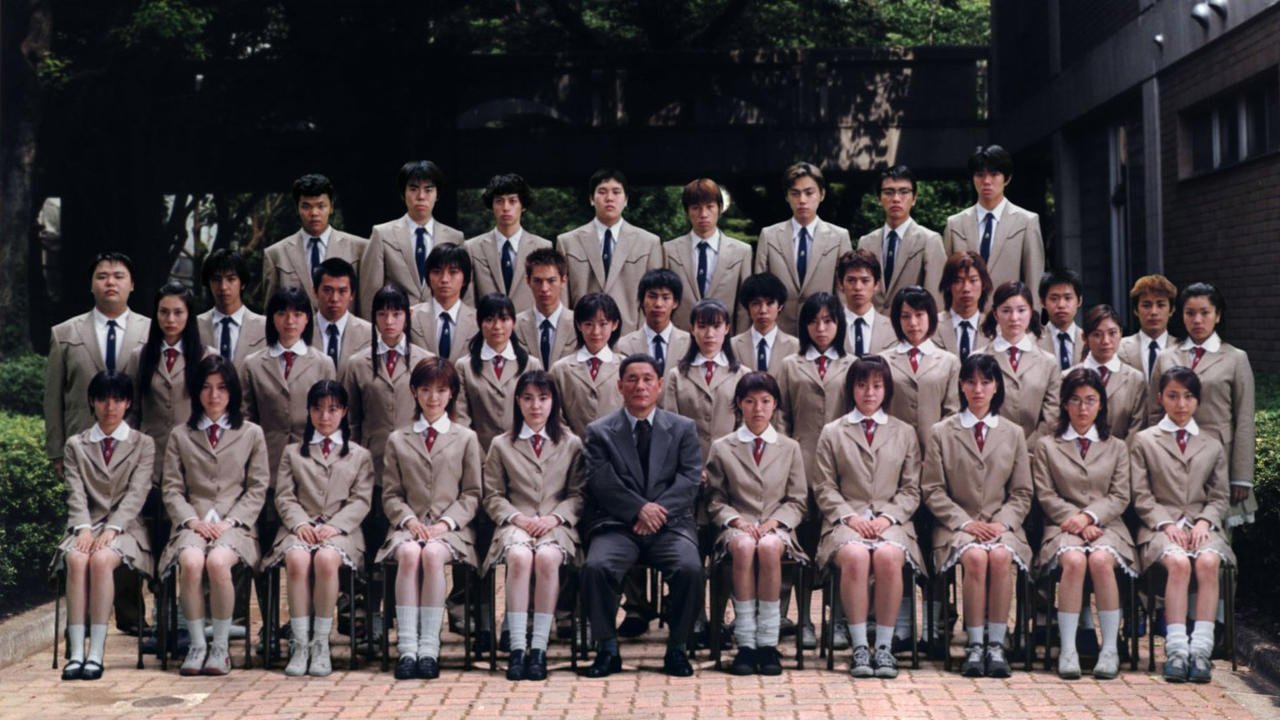
Battle Royale (2000)
At the turn of the century, Battle Royale was an international cultural phenomenon. Soon enough I saw a blurry pirated copy on video, which seemed rather confusing in terms of characters and plot. Thus it is a surprise to learn recently that the movie was not officially released on video in the US until 2012, long after its poor cousin, Hunger Games, gained popularity with the American public. (I must note that the author of HG, Susan Collins, has always maintained that she had not heard of BR before she finished the novels. I believe her.)
The movie, directed by Kinji Fukasaku, is a variation of the horror/action movie genre. The original novel, written in 1997 and published in 1999, was considered shocking and controversial in Japan. There is obvious reference to Lord of the Flies, but it also bares the mark of shonen popular entertainment (mostly manga), which centers on the life of young adults (roughly 12-18 years).
Rewatching it on Criterion Channel in the middle age, I am surprised by its prescience; no, perhaps it is simply astute social observation and commentary. It is me who has been too stupid to realize that our time, in contrast to the post-WW2 baby boom that came to age in the 1960s and 70s, is a time of the old against the young.
In 2023, it is hard not to be inundated with the dumbass meme that the leading politicians are "too old." News media parrot the meme without any insight, crowing on about the age of presidents, presidential candidates, congressional leaders, etc., etc., without a hint of understanding why. When the very old president tries to do something good for young people, for example, by using tax dollars to pay off a portion of their student loans, look how the entire society goes into hysterics: "No one helped me with my student loans. Why should today's young people get any free money?"
Ours is a time in which older generations take ever greater power and resources from younger generations. The shift in population age pattern in the past 80 years is one of the main forces that drive the political and social climates in this era. (Another force is "the pill.") People tend to hoard more resources and power naturally over time (if they stay alive), but this trend is exacerbated by the delay in death. As the proportion of older people grows more rapidly than ever, young people quickly lose the little power they gained through the 1970s. The election of Ronald Reagan in 1980 is the first sign that we were entering of an increasingly conservative era with no end in sight, simply because old people continue to outnumber young people. Since then, (draft-dodging) conservatives never stopped complaining about younger generations for being too soft, too lazy, too fragile, too whiny, too whatever ... (The podcast If Books Could Kill has plenty of materials on this phenomenon. The fear and hatred of younger generations are on full display.)
To express the youth-elderly conflict, director Fukasaku derived inspiration from his youth as a middle-schooler carrying corpses killed by US bombs in WW2. The war is a killing game that old men throw young people into. That's certainly true. That the allegory continues to resonate from 2000 to 2023 is an indication that the generational struggle for power and resources remains the same in peace time and will continue in the foreseeable future, when the population continues to live longer and become older, gripping power and money ever tighter in our spotted, wrinkled, bony hands.
An example of this generational conflict? Climate change politics. Older people have less incentive to sacrifice some of their comfort and convenience, and more importantly financial position, to fend off an uninhabitable environment some years from now, no matter how much lip service is paid to loving their children and grandchildren.
----
I have not watched the Hunger Games movies, but I did read the first book. It is OK but vastly inferior to Battle Royale. The difference between HG and BR is precisely a reflection of the difference between the American and Japanese popular cultures. HG is a typical American fantasy of playing pretend revolution in a faraway land/galaxy of dictatorship. Both exciting and safe, because "it will never happen here!" BR, on the other hand, is a horror story smack in the middle of its own place and time with a unique absurdist humor. The Japanese are the best in the world at the art of death, while the American ... well, as Disney has told us, Americans are immortal; death does not exist for them.
Ironically, 2 decades later, Battle Royale looks more like real-life America than Japan, with young people shooting each other dead in schools (with automatic weapons, just like the movies!) every day while older people buy more and more guns. If Fukasaku could see it from heaven, would he laugh out loud?
Monday, October 16, 2023
eXistenZ (1999)
Not only is this David Cronenberg movie is often compared with "The Matrix" from the same year, it also reminds me of Christopher Nolan's "Inception." It lacks the exuberance of The Matrix, but far outdoes Inception in its handling of multiple layers of game/dream. Perhaps more important, it is funny. It is playful with a wink and a chuckle, something that is not in Nolan's dictionary.
To apply the psychoanalytical premise that fiction serves the same function as dream, games --- or movies, for that matter --- are the same. Cronenberg's dream is obviously more imaginative, more gross, and perhaps less inhibited than most people's, but I had a feeling of recognition with the organic game world in eXistenZ, even when I heard about it in 1999 but never watched the movie at the time. There are shared-dream elements in it, as bizarre as they are. It's not just the bone gun. There are creatures/objects in this world that are somewhere between machine and organism, or between dead and alive. Humans tend to regard other living species as either stupid enough to be no different from machine or smart enough to anthropomorphize. Are the "machines" or game pods living organisms or dead tools? Anyway, this is not necessarily a central concern of the movie, but the idea is lurking somewhere beneath the commentary about game/dream/fantasy.
In 1999, people were not yet walking around with a smartphone permanently attached to their hands. Twenty-four years later, we are all sinking deeper and deeper into a mental existence further detached from our bodily existence. Perhaps there has always been a bodily desire to escape reality that has been discovered, exploited, and monetized only in the past decades. Perhaps this insidious but sweeping change to human existence is largely environmental. In terms of prescience, eXistenZ remains far more relevant than Inception and, to a lesser extent, The Matrix.
Sunday, July 2, 2023
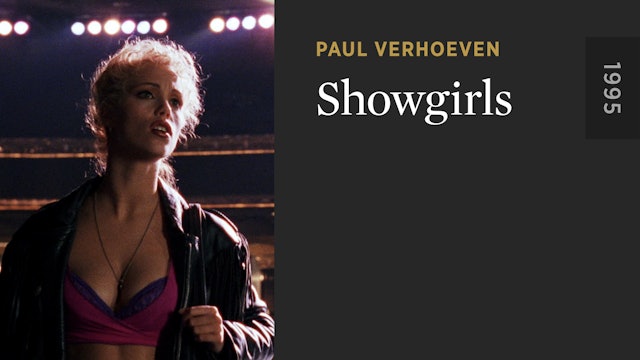
Showgirls (1995)
I got to this notorious Verhoeven movie after seeing at least 6 other movies of his. So, by this time, I am familiar enough with his internal logic and worldview and no longer have that vague disturbing feeling. While I do not disagree with a lot of the discourse on the movie's themes of misogyny, commodification of the female body, and female rage, I do feel like observers are consistently hampered by their inability to imagine that a male author/creator can project his own self into female characters. The universality of this blind spot is absolutely baffling, as I dare say every female storyteller has tried to write from a male point of view. Is it so hard to imagine that male storytellers would identify with female characters sometimes? George RR Martin mentioned that of course all those female characters came out of his own mind just like the male ones, including Cersei. He had to identify with them to write their POV chapters.
What I mean is, social and gender critiques aside (all valid), Nomi represents a pretty big part of Verhoeven himself.
(If the character were male, this identification would be apparent to everyone immediately.)
Many have observed, and Verhoeven himself also acknowledged, that the character's introduction is more than a little strange. From the start, Nomi is presented as brusque, irritable, and combative. In other words, the audience does not recognize her as a white American woman of a lower class. Her behaviors would be far more understandable and acceptable if they had come from a white Dutch man.
Most of the movie demonstrating Nomi's ambitious but conflicted pursuit of success in Las Vegas is an obvious analogy of Verhoeven's own ambitious and conflicted pursuit of success in Hollywood. Nomi's repeated and earnest insistence that she is not a prostitute is cited by critics as one of the laughable choices of the movie --- and indeed I agree, as she clearly seduced the Kyle McLaughlin character in order to get the understudy role --- I interpret this as Verhoeven's self-mockery of his career in America. Sure, he slipped satire into Total Recall, Robocop, and Basic Instinct, but these movies nevertheless were primarily crowd-pleasing blockbusters that sucked the American audience's collective dick. So I can imagine he felt a little bit conflicted about how much he was prostituting his talent and sensibility for fame and fortune. (I read somewhere that he claimed that he moved to Hollywood because his wife pushed him into it. Regardless of the credibility of his claim [throwing his wife under the bus?], it's an indication of his ambivalence.)
In the past 30 years, I have been to Las Vegas twice, once for a professional conference and the other for a figure skating event. The vulgarity and gaudiness and excess of Vegas are accurately reflected in Showgirls' own style. Besides the vulgarity and naked (no pun intended) greed, I am surprised by a sense of hostility permeating ordinary interactions, even though it is 90% service economy. I repeatedly got ripped off by taxi drivers. Restaurant staff were unfriendly. Unlike rural America, the general indifference and antagonism are not related to race or immigration or the usual political trigger points. People just seem tired and hardened, with no empathy to spare. The only nice and honest taxi driver I met, a middle-aged woman, told me that she was a Los Angeles transplant and contemplating moving back to LA.
In that sense, the Molly character in the movie is almost unrealistically tender and generous. Perhaps it is just Verhoeven's commentary about the general condition of African Americans; I don't know. That element aside, Verhoeven's unapologetic cynicism about human nature (see "Flesh and Blood", 1985) fits perfectly for the setting and makes his observation of Las Vegas and, by proxy, Hollywood totally spot on, especially the bosses, from the strip club owner to the show director to the businessmen, are all as ugly as the decorations of Vegas hotels.
Another complaint in the barrage of critical and pop-culture hatred toward Showgirls at the time was that none of the nudity and sex scenes are titillating or gratifying at all. Again I agree, except that it's not necessarily a bad thing. Everyone knows, and Verhoeven admitted himself, that sex is a central concern in his work, and he wants to examine it whenever he can. And yet, nothing in Showgirls is sexually appealing. Quite the opposite. All the sex and nude scenes are about dominance, and I do mean ALL. There is no warmth or tender feeling in any of them. If we have to dig deeper for feelings, perhaps the intense rivalry between Nomi and Gina Gershon's character contains a hint of mutual attraction, but I don't think it was successfully conveyed.
What is truly impressive and not cynical, however, is the dance choreography. Yes, the nudity could be a little distracting, but once we ignore that part (one gets numb quickly), it becomes clear that the dance scenes were well choreographed, filmed, and edited. Elizabeth Berkley performed her dance sequences with a crazed intensity that no doubt was required by Verhoeven. They were not only set pieces but also character- and plot-driven. In a way, it is a pretty good movie musical, if we ignore the Hollywood tradition of movie musicals as wholesome "family" entertainment.
The movie is a little too long (excess is another Verhoeven trait). About two-thirds way through, I was getting somewhat bored. But the revenge scene near the end, although short, woke me up from the slump. The straight, blond ponytail hairstyle, used ONLY in this scene, suggests an entirely different movie that is more committed to rage, which might be more interesting. It reminds me of an early Verhoeven movie, The Fourth Man (1983).
Wednesday, June 14, 2023
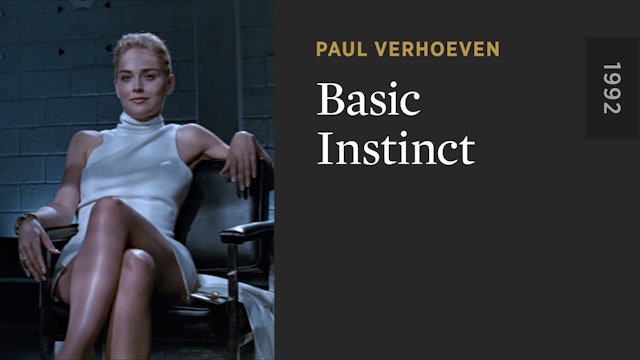
Another Interpretation of Basic Instinct (1992)
It is odd that I never watched "Basic Instinct", despite all the exposure to its references and spoofs over the years, until I got back onto Criterion channel. Perhaps it is my deep fear or disturbance of "scary women". After watching it I can confirm that the main character Catherine, played by Sharon Stone, is indeed one of the scariest women on screen for perhaps three quarters of the movie. Near the end she switches to the manipulation mode and becomes much less scary. The last good scene is Catherine telling her lover, Nick, played by Michael Douglas, to get lost, now that she has finished her book. (Plot-wise, it is rather inconsistent, as Catherine continues to keep other murderers in her life. Why not Nick too?)
I can understand why some critics felt that Catherine is a male character dressed up as a woman, as cited by Karina Longworth in her fascinating You Must Remember This podcast. However, I have the feeling of watching a strange international mashup on screen: a love affair between a Dutch woman and an American man. Disclaimer: I know zero Dutch person in real life. The closest I have gotten to the Dutch culture is limited to superficially meeting a couple of Flemish persons, who would be the first to point out their difference from the Dutch. Nevertheless, Dutch women have a reputation of being one of the most powerful and aggressive groups of women in the world --- Well, who am I kidding, the reputation of Dutch women is that they are the most like men.
On the other hand, Michael Douglas derived his popularity from embodying the quintessential American white men of the Reagan era. So the power dynamic between a European woman and an American man is so potent that, now, 30 years after the fact but on my first viewing, I see this movie as an allegory of the cultural dialog between Europe and United States, or perhaps simply the Netherlands and US, as presented by Paul Verhoeven.
Verhoeven made several hits in Hollywood in the 80s and 90s that are more or less considered satires of the American culture. Robocop is a more explicit satire about the power of corporations and privatization of everything (which proves to be prescient). Starship Troopers is a more subtle spoof of the military and patriotism propaganda. Basic Instinct transparently makes fun of the Puritanical attitude toward sex that is particular to the American culture. (This satire also proves to be prescient for the direction of Hollywood movies in the next 30 years.)
Of course, American audience automatically identifies with Douglas' character, as he is the point-of-view character, and laments his diminished power/dominance in this relationship, and their disorientation has to be soothed by the absurd but more American relationship between Nick and his psychologist Beth, played by Jean Tripplehorn. However, a closer look at Nick suggests that he does not fit the trope of heroic cop that floods American movies and TV. His history of killing not only drug dealers but innocent bystanders is repeatedly brought up and never justified. It is curious and revealing that neither the American audience nor critics ever found that to be a defining trait of the character. Again history confirms the acuity of this observation about the American culture, which echoes the excessive violence in Robocop. Nick is a violent man who is in this job for the privilege of killing people (and getting away with it, as the dialog reminds us), and he does eventually shoots dead his ex-lover (perhaps representing the moviegoing American public), while his victim's last words were "I love you" (I guess she represents American white women?). Thus, he belongs in Catherine's menagerie of blood-thirsty killers.
The simultaneous aggression and submission of this character make it a study in the American masculinity, which can be observed generally in the concurrence of excessive violence and sexual prudishness in American movies. The hilarious "happily ever after" ending may seem stupid but is necessary to protect the audience from facing the uncomfortable death of the American Man. Nevertheless, Nick's obliviousness in that scene carries the allegory to the end.
Wednesday, April 12, 2023
Triangle of Sadness
It is a bizarre coincidence that, in the same year (2022), there was a movie that disguises itself as being sympathetic to abusive power and another movie that disguises itself as making fun of the rich and privileged, while the real sentiment of the filmmakers was the opposite. Perhaps artistic expression always contains an element of pretention or coverup?
Ruben Ostlund's movie is explicitly divided into three parts. It must be noted that the young couple of models, played by Charlbi Dean Kriek and Harris Dickinson, were in all three parts, even if they do not appear to be the center of the story in the second and third parts. The second part, which many critics either embrace or condemn, is the foundation of this appearance that the movie is making fun of the rich, upper-class people in the world. I completely agree with the criticism of this absurd farce, in which a bunch of forgettable caricatures of rich people puked and pooped on a luxury yacht. It is rather curious, however, how bad the middle part of the movie is. It's not funny (worth at most a few awkward chuckles) and totally meaningless. None of the characters carries a trace of truth that reminds the audience of the rich and powerful people in the real world. However, before we completely dismiss it, let's take a look at the first and last parts.
The first part of the movie gives us scenes from a rather unflattering and truly hilarious (here the awkwardness works) relationship between the two models. They argue. They fight. Is it about money? They deny it. Then they seem to admit it. Then they deny it some more. As they dance around the issue of money, we get the vague sense that the conflict has more to do about gender roles than economics. Kriek's character declares that her goal is to find a rich man to marry and Dickinson's character is just a temporary fling during her search. So it is indeed about money, specifically, the traditional gender roles in which men give women money.
The third part is a desert island--"Survivor" type of setup. To sum it up simply, a previous servant on the yacht, a Filipino cleaning lady played by Dolly De Leon, leaps into the position of power because of her superior survivor skills, while the sources of status on the yacht (wealth, rank, brawn) have lost their meaning on the island. She gradually starts to boss everyone around and exerts her dominance by taking the pretty boy into her bedroom. So his gender role is now the same as that suggested (but not realized) for Kriek in the first part --- selling one's body for material gains (in this case, food).
The ending is particularly revealing of Ostlund's own intent.
<SPOILERS BELOW!>
Without going into specifics, let me just say that the message is transparently that power corrupts equally people who did not have it, be it a woman, or a dark-skinned woman, or a dark-skinned older woman without beauty, or a dark-skinned older un-beautiful woman who works downstairs as a servant. As a topic for debate in abstract theory, there is nothing wrong with bringing it up. On the other hand, for Ruben Ostlund to lecture us about the danger of women in power, is a little like a king telling the starving peasants on the verge of revolution to sit down and shut up because, well, you will be corrupted by power once you have mine, so you'd better let me keep it.
Sure, he has the right to feel this way, and I have the right to feel slightly queasy.
In the final scene, we see Dickinson's character running in the jungle. According to Ostlund's own explanation, it suggests that he is on his way to rescue his girlfriend (the young and pretty one, not the recent old woman boss/lover, because he no longer needs her). So here we are back to agonizing over the gender role. What use is a man? Women can fish and cook and start fires and feed themselves. The answer, it seems, is that he can save his girlfriend. There may be some violence involved, but Ostlund does not want to go beyond a mere hint.
So, in the end, Triangle of Sadness is really about gender roles and power, and how both concerns relate to each other. This is not a surprise. He presented the same question, what use is a man?, in his previous movie "Force Majeure". If a man is not able/willing to save his wife and children from death (at the risk of losing his own life), is he worthless? What is his place/role/identity in this world?
As an American woman living in 2023, it is very difficult for me to sympathize with Ruben Ostlund, a Swedish man, on this discussion about whether women with equal power will behave as badly as men do, or whether women in fact already have more power than men, and what that does to men's place in the world. I must say that I have detected, in some fictional representations here and there, a discontent among Scandinavian men, who have lived in a more progressive, more gender-equal environment for much longer than I have. I do not know whether Swedish or Finnish women have surpassed their fellow countrymen in power and begun to oppress them --- although economic data suggest no. But you know the saying, when you are used to privilege, equality feels like oppression. Their feeling of being oppressed is palpable, and I acknowledge that.
What is truly amusing to me, however, is how Triangle of Sadness hides a somewhat reactionary heart underneath an anti-rich veneer by throwing shit around, while Tar pretends to ridicule the "Metoo" movement while tucking its anti-imperialist message in dream scenes. I enjoyed the discovery, but I'm not sure how I feel about so much dodging around.
Sunday, March 12, 2023
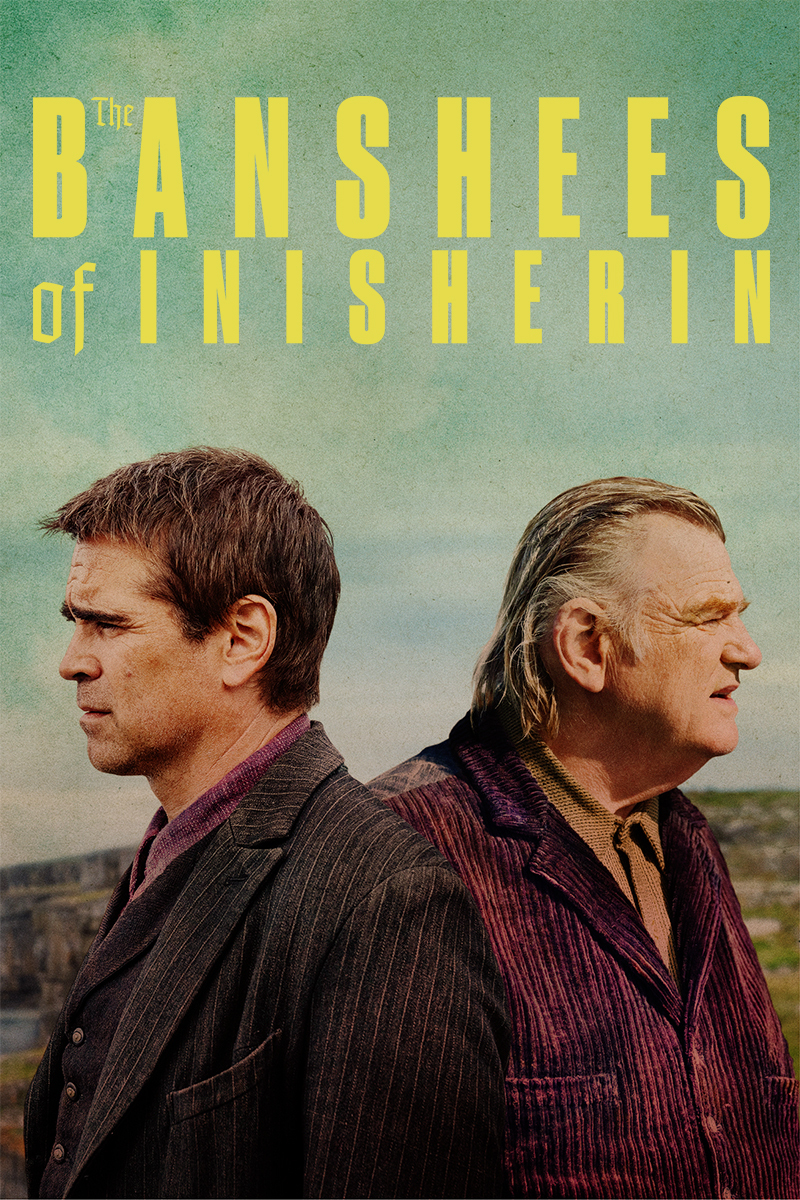
Banshees of Inisherin
For the first 15 to 30 minutes of this movie, I seriously thought it was a satire on modern Internet friendships. In the past couple of years, I have been the dumper and dumpee of several relationships, including being basically ghosted, all of which were equally depressing and traumatizing. So I can sympathize with both characters in their agony and annoyance. The end of friendships is an unavoidable reality throughout one's life, but past experience does not make this process any easier as one becomes older.
Half way into it, however, things made a bizarre and bloody turn, and I had to admit that the strife between Colin Farrell and Brendan Gleeson is not an allegory of friends breaking up in the Internet age. I dug up information on the Irish Civil War of early 1920s and began to understand the author's intent.
With its absurdist style, Martin McDonagh's movie contains a vague feeling that this deadly conflict between fellow Irishmen was senseless and pointless. Aside from the general principle that killing and war are fundamentally senseless, I don't quite agree, even though I am in no position to tell an Irishman anything about his own history. I can see why the conflict between the Free State and Republican factions broke out when the independence war with Britain came to a compromise instead of an outright victory. I have no particular urge to take sides, but each side did have their own reason and logic for the stand they took and felt they had to defend. And let's not pretend that there were only two sides to the conflict. There was an outside force not so subtly nudging them on.
The Irish history is by no means an outlier. The more I learn about it, the more it confirms my revised view of what war is. Conflicts and struggles in society do not have a discrete start and end date. War is just one of many continuous phases of these conflicts among people and factions.
What I appreciate about McDonagh's treatment of war is the willingness to be kind to both sides and acknowledge their past friendship and continued ambiguity with each other. Nevertheless, I find it not completely satisfying as an allegory.
Winding my way back to the issue of severed relationships and rejections, I have long realized that it always goes back to one's relationship with one's mother, that cliché of "attachment."
Saturday, February 25, 2023
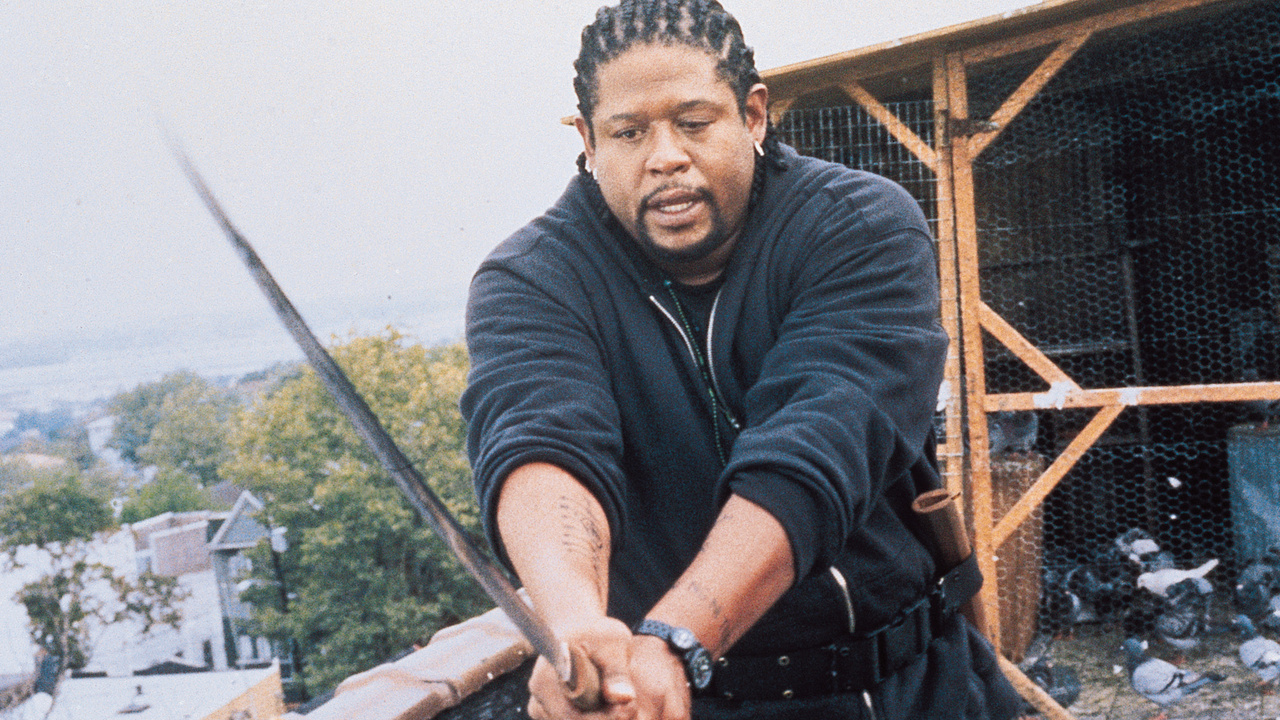
Ghost Dog: The Way of the Samurai (1999)
The Ending of Le Samourai (1967), Explained
A quick online search after watching Jean-Pierre Melville's Le Samourai confirmed my suspicion: The plot is very rarely understood by E...