Search This Blog

Showing posts with label shakespeare. Show all posts

Wednesday, October 17, 2018

King Lear Again

Of all the Shakespeare plays I am fond of --- Henry IV Part 1, Antony and Cleopatra, Othello, Much Ado, Richard III --- King Lear was the first and is still the closest to my heart. I had never seriously watched any Shakespeare plays until I happened upon a PBS broadcast of NT's production of King Lear starring Ian Holm. Before this I had seen Branagh's movie version of Hamlet, but that hardly endeared me to the Bard. (Even today I remain puzzled and indifferent to this most famous and celebrated of plays.) This Lear, however, decimated me.

This is a strange family. There is no mother. The father acts like a child. The daughters, even the bad ones, behave more like adults. And yet there is so much truth in these bizarre relationships, truth that we do not talk about in polite society, especially the society in which I grew up, where children are expected to worship and obey their parents, until the parents become senile and childish (and sometimes mad).  

The shattering truths in King Lear lie not only in family dynamics though. Watching a recent version starring Anthony Hopkins, I cannot help but be reminded of the state we're in now, everything that is happening, watching people squirming to escape the confrontation: the true nature of the relationships between men and women in this world. 

We have had thousands upon thousands of stories about the power struggles between fathers and sons, and the necessity of patricide to "make a man." Rivers are choked with the corpses of King Laius and Darth Vader. But fathers and daughters, that is a territory rarely encroached. While Cinderella's evil sisters remain a staple of female characters, where else have we seen the likes of Regan and Goneril? Not until we got Cersei Lannister. She is far from the most evil character in ASOIAF, but she has more haters than Ramsay Bolton or Tywin Lannister (in fact both have plenty of fans). Evil with ambition earns some grudging respect for the Duke of Gloucester and even heroism for Macbeth, but Regan and Goneril got their father's vicious curses on their bodies and their wombs. 

Coincidentally, I heard on the radio a piece of news about a recent study that found women prisoners are twice or thrice more likely to be punished, and punished more harshly, for the same infractions than male prisoners. This is consistent with previous studies indicating that female lawyers get disciplined far more harshly than male lawyers for the same unethical behaviors. Even in abstract psychological experiments, people tend to hand down more severe punishment to women than to men for the same bad deeds. Women are held to much higher moral standards than men are, and that's not a uniquely American or Protestant phenomenon. 

The conflict between men and women is pervasive, unconscious, and intractable, and perhaps impossible to resolve, ever. At the heart of it might be the unbearable (at least for men and probably for many women) fact that we are the same. Women are no better or worse than men, including, but not limited to, the same thirst for power and the same need to vanquish their parents in their rite of passage.

(This is perhaps one of the many ways gender conflict echoes racial conflict: What is intolerable is not the difference, but rather the recognition of similarity and commonality and, subsequently, our shared humanity. That's just going too far!)

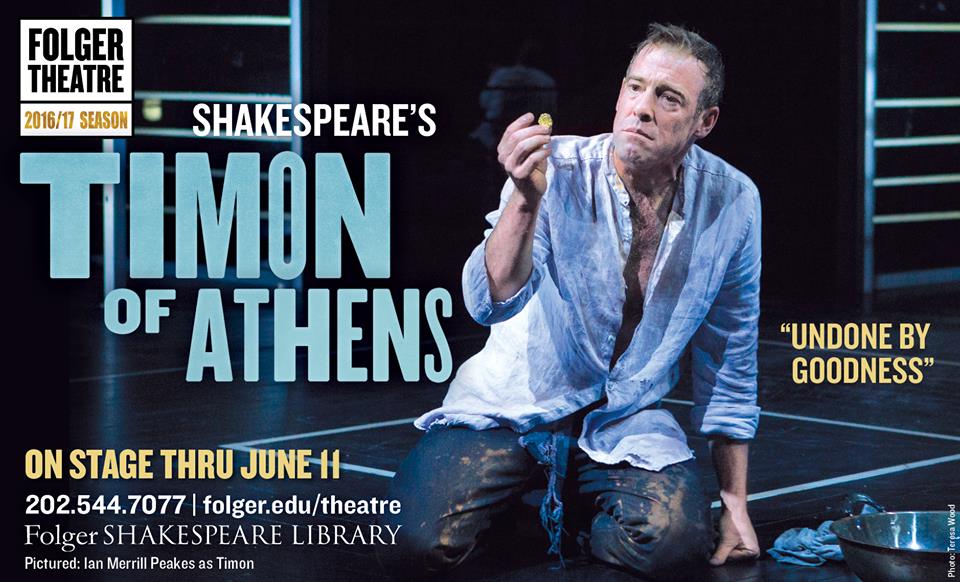
Thursday, June 22, 2017

Timon of Athens


During the intermission of Timon of Athens at Folger, I eavesdropped on a discussion among the 3 persons (who looked like a mother with two teenage children) sitting next to me. The boy kept saying, "His motivation is unclear. Why is he so strange?" He was referring to Timon's showering his "friends" with money and gifts at his own peril. It seems unsatisfactory that Shakespeare should obscure such bizarre behavior or personality. The mother pointed out that such is the tradition of Greek tragedies, and don't forget the play is intentionally set in ancient Greece.

I couldn't help but inject myself into the conversation. "Why does Gatsby throw big parties every night?" Well there's an easy answer --- he wants to announce his presence to the girl across the bay. He wants to demonstrate that he is no longer poor and undesirable. He wants to show Daisy that he now deserves her love.

Is that so different from Timon of Athens?

I pointed out to the boy that bizarre behaviors are common among rich people, contrary to popular American mythology. For every Warren Buffett, you have dozens of Mercers and Kochs, and those are the "normal" ones. The director Robert Richmond modeled his Timon on the legendary weirdo rich man Howard Hughes, with the tics and OCD.

Nevertheless, Timon's desperate need for friends, along with his inability to find any, stabs you straight in the heart. Do we really not feel his motivation in our gut?

If Shakespeare were a true misanthrope, he would confirm Timon's worst nightmare that he truly does have no friends and there truly is no love between people. However, Shakespeare clearly was NOT a misanthrope. In a brilliant bit of casting, Richmond made his steward and one true friend Flavius into a woman. There is a tinge of sexual tension between Timon and Flavius that remains unresolved. Flavius represents real human relationships that Timon is unable to grasp. If we are still too dense to buy into Timon's extreme distrust of humanity, there is another character, General Alcibiades. While he takes revenge against the ungrateful treatment of his fellow Athenians like Coriolanus, his motivation is different from the latter. He is not banished for his own ego; rather, he tried to defend and save a friend. Even in a play that serves up the most angry diatribe against humanity, there is friendship and loyalty.

Maybe this is why Shakespeare's tragedies are so addictive. They're bleak, but they're not all that bleak. He is not an extremist.

Monday, May 1, 2017

The Tide of Time

On the way home from Macbeth on Saturday afternoon, the Metro was flooded with people leaving the People's Climate March. There were middle-aged and young people and couples with children, holding cardboard signs supporting environmental policies and protection against climate change, etc., etc.

All signs suggest that it is too late and the earth is on an irreversible course of climate change that will bring warmer temperature, rising sea levels, and extreme weather. Whether these changes spell doom for agriculture and the human society as a whole, there is no reliable economic model to predict. Obviously, this is no reason to stop the effort to curb carbon emission and other types of pollution, but we're kidding ourselves if we believe that we can still turn the tide back to the world of yesterday, even 50 to 70 years ago.

Ironically, millions upon millions of people are still treating climate change as a pure political issue or a conspiracy created by liberals. This stance will continue until their crops fail in scorching droughts and their homes get swallowed in floods and hurricanes.

My mind made a turn and connected climate change with the three witches with prophetic power. It is curious how Macbeth selectively hears and believes the parts of their prophecies he likes and discards the parts that troubles him. We all do this, and we can't help ourselves. If we could put aside all the killings he commits and orders, Macbeth is just another Oedipus Rex. While the orthodoxy considers Macbeth's fate as a result of his own character flaws (greed, ambition, cruelty, megalomania) with a dash of justice, I wonder if it's a lost child of the ancient Greek's mythology, which attributes human fortune to the fickleness of the gods. We only seem to be a creature of cause and effect and we only seem to control our lives via our choices and actions.


Like the pessimistic projection of climate change based on already-collected data, the hypothesis that free will does not objectively exist is also based on some hard-to-dispute scientific evidence, starting with Special Relativity and including the vastness of the unconscious. This is not to say that free will, as a subjective phenomenon, does not operate in the human mind, much like the functions of perception or emotion or cognition. Nevertheless, we probably do not cause or control our realistic lives nearly as consciously and as freely as we would like to believe.

When we think about history, the conventional habit is to trace the cause and effect of significant events to powerful kings and queens and presidents, and their personalities and relationships and competence. The Wars of Roses went on for decades because, see, Henry V died too young, leaving an infant son who was unable to control the factions of his court. The Cuban missile crisis was resolved before we met annihilation because JFK was a smart guy, or maybe he had a really smart brother to help him, or Khruschev was more reasonable than Americans know. We attribute historical events and trends to human motives and reasons. Maybe GW Bush wanted to show his father he was a good son, or maybe his friends wanted to make a few more billions of dollars in profit. Whatever.

But, imagine if you were an alien observing humans like we humans observe ants or plants. You see patterns, some of which are cyclic and some are linear or spiral. Would you give a damn about the motive of each significant event? If you see the species as a whole go to war with each other every 5 to 10 years, or continually, would you give a damn what the human motive is behind each war? If you see the human society obsessively strips its natural environment with increasing efficiency, do you really need to hear their rationalization?

Can we help ourselves? Macbeth can't.

Saturday, April 29, 2017

Shakespeare Season in Washington

The upcoming theater season in Washington DC will be filled with heavy-weight plays. Before his retirement, Michael Kahn is going to put on HAMLET (!) again at the STC, which will also do Twelfth Night and Waiting for Godot.

As if that's not enough, Folger just sent out an email announcement that they will put on Antony and Cleopatra (!) in October-November, directed by Robert Richmond. 

I went to STC to see the new Macbeth, directed by Liesl Tommy and set in a north African country named ... Scotland. Very nicely done with breath-taking set design that rivaled the set of Wallenstein I saw some years ago. Lady Macbeth, played by Nikkole Salter, was particularly memorable. 


Sunday, March 26, 2017

Timon of Athens


Folger Theater is going to put on a new production of Timon of Athens, directed by Robert Richmond, in a couple of months, so I've started reading it. It is in some ways the same story as Coriolanus, one of ingratitude, betrayal, and rage/revenge. But still ... just like Coriolanus and King Lear, two other characters in parallel with Timon, our feelings toward the protagonist cannot remain purely sympathetic. There is something troubling about his tragedy. Upon first glance, it is a simple injustice done to him by heartless people who betray his generosity. If you chew on it a bit, however, the easy moral lesson just doesn't sit right. The ambiguity is not as explicitly presented as King Lear's opening scene, but Lear's offering his kingdom to his daughters and Timon's free distribution of gifts to anonymous "friends" somehow give off the same vibe.

Timon believes that everyone at his banquet table loves him, because they tell him so while eating his food and pocketing his expensive gifts. Later, a financial downfall proves his judgment wrong, as none of these people wants to lend him a penny to help pay his debts. To Timon, money seems to be the currency of interpersonal relationships. Affection is bought and sold and passed back and forth between people, as solid and countable as gold coins. When it is apparent that this is not the way of humanity, Timon flips out in a rage. People took my money and paid me in love, and now they refuse to love me again by throwing money at me? Bastards! How could they? In Timon's mind, there is no difference between money and relationship. He is not so bad as those who try to buy love and loyalty via exploitation, because his need and neediness for affection are sincere and, can we say, desperate.

Lest we despise or laugh at Timon, who among us have not been plagued by unrequited feelings and unjust relationships? Who has not attempted to win someone's affection by freely giving one's own, only to be rejected or worse, deceived and betrayed? And yet, there is no road of banishment for us, out of Athens and into the woods, alone and independent, never again to beg for someone's unreliable bond. You can give and give and give, with never any guarantee of returned favor. There is no justice or accounting in our relationships with each other.

Tuesday, July 5, 2016

Antony and Cleopatra Notes (1)

Re-reading Act 1, a thought struck me: This is two hearts in conflict with each other and themselves. Antony knows that he must leave the Egyptian queen for his own honor and reputation, not to mention political survival, but he can't. Cleopatra knows Antony wants to leave her and it will all end in tears. They are telling themselves and each other: Go, go away, leave. But they can't.

Thursday, June 2, 2016

Characters of No Importance

It occurred to me only recently that Shakespeare would often stick a character in a play that does not serve the plot but speaks for the average person or, more likely, the playwright himself. The character of no importance observes the absurdity of everyone else in the play and the absurdity of life itself. He sometimes takes part in the action, but always maintains a detached outsider's viewpoint. Some examples that are particularly memorable to me are:
  • The Fool (King Lear)
  • The Bastard (King John)
  • Enobarbus (Antony and Cleopatra)
  • Thersites (Troilus and Cresida) 
There is a long list of Shakespearean fools on Wikipedia, but those characters are identified by the traditional definition of a theatrical fool, who serves a particular function on stage. Thus, Falstaff is classified as a fool even though he is also a central character in Henry IV. 

What I'm talking about, however, is a character that channels Shakespeare's own opinions, which is perhaps closer to the role of chorus, except this "chorus" is a lot more irreverent and cynical and sometimes vicious, and never represents the values and perspective of nobility. 

In general, Shakespeare seemed to be fairly careful in disguising his own opinions and had very limited use of chorus-like devices. When he did use a person as the chorus, he is there to tell the audience about stuff like "previously on this series ..." or "imagine some visual effects here ..." 

Given all the caution, Henry V is an extraordinary play in which he presented two nearly-opposing viewpoints: One of the king and his noblemen and one of the average soldiers. The two sides came to a head when Henry disguised himself to visit the camp at night before the battle of Agincourt and heard the real thoughts among his men. A couple of guys said:
Then I would he were here alone; so should he be sure to be ransomed, and a many poor men's lives saved. ... 
But if the cause be not good, the king himself hath a heavy reckoning to make, when all those legs and arms and heads, chopped off in battle, shall join together at the latter day and cry all 'We died at such a place;' some swearing, some crying for a surgeon, some upon their wives left poor behind them, some upon the debts they owe, some upon their children rawly left. I am afeard there are few die well that die in a battle; for how can they charitably dispose of any thing, when blood is their argument? Now, if these men do not die well, it will be a black matter for the king that led them to it; whom to disobey were against all proportion of subjection.
The guys never appear again. After the battle, the king hanged his old buddy Bardolph.

Monday, May 23, 2016

Lear Again

I was just looking it up again for something on Edmund the bastard, and it occurred to me that this is one of the more readable plays; I hardly needed to look at the annotations. Then I somehow semi-consciously ended up on the YouTube watching a lecture on the play. It was interesting and comfortably detached. At one point a student commented that the characters are all so one-dimensional and only Lear goes through a full spectrum of human emotions. The lecturer asked whether the student thought, for example, Goneril is a one-dimensional villain. The student was apparently unconvinced. Suddenly I felt air went out of my lungs as if being punched in the gut. In a flash I remembered how it was Regan and Goneril that immediately grabbed my sympathies when I first saw the RSC's production of King Lear on TV. It's terrifying how this play has such ferocious power over me.

(It's not just me who find redeeming points in the two wicked daughters. Jane Smiley wrote "A Thousand Acres" loosely based on them.)

For a while I thought perhaps "Antony and Cleopatra" is my favorite. I love Othello and Much Ado as well. But after all this reminds me King Lear does something to me like nothing else.

Monday, May 16, 2016

Troilus and Cressida


It's an odd play, even more of a "problem" than "Measure for Measure." If it weren't written four hundred years ago, one could safely file it under absurdism or postmodernism. Troilus and Cressida defies any conventional classification.

Just when I thought I knew Shakespeare, sort of, I realize I don't. Not at all.

It's a vicious takedown of the heroic and romantic mythologies. He is saying that, the truth of heroism is jealousy and stupidity, and the truth of romantic love is inconstancy and self-interest. It's unusually obscene and sexually explicit. It's roiling with a rage underneath all the bawdy jokes. It's unlike any other Shakespearean play, although the sneering view on war here could have come out of Falstaff's mouth.

How do the two strands of plot connect with each other? One is how two unwilling warriors, Achilles and Hector, finally come to a deadly confrontation. The other is a cynical revision of Romeo and Juliet. I don't know, but I feel in my gut that they do connect in some way.

Come to think of it, it's kind of funny how Shakespeare approached the classics, compared with, say, T. S. Eliot. Good ol' Willie obviously didn't worship the classics as the grandiose foundation of English literature. Rather, he trampled and shat all over the lofty ideals and glory. What a guy.

Monday, March 14, 2016

Othello (STC 2016)


This version is directed by the Brazil-born Ron Daniels and star Farran Khan as Othello and Jonno Roberts as Iago. The lesson is that Othello is the embodiment of the "other" in any society. He could be black in a white-dominated society or, in this case, a (converted) muslim in a Christian society, as the casting and directing suggest. 

The production is a letdown of sorts for me. After a few years of watching Shakespearean plays on stage and in movies, I may be having a burnout. Often a new production seems to be merely ticking off the boxes scene by scene. Actors are happy enough to get the lines out without looking exhausted. There is not a lot beyond the conventional interpretation. There is very little fun or distinctive mark. 

I understand the urge to cast Othello's "otherness" in whatever topical "other" look. Nevertheless I have always felt strongly that Othello should be black. Very black. Black in the way that Laurence Fishburne was in the movie or Laurence Olivier was --- yeah, yeah, I know Olivier did a Blackface there but the intent was not derogatory and my God what a brilliant decision to look thoroughly African! 

And Iago, oh Iago. It is so haaaaarrrrd to do him right. It is extremely rare to have a nuanced Iago who is halfway believable as a human being (even if a psychopathic one) rather than a caricature of villainy with evil maniacal laughs, as he was in this production, which went as far as lighting his face from below for effect. Might as well put a pair of horns on his forehead. 

I have thought about the possibility that this was a (relative) failure on Shakespeare's part, that maybe Iago failed to be human enough, but ... the older I get the more I am inclined to believe that he is indeed very human, but the elements he represents are too disturbing and terrifying for us to recognize within ourselves. He is not for polite company, so to speak, in a civilized society, but he does live among us and perhaps even in us. Whatever motivates him --- hatred, jealousy, fear of the other (?), or plain boredom --- I would love to see a realistic presentation of Iago. No evil laughs please. 

Vishal Bhardwaj's adaptations are some of my favorite re-interpretations of Shakespeare. I have begun to accept that perhaps the only way left for us to continue to own Shakespeare is to retell the stories, leaving behind most of the original text but keeping and even expanding on the spirit, like Bhardwaj has done. Rewriting it into a Hindi movie has clearly freed him and his actors to get to the heart of the matter with additional issues like feminism. Saif Ali Khan's Iago might as well be the most relatable --- yet even scarier --- interpretation that I have seen. 

And so far I have not seen a satisfactory interpretation of Desdemona. Perhaps it will take a female author's retelling to get there.

-----------

Aside: I came to a funny (ironic, not haha) realization. Hollywood depiction of The Black Man, as a representation of the American unconscious, is either the calmly confident and noble general Othello of the first half if he is good (eg, Morgan Freeman, Denzel Washington, Morgan Freeman) or the hot-blooded Thug who murders Desdemona with his threatened masculinity (eg, the popular gangsters).

Another aside: It's also rather funny that Denzel Washington became very popular and well regarded playing the noble black man but only won the best lead actor award playing the dangerous black man (but never as Malcolm X). 

Monday, June 22, 2015

Rosencrantz and Guildenstern Are Dead at Folger


I have heard the name Aaron Posner mentioned in association with DC theater scenes several times, but only today saw his direction for this Folger production of Tom Stoppard's early but most famous play. It's indeed quite good, quite impressive. The comic timing was spot on and had the audience laughing all the way through, despite the play's length and the absurdist dialog. The casting was inspired and the two young lead actors had real chemistry.

Yes, it's known as an existentialist and absurdist play. It's about the unreal space occupied by minor characters between their sporadic appearances in the main characters' story. It's the meaninglessness and aimlessness of life, and the inevitability and pointlessness of death.

It's all very clever and meta. The production notes point out that it owes as much to Shakespeare (ie, the source in Hamlet) as to Waiting for Godot. I have not seen Waiting for Godot, but I cannot shake the feeling that all this was said by Shakespeare already, not only in "the undiscovered country from whose bourn no traveler returns," but also "tomorrow, and tomorrow, and tomorrow, creeps in this petty pace from day to day, to the last syllable of recorded time. And all our yesterdays have lighted fools the way to dusty death."

Tuesday, May 12, 2015

Note to Self: Othello @STC next season

Just got the brochure in the mail. No dates yet. I will go see it.

Below is a poster of Vishal Bhardwaj's modern adaptation of Othello, Omkara (2006). It's pretty excellent and very faithful to the play. Like in most productions, Iago, played by Saif Ali Khan, steals the show.


Saturday, April 25, 2015

King John and ASOIAF

Let me count the similarities ---

1. The bastard of Richard the Lionheart. He's pretty dashing, but he talks like Tyrion Lannister, or more accurately Tyrion talks like him. And they both are in fact loyal and pure at heart. They just like to put on a cynical appearance and deliver some zingers.

2. The sympathetic poor Hubert. The misunderstood killer. The wronged bad guy with a heart of gold. He is almost exactly like Sandor the Hound.

3. At the center of the three-sided battles is the question of whether it is justified to murder a child. John decided that he had to, and was duly punished for the crime. Ned Stark refused to be the cause of potential execution of three children born of incest (and treason), and he was duly punished for his kindness. Yes, damned if you do and damned if you don't.

4. Even after all three parties opposing him (Rome, France, and his own dukes) have been appeased, King John can still be killed off by an almost random person and act. See also Ned Stark and Balon Greyjoy and Tywin Lannister.

This is what drives me crazy when I try to dig out Shakespeare's influence on GRRM. Nothing is concretely transplanted --- No, GRRM is too clever for that. Rather, it is a strong whiff of shared view on people and the way of the world.

Friday, April 24, 2015

King John Revisited

I am trying to test my memory on this absurdly complicated story.

In the beginning King John was the de facto king of England. His brother, Richard the Lionheart, named him heir to the throne, despite a stronger claim by their nephew Arthur, as Arthur's father (dead) had been older than John. Still an innocent child, Arthur was not particularly keen on overthrowing his uncle, but his keen mother, Constance, took him and the claim to the King of France, Philip. France confronted England in Arthur's name. One does not need France's true intention spelled out, however, considering the ongoing land disputes between the neighboring countries (England held Brittany and other territories on the Continent).

And so they attempted to resolve the dispute the old fashioned way: through war. The conflict was stuck in a stalemate. What to do? John and Philip reached a truce, in which John married his niece Blanche to the Dauphin Louis and England gave up some of the land to France as her dowry. Methinks England probably lost in reality. The war ended and Arthur's suit was put aside. Constance, of course, was not happy about the arrangement, but John and his army had captured Arthur in a battle. Now England seemed to hold all the cards ... Or do they?

Peace with France might not be the best policy, but the king had little choice at the moment, because he was being attacked on another side by the Pope, who was unhappy about his domestic policy to levy taxes on the churches. England's conflict with Rome also put France in an awkward position. If you don't denounce England, the angry Roman envoy Pandolf threatened Philip, you would be excommunicated along with John. Ah the problem of The Three Kingdoms. The fragile alliance between England and France hung in a balance. Pandolf convinced the Dauphin to invade England, because now Louis also had a claim to the English throne through his marriage to Blanche. Oh isn't that clever of the little cardinal?

Meanwhile in England, John did not want to sit and wait for the French invasion in the name of rescuing Arthur, the rightful king. So he ordered the boy executed by Hubert, everyone's favorite killer. Only this killer had a heart of gold (unlike the killers in Richard III but not unlike Sandor Clegane) and was moved by the child's innocence. So he quietly hid Arthur somewhere in the Tower, while telling the king he'd done the deed. But the king changed his mind two minutes later! When his already-disgruntled lords were appalled and outraged that he had murdered a child! John wished he would kick the stupid lords' asses, no doubt, but right now he needed their help to fight off the French. Oh how he regretted having given the order.

Man, it sucks to be a lowly henchman. One moment your boss wants the kid dead, the next he is blaming you for being a psychopathic killer. What a bhenchod (oops, wrong language). Anyway, so Hubert told John the truth and they all hugged each other and thought, The kid's still alive! We're all saved from a rebellion and bad names for a thousand years! Unbeknownst to them, Arthur sneaked out of the Tower and jumped the wall and broke his own neck, lying dead in front of the fuming lords. Awkward. If they had been wavering a bit about betraying England, now they had to be pushed to the Dauphin's side by the bloody corpse.

And so there John sat in his tent on the battlefield and couldn't believe how things had fallen apart. An hour ago he had married Blanche to Louis, got France off his back, and Arthur had lost. Everything had been so peachy. Suddenly he became a child-murderer, even though he rescinded the order, was excommunicated by Vatican, and was about to lose his country to France! Maderchod (sorry, wrong language again). In a desperate last-ditch effort, he treated with Pandolf and gave the Vatican whatever they wanted.

Mission happily accomplished, Pandolf went to Louis and said, OK, we can go home now, I got what I wanted. Louis laughed, What about what I want? Do you think you can let the wolf out of the cage and then drag him back before he's fed? The wolf will not let go of the big fat piece of steak between his teeth. He told Pandolf to get lost and pressed his army on, along with Salisbury and the other well-meaning English traitors. Finally, somehow, the English lords came to their senses and decided to switch sides from the French Dauphin. Louis had to abandon his dream and go home. All seemed to be finally looking up for John. Then King John got himself poisoned by a monk, I guess because of his earlier excommunication. So he died and his son Henry was crowned. The end.

How did he cram all this into just one play?! It gave me so many whiplashes I thought my head was going to fall off.

Oh, and in the middle of it all, there was this fabulous character who is a bastard and has all the best one-liners.

Monday, March 23, 2015

King John

I'm up to Act 4 now.

Oh man it is such an intense play packed with twists and turns. Characters take turns throwing flaming insults at each other. Oh the madness, rage, and screaming. Why isn't it being revived more often? Why had I never heard of it before?

At the center of the plot is King John who is stuck in an impossible situation. His brother, Richard the Lionheart had passed his throne to John, but their older brother's son Arthur, still a teenager, had a better claim. Although John seized the crown with force, France was trying to invade and install Arthur. When John captured Arthur in battle, he was stuck between rock and a hard place. Keep Arthur around, France would invade in the name of rescuing the rightful king. Get rid of Arthur, which was what he did, would drive barons already annoyed by his fiscal policies into open rebellion. To add to his siege was the Pope, in a dispute with John not unlike the one between the Vatican and Henry VIII three hundred years later. 

Yes, John was a kinslayer, but what else could he do? He was damned if he did and damned if he didn't. I thought about it and thought about it --- Short of conceding the crown to his nephew, he had no way out of the dilemma. I suppose it is a far more common situation in human history than we are willing to admit to ourselves --- The choices you are given are no choice at all. You are fucked no matter what you do.

Wednesday, December 31, 2014

Shakespearean Plays on Stage

It occurred to me that I should keep a record of the ones I've seen on stage:

Richard III (STC, lead: Stacy Keach)
King Lear (STC, modern version set in the Balkans)
Henry V (Folger, lead: Zach Appelman)
Much Ado About Nothing (STC, set in Cuba)
Romeo and Juliet (STC, all male production)
Coriolanus (STC 2013)
Measure for Measure (STC 2014)
Richard III (Folger Theater 2014, lead: Drew Cortese)
Henry IV, Part 1 (STC 2014, Stacy Keach as Falstaff)
Henry IV, Part 2 (STC 2014)
Julius Caesar (Folger 2014)

Aim to see at least one in London (The Globe) and one in Stratford-upon-Avon.

Saturday, November 8, 2014

Julius Caesar at Folger

"Et tu, Brute?"
Everyone has his (or her) idea. I want to believe my idea is closer to Shakespeare's original intention, but Robert Richmond probably would disagree.

One of the things I disagree with with Richmond is Cassius. He is played with an evil air, flailing his hands and arms like a villain, exuding spite in his condemnation of the tyrant. My friend who went to see the play with me said that Cassius is often interpreted as an Iago-like character. I was, like, no! Cassius is not a villain. He is a radical, an agitator, an extremist, but a wise one who knows that a radical does not win over the masses. Therefore he needs Brutus, the most honorable and trusted Roman senator, on his side. And Brutus is ideologically against Caesar the would-be emperor from the start. Cassius only needs to convince him that assassination is the only way. Cassius talks passionately about his cause; there is no sign to indicate he does not mean it. In the end he dies heroically on the battlefield. He is no Iago.

This issue goes deeper into the heart of the play itself. Between Caesar/Antony and the Senators, Shakespeare takes no side whatsoever. Both sides wholeheartedly believe their own righteousness and neither side is portrayed as malicious or weaselly. Caesar is written with signs of potential tyranny, but then the conspirators swarm and stab him to death (they have reasons for that, too). Nobody is saintly or whitewashed. Here Shakespeare truly splits down in the middle. Just because Antony and Octavius win and Brutus and Cassius lose in the end, it is no indication of where the writer's sympathies lie. People instinctively associate virtue with victory. Not Shakespeare. Certainly not in this play. Unfortunately this production's sympathy tilts in favor of Caesar/Antony and against the senators. It's a misstep in my opinion.

Perhaps it is not entirely true that Shakespeare takes no side. His sympathy clearly lies with Brutus. Brutus is (as GRRM calls) the viewpoint character for the whole thing. In a play otherwise filled with testosterone and politics, we see the tender domestic moments between Brutus and his wife --- which is botched in this production, as both my friend and I agree. Brutus chooses to murder his friend to save the republic and democracy. He is the example of "the human heart in conflict with itself." He is true and noble to the core. He wins battles and is gentle to his wife and his page. When Antony says Brutus is "the noblest of Roman of them all," he is speaking for the author. But look where honor and noble qualities get him, poor Brutus. The public can be bribed with a few pretty words and coins --- this is democracy for you. Caesar is dead but dictators immediately follow and senators are killed off. He is the quintessential tragic hero, because he represents the selfless courage, but it's all a waste.

If that is life, why not live like Jack Falstaff?

Hence my final complaint about this production. Brutus, played adequately but too quietly by the English actor Anthony Cochrane, lacks the presence and inner conflicts to become the center of the play.

*****

There is no shortage of violence in Shakespearean plays. This one is full of close-range stabbings. Not only do they stab Caesar, but a few other characters stab themselves too. The lines are littered with references to the gut. It's all very visceral.

In the middle of the assassination scene, which by the way was staged not too bloody and lacked a viciousness, an image appeared in my mind: A bright sunny morning, on the Forum in Rome, on the stone-paved square before the senate, a group of old and middle-aged men descend upon an old man and stab him wherever they can get a blade in, like a murder of crows swarming a corpse. Blood is spewing everywhere, splattered on the senators' faces and togas. Then, just as quickly, they disperse from the body, standing aside and staring at the lifeless pile of rag soaked in blood, trembling with fear and adrenalin. Dead silence falls upon the Forum.

Stabbing is such an intimate act of killing. It's also such an Italian thing.

Politics has always been soaked in blood and death, including many public ones. We modern people have forgotten the bodies hanging on market squares and the heads on spikes on city walls.

*****

I imagine it would be very difficult to stage a very bloody and visceral public stabbing scene. Obviously you can't stop the play to mop up all the fake blood poured on stage. Yet without blood poured all over the stage, somehow it's just not very horrible.

Overall this production is oddly stiff. My friend calls the staging "static." Characters do not move around a lot and rarely touch each other. They keep their distance. I also do not like the costume. In the first half, they wear vaguely medieval clothes. In the second half, the war scenes were moved to World War I military wear. Richmond explained that he was influenced by the WWI memorial activities in UK earlier this year. I don't think it's very effective. In my mind, everyone in the play should wear white togas and, when necessary, bear their flesh. It would cost less. The blood on white toga would be so much more in your face. The production is too English and not enough Italian.

I don't understand the urge to "modernize" the staging and costumes in many Shakespearean plays. The attempts to scream at the audience that Shakespeare is still relevant today to them are rather silly. If you can't hear and see the plain universal relevance in the words, you are wasting your time.

Sunday, November 2, 2014

Antony and Cleopatra

Yesterday I was thinking which of the plays I have seen and read is my favorite. Can't narrow it down to one. King Lear was the first and foremost, of course. Macbeth is the most different. Also love Henry IV, Part 1. And Much Ado, which I never get tired of watching. It's like what Woody Allen said about pizza and sex.

But I want to read Antony and Cleopatra again, maybe a few more times. I think of it as the "kitchen sink" play. It's got a bit of everything --- war, politics, sex, love and death, pettiness and silliness, jokes. From the biggest to the smallest, from the highest (international war) to the lowest (bedchamber humor). It's got everything and anything and goes all around the world.

In the face of such voluptuousness, perfection becomes a totally useless and meaningless concept.

Monday, October 27, 2014

Powerful Female Characters

One of the irritating things is how famous and popular Shakespeare is. Because he is so damned popular, a lot of people think they know what these plays are about when they really don't. People throw around stuff like, his female characters are merely decorations to the male characters, which is a clear sign that they have not actually read any of the plays except maybe Hamlet. Of all the Shakespearean plays I've read, Hamlet is the only one about weak women with two parallel characters in the Queen and Ophelia, a mother and a daughter, fucked over by men and just taking it dumbly. The rest, uh, not even close.

Funny how "strong female characters" are suddenly a "thing" these days. When people talk about this, they usually mean Katniss Everdeen from Hunger Games. Not that I want to knock Hunger Games, but come on. What does this say about women's place in society in our time? I'd hardly regard such a cliche as great assurance for a thoroughly free mind.

Male authors tend to write women into stereotypes, a more polite term is "archetypes." The most prominent types are the virgin and the whore, or the mother and the femme fetale. Whatever. With impeccable insight, Catholicism tells us that the virgin and the mother are the same woman (at least to men): a de-sexualized female who is infinitely loving and accepting and omnipotent to our every wish and need. The whore is the woman he both wants and fears. Anyway, Carl Jung might have better explanations about all this. All I'm trying to say is that male writers tend to write female characters that are not too real or diverse and rather tend to fall into these categories. (I'm not trying to be completely one sided about it. Female writers cast male characters in the stereotypical images of their father figure and greatest fear too.)

Incidentally, the two female archetypes are exactly the two female characters in Hamlet, except the roles are somewhat twisted around. The mother is the whore, whose sexuality has contributed to the destruction of the kingdom. The lover is the virgin, who is too weak to bear the leading man's complicated needs and desires and baggage. Therefore, neither provides quite enough fulfillment of the male audience's fantasy for the perfect partner. I am finally at an age where I can imagine how instinctively disturbing Queen Gertrude is to men. Ophelia, on the other hand, is a perfect tragic virgin lover to a lot of men. Again it has taken me a long, long time to sympathize with this fantasy.

Outside of Hamlet, however, the women rarely fall into these types. In fact they are often very scary, and their scariness often do not come from their seductive sexual power over the male characters. In fact, Shakespeare seems to be especially fond of a type of women who are, for lack of a better expression, headstrong. The good ones, the bad ones, they are all so damned willful!

For example, Juliet of Capulet runs away with the guy she is supposed to hate, in open defiance of her parents. Do you think that's easy for a thirteen-year-old aristocratic girl? Then Desdemona runs away from home to that guy who is no match for her family, in the middle of the night, when her dad is asleep. Anyone who thinks Desdemona is just another victim should go read the play. From the first to the last scene, she is sometimes confused and sometimes retreating from madness, but she is no weakling. In the last moments she is screaming that she's never had an affair with Cassio and she is not guilty of anything. Her husband overpowers her with brute strength but never gains any psychological upper hand. See also Portia (Merchant of Venice), Isabella (Measure for Measure), Regan, Goneril, and Cordelia (King Lear), Cleopatra (Antony and Cleopatra), Lady Macbeth (Macbeth), Queen Tamora (Titus Andronicus), Volumnia (Coriolanus); each is tougher than the next and every single one of them knows what she wants and grabs it with no apology. In other words, they are powerful.

A lot of men, including male writers, don't like women who are too powerful and would never write them. Perhaps just as many women are equally uncomfortable with powerful women. That is why headstrong female characters are uncommon and widely disliked or misunderstood. Look how public perception of Juliet, Desdemona, and Cordelia is softened from their original shapes to become more palatable as good women. The funny thing is that not only did Shakespeare write a whole of tough cookies, but they can be both good and bad. They are a force of nature that, like the crashing waves, can kill you or carry you to the heavens (or both). They are sometimes terribly destructive. This is something that today's writers are unable to deal with. So powerful female characters have to be good and stay good and be the perfect mother figure, so as not to threaten the sensibility of readers and writers themselves. But if we never acknowledge and accept the destructiveness of power, we will never be real.

Then there's one of my favorite female characters of all time, Beatrice (Much Ado About Nothing). When asked how he can write so many interesting and believable female characters, GRRM said he just puts himself in their shoes and treats female characters like male characters, ie, like human beings. The fact that Beatrice is such a meticulous mirror image of Benedick is proof that Shakespeare takes the same approach. If you can treat them all like human beings, you won't need stereotypes.

Stuff That Stays With You

After Othello is informed of the truth, it's perfectly reasonable and expected to say things like these to express his regret and lay down some sort of defense of his actions. 

Speak of me as I am; nothing extenuate,
Nor set down aught in malice: then must you speak
Of one that loved not wisely but too well;
Of one not easily jealous, but being wrought
Perplex'd in the extreme;

And lines like these below fit the context and serves to conclude the play.

I kissed thee ere I killed thee: no way but this;
Killing myself, to die upon a kiss. 

Yet between these lines comes something weird, an intrusion of a memory of violence and sudden death, something like, "Many years ago in a foreign land, there was this guy who was talking trash about Venice and I just went up to him and stabbed him in the heart, just like this."
And say besides, that in Aleppo once,
Where a malignant and a turban'd Turk
Beat a Venetian and traduced the state,
I took by the throat the circumcised dog,
And smote him, thus.

The image is so sudden and so vivid and so violent that I don't understand it at all. I can't understand it in a rational, intellectual sense. It's just a brick that hits me between the eyes and leave me blinded and stunned.

I keep thinking about this strange insertion. If I were to write an academic analysis on this ending, I'd get an F. But then if it makes perfect sense, I would not be haunted by it now, would I? It drives me crazy trying to imagine what's going through Othello's mind in that moment, right after he has made up his mind to punish himself with death. It goes something like, oh well, I hate myself, I cannot bear it to live another moment with my guilt and shame and without her, so here we go, I'll just stab myself right there and make it quick, because I know where the human heart is, and that's because all those years ago when I was a hot-blooded young man I grabbed a guy by the throat and stabbed him, and he died instantly, his confused and vacant eyes staring at me. The sun was scorching like a nightmare, I remember, and the streets were full of people; they all looked at me with horror and shock and disgust, just like these Venetians who are staring at me now ...

This is the kind of shit that stays with you: weird but true, shocking but makes sense, out of nowhere but deep down honest. Who can do this? Almost no one.

The Ending of Le Samourai (1967), Explained

A quick online search after watching Jean-Pierre Melville's Le Samourai confirmed my suspicion: The plot is very rarely understood by E...