Search This Blog

Showing posts with label music. Show all posts

Thursday, April 24, 2025

Sinners: A Musical


"Sinners" is, as one critic put it, chaotic, in a good way. I understood why after reading a Ryan Coogler interview, in which he said he was frantically trying to stuff everything he wanted into this movie, because (he believes) that this is the last chance he will ever have to make an expensive movie that is entirely original --- not a part of an IP, not a sequel, prequel, or spin-off. It's a sad state of affairs, a symptom of our time, but I digress. "Sinners" is many things: a southern Gothic, a period movie, a Black movie, a horror/vampire movie, a noir, and in the end it couldn't even let go of the dream of an action movie with machine guns. It has many interesting little touches, from a lynching scene conveyed through only sound design to seamless but understated special effects of twins, played both by Michael B. Jordan, physically interacting again and again. It's a lot. 

For me, however, this movie is first and foremost a musical. In the winter of 1998, my classmates and I went to a pharmacy conference in New Orleans, where I followed a few friends to a bar with live music, and it was the first time in my life that I came into contact with blues music. As a person who grew up on cantopop and a tiny bit of rock, I never thought blues would touch me so deep on first sight (sound). Later I came to learn a bit about Jazz. I especially like ragtime and early jazz. I don't often listen to blues, but it always has a special place in my heart. 

When Miles Caton, who plays Sammie, opened his mouth the first time on the car ride with Stack, the hair on my arms stood on ends in an instant, and tears came to my eyes. I felt chills all over. This is authentic classic southern blues without the modern frills or flourish (not that there is anything wrong with those). It fills me with delight that Coogler is dead serious about the authenticity of the music, in collaboration with Ludwig Goransson.  

Then the soundtrack expanded beyond blues and into Irish folk music that reminds me of bluegrass (named later than the movie's period). To me it is clear that Coogler is explaining, via blood-sucking fantasies, how Irish folk music and blues/jazz came together in rural America. Yes, it's nerdy ... and fun. 

Given the massive amount of content and themes crammed into the 2+-hour movie, it is satisfying that music takes up a large portion of the screen time. Hence, it is not an exaggeration to call it a musical. Perhaps one day it would even be adapted into a Broadway musical. There is certainly enough material to get started. 

Beyond the soundtrack itself, "Sinners" also puts a music-related question at its center. While the twins, Smoke and Stack, are the lead characters, the heart of the story is no doubt Sammie. He is the ring in Lord of the Rings and the McGuffin in any action movie. Unlike the conventional vampire movies, the vampire Remmick is coming not only after the fresh blood but also, and perhaps first and foremost, for the mystical musical gift in this ordinary-looking teenager. Hence, the symbolism is both unlike anything else and eerily resonant. 

On a smaller scale, it is the irresistible power of Black music that attracts complex relationships and reactions, ranging from genuine love, learning, and sharing to envy and appropriation, to exploitation and demonization. On a larger scale, it investigates the meaning of art in society and its position above morality and order, and its effect on people's emotions and animal instincts. Coogler might not have formulated a clear system of philosophy on this matter, but what he has thrown out there is extremely fascinating and original. An original idea, in our day and age, is damned rare and precious. 

Sunday, February 7, 2021

Good Jazz in Movies

I have complained about bad jazz in movies. I have also seen some movies in which the jazz is pretty good, but they tend to be biopics of famous musicians, such as Miles Davis ("Miles Ahead" 2015, an extremely forgettable movie) and Charlie Parker ("Bird" 1998). Almost 20 years ago, I went through a phase as a Spike Lee fan, and his "Mo' Better Blues" is very good. 

The recent movie "Sylvie's Love" is a rare example of having good jazz without being a jazz musician biopic. 

The male lead character Robert is a talented saxophone player, and the playing was pretty convincing in the movie --- I was shocked to discover that the actor, Nnamdi Asomugha, is not only not a musician but rather an ex-footballer. The depiction of jazz musician's life is, even if not necessarily very realistic, at least reasonable. There are scenes of band rehearsals and conflicts with the manager, of traveling and touring. We are even treated to the real decline of the popularity of jazz in the 1960s. 

The movie itself is not my cup of tea. I am perhaps constitutionally unsuited for swoony melodrama. Todd Haynes' similar tribute to Douglas Sirk, Far from Heaven, did nothing for me, either. I only care about the jazz-related elements. 

The most thrilling scene is where the female lead and title character, Sylvie (Tessa Thompson), talks to Robert about jazz giants like Monk and recommends new albums to him, even though she does not play jazz herself --- her own passion is television. It is the exchanges of two jazz-loving minds. 

The movie's writer and director, Eugene Ashe, is himself a musician. So it is not surprising that many of the details are authentic. Nevertheless, I wish there were more details in Robert's professional life in the movie. The final part of the movie (spoilers!) is a big letdown, unfortunately. There is no reason for Robert to make the stupid choice of leaving both Sylvie and music, two of his life's passion, just because he is no longer a star. OK, there are reasons for this: 1) the convention of melodrama that requires a stupid excuse to separate the lead characters in order to produce a tear-jerking finale, 2) the male chauvinistic notion that he has to make more money and be more successful than she is, and 3) the need for an ending in which the woman makes a sacrifice for him.

Saturday, January 2, 2021

Alone and Together in Jazz

From time to time jazz music is depicted in movies. The last time I complained about it was regarding "La La Land." Someone's comment that the new Pixar movie "Soul" is a "mutated La La Land" kind of gave me a zap and explains why I also dislike how jazz is depicted in this animation. 


The music in the movie is very nice, of course, except the climatic piano solo when the main character, Joe Gardner, achieved enlightenment. When that tinkly, empty, vanilla, forgettable, sugary pop tune came up, the unpleasant association with the theme music from "La La Land" came to mind. Riiiiiight. This is a character that lives, breathes, and oozes traditional jazz, and at the moment of his emotional epitome, you give me this ... thing? You've got to be kidding me. 

There are a few other jazz-related scenes that bother me. For example, the audition scene. Joe got into his own "zone" of playing piano and forgot about everyone around him including other members of the quartet. When he "woke up," the saxophonist and leader of the band, was so impressed with his playing that she gave him the job on the spot. 

I am not a musician of any kind, but I find this scene not only unrealistic but distasteful. I cannot imagine any musician, unless he is playing solo, would forget to listen. 

Yes, to listen. It is a skill almost as important as to play, or perhaps more important. 

The movie's standard of a good musician seems to be entirely individualistic, with no room left for collaboration. I don't need to be a musician to realize that it's absurd. I don't know anything about classical music, but it is obvious that a member of an orchestra has to watch the conductor and listen to his or her colleagues all the time. Has any musician ever played solo all his career?

Unlike classical music, jazz requires extensive improvisation. If band members do not listen to and respond to each other using their utmost attention, a jazz band would end up like the school band being ridiculed at the beginning of the movie --- a screeching mess. However, we see no collaboration whatsoever in the movie. Joe and the other band members hardly exchanged a look, much less a word, during the audition, before he was hired on the spot by the band leader and told to come back to perform that night. No rehearsals. No jam sessions. No preparation. What's worse, all it took for the band to deliver a fabulous performance on that night was for Joe to wear a good-looking blue suit. 

Well, OK, I guess it's not really a movie about jazz music or musicians, despite the soundtrack and the photographs of Nina Simone and Duke Ellington on the wall. 

Thinking about this some more, I realize that it is the underlying value system represented by the movie that bothers me the most. First, the filmmakers seem to imply that excellence does not require hard work. All you need is "flow" or being "in the zone" or, put it more plainly, having talent. Much has been written in educational psychology that American children are put in a disadvantage relative to Asian children, because they are taught almost all the time that talent and intelligence determine their success, while hard work is considered a shameful mark of being dumb. Only stupid children have to work hard, right?

Second, and perhaps more pertinent in today's world of global connectedness, is the extreme individualism. Or shall we call it the mythology of individualism? Michael Lewis observed in his book "The Undoing Project," which chronicles the history-making friendship and collaboration of Kahneman and Tversky in behavioral economics, that the American culture worships individual "heroes" and has zero recognition of or interest in collaboration of multiple persons or a group. What is curious is that the culture not only does not value collaboration, it no longer sees it. The only visible figures are individuals and their individual talent and achievement. 

Back to jazz. The freedom it affords individual band members to play and riff exists simultaneously with the requirement for the band to play together. Members of the best jazz ensembles embrace each other's performance with organic and telepathic togetherness. They stimulate and inspire each other to create something much larger than the sum of their individual contributions. That's why jazz is irresistible. 

I am by no means a jazz aficionado, but it is sad to see it being portrayed by people who care about jazz even less than I do. 

Saturday, June 8, 2019

Jazz and La La Land (2016)

Last week I needed some background music to help me concentrate on work. Instead of going with piano tracks from Studio Ghibli movies, I made the mistake of picking La La Land. The music is pleasant enough, but it reminded me how much I despise the movie.

When I first saw La La Land in theaters 3 years ago, I was both amused and slightly uncomfortable about all the passionate talk about old-fashioned "pure" jazz by the male lead, played by Ryan Gosling.


You see, I, too, am a fan of old-fashioned, classical jazz from the 30s and 40s. I am not saying there is anything necessarily wrong with a white man "defending" and "saving" this "dying" art form --- Jazz belongs to everyone --- although I take exception to the tiresome claim that jazz is "dying" or "dead." (Change is not death!) But the scene in which he admonishes another jazz musician (played by John Legend, who is a pianist but NOT a jazz musician) for selling out to popular music is pretty juvenile and dick-ish.

While the character, who obviously speaks for the writer/director Damien Chazelle, lectures others sanctimoniously about the "purity" of old jazz, the music he creates and plays in the movie basically slaps himself in the face, because that is most certainly NOT old jazz. In fact there is no original, memorable jazz music on the entire soundtrack.

Again, I do not hate the movie's music, composed by Chazelle's Harvard classmate Justin Hurwitz. It's catchy, light, charming, typical French Bourgeois fluff. The real egg-on-the-face point is for the character to declare his love and admiration for Thelonious Monk and then play the syrupy theme. It's like Dan Brown declaring himself the one true heir to Shakespeare.

Far be it from me to decide what pure or good jazz is. Real jazz musicians have commented on how ignorant the movie is about jazz.

The cherry on top of all this self-inflicted damage is casting a (according to the American definition) black musician to be lectured by white boy pure-jazz savior. Well I guess an anti-obliviousness pill could do him some good.

Tuesday, November 1, 2016

Sundance Sings the Blues

I have not watched NBC's "The Voice" for a few years but stumbled upon it again this season. My favorite singer of this season is immediately and undoubtedly Sundance Head.

He wears a cowboy hat and picked Blake Shelton as his coach. I don't know country music but I assume he's a country singer. It was a bit odd that I'd automatically prefer a country singer over everyone else, because the genre is never my cup of tea.

Out of curiosity I looked up Sundance's audition song, "I've been loving you too long." It turned out to be an R&B oldie by Otis Redding. Thanks to YouTube, I found out that Sundance Head has covered other blues songs, including At Last. He may look country but his heart is clearly in blues. No wonder... As a person so totally unschooled in music, I am drawn to blues by instinct. Is it me or is it just that blues is universal?

Saturday, July 2, 2016

Jason Moran: Armory Concert


To be honest, when I was first attracted to Jason Moran's music, it was not jazz but rather a piece he adapted from Ravel. I think it was his penchant for cross-genre blending that got me. The idea of mixing and crossing over was also what drew me to the Moran-Denk concert at Kennedy Center. Subsequently, I read about his multimedia projects that blend music with visual artists and other types of experience, even skateboarding.

A few days ago Moran released an album of recordings from his performance at the Park Avenue Armory. I have not heard it, except a sample of "Reanimation." The review in NYT makes it sound extremely intriguing.

Sure, his roots are unmistakably jazz, but he has expanded his mind and fingers into not only other genre of music but also other senses. Somehow this spirit is both universal and uniquely jazz-y.

Friday, July 1, 2016

Moran and Denk

Jason Moran

Jeremy Denk

Last October, I saw a performance involving Jason Moran and Jeremy Denk, a dialog of sort, between a jazz pianist and a classical pianist of similar age and, I believe, similar sensibility. It was part of Jason+, a series organized by Moran, who is the director of jazz programs at Kennedy Center.

Neither pianist is confined within their respective genre. Moran was classically trained and has a modern bent on jazz. His idol / inspiration is Thelonious Monk, who was himself an experimenter. I first heard about Denk was on an NPR program, in which he discussed Bach's Goldberg Variations. His inspiration, besides Bach, is Gyorgy Ligeti.

It was a tense time for me, when half of my brain was always waiting for the phone to buzz with news about my mother's illness --- and indeed it buzzed during the performance that evening. Nevertheless I was engrossed by Moran and Denk. They pounded their pianos alternately, each running down a catalog of representative pieces they had selected. Denk went from Bach to Ligeti, and Moran went from James Johnson to Monk. Denk showed off a bit of improvisation. Moran stuck to a fairly traditional and crowd-pleasing approach, although from some of his recordings I knew he could be more modern if he wanted to.

I don't know enough about music to comment intelligently about their skills, which I assume superb, or the music itself. However, the chronological order of their selected pieces struck me with the parallel of two separately evolved genre of music. The lineage of Denk's catalog grew out of central Europe --- Austria, Germany, and Czech some 400 years ago --- and later spread to Russia and western Europe. Moran's genre is one and half centuries of American music rooted in transplanted African slaves. These two lines of music, invented by a small number of people, have formed the two dominant strands in the whole world.

Isn't it strange, I thought, that the music from other regions of the world and in the thousands of years of human history has not achieved nearly as much sophistication and universal appeal? Indian music may provide some competition, but other places not so much. China, for its massive number of people living through a space of a couple of thousand of years, has produced no music of any worth whatsoever.

Monday, February 29, 2016

Road Show


How fortunate that I live in the Washington DC area and get to see more Sondheim shows than anyone living now in New York City. At places during this rarely produced musical, I did wonder where the "Road" was leading, but the last 15 minutes really pulled itself together and made everything work.

Not having seen all of Sondheim's musicals, I don't know for sure if this is the first time he presented a gay romance in any of his work, but it is the first time I've seen him do it. The song "The Best Thing That Ever Has Happened," sung between an older man and his younger lover, is a blatant reference to his own life. I cannot help but shiver at the association. And the climactic confessional song about family --- that years and people come and go but one is forever stuck with his family --- says it all. That's what everything comes down to.

I can see why this doesn't suit Broadway, and I can see why critics feel mixed about it, but Road Show as Sondheim's last musical only added to my love for him. It may not be a masterpiece, but it's intimate and personal and, as such, does not cater to anyone. Why should he, at the end of a Shakespearean career?

The music. Oh the music. Can someone please do an instrumental recording of the complete Sondheim? Over and again during the show, I was drawn away from the story and lyrics by the lone piano tune that dominated the production, with an occasional fiddle. It's catnip to me. Inside I was twitching with delight.

Tuesday, April 7, 2015

Get on Up


What do you do if you want to make a biopic of James Brown? The easiest and most obvious approach is to recreate a compilation of his greatest hits, sprinkled with anecdotes of his life. That was exactly the director Tate Taylor did. In a sense that is enough. It might have been even better to just do a fake concert movie with his recordings, re-enacted by actors, one song after another. James Brown's songs are sufficient to carry a movie all on their own.

The only somewhat distinctive but not entirely successful feature of this movie is to sprinkle the life anecdotes out of chronological order. The messages and themes, however, are no different from most other ordinary biopics of geniuses, especially but not limited to music geniuses. It's always about what egoistic womanizers they are. That is also not entirely wrong, because they do tend to be egoistic womanizers. Still, it is also a trope. Another trope is the tortured genius, whose childhood emotional trauma has driven him to the road to success.

Why is it so difficult to depict the life of an artistic genius that seems realistic and fascinating? The play "Red" about Mark Rothko might be the closest to believability that I have seen. It is hopeless when it comes to musical geniuses, however. We all seem to be more interested in their bedrooms drama than the grinding rehearsals in studios. Are filmmakers themselves not interested in how creative sausages are made or, more likely, they think the audience are not interested in the unglamorous hard work? But I am interested! The best scene in the movie is precisely a rehearsal, in which Brown schools his musicians on rhythms and syncopation. Its writing is not particularly credible, but is nevertheless all about working rather than fake and superficial psychoanalysis or wasted glimpses at women.

I did not begin to appreciate funk and old-school R&B until only recently. I wonder why it took me so long. It seems that when it comes to music I am just really slow.

Tuesday, November 11, 2014

Visitors by Godfrey Reggio (with Philip Glass and Jon Kane)


It's kind of funny for me to talk about something like Visitors. Maybe I should draw something and post it as a commentary --- but then I suck at drawing.

I think the intention and effects of Godfrey Reggio's movie Visitors are fairly obvious if one is familiar with modern art. The point is to speak directly to and interact with the audience's emotions.

In one of the DVD featurettes, Reggio said something like, music speaks directly to people's emotions or souls, "It doesn't go through the metaphor." The images in Visitors get close to the same effect, although some shots (I suspect) are not entirely free of metaphors, such as the shots of trash bags tumbling down en masse and the lowland gorilla staring sadly at rows of human audience's heads.

I often think of something Joseph LeDoux wrote: the human brain has not evolved to integrate the conscious thinking top layer and the instinctive feeling lower layer. The point of music, modern art, images, etc., is to get straight to the lower layer without the mediation and interference of the top layer (which is what I am doing --- all words are top-layer abstract stuff).

The movie's title and the bookending shots of the moon's surface suggest a view of perhaps aliens. I imagine aliens would not have very different reactions to the shots of human faces and those of square buildings and windows. But we do. We humans have vastly different reactions to them.

Monday, September 8, 2014

Two Sleepy People by Fats Waller

好可爱啊,我真喜欢 Fats Waller 写的情歌小曲儿。Two Sleepy People 就是一个典型。

Sunday in the Park With George

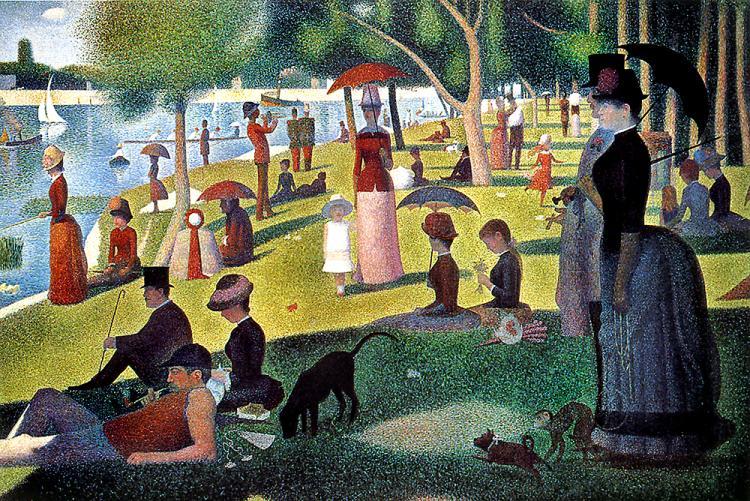
A Sunday Afternoon on the Island of La Grande Jatte by Georges Seurat

I saw the Sondheim revival by Signature Theater yesterday with a friend. We started talking about how some of the music is intended to imitate George Seurat's pointillism, ie, using "dot dot dot" in his paintings. Since we had been discussing choreography in figure skating before the show, my friend and I began to bounce around ideas about how one would do a "dot dot dot" impression on ice with skates. Quick turns on one or both feet, maybe, like Scott Hamilton used to do. I suggested a series of little hops, perhaps on toe picks. Most humans have a bit of synesthesia, which allows us to mix media (visual, auditory, and movement) and use symbols. (BTW, the female lead character's name is Dot, clearly not an accident.)

It is something only Sondheim can pull off --- A musical with almost no story, which is essentially a meditation and dissertation on the creative process, composed with a pile of dots and points and a collection of little anecdotes and episodes. Nevertheless there are bits of character details, which makes me suspect that he and James Lapine wrote up a whole other book on all the characters and their relationships and a full profile for each one with all their complexes ... and 99% of that has been left out of the musical. Note how Sondheim refuses to paint George Seurat as a stereotypical misunderstood genius who was wronged by people around him. No no no. The two Georges in the show both have their flaws and strengths, opposite as they are. Sondheim treats them both with compassion and tenderness, but never indulgence or victimization. While he is sympathetic to Seurat's inability to express his feelings, he does not diminish the humanity in the ordinary people around the genius, like the long-suffering model/lover Dot ("There is someone in this dress!"). So good. So good!

The theme song "Sunday" is, according to Sondheim, written as one big, circular sentence.

["Order, design, tension, balance, harmony"]

Sunday, by the blue purple yellow red water
On the green purple yellow red grass
Let us pass through our perfect park
Pausing on a Sunday

By the cool blue triangular water
On the soft green elliptical grass
As we pass through arrangements of shadow
Toward the verticals of trees
Forever

By the blue purple yellow red water
On the green orange violet mass of the grass
In our perfect park

Made of flecks of light
And dark
And parasols

People strolling through the trees
Of a small suburban park
On an island in the river
On an ordinary Sunday
Sunday
Sunday


And yes, the songs in the musical are all damned un-hummable.

Thursday, August 21, 2014

A Late Quartet


As a rather understated chamber piece movie about musicians, the writer/director Yaron Zilberman went *just* a tad too far. It would have been a much, much better script if only he had cut out one subplot, involving the Russian first violinist and his young student. Ack, that one really went over the line with me. All right, the other subplot involving Philip Seymour Hoffman and Catherine Keener was also soap opera-ish, but one soap opera in one movie, especially when it's restraining itself so strenuously, is manageable. Two would be too much! Argh!

Also I wish Zilberman had given us more on how irresistible playing the music is. That would balance out my constant incredulity that the characters are so averse to breaking up. In fact I was rooting for them to break up the whole time.

Ah, but I'm doing what Pedro Casals despised, aren't I? Why not focus on the good stuff?

I still love PSH.

Monday, June 30, 2014

Six by Sondheim


James Lepine strung together clips and photographs and interviews with six of his songs. I frowned, a little, at the choice of "Send in the Clown." Perhaps it's my snobbery. Certainly those are not six of MY favorite Sondheim songs. One could argue that the selection is intended to be biographical, not "greatest hits," but then Send in the Clown still does not fit.

The joy is seeing old reels of the original casts of Gypsy and Sunday in the Park and Company and even a black-and-white clip of West Side Story, and young Sondheim playing the piano and singing his own songs. (The film with him directing the original recording of Company was particularly moving.) And of course his interviews over the years. One never gets tired of listening to him talk.

The documentary is almost entirely devoted to his work, with mere scraps of his personal life here and there. A viewer without previous knowledge of Sondheim's biography would probably feel lost or confused. A bit coy, I thought, which is not his style.

Monday, June 9, 2014

Duke


Teachout's biography of Duke Ellington still leaves many questions unanswered at least for me, but it is a good overview of what Ellington did in his career. Well, most of what he did was touring with his constantly churning, frequently dysfunctional, often brilliant and sometimes lackluster band.

I am of course interested in his psychology as a person who was simultaneously irresistible and unknowable, but unfortunately Teachout didn't provide a lot of analysis (speculation?) in this area. Every couple of chapters Teachout would gripe about how Ellington stole credit for music written by his band members (including an entire chapter about how Billy Strayhorn was wronged by not only Duke but also critics and historians) or how he mistreated women in his life. He does not, however, provide any explanation on why Ellington was able to do these things without losing their attachment to him.

For example, one could argue that Strayhorn remained in Duke's shadow because of his lack of marketability as a homosexual, but by all account Strayhorn did not act as if he was ashamed of his sexuality and never pretended to be straight. He could have stayed in others' shadows if he were so inclined. Why did he stick with Duke's band for most of his life and watch Duke take credit for his own work? Why did many others in the band? Band members trickled (or stormed) in and out over the five decades, some left in a rage and struck out on their own. Some came back. (Johnny Hodges was an example of success in both places.) I can believe that Strayhorn grew to resent Duke's credit-hogging of his work, but he nevertheless drifted back into Duke's fold until his (Strayhorn's) death. They were jazz musicians for god's sake, by nature and definition unabashed individualists. They are notoriously harder to herd than cats!

The same with women. It's not like Ellington's major long-term relationships were with weak, submissive women. His first love and only wife slashed his face with a razor. Another of his long-term partner Evie had a fiery temper. None of them seemed like spineless voiceless victims. Every few chapters, Teachout would indignantly remind the reader that Ellington refused to give the title of Mrs. Ellginton to women in his life. Yet most of them did not leave him. Why? What was his pull? Ellington spent lavishly on his friends and family, so much so that he was deep in debt at the time of death. But money alone cannot explain his hold on people around him.

One thing in Duke's personality that did come through in the biography is his intense fear of being alone and his actual loneliness. He needed the band and could not live without it, but this busyness never provided the relief from the loneliness.

Another thing that came through, without heavy-handed treatment, is the scars of racism that all American jazz musicians have to live with. And yes, the white ones too.

Not being a musically knowledgeable person or a connoisseur of Ellington's discography, I am not able to assess Teachout's critique of Duke's music. It seems that Ellington's innate sensibility as a visual artist --- he showed a lot of talent in art before he got into music --- gave a strong impressionistic character of his music. Teachout does not, however, comment on the sensuality and sexuality that are evoked bluntly, almost nakedly, in some of his pieces.

Wednesday, April 30, 2014

Currently Reading: Duke

I made a mention of this biography of Duke Ellington by Terry Teachout previously. It finally came through the library's ebook queue a couple of weeks ago. I am reading it slowly at bedtime.

At 15%, the author has just got to the Cotton Club, a Harlem club owned by a notorious Irish gang boss Owney Madden and his violent legbreakers. The Cotton Club served up light-skinned, scantily-clad showgirls and black jazz musicians to an exclusively white clientele who ventured to Harlem for a flavor of the exotic. By all account Madden is the worst type of gangster. But he paid the musicians and showgirls fair to good wages and never bothered them artistically or bodily. Oddly, working for the worst gangsters afforded by-proxy protection for them from other troubles.

Curiously, Madden frequently played bridge with Ellington and Bubber Miley (the trumpeter) after the shows. Another band member (Sonny Greer) said he "loved Duke and loved me." They were said to get along quite well. In later years, Ellington never talked about the segregation and seediness of the Cotton Club and called it a classy joint.

If I were to write this into fiction it would be way too cheesy and cliched. I guess I'd have to do it in Chinese. [g]

****
Other mind-tickling observations about Duke so far:

He showed early talent in art and started a sign-painting business in the U Street neighborhood when he was but a teenager. He worked on that and music was only moonlighting. He made quite a lot of money from both sides of the business, enough to buy a house (!) before he hit 20. 

Musicians who worked with him and knew him well complained about his deft manipulation of them ... and admitted that his manipulation made them better. 

He couldn't study anything systematically to save his life. Instead he would always pick things up bits and pieces here and there, like driving around Central Park in a cab with a classical musical teacher to learn the basics of composition. The rest he just made up as he went along.

He loved contrasts.

Tuesday, November 5, 2013

New Biography on Duke


Serendipity is at work lately. I just borrowed a book yesterday that's a compilation of jokes and anecdotes jazz musicians told each other. Today I heard an interview on the radio with the author of a new Duke Ellington biography.

One of the stories Teachout told was this. Ellington had a scar on his left cheek, which could not be seen on stage (because the pianist always sits with the right side of his face to the audience) and was rarely photographed, but the scar is visible on the cover of his book (above). How did he get the scar?

At 19 Ellington married his high school sweetheart Edna Thompson. In the late 1920s, when he was a big success at the Cotton Club in Harlem, Edna and their son Mercer came up from Washington to live with him. One day in 1927 or 28, when Ellington and Edna were in bed together, without warning, Edna pulled out a razor and said, "I know what you've been up to and I'm going spoil the pretty looks" (or something to that effect) and slashed his left cheek. Ellington, who was 28 or 29 at the time, ran out of the house. Edna left New York and went back to DC. They separated but he didn't divorce her.

I gasped when I heard it. Very rarely do you get a dramatic moment in life that illuminates two persons so thoroughly and deeply.

Duke Ellington was a relentless womanizer and had countless affairs with women all his life. Edna's revenge obviously was not effective in stopping him. Jazz pianist Marian McFarland said he had so much sex appeal that it was (almost?) frightening. He was also enigmatic to men and women alike and ultimately unknowable. 

Wednesday, October 23, 2013

The Demise of Bill Evans

I swear I had no idea before hearing about Bill Evans' addiction and death. It was shocking. Why? Because I would never have thought a man so thoughtful, rational (as much as an artist can be), introverted, and gentle of nature, and smart, would fall victim to impulses and destroy his life in this way. Like Bix Biederbacke, it was a way of self-destruction, perhaps in order to escape psychological pain, but before their deaths they coped with music.

His father was an alcoholic. How much that contributed to his own depression and addiction I don't know, but it had to have some effect. Evans was enormously successful after he was hired by Miles Davis into his band. They were very different in personality but understood and appreciated each other. America's racial conflicts in the 50s was one of the main factors that split them up. Evans went on to become the preeminent jazz pianists of all time.

He was very intellectual, and that also made his addiction a surprise. He was not one of those instinct-driven, impulsive artists who operate on pure emotions. I have seen some videos of his interviews and he talked about jazz music like an academic, minus the snobbery. So analytical. So cool and articulate. So ... normal and sane.

It's heartbreaking. This biography recounts how, when he was addicted to heroin in the 1960s and broke and starving, he regularly called his friends begging for money. When he later got a big advance on a contract, he meticulously paid each one back. A man like this shouldn't be an addict. What contradiction. What nonsense.

He eventually quit heroin for a while, but then his wife committed suicide, and he went back on dope. Then he got himself into methadone treatment and stayed clean and productive for another decade. Then in 1980 he got hooked on cocaine and died quickly. It was over, just like that.

Sunday, September 29, 2013

Ballet etc.

Apollo's Angels 这本书基本上稀里哗啦地跳着看完了。尾章作者十分坦率地说 Ballet is dying. 而且回天无力。作为一个热爱芭蕾的人,作者对此当然十分伤感。作为一个不太了解芭蕾的人,我没有那么伤感。芭蕾的历史前前后后也就三百多年,如作者所述,芭蕾的兴起和发展与王公贵族宫廷礼节有不可分割的关联。养育的土壤已经消失,芭蕾之树不能凭空生长。芭蕾虽然无以为继,但舞蹈本身从来没有离开过人类社会,以后也会继续以各种形式流传。

同时想到古典音乐。所谓 classical music,指的是从德奥中欧发展出来的一套音律体系和作品,满打满算不到四百年的历史,目前面临跟芭蕾类似的命运。即使现在仍有很多人学教演奏古典音乐,但它在社会中已经非常边缘化,广播上成天播的是死人写的作品,还活着的作曲家的作品基本没有人听(除了Philip Glass是唯一的例外)。同样的,音乐从来不需要发明也不会消失,它会以各种不同的方式继续流传下去。

但是,古典音乐归纳出的音律,芭蕾归纳出的控制肢体的技巧,不会消亡,而是被吸收到现在和未来的音乐舞蹈之中,达到某种永生。

Wednesday, August 28, 2013

Sound of Noise

This is the most weird and funny movie about music. I have never seen anything like it and doubt anything like it exists. One of the most bizarre aspects is how the movie deftly makes the music-obsessed vandalists and the tone deaf and music-hating detective BOTH sympathetic.

The Ending of Le Samourai (1967), Explained

A quick online search after watching Jean-Pierre Melville's Le Samourai confirmed my suspicion: The plot is very rarely understood by E...