Search This Blog

Showing posts with label theater. Show all posts

Sunday, July 5, 2026

Pippin: The Meaning of Life


A young man's search for the meaning of life --- an evergreen theme in storytelling. Is it to slay the dragon and rescue the princess? That is a whole genre onto itself. All other popular tropes are presented in the musical Pippin: 

  1. To be a revolutionary and commit patricide. 
  2. To become his father and possess his power and glory. 
  3. To have sex as much as possible. 
  4. To amass fame and fortune (basically the same as #2). 
  5. To find creative outlet in art or enlightenment in religion (mentioned but glossed over). 
  6. To live an ordinary life with a wife and a kid and do humble and repetitive work. 
  7. To light youth on fire and go out with a bang.
Whether it was Stephen Schwartz, or Roger O. Hirson, or Bob Fosse who came up with this list I don't know, although I suspect #3 was probably Fosse's contribution. What I find amusing is how all-encompassing the list is in the human culture, at least in the modern, industrial and post-industrial society. Before the modern era, religion and spiritual enlightenment might have featured a more prominent place, along with the forever father-son succession drama. Isn't it funny that people's (men's?) imagination is so limited? How many stories have been told to repeat the same quest over and over and over again?

Perhaps Joseph Campbell's followers would say that such convergence is inevitable, because humans are fundamentally the same. Men collectively pursue the same few paths that give their lives meaning. It may or may not be true, but I simply lament the shortness of the list --- can't we even come up with at least 10 options? 

The same question is never debated by women, because for most of human history there were no options. Women are precious resources for making babies and making babies survive to adulthood, including young men who fret about the meaning of life. With the advent of birth control, however, women can no longer escape the same question. Whether our culture coalesces the meaning of a woman's life into a short list of options also, I don't know. I do hope, however, that our imagination is not limited to men's short list. 

It is almost hilarious that, even in this day and age, we are still inundated with the same story: A person cannot find happiness unless his life has meaning and/or purpose. What might this meaning or purpose be? All the self-help gurus, who have moved their butts from books and TV to social media, are giving out the same short list, including #3. I mean, really, is this the best we can do? 

Can I do better than mainstream society though? Can I come up with something outside of the list? 

Well, I don't know. All I can do is observe life. What interests me is how #6 is dismissed as boring and repetitive and intolerable. Maybe an ordinary working life with one wife and one child is intolerable to Bob Fosse. I look around, however, and do not see that much repetition. Take, for example, the daily work of a health care professional, such as a nurse or a physical therapist or a primary care physician or a psychotherapist. The nature of the work remains constant, but each patient is slightly different. Even if multiple patients have the same disease, they have different symptoms, different ways of expressing their discomfort and pain, different trajectory of recovery (or not), different comorbidities, different personalities, different abilities to cope, different communication styles, different motivation to comply with or reject treatment ... The variations go on. Moreover, new treatments and new research come out all the time. Yesterday metformin was the best option for type 2 diabetes, but now everyone is shooting themselves up with Ozempic or Zepbound. What does one tell the next patient? Can we find some meaning of life in the people whose infections resolve after a week or two, whose wound you suture, whose pain that got better or worse, or whose blood pressure that went up and down? 

That is just the work part. What about relationships? 

Can you find meaning of life is in the argument you have with your brother, even if you have both forgotten it a few months later? Or the love you make with your spouse, and the talk about both of your 401(K) accounts afterward? Or your kid's PTA meeting in Grade 3, which is not the same as the PTA meeting in Grade 4 or 5? 

In the past 6 months, I have been experimenting with recipes involving a kind of tofu skin product, a Taiwanese specialty that I first discovered on YouTube videos. It has the marvelous ability to soak up the sauce quickly in a wok. So far I have cooked it in different mushroom sauces, but I have plans for tomato sauce, braised meat sauce, and maybe seafood sauce. Could tofu skin recipes be one of my many meanings of life? 

Ah, but none of these trivialities are fulfilling, says Pippin. 

Let's look at the word fulfill. Full and fill. The primitive meaning is the feeling of being full, having food in the stomach, the relief of hunger. 

Maybe this is the universal meaning of human life at the bottom of it all. No feeling in the world is more real than the transition from hunger to satiety. I wonder if this is one of the sources of our confusion --- the constant satiation and lack of hunger. 

All the more reason to find the meaning of life --- at least some of it --- in tofu skin recipes. Once I get tired of it, I can move on to egg custard recipes and bean soup recipes. 

Wednesday, February 14, 2024

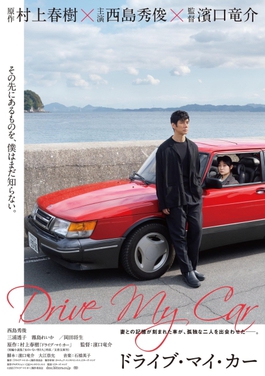
Life and Death as Tropes: Drive My Car


I don't need to dwell on the many wonderful qualities of this 2021 movie, except that the single most effective choice made by the director (Ryusuke Hamaguchi) was to cast a deaf actor as Sonia in Uncle Vanya, the play within the movie. It is absolutely ingenious and perfect. I don't know how other people feel about the extensive enactment of "Uncle Vanya" and use of its lines to suggest the characters' state of mind throughout the movie. For me, who recently read the play and watched 2 other movies based on it, the power of Chekhov is immense. It is unmistakable that Hamaguchi feels the same way. 

Nevertheless, I want to touch on a particular aspect of the movie that is unsatisfactory to me. Spoilers abound below.

After watching "Drive My Car," I went and read the original short story by Haruki Murakami and a couple of other stories in the same collection, Men Without Women, that contributed minor elements to the movie. I have not read any of Murakami's novels, but one cannot escape his cultural influences. I read his “Barn Burning" after watching Lee Chang-Dong's adaptation, the 2018 movie "Burning", which left little impression (unlike the movie). None of his short stories resonated with me (quite the opposite of Chekhov). 

One of the things that has bothered me from the start about Murakami's works is his (ab)use of deaths, often in female characters and sometimes suicide, as a crutch in service of the male character's emotional state. There is a similar phenomenon in English-language popular culture that, by now, has been well established, ie, female characters die in order to bring about the spiritual growth or maturity of the (male) hero. Fundamentally, I think Murakami's tendency is not that different, but it might seem a little different to western critics because of the pervasive sense of melancholy in Japanese arts and culture. Death evokes a kind of beauteous sentimentality about the fleeting nature of life and all good things. That in itself is fine, but excessive use with a callousness can trivialize death as a dramatic device and obliterate its meaning.

The flip side is another convention in Japanese popular culture, based on my limited exposure: the trope of life affirmation. I have lost count of Japanese movies and TV series in which characters tell each other or themselves with a loud declaration: "I/you/we must go on living!!!" (At least 3 exclamation marks!) Implied in the declaration is that living takes too much effort and death is the default position. 

Putting aside the rightness or wrongness of this philosophy --- who am I to judge? --- I am merely pointing out that death and "pushing oneself to keep on living" are two tropes in Japanese popular culture. I don't know how the average Japanese people in real life feel about it, as I don't know any Japanese person in real life. Maybe they don't give a fuck and enjoy life just fine. 

Coming back to "Drive My Car," the theme is the difficulty for people to connect with each other, even between couples in love or parents and children. The main character is haunted by his inability to talk to his wife about her having sex with other men; now it's too late to understand because she died suddenly. The driver is haunted by her guilt over the death of her abusive mother. The two lonely people, damaged by the death of their loved ones, connect with each other in the little red Saab. The climactic scene, when the main character expresses his regret for his avoidance of talking to his straying wife when she was alive, did not have the expected effect on me. Instead, for me, it was a moment like, "Isn't it ironic, don't you think? A little too ironic..." 

The main character had repressed his feelings about his wife's infidelity and maintained the pretense of a happy marriage, because of his fear of the confrontation with his wife and possible dissolution of their marriage. That part is obvious. So then, isn't it convenient that she is dead? Her sudden and random death is, symbolically, his (the author's) wish fulfillment. Her death removes the threat of being exposed to an intolerable reality --- that she is a real person with her own thoughts, feelings, desires, and intentions, which may not align with his. Maybe she doesn't love him any more. Maybe she prefers other men to him. Maybe she will leave him.

One could extend this argument to the movie itself. After observing these two characters gently and compassionately for over 2 hours, it successfully avoids the hard stuff: a painful self-discovery, both of the main character's insecurity about his manhood and of the driver's hatred for her mother and her desire for separation. Also avoided is the characters' aggression toward the people they love. Their anger and resentment alongside love and attachment. Their fear of rejection and abandonment.  All the difficult and terrifying honesty is swept under the rug of a rote declaration, "We must go on living!" The end.

The truths in life must be avoided at all cost (eg, love exists alongside hate, we all have aggression, attachment cannot be permanent, we are not the center of the universe). In comparison, death is an easy escape from painful confrontations. Hence we can see how these tropes are so irresistible to dramatists. That is why we all need to go back and read Chekhov again.

Saturday, March 11, 2023

Someone in the Tree (Pacific Overtures)


One of the least produced Sondheim musicals, Pacific Overtures is a show that I very much wanted but did not expect to see in my lifetime. And yet! Signature Theatre nearby produced it this year! So of course I have to go see it at least twice. 

Compared with the original Broadway version, which can be seen on YouTube, this production is necessarily smaller, shorter, and more modest, but immensely enjoyable nevertheless. 

The history around the opening of Japan to western countries is complex and fascinating. I somehow fell into it because of my interest in Japanese jidaigeki action cinema and the Nemuri Kyoshiro novels in the past few years. The period around the fall of the Tokugawa shogunate is a critical juncture in the history of modern Japan and continues to inspire much pulp fiction and genre movies in Japan. I know why I am interested in this part of history, but for the life of mine I cannot imagine how Sondheim got into it. 

The amount of effort he put into making Pacific Overtures must have been enormous. Of course it is not an accurate documentary of Japanese history, but the artistic rendition of it is consistent with my understanding. The music is obviously influenced by Japanese traditional theater, namely Noh and Kabuki, of which I am very ignorant. The original set and direction were also designed to evoke that feel, which suggests that Harold Prince was equally interested in this approach. 

It is extraordinary that the entire musical is presented from the Japanese point of view. There is zero white character inserted into the story to lead the audience into the unfamiliar setting and allow them to identify with. If it were a book, Pacific Overtures would be closer to a nonfiction book than a novel, with some humor and gag thrown in for effect. Sondheim and Prince never bothered to make it easier or "friendlier" for American audience, so the audience has to make an effort to imagine themselves in this unfamiliar historical place, with few conventional tools to latch onto. 

Although the show does not have a conventional protagonist and antagonist and has a generally detached narrative tone (not least through the use of a narrator as common in Japanese theater), one song stands out to counterbalance this impersonal tone. Someone in the Tree has three ordinary characters talk about an important historical moment, the negotiation and signing of the Kanagawa Treaty between Japan and the US. It reminds me of the song "Room Where it Happens" in Hamilton, which no doubt was influenced by "Someone in the Tree." Note that although two of the characters claim to be there in the room where it happened, they were of no importance and had no involvement. They were merely observers and entirely passive, even though their lives and fates were irrevocably altered by the treaty. 

In some sense, Someone in the Tree is about hyperobjects, average people living in a world too large and complex to be known or understood. We live through and witness history, but we cannot control or make history, or even begin to understand its mechanisms. 

In any story set in a background of changing times, there is always a tension between the small scale and big picture. To focus on the tides of time and grand scheme of things always runs the risk of losing sight of individual lives and tears, but individual lives are truly and tangibly affected by the invisible hand of historical events. It is a constant dilemma for storytelling, because it is also the unknowable reality of our daily lives. 

Saturday, April 29, 2017

Shakespeare Season in Washington

The upcoming theater season in Washington DC will be filled with heavy-weight plays. Before his retirement, Michael Kahn is going to put on HAMLET (!) again at the STC, which will also do Twelfth Night and Waiting for Godot.

As if that's not enough, Folger just sent out an email announcement that they will put on Antony and Cleopatra (!) in October-November, directed by Robert Richmond. 

I went to STC to see the new Macbeth, directed by Liesl Tommy and set in a north African country named ... Scotland. Very nicely done with breath-taking set design that rivaled the set of Wallenstein I saw some years ago. Lady Macbeth, played by Nikkole Salter, was particularly memorable. 


Thursday, April 27, 2017

The Seagull

I think I'm in love with Chekhov. The thing is that he puts the audience in a situation in which you want to both laugh and cry at the same time. He jams comedy and tragedy together, and yet I don't feel the whiplash from such jarring contradictory tones. Reading the scripts of The Seagull and Three Sisters, I keep laughing even though laughing seems inappropriate because it's all so sad! And funny! And sad and funny! Also I suspect that his scripts are best presented on screen, perhaps television rather than movies (never mind TV was not even invented in Chekhov's time). They are so subtle and full of winks and nudges, totally unsuited for a large theater where actors have to raise their voices to be heard. And the plays are best acted by professional comedians with mature mastery of ... timing.

In The Seagull, at first I was taken aback by how Oedipal it is in the depiction of the mother-son relationship (Irina Arkadina and Konstantin). Chekhov is Freud's contemporary, but surely the latter had no influence in Russia, did he? This is explained in the translator Paul Schmidt's notes --- Chekhov modeled it on Hamlet and Gertrude. No wonder ...

This type of generational rivalry usually occurs between parent and child of the same gender: mother versus daughter, father versus son. Here Arkadina's contempt for her son's literary and dramatic pursuits reflects perhaps a generational conflict between Chekhov and his older or younger colleagues in real life. Her prima donna personality must have been modeled on real stars he had met. Any other writer would surely tar and feather her as a horrible villain, but I want to laugh.

Regardless, more than anything, this particular play seems to disprove the theory that Chekhov always writes about people's inaction and stagnation and unfulfilled dreams. On the contrary, nearly all of the characters in the play have taken quite decisive actions. Trigorin seduces Nina. Nina elopes with Trigorin and even goes forth with her dream of becoming an actress. Konstantin writes and gets published and continues to write his experimental plays. Masha marries Medvedenko and has a baby with him. Even Sorin, the guy with lifelong regrets, has worked as a government bureaucrat for nearly 30 years. He hasn't been sitting in a chair all day. They are not people of procrastination, moping around mumbling should have could have would have. They are people of action!

And look where all the actions get them. Maybe that is the point. Contrary to the advice of American self-help books, taking action does not deliver people to happiness and "self-actualization" (but neither does inaction). What then? All we can do is march on in spite of it all ...

Monday, May 16, 2016

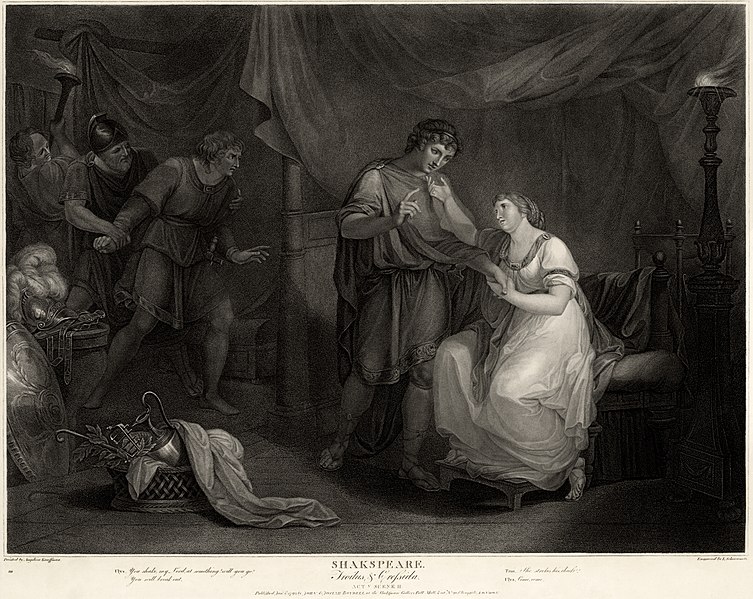
Troilus and Cressida


It's an odd play, even more of a "problem" than "Measure for Measure." If it weren't written four hundred years ago, one could safely file it under absurdism or postmodernism. Troilus and Cressida defies any conventional classification.

Just when I thought I knew Shakespeare, sort of, I realize I don't. Not at all.

It's a vicious takedown of the heroic and romantic mythologies. He is saying that, the truth of heroism is jealousy and stupidity, and the truth of romantic love is inconstancy and self-interest. It's unusually obscene and sexually explicit. It's roiling with a rage underneath all the bawdy jokes. It's unlike any other Shakespearean play, although the sneering view on war here could have come out of Falstaff's mouth.

How do the two strands of plot connect with each other? One is how two unwilling warriors, Achilles and Hector, finally come to a deadly confrontation. The other is a cynical revision of Romeo and Juliet. I don't know, but I feel in my gut that they do connect in some way.

Come to think of it, it's kind of funny how Shakespeare approached the classics, compared with, say, T. S. Eliot. Good ol' Willie obviously didn't worship the classics as the grandiose foundation of English literature. Rather, he trampled and shat all over the lofty ideals and glory. What a guy.

Monday, February 29, 2016

Road Show


How fortunate that I live in the Washington DC area and get to see more Sondheim shows than anyone living now in New York City. At places during this rarely produced musical, I did wonder where the "Road" was leading, but the last 15 minutes really pulled itself together and made everything work.

Not having seen all of Sondheim's musicals, I don't know for sure if this is the first time he presented a gay romance in any of his work, but it is the first time I've seen him do it. The song "The Best Thing That Ever Has Happened," sung between an older man and his younger lover, is a blatant reference to his own life. I cannot help but shiver at the association. And the climactic confessional song about family --- that years and people come and go but one is forever stuck with his family --- says it all. That's what everything comes down to.

I can see why this doesn't suit Broadway, and I can see why critics feel mixed about it, but Road Show as Sondheim's last musical only added to my love for him. It may not be a masterpiece, but it's intimate and personal and, as such, does not cater to anyone. Why should he, at the end of a Shakespearean career?

The music. Oh the music. Can someone please do an instrumental recording of the complete Sondheim? Over and again during the show, I was drawn away from the story and lyrics by the lone piano tune that dominated the production, with an occasional fiddle. It's catnip to me. Inside I was twitching with delight.

Tuesday, February 23, 2016

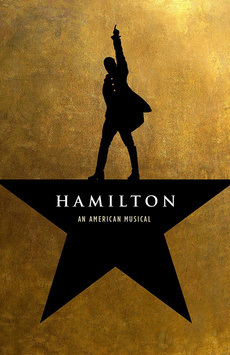
Hamilton the Musical


When a friend of mine told me that she could not get tickets to Hamilton this summer --- or in fact for the rest of 2016, I was flabbergasted. Last summer, after it opened on Broadway in July, I bought 2 tickets in August for a Saturday (!) matinee show in September. How could the wait become a whole ye... Damn you online scalpers!

I have tried to explain to a few people just what is so successful about Hamilton that has caused such a breathless sensation. It's hard. I don't think Lin Manuel Miranda, the writer of the musical who adapted it from a biography written by Ron Chernow, can fully explain it. Everything clicks in various surprising and mind-tickling ways. So many things could have gone wrong in this rather daring re-telling of American Revolution from the point of view of Alexander Hamilton. It could have been too cynical or too earnest, too reverential or too disrespectful, too serious or too silly, too boring or too absurd ... Somehow by some miracle of not only Miranda's skills but also his personality, it has circumvented every gaping pitfall and kept the tone to an improbably perfection that pleases everyone. Unless you are a raging white supremacist who carry the Klan membership card in your pocket, everyone from a rabid liberal to a recalcitrant conservatives is thrilled and charmed by this portrait of a young United States. It's so universally flattering, except to maybe a British royalist, that you don't even feel the flattery.

Of all the things that have been vehemently praised by pretty much every talking head associated or unassociated with musical theater, one extraordinary thing is the fact that it has a cast of almost entirely minorities. The key actors are primarily black, some Hispanic (including Miranda himself who is Puerto Rican), and one Asian (Phillipa Soo). Of course it was a conscious decision to give many underrated and underappreciated actors a place to shine. Miranda has said in several interviews that he wanted to represent the faces of America then --- European immigrants fighting for independence --- with the faces of America now, as recent immigrants have predominantly darker skin. But, I can't help the feeling that the casting was initially dictated by his writing voice.

LM Miranda can juggle multiple music styles, but his specialty has always been rap, as shown in his previous musical In the Heights. He admitted in one interview that he started thinking about writing the show as he gobbled down Chernow's book for the first time. The voice in his head was the voice most familiar to him: rap. In 2009, he wrote one rap number summarizing Hamilton's life and performed it at a White House event. It was well received. From the beginning, the basic voice of this musical had to be rap.

The next logical conclusion must have been that he would have to cast several black actors to perform his rap lyrics. I don't know if the image of a cast of white Broadway actors rapping as Hamilton, Jefferson, Madison, and Aaron Burr crossed his mind. It did mine and gave me a shudder. It would have been so wrong in so many ways, not least the suggestion of cultural appropriation and reminder of repeated insults to minorities from the birth of this nation. No, his lines would have to be sung/spoken by black actors (and himself) who know what they are doing. As such, a minority-dominated cast is not only preferred but practically inevitable. Indeed, he had to convince a professional rapper friend, Daveed Diggs, to suspend his tour to join the cast. Diggs turned out to be an absolute highlight of the show.

Would this pose an issue as Hamilton goes on a National tour to Chicago and Los Angeles? Can they find a predominantly black and Hispanic cast who can handle the demanding lyrics and rhythm? We'll have to wait and see.

Monday, June 22, 2015

Rosencrantz and Guildenstern Are Dead at Folger


I have heard the name Aaron Posner mentioned in association with DC theater scenes several times, but only today saw his direction for this Folger production of Tom Stoppard's early but most famous play. It's indeed quite good, quite impressive. The comic timing was spot on and had the audience laughing all the way through, despite the play's length and the absurdist dialog. The casting was inspired and the two young lead actors had real chemistry.

Yes, it's known as an existentialist and absurdist play. It's about the unreal space occupied by minor characters between their sporadic appearances in the main characters' story. It's the meaninglessness and aimlessness of life, and the inevitability and pointlessness of death.

It's all very clever and meta. The production notes point out that it owes as much to Shakespeare (ie, the source in Hamlet) as to Waiting for Godot. I have not seen Waiting for Godot, but I cannot shake the feeling that all this was said by Shakespeare already, not only in "the undiscovered country from whose bourn no traveler returns," but also "tomorrow, and tomorrow, and tomorrow, creeps in this petty pace from day to day, to the last syllable of recorded time. And all our yesterdays have lighted fools the way to dusty death."

Tuesday, May 12, 2015

Note to Self: Othello @STC next season

Just got the brochure in the mail. No dates yet. I will go see it.

Below is a poster of Vishal Bhardwaj's modern adaptation of Othello, Omkara (2006). It's pretty excellent and very faithful to the play. Like in most productions, Iago, played by Saif Ali Khan, steals the show.


Friday, April 24, 2015

King John Revisited

I am trying to test my memory on this absurdly complicated story.

In the beginning King John was the de facto king of England. His brother, Richard the Lionheart, named him heir to the throne, despite a stronger claim by their nephew Arthur, as Arthur's father (dead) had been older than John. Still an innocent child, Arthur was not particularly keen on overthrowing his uncle, but his keen mother, Constance, took him and the claim to the King of France, Philip. France confronted England in Arthur's name. One does not need France's true intention spelled out, however, considering the ongoing land disputes between the neighboring countries (England held Brittany and other territories on the Continent).

And so they attempted to resolve the dispute the old fashioned way: through war. The conflict was stuck in a stalemate. What to do? John and Philip reached a truce, in which John married his niece Blanche to the Dauphin Louis and England gave up some of the land to France as her dowry. Methinks England probably lost in reality. The war ended and Arthur's suit was put aside. Constance, of course, was not happy about the arrangement, but John and his army had captured Arthur in a battle. Now England seemed to hold all the cards ... Or do they?

Peace with France might not be the best policy, but the king had little choice at the moment, because he was being attacked on another side by the Pope, who was unhappy about his domestic policy to levy taxes on the churches. England's conflict with Rome also put France in an awkward position. If you don't denounce England, the angry Roman envoy Pandolf threatened Philip, you would be excommunicated along with John. Ah the problem of The Three Kingdoms. The fragile alliance between England and France hung in a balance. Pandolf convinced the Dauphin to invade England, because now Louis also had a claim to the English throne through his marriage to Blanche. Oh isn't that clever of the little cardinal?

Meanwhile in England, John did not want to sit and wait for the French invasion in the name of rescuing Arthur, the rightful king. So he ordered the boy executed by Hubert, everyone's favorite killer. Only this killer had a heart of gold (unlike the killers in Richard III but not unlike Sandor Clegane) and was moved by the child's innocence. So he quietly hid Arthur somewhere in the Tower, while telling the king he'd done the deed. But the king changed his mind two minutes later! When his already-disgruntled lords were appalled and outraged that he had murdered a child! John wished he would kick the stupid lords' asses, no doubt, but right now he needed their help to fight off the French. Oh how he regretted having given the order.

Man, it sucks to be a lowly henchman. One moment your boss wants the kid dead, the next he is blaming you for being a psychopathic killer. What a bhenchod (oops, wrong language). Anyway, so Hubert told John the truth and they all hugged each other and thought, The kid's still alive! We're all saved from a rebellion and bad names for a thousand years! Unbeknownst to them, Arthur sneaked out of the Tower and jumped the wall and broke his own neck, lying dead in front of the fuming lords. Awkward. If they had been wavering a bit about betraying England, now they had to be pushed to the Dauphin's side by the bloody corpse.

And so there John sat in his tent on the battlefield and couldn't believe how things had fallen apart. An hour ago he had married Blanche to Louis, got France off his back, and Arthur had lost. Everything had been so peachy. Suddenly he became a child-murderer, even though he rescinded the order, was excommunicated by Vatican, and was about to lose his country to France! Maderchod (sorry, wrong language again). In a desperate last-ditch effort, he treated with Pandolf and gave the Vatican whatever they wanted.

Mission happily accomplished, Pandolf went to Louis and said, OK, we can go home now, I got what I wanted. Louis laughed, What about what I want? Do you think you can let the wolf out of the cage and then drag him back before he's fed? The wolf will not let go of the big fat piece of steak between his teeth. He told Pandolf to get lost and pressed his army on, along with Salisbury and the other well-meaning English traitors. Finally, somehow, the English lords came to their senses and decided to switch sides from the French Dauphin. Louis had to abandon his dream and go home. All seemed to be finally looking up for John. Then King John got himself poisoned by a monk, I guess because of his earlier excommunication. So he died and his son Henry was crowned. The end.

How did he cram all this into just one play?! It gave me so many whiplashes I thought my head was going to fall off.

Oh, and in the middle of it all, there was this fabulous character who is a bastard and has all the best one-liners.

Friday, February 13, 2015

The Hard Problem

Tom Stoppard is tackling "the hard problem" of consciousness. The play has just opened on National Theatre in London last month. I have not seen any reviews and am curious to see it at some point.

The last time I saw his "Arcadia," in which he dramatized the Second Law of Thermodynamics, I did not love it. It was clever but kind of lacked emotional impact. Well, I guess it is too difficult to be touched and moved by the inevitable rise of entropy in a closed system ...

Oliver Burkeman at The Guardian recently wrote a fairly comprehensive introduction about the current debate among neuroscientists over "the hard problem." I dunno. From where I sit, there is no convincing logic or evidence to suggest that a physical and material consciousness is impossible. I don't understand this insistence that consciousness is immaterial. Why can't it be as material as the electrochemical signaling system that runs breathing and heartbeats, sends commands to muscle contractions, processes visual and other stimuli, and stores and retrieves memory, etc., etc., etc.? If we are to believe that memory is not elusive but rather material (and we have pretty good evidence now that it is), what makes you believe that consciousness is fundamentally different from memory?

The romantic notion that consciousness is immaterial and therefore unknowable is, in my opinion, just a reincarnation of our past romantic notion of the soul, which itself was a variation of beliefs in one or more supernatural powers (ie, gods) and an afterlife. We are just unwilling to let go of the immaterial concepts, so we transfer this wish from god to soul to consciousness, keeping the romance alive!

I don't know if Stoppard is going with the romantic or the kill-joy approach in "The Hard Problem."


Post Script: From a review of the play, I suppose I should adjust my expectations accordingly. Yeah, I know, I am being difficult here. Is it ever possible to be both scientific and emotionally appealing and resonating? Well ... the answer seems to be no. The truth is usually pretty unappealing to us.

Wednesday, December 31, 2014

Shakespearean Plays on Stage

It occurred to me that I should keep a record of the ones I've seen on stage:

Richard III (STC, lead: Stacy Keach)
King Lear (STC, modern version set in the Balkans)
Henry V (Folger, lead: Zach Appelman)
Much Ado About Nothing (STC, set in Cuba)
Romeo and Juliet (STC, all male production)
Coriolanus (STC 2013)
Measure for Measure (STC 2014)
Richard III (Folger Theater 2014, lead: Drew Cortese)
Henry IV, Part 1 (STC 2014, Stacy Keach as Falstaff)
Henry IV, Part 2 (STC 2014)
Julius Caesar (Folger 2014)

Aim to see at least one in London (The Globe) and one in Stratford-upon-Avon.

Into the Woods (movie)

Before the movie came out, Sondheim fans were worried that Disney would pour syrup all over the original musical and fuck it up. After the movie came out the complaints seemed to die down, but I still think the movie has been sugarized and messed up.

Let's not kid ourselves. The marketing campaign for the movie gave it away. The movie was marketed as a "family film" and it is adapted in that way. People who had never seen the original musical or the video of the original musical or who didn't know Sondheim from Speilberg took their kids to see the film. How could they possibly be given the musical in its original way as intended by Sondheim and Lapine?

Case in point is how the Wolf is kept --- but not really --- in the movie. The sexually suggestive song he sings to the Little Red Riding Hood ("Hello Little Girl") is quickly gotten out of the way in a blur. Not to mention the costume ... Awkward ...

And the movie does nothing for one of the main themes of the musical: parent-child relationships. No one would come out of the movie with any enlightenment or insight about this. What a waste. Into the Woods was, in some ways, Sondheim's psychological processing of his troubled relationships with a narcissistic mother and a father who escaped to save himself and left his son to drown. Damned if you got any of that from the movie.

The most important song in the musical is "No One is Alone." In the movie, the setup for the song gives you a fraction of its meaning and emotional depth. Everything is dumbed down and dashed off, as if afraid the audience would actually think about the lyrics and messages and meaning, and feel slightly disturbed.

One critic observed that the tempo of the songs in the movie is too slow. I think the reason is that most of the actors couldn't sing them properly. Movie actors are shit at singing, especially such difficult songs. The much revered great Meryl Streep was pretty shit at playing the witch too. Bernadette Peters can destroy her performance with a few verses.

This is why I prefer the stage to movies. 

Saturday, November 8, 2014

Julius Caesar at Folger

"Et tu, Brute?"
Everyone has his (or her) idea. I want to believe my idea is closer to Shakespeare's original intention, but Robert Richmond probably would disagree.

One of the things I disagree with with Richmond is Cassius. He is played with an evil air, flailing his hands and arms like a villain, exuding spite in his condemnation of the tyrant. My friend who went to see the play with me said that Cassius is often interpreted as an Iago-like character. I was, like, no! Cassius is not a villain. He is a radical, an agitator, an extremist, but a wise one who knows that a radical does not win over the masses. Therefore he needs Brutus, the most honorable and trusted Roman senator, on his side. And Brutus is ideologically against Caesar the would-be emperor from the start. Cassius only needs to convince him that assassination is the only way. Cassius talks passionately about his cause; there is no sign to indicate he does not mean it. In the end he dies heroically on the battlefield. He is no Iago.

This issue goes deeper into the heart of the play itself. Between Caesar/Antony and the Senators, Shakespeare takes no side whatsoever. Both sides wholeheartedly believe their own righteousness and neither side is portrayed as malicious or weaselly. Caesar is written with signs of potential tyranny, but then the conspirators swarm and stab him to death (they have reasons for that, too). Nobody is saintly or whitewashed. Here Shakespeare truly splits down in the middle. Just because Antony and Octavius win and Brutus and Cassius lose in the end, it is no indication of where the writer's sympathies lie. People instinctively associate virtue with victory. Not Shakespeare. Certainly not in this play. Unfortunately this production's sympathy tilts in favor of Caesar/Antony and against the senators. It's a misstep in my opinion.

Perhaps it is not entirely true that Shakespeare takes no side. His sympathy clearly lies with Brutus. Brutus is (as GRRM calls) the viewpoint character for the whole thing. In a play otherwise filled with testosterone and politics, we see the tender domestic moments between Brutus and his wife --- which is botched in this production, as both my friend and I agree. Brutus chooses to murder his friend to save the republic and democracy. He is the example of "the human heart in conflict with itself." He is true and noble to the core. He wins battles and is gentle to his wife and his page. When Antony says Brutus is "the noblest of Roman of them all," he is speaking for the author. But look where honor and noble qualities get him, poor Brutus. The public can be bribed with a few pretty words and coins --- this is democracy for you. Caesar is dead but dictators immediately follow and senators are killed off. He is the quintessential tragic hero, because he represents the selfless courage, but it's all a waste.

If that is life, why not live like Jack Falstaff?

Hence my final complaint about this production. Brutus, played adequately but too quietly by the English actor Anthony Cochrane, lacks the presence and inner conflicts to become the center of the play.

*****

There is no shortage of violence in Shakespearean plays. This one is full of close-range stabbings. Not only do they stab Caesar, but a few other characters stab themselves too. The lines are littered with references to the gut. It's all very visceral.

In the middle of the assassination scene, which by the way was staged not too bloody and lacked a viciousness, an image appeared in my mind: A bright sunny morning, on the Forum in Rome, on the stone-paved square before the senate, a group of old and middle-aged men descend upon an old man and stab him wherever they can get a blade in, like a murder of crows swarming a corpse. Blood is spewing everywhere, splattered on the senators' faces and togas. Then, just as quickly, they disperse from the body, standing aside and staring at the lifeless pile of rag soaked in blood, trembling with fear and adrenalin. Dead silence falls upon the Forum.

Stabbing is such an intimate act of killing. It's also such an Italian thing.

Politics has always been soaked in blood and death, including many public ones. We modern people have forgotten the bodies hanging on market squares and the heads on spikes on city walls.

*****

I imagine it would be very difficult to stage a very bloody and visceral public stabbing scene. Obviously you can't stop the play to mop up all the fake blood poured on stage. Yet without blood poured all over the stage, somehow it's just not very horrible.

Overall this production is oddly stiff. My friend calls the staging "static." Characters do not move around a lot and rarely touch each other. They keep their distance. I also do not like the costume. In the first half, they wear vaguely medieval clothes. In the second half, the war scenes were moved to World War I military wear. Richmond explained that he was influenced by the WWI memorial activities in UK earlier this year. I don't think it's very effective. In my mind, everyone in the play should wear white togas and, when necessary, bear their flesh. It would cost less. The blood on white toga would be so much more in your face. The production is too English and not enough Italian.

I don't understand the urge to "modernize" the staging and costumes in many Shakespearean plays. The attempts to scream at the audience that Shakespeare is still relevant today to them are rather silly. If you can't hear and see the plain universal relevance in the words, you are wasting your time.

Monday, September 8, 2014

Sunday in the Park With George

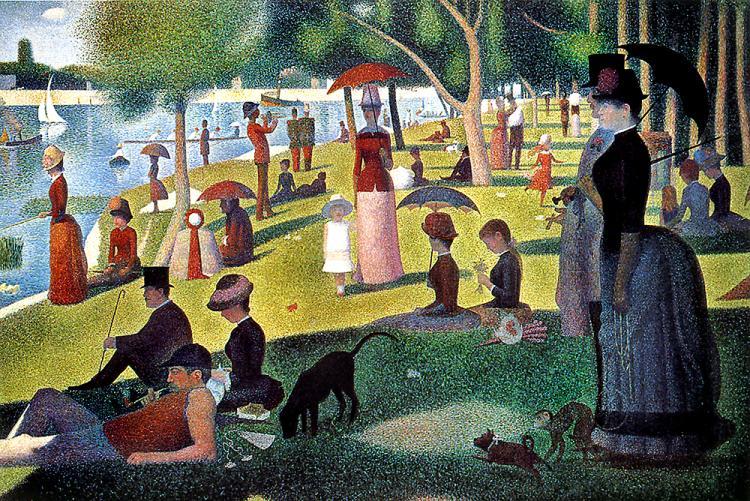
A Sunday Afternoon on the Island of La Grande Jatte by Georges Seurat

I saw the Sondheim revival by Signature Theater yesterday with a friend. We started talking about how some of the music is intended to imitate George Seurat's pointillism, ie, using "dot dot dot" in his paintings. Since we had been discussing choreography in figure skating before the show, my friend and I began to bounce around ideas about how one would do a "dot dot dot" impression on ice with skates. Quick turns on one or both feet, maybe, like Scott Hamilton used to do. I suggested a series of little hops, perhaps on toe picks. Most humans have a bit of synesthesia, which allows us to mix media (visual, auditory, and movement) and use symbols. (BTW, the female lead character's name is Dot, clearly not an accident.)

It is something only Sondheim can pull off --- A musical with almost no story, which is essentially a meditation and dissertation on the creative process, composed with a pile of dots and points and a collection of little anecdotes and episodes. Nevertheless there are bits of character details, which makes me suspect that he and James Lapine wrote up a whole other book on all the characters and their relationships and a full profile for each one with all their complexes ... and 99% of that has been left out of the musical. Note how Sondheim refuses to paint George Seurat as a stereotypical misunderstood genius who was wronged by people around him. No no no. The two Georges in the show both have their flaws and strengths, opposite as they are. Sondheim treats them both with compassion and tenderness, but never indulgence or victimization. While he is sympathetic to Seurat's inability to express his feelings, he does not diminish the humanity in the ordinary people around the genius, like the long-suffering model/lover Dot ("There is someone in this dress!"). So good. So good!

The theme song "Sunday" is, according to Sondheim, written as one big, circular sentence.

["Order, design, tension, balance, harmony"]

Sunday, by the blue purple yellow red water
On the green purple yellow red grass
Let us pass through our perfect park
Pausing on a Sunday

By the cool blue triangular water
On the soft green elliptical grass
As we pass through arrangements of shadow
Toward the verticals of trees
Forever

By the blue purple yellow red water
On the green orange violet mass of the grass
In our perfect park

Made of flecks of light
And dark
And parasols

People strolling through the trees
Of a small suburban park
On an island in the river
On an ordinary Sunday
Sunday
Sunday


And yes, the songs in the musical are all damned un-hummable.

Wednesday, August 13, 2014

Antony and Cleopatra

The play has a number of unusual features that break various stage conventions. No doubt other Shakespeare scholars have written extensively about them, but it was fun to discover them for myself. 

- There are all these henchmen and lieutenants and god-knows-whos that would show up, say a few lines, and never show up again! The named characters are so numerous that I have to suspect that any regular cast would have to rush through all the "revolving door" procedures throughout the play.

- The scene switching between Rome and Alexandria is so quick and frequent as to resemble cinematic editing. It reminds me of the way Robert Richmond handled the battlefield scenes in Henry V. He "cut" rapidly between the English and French camps with alternating spotlights on the upper and lower corners of stage.

- The large scale in characters and geography matches the complexity of political machination, double-crossing, betrayals and failed betrayals, alliances and breakups, and all the typical Roman Empire bloody struggles on a global scale.

- All that mixed-up conspiracy and political stuff takes up only three quarters of the play, and the last quarter is spent on an eerie, tragic, comical, absurd, heartbreaking, and twisty long climax that has everything and the kitchen sink thrown into it. It's sort of like the climatic battle sequences in Joss Whedon's "The Avengers" that eat up almost half of the movie, except more gut-wrenching. Holy macaroni the last quarter of the play should really have its own full-length play. Reading it got me all twisted up inside and filled me with all kinds of contradictory feelings that I don't know how to sort out.

- Also attesting to the massive scale of just the finale, Act 4 features not one but two big battles: One on land and the other at sea. The siege of Alexandria must have been at least a partial model for GRRM's siege of Meereen, which has presumably been completed in The Winds of Winter.

It is just the biggest play I have ever read and totally blows my mind. Ah it has to go on my must-see list.

Ultimately though, what makes the play immortal is the human truth in it. Despite the weight of history and expectation for "greatness" associated with the subject and characters, he gives us the naked truth about a middle-aged, professionally successful couple who fall madly in love and act stupid and ridiculous. We can't help but love them and root for them, not because they are regal and heroic, but because we recognize ourselves in them. And we have to despise Octavius Caesar because he is the most responsible adult in this whole mess who acts with impeccable strategy and reason, without any emotion or frailty.

Enobarbus might be my new favorite Shakespearean character. I love him so much.

One can analyze Shakespeare with a hundred books as thick as bricks, but I have no words to describe how he makes me feel --- a mass of jumbled conflicting explosive feelings that seem to encompass an entire lifetime and all its laughter and tears, joy and sorrow, longings and regrets, all at the same time.

Monday, June 30, 2014

Six by Sondheim


James Lepine strung together clips and photographs and interviews with six of his songs. I frowned, a little, at the choice of "Send in the Clown." Perhaps it's my snobbery. Certainly those are not six of MY favorite Sondheim songs. One could argue that the selection is intended to be biographical, not "greatest hits," but then Send in the Clown still does not fit.

The joy is seeing old reels of the original casts of Gypsy and Sunday in the Park and Company and even a black-and-white clip of West Side Story, and young Sondheim playing the piano and singing his own songs. (The film with him directing the original recording of Company was particularly moving.) And of course his interviews over the years. One never gets tired of listening to him talk.

The documentary is almost entirely devoted to his work, with mere scraps of his personal life here and there. A viewer without previous knowledge of Sondheim's biography would probably feel lost or confused. A bit coy, I thought, which is not his style.

Sunday, June 29, 2014

Private Lives (STC)

Bianca Amato and James Waterston

Saw it at Shakespeare Theatre Company in town today. I love it. Indeed I prefer it to "The Important of Being Earnest," which is more famous but a bit too classically farcical for me. This, oh, this oozes irony! Such merciless depiction of --- no, attack on --- romantic relationships and marriage.

I have a weakness for this particular brand of cynicism, perhaps because of an early inoculation with Maugham's stories. Looking back, perhaps chick lit would have been more suitable brain food for a girl in puberty, but that's all too late now. Anyway, the attitude might be bred in a specific time and place, namely early twentieth century Britain. Maugham, Noel Coward, Terence Rattigan, preceded by Wilde, more or less belong to the same group. Shaw belonged to the same period and also had the biting wit, but his concerns were rather quite different (because he was not homosexual?).

"Private Lives" is claustrophobic, and that is Coward's point about monogamous marriage. Indeed a passionate, smothering, consuming great love cannot survive such an institution, as anyone who has been married for love knows. I think we can all recognize and identify with the "concentrated" study of a marriage.

Before it started I saw in the playbill that the lead actor was named James Waterston. I wondered about his relation with Sam Waterston. The moment he came out I laughed. There was no mistaken that nose and that profile. He had to be the son.

Wednesday, June 25, 2014

Julius Caesar @ Folger

Funny. Just a few weeks ago I wondered out loud whether the sudden surge of revivals of Coriolanus suggests possible revivals of Julius Caesar. Yesterday I received a brochure from Folger that it will be the opening play for the next (14-15) season. Again directed by their resident director Robert Richmond.

I look forward to seeing it.

Meanwhile, Richard III is getting hot. Folger and Broadway (starring Mark Rylance) both had a revival last season. Mark Freeman is doing it this summer at the West End. OK maybe Richard III is far more frequently revived than Coriolanus or Julius Caesar. I see a growing interest in the historical plays, heavy with political elements, in recent Shakespeare productions. Just another testament of how relevant he remains in the way we live now.

The Ending of Le Samourai (1967), Explained

A quick online search after watching Jean-Pierre Melville's Le Samourai confirmed my suspicion: The plot is very rarely understood by E...