韩国嫩豆腐的袋装调料已经来来回回地用过很多次了,可是做出来的豆腐羹总是不对头。今天用了两倍的豆腐,汤水量减半,多多放clam肉(我懒得弄带壳的活clam),其他蘑菇什么的照旧,另外多加了一勺韩国超市买来的红色辣酱。这下效果显著,居然真的跟店里的嫩豆腐有点象,歐也!
不过最后那一步打入生鸡蛋还是不行,看样子是工具的问题,没有保温的石头煲就做不出保留在介乎生熟之间的那种效果。
Thursday, August 23, 2012

Wednesday, August 22, 2012
See? See?
A couple of weeks after I wrote about the characteristic contradictions in Scandinavian tragi-comedies, here I read a review about yet another Swedish movie built on such absurdist contradictions:
The movie's plot reads like a stereotypical male fantasy, but the hilarious absurdity is just so ... Swedish.
Despite his thuggish looks, Dennis is a sensitive soul who's hungry for love. So the sex tourism goes badly, until he meets some friendly goblins — local bodybuilders for whom Dennis, to his innocent delight, is a legend — and a seasoned princess named Toi (Lamaiporn Sangmanee Hougaard). A widow who owns the gym where Dennis finds a haven from all the loveless hyper-sexuality, Toi has a lot of patience for a prince with a whole lot of baggage and next to no experience.
The movie's plot reads like a stereotypical male fantasy, but the hilarious absurdity is just so ... Swedish.
Saturday, August 18, 2012
Martha Marcy May Marlene
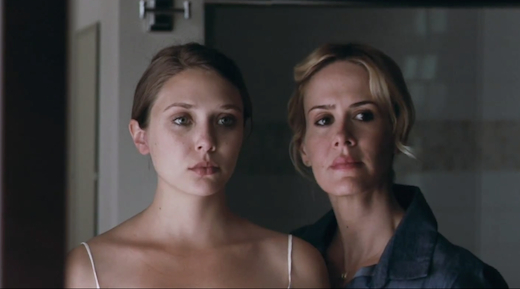
This is the creepiest movie I've seen in years. Since Memento, this is perhaps the best example of effectively using narrative structure to pull the viewer into the character's head and simulate what the character is feeling. A number of reviews complained that the transitions between the past and present are sometimes confusing and indistinguishable. Well, duh. Of course they are indistinguishable for the initial moments. That's just the point. There is only one quick scene of violence in the whole movie, but the second half is so tense that I couldn't tear away from the DVD to go to the bathroom.
As a first feature, Sean Durkin showed great confidence by being very restrained and trusting the autdience's observation and imagination. It can be rewarding if you really pay attention, or incomprehensible if you expect to be spoonfed. Like Roose Bolton, he speaks softly, so that you have to lean in and strain to hear it. By the mere act of leaning in and paying close attention, you left your mind be taken over.
At one point, I was pulled so deep into the title character's mind that, for a short second, I had the illusion that I was a young person without any real means of making a living and surviving the world. In that moment, I was taken out of myself and very nearly became the character. It was a bizarre feeling; I can't say I've ever experienced it before.
One very well-done thing most (male?) reviewers seem to miss is Lucy, played by Sarah Paulson, and a history of sibling tension only hinted at. Let's face it, the architect brother-in-law, played by Hugh Dancy, is written as a self-absorbed jerk. Whatever the family circumstance was for the sisters, one escaped into the arms of a jerk and the other found family in a cult. Also observe how Lucy's feeling toward Martha slowly shifted from annoyance and a hint of envy to concern and sympathy, all the time with an underlying guilt. It seems very realistic to me.
I like stories that fully acknowledge and suggest a larger world outside the frame of the story itself and that the characters live in that larger world with most of it unseen by the reader/viewer, even though each story is in fact confined to the length of so many pages or so many minutes.
Thursday, August 16, 2012
Symphonic Dances Rachmaninoff
Heard this piece on the radio and thought "how Prokofiev." Then the announcer said it was Rachmaninoff's last composition after he escaped to New York (Long Island, actually) in 1939.
Sunday, August 12, 2012
Reinhold Gliere

听广播的时候撞上一首深得我心的曲子,很提神的 chords,但又不突兀。回家一查电台的 playlist,是苏俄时期的近代作曲家 Reinhold Gliere 写的芭蕾 Khrizis, Suite No. 2. 很喜欢。
去查 Gliere 的背景,原来当过 Prokofiev 的师父,Hmm...
Khrizis 似乎挺冷僻的,在 YouTube 上没找到试听版,倒是发现 Gliere 比较有名的作品是个叫 The Red Poppy 的芭蕾。不看不知道,一看吓一跳,原来这个舞剧讲的是苏俄红军在中国解救劳苦人民的故事,主要人物是个美丽的中国姑娘,爱上了苏俄船长,还为他牺牲。哇哈哈笑死我了,原来俄国男人跟西方男人一样对东方姑娘有各种幻想,连布尔什维克也这样。
然后又吓一跳,原来 Michelle Kwan 早在97年即用过 Red Poppy 的音乐做短节目。
Saturday, August 11, 2012
热爱和平的瑞典人
... 发明了机关枪。
在电视上看到根据 Philip Pullman 的小说改编的 The Shadow in the North,好奇去 wiki 了一下,然后在条目里顺藤摸瓜地看见小说里的蒸汽枪 (steam gun) 虽然是虚构的,但大有历史依据。至少有一款机关枪是在英国的瑞典工业家 Nordenfelt 赞助下发明生产的,称为 Nordenfelt gun。加上诺贝尔发明的炸弹,瑞典人对现代战争的贡献不下于中国人发明的罗盘对殖民主义扩张运动的贡献。
I'm sure Swedes are well equipped to appreciate the irony.
在电视上看到根据 Philip Pullman 的小说改编的 The Shadow in the North,好奇去 wiki 了一下,然后在条目里顺藤摸瓜地看见小说里的蒸汽枪 (steam gun) 虽然是虚构的,但大有历史依据。至少有一款机关枪是在英国的瑞典工业家 Nordenfelt 赞助下发明生产的,称为 Nordenfelt gun。加上诺贝尔发明的炸弹,瑞典人对现代战争的贡献不下于中国人发明的罗盘对殖民主义扩张运动的贡献。
I'm sure Swedes are well equipped to appreciate the irony.
Snabba Cash and Contradictions
What I don't like about it are some been-there-done-that elements. One of the three main characters, the spiffily dressed MBA student Johan (middle in the poster), is clearly a Tom Ripley rip-off. The shaky hand-held camera is way overdone ten years ago. The jump cuts that slightly mix up temporal sequence of scenes are very Steven Soderbergh. None of this is particularly new. Plus too many plot gaps can be frustrating to habitual mystery readers who care about logical transitions --- it's an indication of carelessness in the director and editor. I'm sure the novel on which it was based is better. It also lacks the characteristic black/cold/absurd humor characteristic of other Scandinavian noir films. Replacing it is a melting-pot view of the Swedish immigrants and a mixture of Swedish, Spanish, and (I assume) Serbian dialog. The tone is problematic, oscillating between cynical and sentimental. The main character, the blond Swede Johan, is too sleazy looking to garner sympathy, and the Spaniard Jorge (left) is poorly drawn.
Nevertheless, what I like about this and other Scandinavian noirs is the sense of irony and contradictions. I have observed that some people --- mentally healthy and normal, functional people --- have been born without a sense of irony. I suppose humanity does not need it to survive. So then why do some of us have it and some don't? I am convinced that it is completely innate and cannot be taught. I wish someone would invent a checklist to diagnose who can recognize/appreciate irony and who cannot, just like depression or bipolar diagnostic criteria.
About contradictions. The most egregious example in the movie is that the Serbian hit man Mrado (right) is given an 8-year-old daughter that he has to take around to all kinds of shady occasions, playing in the room while others talk about killing, drug dealing, and beating up rivals. In one scene, she is playing with her stuffed animal while her dad was trying out some submachine guns laying on the bed. Hmm... I hope she grows up into a peace-loving girl. Although slightly softened, Mrado is not turned into a kind and loving human being by having a cute little girl around. Ah I must steal this (not the hitman-with-a-girl cliche but character contradictions) for myself!
Subscribe to:
Posts (Atom)
The Ending of Le Samourai (1967), Explained
A quick online search after watching Jean-Pierre Melville's Le Samourai confirmed my suspicion: The plot is very rarely understood by E...
