I stood inside an office building, waiting for my friend, Eve, to come out and have lunch together. Through the floor-to-ceiling glass wall was a panoramic view of the river. Eve was walking down the lobby toward me when the light changed, and suddenly we saw each other's face covered with a blue sheen. We turned toward the wall and saw the sky turning into a deep, dark shade of blue.
We ran outside and stood on the river bank. The entire world was bathed in an eerie blue light. People gathered around in stunned silence. As we looked up, everyone's face glowed in an intense blue-white light, as if having absorbed and then emitting a high-energy pulse, as if we had entered a photograph-developing dark room, except the color was blue. Before us, the wide river flowed calmly. In a gentle breeze, the ripples flickered blue with dark, glistening peaks.
Someone beamed a flashlight into the sky. The beam of light touched an invisible ceiling somewhere above and was swallowed whole, leaving only a flat, small, white disk, like a paper cutout with little holes within. A few more such disks appeared in the sky. They floated silently and slowly, like snowflakes that never fall to the ground. Soon, more white pieces began to appear. They all seemed two dimensional, like paper cutouts with intricate patterns. One looked like a butterfly. Another looked like a fish with holes for scales. They drifted weightlessly, icy and indifferent, in the starless sky.
Saturday, May 12, 2012

Wednesday, May 9, 2012
Fate
Reading "The Song of Achilles" reminded me of an old movie that left a deep impression on me "Portrait of Jennie," which led me to the novella by Robert Nathan of the same name. It is a tender and haunting story set and written in the late 1930s.

What do Greek mythology and "Portrait of Jennie" have in common? Both deal with predetermined fate and people who are resigned to that knowledge. Does one struggle and fight or accept and make the best of it?
What do Greek mythology and "Portrait of Jennie" have in common? Both deal with predetermined fate and people who are resigned to that knowledge. Does one struggle and fight or accept and make the best of it?
The Marriage Plot

The novel is most amusing and fun when it is gently poking fun at its various characters and the social and academic strata they represent, very much in the same vein as Jane Austen novels. I don't even mind so much that the heroine, the sheltered, naive, and priviledged Madeleine, is not made to be very likable or sympathetic. The problem, I think, is the character Leonard, a dangerously charismatic bipolar patient who is socioeconomically below Madeleine's WASP background. His presence does not fit in the Austen-like tone of the rest of the book. He kind of screws up the entire novel because one cannot mock or satirize, even if kindly, someone who is in such a terrible situation through no fault of his own.
I much prefer the humors about university English department through Madeleine and the obligatory post-college spiritual journey of Mitchell. It was immediately obvious that Mitchell reflects the most of the author himself. I really enjoy the character's youthful earnestness and doubt. Mitchell feels like the most authentic of the three, and his arc is the most believable and nuanced.
Perhaps because I am fairly close to bioscience research and mental illness, Eugenides' depiction of both aspects in Leonard (being a scientist and bipolar patient) seems well researched but not convincing. Thus Leonard's pull on Madeleine is also quite unconvincing.
Monday, May 7, 2012
Swimming Video
今天去游泳时某同学要求跟着,还拿照相机拍了一段video。回家后看自己挥着两条小胖胳膊在水里慢吞吞地划呀划的,忍不住哈哈笑出声来。不过真的颇有教育效果,可以看出自己换气的时候头转动幅度太大了。难怪花样滑冰教练都爱给学生拍录像呢。
Friday, May 4, 2012
Birdsong (TV)

This TV miniseries irritates the hell out of me. They fancy themselves Anthony Minghella making "The English Patient" or something. Besides gruesome WWI battlefield scenes, liberally littered with broken bodies and spilled bowels, there are long takes of nothing but people staring at each other, muttering a few words that are supposed to be romantic or profound. If it weren't for Richard Madden's minor role in it, I would have given up within the first half hour. Poor Eddie Redmayne. I do like him and don't mind his freckles, but all his endless sad gazing at the camera with his deep-set eyes, accompanied by faint, tinkly soundtrack music, just got me sick and tired after the first dozen times. Oh, the endless, endless weeping! Ugh. The pace is "artfully" ponderous and the scenes are damned repetitive. The characters and plot seemed to have come straight out of trashy French romance novels. The soapy cliches have been exploited so ad nauseum by now that even the trashiest genre fiction writers today would be ashamed to recycle them. I guess only the serious mainstream literary authors, sitting in their musty university English department offices, are not embarrassed to continue to exploit these cliches. Why the fuck are these characters so fucking weepy and hysterical all the time at the slightest provocation? Yet they are supposed to be hardened by war and carnage. This is as bad as Korean TV soap operas. The last straw is that the hero lives to the end! Yay, happy ending! Everyone else dies, on the battlefield, in the trenches, in the tunnels, whatever, but he survives desperate situations over and over and over again. Groan. I am sorry but this kind of storyline can no longer gain the respect of anyone who has gone through A Song of Ice and Fire. Perhaps I should blame GRRM for spoiling my appetite. Once you've tasted the most potent flavors, the watery old crap just won't do.
Death of a Salesman
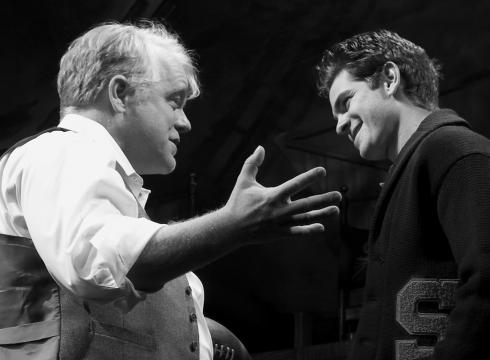
Is it the great America tragedy or the great American satire? I consider it the latter, with scathing ironies on everything held up as the archetypical American Dream: a house paid off in 25 years, worship of youth and popularity ("being well liked"), a boastful masculinity, a delusional optimism, and, most of all, selling things. Sell, Sell, Sell! Everyone can see Willy Loman is pathetic, yet no one walks out thinking the play is really about the "Death of the American Dream." It has been considered by many to be the "greatest American play." Ironic, isn't it?
But it is also a family tragedy in the sense of great American family tragedies. I most identify with Happy Loman, desperately trying to hold the family together by toeing the line, obliviously idolizing everyone else but baffled by their bitterness toward each other, perpetually wondering what the fuck is wrong with your clansmen.
What is wrong with the family? What a bizarre and fucked up relationship Willy and Biff have. In the best of times, they simultaneously idolize and be idolized by each other, and in the end crush each other under the weight of both men. Willy incessantly fawns over Biff's youth and popularity in high school, which feeds his own delusional self-image of being a "well liked" salesman up and down the Northeast. Biff basks in his father's adoration and idealization, swallowing Willy's myth line and hook to his own peril. Biff's idol shriveled and died when he happened upon Willy sleeping with a trashy woman on the road some years ago, and the death of his Father myth lay waste to his subsequent life. The death of Willy's Son myth comes much later and more reluctantly, resulting in Willy's suicide. In a way, Biff's self-destruction is a form of suicide, too. Father and son, what symmetry!
Why should it be so strange that one would look to his son for comfort and dependency and other kinds of safety and protection normally provided by one's parents? Oh, Willy's father was absent in his childhood. The substitute father, his brother Ben, abandoned him, too. Is it so incomprehensible that a weak, frightened, pathetic man would cling onto his first-born son as a shield against the constant assaults on his self-esteem from the world? It is fairly common, in fact, for parents to try to boost their own sense of worth through bloated expectations on their children's worth. And children under such desperate parental neediness eventually crumble, even without the revelation that their parents are but weak and pathetic nobodies.
Parents and children are all desperately seeking a safe haven for their fragile and broken psyche. Delusions abound. Everyone in the play lives in a rosy delusion of the others, even Biff, whose rage is rooted in his inability to let go of his Father myth. I suppose it is inevitable that most children cannot help but idolize their parents and believe them omnipotent. But then from whom do parents find such comfort if they have not found it in their own parents? I guess that is the universal appeal of religion.
***********
看完 Salesman 之后的当晚做梦梦见了 Paul Giamatti。
Tuesday, May 1, 2012
二手资料
在纽约听来的故事。
某个韩德混血男青年,因为会讲韩语而被选中给韩裔灰色生意做事。报酬优厚,要做的事却很简单,就是开了豪华车跑机场接送人。接送的全都是韩裔美女,送的都是城内高级酒店,几个钟头或一夜后即送回机场飞走。偶尔也会有接送大亨嫖客的任务。
有一次接了位美女,坐在后面一直哭泣。他默默地把车开到了别处,也不知干了什么,或许只是请美女喝了杯咖啡,总之没有把她按指定时间送到指定地点。第二天清早便把她送回机场离去。
于是这个司机工作也没了。
某个韩德混血男青年,因为会讲韩语而被选中给韩裔灰色生意做事。报酬优厚,要做的事却很简单,就是开了豪华车跑机场接送人。接送的全都是韩裔美女,送的都是城内高级酒店,几个钟头或一夜后即送回机场飞走。偶尔也会有接送大亨嫖客的任务。
有一次接了位美女,坐在后面一直哭泣。他默默地把车开到了别处,也不知干了什么,或许只是请美女喝了杯咖啡,总之没有把她按指定时间送到指定地点。第二天清早便把她送回机场离去。
于是这个司机工作也没了。
Subscribe to:
Posts (Atom)
The Ending of Le Samourai (1967), Explained
A quick online search after watching Jean-Pierre Melville's Le Samourai confirmed my suspicion: The plot is very rarely understood by E...
