Just got the brochure in the mail. No dates yet. I will go see it.
Below is a poster of Vishal Bhardwaj's modern adaptation of Othello, Omkara (2006). It's pretty excellent and very faithful to the play. Like in most productions, Iago, played by Saif Ali Khan, steals the show.
Books, movies, food, and random thoughts in English and Chinese. Sometimes I confuse myself.
Search This Blog
Tuesday, May 12, 2015
Tuesday, May 5, 2015
Theological Subversiveness in Mahabharata (Notes #17)
I suppose one should not be surprised by the mess of stories, mythologies, cults, and messages that were crammed into Mahabharata over centuries of telling and retelling. Many of the lessons and points conflict with and even contradict each other, down to the basic definition of "dharma." Fine. There is something in the Indian history and culture that drove the exacting English colonialists crazy, because one can never seem to get a straight answer to any question about India. Any simple question, like, What is dharma? What is maya? What is sin?, can lead to a lifetime of research and philosophical argument with no end in sight.
Be that as it may, I want to sort out a few signs of direct theological antagonism in the epic, particularly in the Bhagavad Gita.
The most striking message in the Gita is to act without expectations of rewards, ie, the karma yoga. This is in opposition to the traditional Indian mythology based on asceticism, which is full of anecdotes of someone getting his wish granted by a god, big or small, by starving himself, chanting the god's name a million times, and standing on his toe for a few years, known as tapasya. If you're a well pampered king who doesn't want to go through that self-torturing routine, you can hire a team of Brahmins to do the praying for you and throw in a lot of good stuff (eg, milk, ghee, flowers) in the ceremony. Voila! You get your wish granted. It is such a straightforward even exchange between the gods and men and universal to nearly all ancient cultures on earth. I offer/sacrifice something precious to the gods, and the gods give me what I want. Simple and instinctive. Yet the Gita says, you should not even expect a reward for your sacrifice to the god. Forget it.
Well, that's an unpleasant gift, isn't it? Even though it is more realistic and empirically true, telling people that they cannot bargain with (and therefore control) fate/gods/fortune is contrary to our hopes and dreams. Such realism can't win any followers. So we are thrown a bone. Yes, there is a reward, which is moksha. Who needs earthly rewards (eg, wealth, happiness, long life, death to your enemies) when you can achieve the ultimate joy of being released from the cycles of life and death, heaven and hell.
Be that as it may, I want to sort out a few signs of direct theological antagonism in the epic, particularly in the Bhagavad Gita.
The most striking message in the Gita is to act without expectations of rewards, ie, the karma yoga. This is in opposition to the traditional Indian mythology based on asceticism, which is full of anecdotes of someone getting his wish granted by a god, big or small, by starving himself, chanting the god's name a million times, and standing on his toe for a few years, known as tapasya. If you're a well pampered king who doesn't want to go through that self-torturing routine, you can hire a team of Brahmins to do the praying for you and throw in a lot of good stuff (eg, milk, ghee, flowers) in the ceremony. Voila! You get your wish granted. It is such a straightforward even exchange between the gods and men and universal to nearly all ancient cultures on earth. I offer/sacrifice something precious to the gods, and the gods give me what I want. Simple and instinctive. Yet the Gita says, you should not even expect a reward for your sacrifice to the god. Forget it.
Well, that's an unpleasant gift, isn't it? Even though it is more realistic and empirically true, telling people that they cannot bargain with (and therefore control) fate/gods/fortune is contrary to our hopes and dreams. Such realism can't win any followers. So we are thrown a bone. Yes, there is a reward, which is moksha. Who needs earthly rewards (eg, wealth, happiness, long life, death to your enemies) when you can achieve the ultimate joy of being released from the cycles of life and death, heaven and hell.
Sunday, May 3, 2015
The Palace
Last night I dreamed of the palace again. This has become a recurrent dream in recent months. The building is always somewhere nearby, in downtown DC or on the National Mall, behind one of the Smithsonian museums but easily. Or it might be just past Old Town Alexandria, between the red-brick buildings and the river. Or it was a ten-minute walk from home, across a field of waist-high grass and behind willow trees.
On the outside it is not gigantic but exquisitely complex. Topped with a golden dome, the deep blue frames and colored glass form intricate patterns. Whenever I visit it in a dream, it is always with someone --- family, friends, or just Sam, but never alone. It's a hidden gem that I show off to them. We have to first pass through a plain and ordinary building and a courtyard to see the grandeur of this palace.
At the sight of the dome and the glorious walls, a gentle gladness and calm excitement wash over me. We enter the palace and up the spiraling stairs. No royalty live here; it is an art museum, like National Gallery of Art. Let me show you all the good stuff, I say to my companions. It feels like home.
On the outside it is not gigantic but exquisitely complex. Topped with a golden dome, the deep blue frames and colored glass form intricate patterns. Whenever I visit it in a dream, it is always with someone --- family, friends, or just Sam, but never alone. It's a hidden gem that I show off to them. We have to first pass through a plain and ordinary building and a courtyard to see the grandeur of this palace.
At the sight of the dome and the glorious walls, a gentle gladness and calm excitement wash over me. We enter the palace and up the spiraling stairs. No royalty live here; it is an art museum, like National Gallery of Art. Let me show you all the good stuff, I say to my companions. It feels like home.
Friday, May 1, 2015
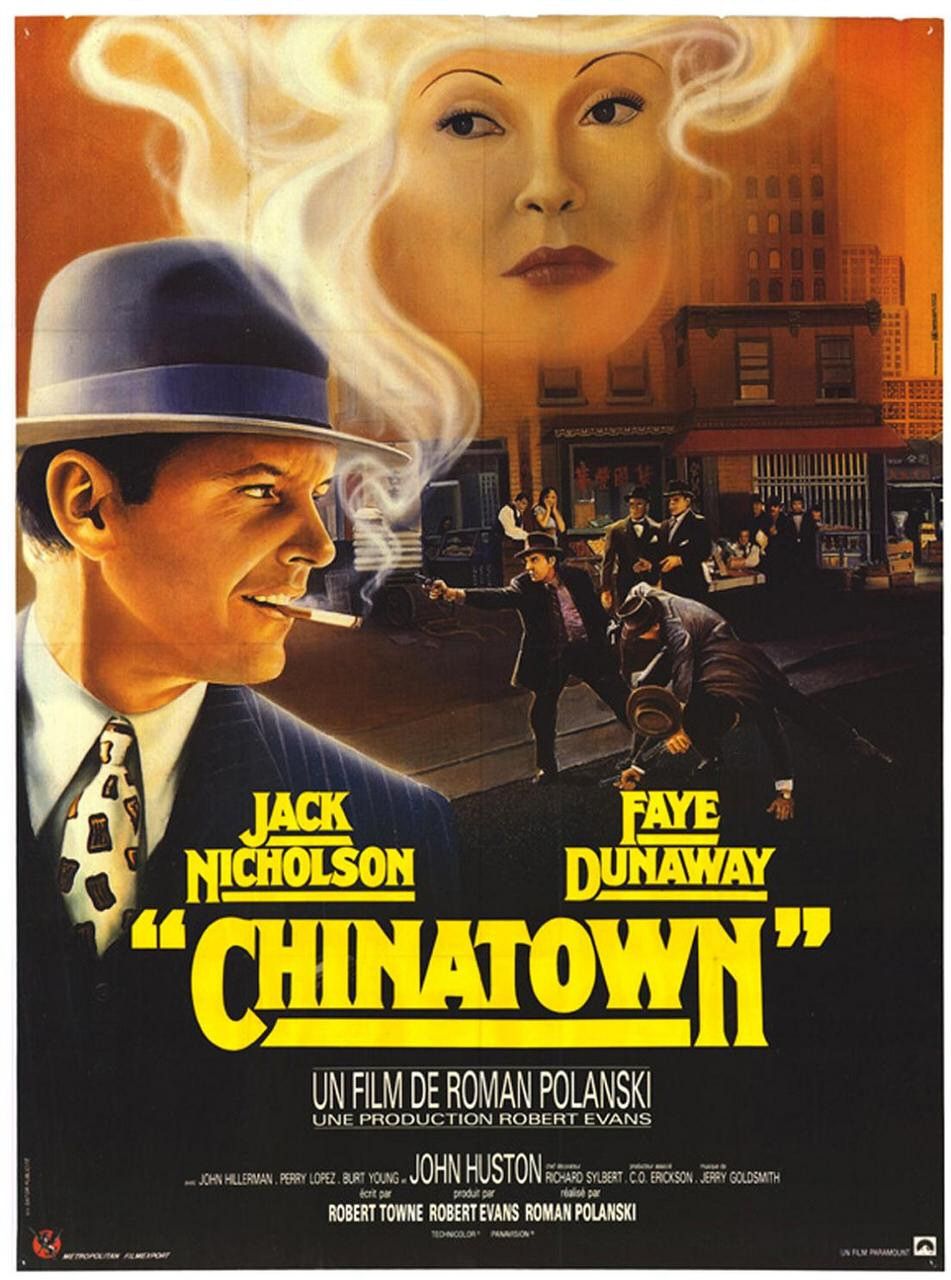
The Ending of Chinatown (1974)
The original ending of Chinatown, written by Robert Towne, was changed by the director Roman Polanski to be more tragic and ironic, and Towne complained about it later in some book he wrote. Film critics generally take Polanski's side as the superior choice.
In Polanski's version (ie, the movie version), Jake the private detective (Jack Nicholson) and his associate, the villain Noah Cross (John Houston) and his henchman, his daughter Evelyn Cross (Faye Dunaway) and her daughter/sister Kathrine, and a couple of police detectives all congregate in Chinatown. Evelyn tries to drive away with Kathrine. Her father, the henchman, the police, and even Jake try to stop her, but somehow by holding a gun she gets into a car and drives off, and then one of the policeman shoots and kills Evelyn. Noah takes Kathrine. The end.
Towne's version is in some sense indeed more conventional to the genre and appealing to the popular expectation. Jake, Noah, Evelyn, and the police (but no Kathrine) also converge on a beach in pouring rain. Evelyn takes her revenge by shooting her father dead. She goes to jail. The end.
Well, I can see why critics favor Polanski's version of the ending, and clearly he wanted to do this when he read the script, because earlier in the movie he dropped several foreshadowing hints to duplicate the climactic ending (eg, Jake has his car's tire shot out by an orange farmer, Evelyn lowers her head in the car and accidentally hits the horn). An unsatisfying and tragic ending in which "the bad guy wins" is bound to stay with you longer than a just resolution. It is also understandable that Polanski wants a bleak ending in which the lead female character dies, since this was a few years after his wife was murdered by the Mansons.
Yet, I am not happy about Polanski's ending, either. All 3 female characters in the movie are victims through and through, used and abused lying down. They are weak and neurotic and pathetic. It is suggested but not confirmed that Evelyn has given her daughter to her husband as a sexual gift. One might excuse this treatment of women within the context of time and culture, but it becomes a lot harder to excuse when the original ending gives so much more power to Evelyn. Even if she fails in her revenge --- which would be an ending I prefer, she would have made an attempt and done something more than running away. Why not keep her fight while still kill her off and let the bad guy win?
I know it is not fashionable to bring Polanski's personal life into critiques of his work, but if we want to acknowledge the effect of his wife's murder, then I think his sexual preference for adolescent girls is fair game. One may argue that it is no surprise that he doesn't much like women with any strength. I suppose a male critic is unlikely to notice the dismal portrayal of women or be disturbed by Faye Dunnaway getting slapped around by the hero without much resistance. Even I did not much think of it, until I read up on what Towne had in his original script.
Last week I re-watched "The French Connection" (1971) and was much disappointed by several plot holes and unrealistic, illogical details in a film that prides itself for the documentary-like realism in style. The plot problems in "Chinatown" are less glaring, but nevertheless quite visible. For example, it is never explained clearly who hired Jake to expose Mulwray's extramarital affair in the first place, and the feeble reveal is limp and unconvincing and does not fit into the two main threads of the story. It is never explained how the police get to Chinatown in the end, yet do not seem to make a real effort to arrest Evelyn, who is by then the main suspect in her husband's murder and is about to become a fugitive. Why and where does Evelyn intend to run in the car? The story states early on that she did run away from home years ago, yet this time she is still incredibly incompetent at running away. It also makes no sense for Jake to confront Noah Cross, right before he carries out Evelyn and Katherine's escape. What is he, born yesterday? What's the rush?
I don't know what's the problem with these classic movies from the early 1970s. Did they not have script editors back then? Maybe I should re-watch The Godfather next because I do not remember any visible plot holes in that movie. This is not to say movies today do not have glaring holes and mistakes, but tightly written scripts like "Michael Clayton" and "One False Move" are not uncommon.
Saturday, April 25, 2015
King John and ASOIAF
Let me count the similarities ---
1. The bastard of Richard the Lionheart. He's pretty dashing, but he talks like Tyrion Lannister, or more accurately Tyrion talks like him. And they both are in fact loyal and pure at heart. They just like to put on a cynical appearance and deliver some zingers.
2. The sympathetic poor Hubert. The misunderstood killer. The wronged bad guy with a heart of gold. He is almost exactly like Sandor the Hound.
3. At the center of the three-sided battles is the question of whether it is justified to murder a child. John decided that he had to, and was duly punished for the crime. Ned Stark refused to be the cause of potential execution of three children born of incest (and treason), and he was duly punished for his kindness. Yes, damned if you do and damned if you don't.
4. Even after all three parties opposing him (Rome, France, and his own dukes) have been appeased, King John can still be killed off by an almost random person and act. See also Ned Stark and Balon Greyjoy and Tywin Lannister.
This is what drives me crazy when I try to dig out Shakespeare's influence on GRRM. Nothing is concretely transplanted --- No, GRRM is too clever for that. Rather, it is a strong whiff of shared view on people and the way of the world.
1. The bastard of Richard the Lionheart. He's pretty dashing, but he talks like Tyrion Lannister, or more accurately Tyrion talks like him. And they both are in fact loyal and pure at heart. They just like to put on a cynical appearance and deliver some zingers.
2. The sympathetic poor Hubert. The misunderstood killer. The wronged bad guy with a heart of gold. He is almost exactly like Sandor the Hound.
3. At the center of the three-sided battles is the question of whether it is justified to murder a child. John decided that he had to, and was duly punished for the crime. Ned Stark refused to be the cause of potential execution of three children born of incest (and treason), and he was duly punished for his kindness. Yes, damned if you do and damned if you don't.
4. Even after all three parties opposing him (Rome, France, and his own dukes) have been appeased, King John can still be killed off by an almost random person and act. See also Ned Stark and Balon Greyjoy and Tywin Lannister.
This is what drives me crazy when I try to dig out Shakespeare's influence on GRRM. Nothing is concretely transplanted --- No, GRRM is too clever for that. Rather, it is a strong whiff of shared view on people and the way of the world.
Friday, April 24, 2015
King John Revisited
I am trying to test my memory on this absurdly complicated story.
In the beginning King John was the de facto king of England. His brother, Richard the Lionheart, named him heir to the throne, despite a stronger claim by their nephew Arthur, as Arthur's father (dead) had been older than John. Still an innocent child, Arthur was not particularly keen on overthrowing his uncle, but his keen mother, Constance, took him and the claim to the King of France, Philip. France confronted England in Arthur's name. One does not need France's true intention spelled out, however, considering the ongoing land disputes between the neighboring countries (England held Brittany and other territories on the Continent).
And so they attempted to resolve the dispute the old fashioned way: through war. The conflict was stuck in a stalemate. What to do? John and Philip reached a truce, in which John married his niece Blanche to the Dauphin Louis and England gave up some of the land to France as her dowry. Methinks England probably lost in reality. The war ended and Arthur's suit was put aside. Constance, of course, was not happy about the arrangement, but John and his army had captured Arthur in a battle. Now England seemed to hold all the cards ... Or do they?
Peace with France might not be the best policy, but the king had little choice at the moment, because he was being attacked on another side by the Pope, who was unhappy about his domestic policy to levy taxes on the churches. England's conflict with Rome also put France in an awkward position. If you don't denounce England, the angry Roman envoy Pandolf threatened Philip, you would be excommunicated along with John. Ah the problem of The Three Kingdoms. The fragile alliance between England and France hung in a balance. Pandolf convinced the Dauphin to invade England, because now Louis also had a claim to the English throne through his marriage to Blanche. Oh isn't that clever of the little cardinal?
Meanwhile in England, John did not want to sit and wait for the French invasion in the name of rescuing Arthur, the rightful king. So he ordered the boy executed by Hubert, everyone's favorite killer. Only this killer had a heart of gold (unlike the killers in Richard III but not unlike Sandor Clegane) and was moved by the child's innocence. So he quietly hid Arthur somewhere in the Tower, while telling the king he'd done the deed. But the king changed his mind two minutes later! When his already-disgruntled lords were appalled and outraged that he had murdered a child! John wished he would kick the stupid lords' asses, no doubt, but right now he needed their help to fight off the French. Oh how he regretted having given the order.
Man, it sucks to be a lowly henchman. One moment your boss wants the kid dead, the next he is blaming you for being a psychopathic killer. What a bhenchod (oops, wrong language). Anyway, so Hubert told John the truth and they all hugged each other and thought, The kid's still alive! We're all saved from a rebellion and bad names for a thousand years! Unbeknownst to them, Arthur sneaked out of the Tower and jumped the wall and broke his own neck, lying dead in front of the fuming lords. Awkward. If they had been wavering a bit about betraying England, now they had to be pushed to the Dauphin's side by the bloody corpse.
And so there John sat in his tent on the battlefield and couldn't believe how things had fallen apart. An hour ago he had married Blanche to Louis, got France off his back, and Arthur had lost. Everything had been so peachy. Suddenly he became a child-murderer, even though he rescinded the order, was excommunicated by Vatican, and was about to lose his country to France! Maderchod (sorry, wrong language again). In a desperate last-ditch effort, he treated with Pandolf and gave the Vatican whatever they wanted.
Mission happily accomplished, Pandolf went to Louis and said, OK, we can go home now, I got what I wanted. Louis laughed, What about what I want? Do you think you can let the wolf out of the cage and then drag him back before he's fed? The wolf will not let go of the big fat piece of steak between his teeth. He told Pandolf to get lost and pressed his army on, along with Salisbury and the other well-meaning English traitors. Finally, somehow, the English lords came to their senses and decided to switch sides from the French Dauphin. Louis had to abandon his dream and go home. All seemed to be finally looking up for John. Then King John got himself poisoned by a monk, I guess because of his earlier excommunication. So he died and his son Henry was crowned. The end.
How did he cram all this into just one play?! It gave me so many whiplashes I thought my head was going to fall off.
Oh, and in the middle of it all, there was this fabulous character who is a bastard and has all the best one-liners.
In the beginning King John was the de facto king of England. His brother, Richard the Lionheart, named him heir to the throne, despite a stronger claim by their nephew Arthur, as Arthur's father (dead) had been older than John. Still an innocent child, Arthur was not particularly keen on overthrowing his uncle, but his keen mother, Constance, took him and the claim to the King of France, Philip. France confronted England in Arthur's name. One does not need France's true intention spelled out, however, considering the ongoing land disputes between the neighboring countries (England held Brittany and other territories on the Continent).
And so they attempted to resolve the dispute the old fashioned way: through war. The conflict was stuck in a stalemate. What to do? John and Philip reached a truce, in which John married his niece Blanche to the Dauphin Louis and England gave up some of the land to France as her dowry. Methinks England probably lost in reality. The war ended and Arthur's suit was put aside. Constance, of course, was not happy about the arrangement, but John and his army had captured Arthur in a battle. Now England seemed to hold all the cards ... Or do they?
Peace with France might not be the best policy, but the king had little choice at the moment, because he was being attacked on another side by the Pope, who was unhappy about his domestic policy to levy taxes on the churches. England's conflict with Rome also put France in an awkward position. If you don't denounce England, the angry Roman envoy Pandolf threatened Philip, you would be excommunicated along with John. Ah the problem of The Three Kingdoms. The fragile alliance between England and France hung in a balance. Pandolf convinced the Dauphin to invade England, because now Louis also had a claim to the English throne through his marriage to Blanche. Oh isn't that clever of the little cardinal?
Meanwhile in England, John did not want to sit and wait for the French invasion in the name of rescuing Arthur, the rightful king. So he ordered the boy executed by Hubert, everyone's favorite killer. Only this killer had a heart of gold (unlike the killers in Richard III but not unlike Sandor Clegane) and was moved by the child's innocence. So he quietly hid Arthur somewhere in the Tower, while telling the king he'd done the deed. But the king changed his mind two minutes later! When his already-disgruntled lords were appalled and outraged that he had murdered a child! John wished he would kick the stupid lords' asses, no doubt, but right now he needed their help to fight off the French. Oh how he regretted having given the order.
Man, it sucks to be a lowly henchman. One moment your boss wants the kid dead, the next he is blaming you for being a psychopathic killer. What a bhenchod (oops, wrong language). Anyway, so Hubert told John the truth and they all hugged each other and thought, The kid's still alive! We're all saved from a rebellion and bad names for a thousand years! Unbeknownst to them, Arthur sneaked out of the Tower and jumped the wall and broke his own neck, lying dead in front of the fuming lords. Awkward. If they had been wavering a bit about betraying England, now they had to be pushed to the Dauphin's side by the bloody corpse.
And so there John sat in his tent on the battlefield and couldn't believe how things had fallen apart. An hour ago he had married Blanche to Louis, got France off his back, and Arthur had lost. Everything had been so peachy. Suddenly he became a child-murderer, even though he rescinded the order, was excommunicated by Vatican, and was about to lose his country to France! Maderchod (sorry, wrong language again). In a desperate last-ditch effort, he treated with Pandolf and gave the Vatican whatever they wanted.
Mission happily accomplished, Pandolf went to Louis and said, OK, we can go home now, I got what I wanted. Louis laughed, What about what I want? Do you think you can let the wolf out of the cage and then drag him back before he's fed? The wolf will not let go of the big fat piece of steak between his teeth. He told Pandolf to get lost and pressed his army on, along with Salisbury and the other well-meaning English traitors. Finally, somehow, the English lords came to their senses and decided to switch sides from the French Dauphin. Louis had to abandon his dream and go home. All seemed to be finally looking up for John. Then King John got himself poisoned by a monk, I guess because of his earlier excommunication. So he died and his son Henry was crowned. The end.
How did he cram all this into just one play?! It gave me so many whiplashes I thought my head was going to fall off.
Oh, and in the middle of it all, there was this fabulous character who is a bastard and has all the best one-liners.
Thursday, April 9, 2015
Bhagavad Gita and Figure Skating (Mahabharata Notes #16)
The phenomenon of "choking" in competitive sports is well known. It refers to those high-stake moments when a competitor performs far below his normal ability, as if he has forgotten to be himself. Choking is particularly in sports that require highly precise techniques, such as figure skating. After years of watching skating live, it's become clear to me that, in an important competition, figure skaters routinely achieve no more than 70% of the highest level of difficulty they are capable of in practice. This level can drop further if the skater is temperamentally sensitive to the psychological pressure. For skaters often called "headcases," he might fail on techniques in a critical championship that he would succeed with 90% certainty in practice. Why? Perhaps the reason is that figure skating is exquisitely affected by the skater's mind. I have done a little bit of recreational swimming, running, and skating, and found that skating demands the most attention and concentration. Therefore, when the brain is wandering toward the thoughts of winning and losing, it is so easy to lose focus, which destroys one's technique.
The fact that many of my favorite skaters are prone to "choking" has vexed me for years and led me to wonder years why the mind fails them. Do they unconsciously sabotage their own success? Or does the chance of choking increase with how badly one wants to win? If so, how does one suppress the desire to win for a few minutes in order to focus on just the skating?
This is why, when I first read one of the themes in Bhagavad Gita, "detach from the fruits of your action," I immediately felt a tingling inside my skull. There is something profound and subtle about this seemingly paradoxical about the advice.
And this phenomenon is not limited to sports, for in life the wish to have something does not often lead to choices toward its realization. Thinking about what you want may spur you on sometimes and paralyzes you other times. The problem of self-defeating behaviors is complicated and difficult to remedy.
The fact that many of my favorite skaters are prone to "choking" has vexed me for years and led me to wonder years why the mind fails them. Do they unconsciously sabotage their own success? Or does the chance of choking increase with how badly one wants to win? If so, how does one suppress the desire to win for a few minutes in order to focus on just the skating?
This is why, when I first read one of the themes in Bhagavad Gita, "detach from the fruits of your action," I immediately felt a tingling inside my skull. There is something profound and subtle about this seemingly paradoxical about the advice.
And this phenomenon is not limited to sports, for in life the wish to have something does not often lead to choices toward its realization. Thinking about what you want may spur you on sometimes and paralyzes you other times. The problem of self-defeating behaviors is complicated and difficult to remedy.
Subscribe to:
Posts (Atom)
The Ending of Le Samourai (1967), Explained
A quick online search after watching Jean-Pierre Melville's Le Samourai confirmed my suspicion: The plot is very rarely understood by E...

