Search This Blog

Sunday, December 12, 2021

The Duel! The Duel!


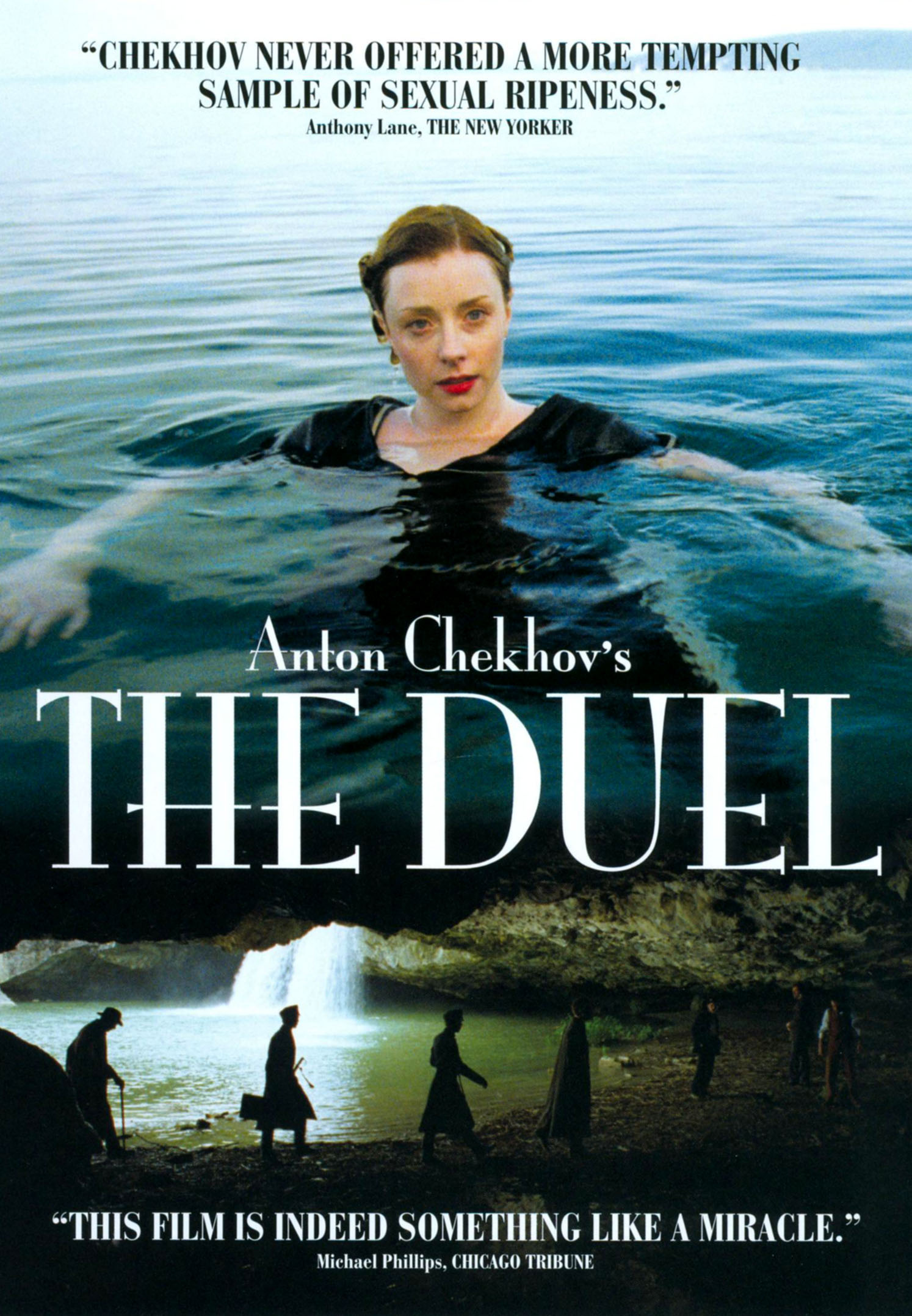
It might be unbelievable but in fact I had no idea the book I borrowed last week from the library, The Complete Short Novels by Chekhov, contained a short novel titled "The Duel". Well, I mean, there are more than one duel in Chekhov's plays, so it's not surprising that one pops up in a novel, right? 

At one point while reading this short novel, I burst out laughing so loud that one could hear me from another room. First and foremost, Chekhov is a comedy writer. I'm not talking about the kind of gentle and sad smiles with lamentation often associated with him, although those are present too, occasionally. No, I'm talking about gags and jokes and mockery of human frailties. 

I gotta admit it, I love this kind of mockery, which exposes how pathetic our lives are and how little our struggles mean. The existential laugh. It seems to be a fairly common theme in Russian literature at the time --- the futility of the intellectual angst over how to save the Motherland and her peoples from poverty and backwardness and the crushing bureaucracy and corruption blah blah blah. Throughout the novel, Chekhov made references to Tolstoy and Turgenev, which also made me laugh. And yet, as much as the novel is steeped in the time and place and those specific problems, I find it much more relatable and relevant to me and our times than anything else. The pathetic lives and anguish of these characters are instantly recognizable in people around me, including in myself. I would even venture to say that there are numerically more people today around the world that are Chekhovian than in 1890s Russia. They, no, we, are all wailing into the void --- "What should I do with my life?!" 

Not that he provides a definitive answer, mind you, or a definitive non-answer, as he was too early for Modernism or Existentialism. The answer he gave is in the example of himself. On top of the piercing insight and the hilarious mockery, he remained kind and warm and able to empathize with pathetic losers that are us. Right now is a pretty bad time to maintain warm feelings about humanity (although when was it ever a good time?). I often wonder if our need for "society" is more of a hardwired instinct than a justified choice. Chekhov seems to be showing us one way of living: One can see the crap that is humanity and still choose to live without illusions and perhaps even love while carrying all the baggage. Why not? (No, the lesson is not to literally work like a dog to pay off your debts, unless that's what you want to do.)

Ever since I smelled a whiff of The Origin of Species in Turgenev's Fathers and Sons, I now see it everywhere (LOL). There is a German character in The Duel who is constantly spewing social Darwinism. It's quite chilling to consider how prescient this character is (and he is German too!), but I can imagine that view might have been popular at that time, before we had the hindsight of the real horror it is capable of inflicting. Nevertheless, a man like Chekhov can instinctively see through this bullshit, no matter how smart or rational it appears to be.

Yes, that's why I love him, because Chekhov inoculates us against bullshit and despair.


Friday, December 3, 2021

Duels on Screen

After denigrating the actual practice of dueling, I have to admit, to my chagrin, that I love watching one-on-one duels in movies. 

Most martial arts movies would include both brawls and duels. Both types of fighting can be well choreographed and well shot, edited, and presented. Nevertheless, a duel usually takes center stage as the climax of a movie. 

From of a purely instinctual perspective, a martial arts movie is composed of a series of ever escalating fights, because that's what human audience consistently wants from a story. Escalation. The hero of the story, with whom we identify, encounters fights of increasing danger and difficulty. If the sequence is reversed into decreasing difficulty, we would invariably lose interest before the triumph arrives. 

There are of course movies that climax on the biggest brawl. The one that comes to mind is the 1925 Japanese silent movie Orochi, possibly the earliest chanbara film. Chang Cheh also liked to end his movies with brawls, followed by the hero's death. Nevertheless, in the genre of martial arts movies, duels clearly outnumber brawls. The reason is quite natural---brawls are impersonal and anonymous, in which our emotional attention is on only one person, while duels concentrate and heighten the drama between two key characters and are therefore personal. One can fit a lot more emotional content into a duel.  

Orochi (1925)
Orochi (1925)

I was thinking about climactic duel scenes in general when I recently re-watched the kitchen fight scene in The Raid 2 (2014) between Iko Uwais and Cecep Arif Rahman. Having only two actors, both top Silat practitioners, do a one-on-one combat, provides a kind of clarity that was less than fully realized in The Raid 1 (2011). Note how this scene is brightly lit with long takes and mid-range full-body shots. Everything in the scene is devised to illustrate the art of Silat as well as the characters' emotional states in high-fidelity details. 

Two other classic duel scenes that I re-watch from time to time are Kill Zone (SPL, 2005), between Donnie Yen and Wu Jing, and Once Upon a Time in China 2 (1992), between Jet Li and Donnie Yen. (Oddly enough, both involve Yen.) 

One of the most classic dueling fights, however, is neither so vicious as those above nor even used in climax. It's right in the middle of Pedicab Driver, between Sammo Hung and Lau Kar-Leung (1989). It's brimming with humor and personality, truly one of my all-time favorite fight scenes. 


As we can see from these clips, the dueling format forces the action choreographer, actors, and cinematographer to do good work, as there is little room to hide incompetence, unlike shaky camera, quick editing, blurry brawls, and all the tricks to allow the stunt team to do most of the heavy lifting. Thus, these scenes build an intimacy between the audience and the dueling characters, in which the audience feels the bruises, cuts, and bleeding far more acutely than a brawl scene. 

Monday, November 29, 2021

Fathers and Sons and Science


Beyond all the commentary on generational relationships, what struck me from the beginning is the presentation of a "science nerd" at the center of this novel. There is some rather convincing details of medicine, heck, even more than any Chekhov I have read.

The medical student Bazarov, sitting in an awkward social position between aristocrats and peasants, is surprisingly modern. He could be a computer geek, a silicon valley dude, or a climate change scientist in today's novels: smart and blunt and egocentric, probably somewhere "on the spectrum." His wholesale rejection of "romanticism" and his cold rationality stood alone among the poetic and heroic characters of the time. The irony vibrating beneath the clashes between Bazarov and Pavel Petrovich sometimes threatens to become overt satire. Of course, Turgenev isn't necessarily endorsing a lack of all delicate feelings and social grace, but it is obvious that he feels, like Bazarov, an impatience with the sentimentality and histrionics in Russian literature.

I don't know whether Turgenev was aware of The Origin of Species, the book that shocked the world in 1859, but I have a suspicion that he had at least heard about it. He was fluent in English, German, and French and chose to stay out of Russia for many years. He was known to be skeptical toward religion, which was uncommon for his generation. Beyond the sympathetic portrayal of Bazarov, the novel is permeated with an attitude of mild distain for the traditional Russian culture and social conventions. Turgenev is looking at his motherland with the eye of an expatriate who has digested and excreted much of the nationalistic cool-aid. 

It was said that Dostoyevsky and Tolstoy did not get along with Turgenev in real life. Who would have guessed?!

Sunday, November 28, 2021

Fathers and Sons and Duels


So I have finally gotten around to read Turgenev. The impetus was seeing on Kindle's list how short Fathers and Sons is --- Are you sure it is not a thousand pages?! Now I can claim to have read classical (translated) Russian literature without breaking a sweat. I can hardly believe it! 

OK I kid. That's a bit of exaggeration. I have read Chekhov's plays and they too were easily accessible to plebs like me. They even made me laugh. There is something similar between Turgenev and Chekhov. Perhaps it's the restrained sarcasm and satire, largely on the "Russian national character" itself. 

My feelings about Fathers and Sons aside, one episode in the novel gave me a real jolt. Around 80% of the novel, the main character, Bazarov, a medical student, was challenged to a duel by an aristocrat of an older generation (people who are now fashionably referred to as "Boomers") on a provincial estate. Turgenev narrated the episode with barely concealed contempt. Nevertheless it was a shock for me to realize that duels between men were commonly practiced and socially accepted less than 200 years ago. Well, you know, men from the civilized, educated class (unlike the unwashed illiterate peasants and craftsmen) would ceremonially fight and kill each other in public to resolve personal disputes ranging from extramarital affairs to political differences. 

I mulled over what it must have been like living in a society like that. It's not like I have never heard of duels before or was unaware that Pushkin was killed in a duel. I grew up reading Alexandre Dumas' adventure novels. As recent as a few years ago, the popular musical Hamilton depicted not one but two duels for blah blah blah reasons. It was a damned normal social interaction. Although the formalized and ritualized practice of duels was specific to European cultures, individual male humans have been brawling with each other since the dawn of society. Nevertheless, I have never thought about the general state of social norms for everyone else, if high-class men could kill each other legally in duels. Surely, women and lower class men in such a society would also have a more relaxed (? for lack of a better word) attitude about violence and death compared with today.

It is nearly impossible for a person to imagine living outside of his or her current life. The modern society, in which violence is heavily centralized and regulated, is only in existence for less than two centuries, and that process is shorter in some places than in others. I wonder whether that is long enough to habituate all men in a life without frequent and intimate bloodletting activities. A few days ago the internet is abuzz with a video of a man shooting and killing another man on his front yard in Lubbock, Texas.

In the grand scheme of history, a duration of one to two centuries is but a blip, probably insufficient to obliterate a ubiquitous culture of bloodthirst. What is the future of human violence? Will it go the way of legal duels, abandoned and forgotten, or will it revive itself in new methods and appearances? 

Fathers and Sons is a novel about a transitional time, when serfdom had just been abolished in 1861 (almost the same time as the slave emancipation in the US in 1863) and nobody knew what the hell was going to happen to the social order. The past is not dead and much of it is not even past, but still changes keep happening, casting human tendencies into their new incarnations. There is a pervasive feeling of despair and resignation in the 19th century Russian literature that the Russian people and the massive imperial bureaucracy would always remain the same, despite all the talks of ideals and reforms by the intelligentsia. The subsequent events have supported this feeling through today. Russia remains the same in spirit if not on the surface. 

Not only Russia, of course. 

Monday, November 8, 2021

Xenocide


I was so so about Ender's Game, really liked Speaker for the Dead, and the third book of this series, Xenocide, has left me with mixed feelings. 

Orson Scott Card is a sophisticated science fiction writer and has built a detailed and reasonably logical universe with 3 intelligent species as well as various technologies. Given that these novels were written during the early days of the internet, some of the connectivity-related elements are fairly prescient.  

There is an issue that has bothered me from the start, but it is not easy to pin down. On the surface level, the problem is the main character, Andrew Wiggin, who never seems human or possesses distinctive human qualities. Rather, he is the embodiment of the omnipotent fantasy, also known as a "superman" figure. Supporting characters are given human flaws and traits amidst family secrets, which worked better in Speaker for the Dead but becomes an intractable squabbling mess in Xenocide. It seems to suggest that the author is not incapable of delving into humanity but is clearly not all that interested in it.

The problem becomes clearer as we are introduced to a genetically enhanced subspecies of humanity on the planet Path, who are presumably Chinese. From the start, Orson Scott Card has always been more interested in superhumans than humans. In his world, a small group of individuals with superhuman intelligence determine the fates of a planet, many planets, the universe, and other species of organisms. The story is always centered around their superpowers, but we never see the consequences and implications of these superpowers to the masses on the ground level. Actually, the only consequences we see are consistently favorable to Ender. There is no animosity between the Hive Queen and her species' "ender"; in fact the text suggests that she loves him. It does not make sense but hey she's alien so I guess it's all OK then. 

The masses of humans and pequeninos are presented as stupid and mindless mobs who cannot be told the true causes of their extinction or survival. No, they are all too stupid to understand and must be kept in total ignorance for their own good. The masses are also presented as the evil bureaucracy of Starway Congress. Even though there is one character in Xenocide who appears to have risen from the proletariats to be of equal intelligence as "the chosen ones," she is later revealed to be also genetically destined to be superhuman. 

It appears that Orson Scott Card is very much aware of his elitism and reluctant to put it on full display. Nevertheless, the theme is that we have to trust in the benevolence of a small group of superhumans, who are superior to and the rightful rulers of the faceless masses. As such, the scale of these stories are both grand and puny, with handful of persons across the universe controlling the life and death of supposedly millions of people and nonhuman organisms, although they exist as more or less an abstract notion. In a way the sequels remain true to the video-game nature of the original Ender's Game. They are supposed to be about real lives and real stakes of the universe but remain on paper or in cyberspace, floating above the earth of each of the planets.

One could argue that the vast majority of people in the world believe themselves to be superior to others, or at least more special than others. Perhaps not as many indulge in his own world-savior fantasies, but the prevalence is particularly high in the sci-fi/fantasy circles. In that sense Orson Scott Card is not that special. And some readers no doubt identify with the god-like patriarch that is Ender. 

So the flip side of the superman power-trip fantasy is its patriarchal subtext. The most disturbing portrayal of an intelligent life form is a character known as Jane. She (yes, the character, who is a "ghost in the shell", is deliberately given a face of young Caucasian female) is the worst kind of male fantasy of an ideal female. The author has enough self-awareness to refrain from creating an all-submissive, boot-licking human female character with absolute devotion to one man, but he lets himself go all-out on the "artificial" female character, because he can always disclaim her humanity. Clever and, in a way, honest. The character itself (I would not call it "her," which is neither credibly human nor logically computational) though is pretty nauseating.

Thursday, October 7, 2021

The Most Violent Movie I Have Seen (to date)

I don't watch horror movies at all, but even I can pick up the flavor of horror in "The Night Comes for Us" (2018). It is the sense of dread between the action scenes --- and there are many action scenes --- as well as the obviously low-budget but gloriously creative makeup and camera work around all the slashing and eviscerations, that hints at Timo Tjahjanto's horror movie credentials. 


I did watch The Raid 2 but not The Raid 1, so I was not entirely unprepared for the viciousness in fight scenes involving pencak silat. But still. Gareth Evans is not a horror director. 

According to Wikipedia, Tjahjanto wrote The Night Comes for Us as an homage to 1980s Hong Kong gangster movies. It's probably true, given the various references to the Triad, frequent use of axes, and the Chinese (albeit in Mandarin rather than Cantonese) dialogs randomly peppered throughout the movie. However, in 2018, even Chang Cheh's or John Woo's amounts of bloodletting are no longer sufficient --- blame it on inflation. 

This is the only movie that I am aware of, in which Joe Taslim and Iko Uwais not only share the screen but even fight each other. And what a fight it is. The latter half of the movie is stacked with three progressively more brutal fight scenes: Taslim's brawl in the warehouse, Julie Estelle versus two female assassins, and Taslim versus Uwais. Any of these three fight scenes is enough to be the climax for an average action movie, perhaps already excessive for an American action movie. The climax here is as eye-popping as any fight scene I have ever watched. There are many silat moves that even an ignoramus like me can appreciate. Both actors, with real chops, executed the choreography with impressive long takes and dangerous complexity. And there are numerous surprises, culminating on the stab in the ... oh I won't spoil it. Tjahjanto showed me something I have never seen before in other movies. Isn't that enough?

Saturday, August 21, 2021

A Remarkable Person

In January 2000, I was briefly unemployed after the completion of my post-graduate internship. In fact, I was waiting for a job offer from the place where I did the internship, but that's beside the point. During the idle weeks, I sometimes walked to the library nearby for internet access. (Ah, the era of no smart phones.) 

On a cold day with melting snow on the ground, while using the library computer, an Asian American young man, of the same age as I was, standing next to me asked me whether I would meet him for coffee. I was not interested in a romantic relationship at the time, but I was too bored to turn down an opportunity to meet my curiosity half way. So we met for coffee once and talked. I remember much of what he told me. He was of Korean heritage but born in the US. He enlisted in the military out of high school, where he was diagnosed with depression and soon left it. He alluded to pressure from his parents for him to be "tough," which might have led to the disastrous experience. He continued to feel conflicted and confused. I listened with interest and sympathy, and suggested that he "should talk to someone," ie, to pursue psychotherapy. To be sure, I had not gone through any psychotherapy myself by that time, but I had an interest in psychology and some education in that area to sense that it could be beneficial to the young man. 

Before we parted --- never to see each other again --- he said, "You are a remarkable person."

Years later, I had my own encounter with psychotherapy, which led to some important, even transformative, growth in me. I continue to think of this young man from time to time. I hope he did pursue his own psychotherapy and achieve his version of emotional growth. There is a connection between me and the vulnerable and confused person on that day that seems to become stronger over time. 

And I continue to have complicated feelings about being a "remarkable" person, one of the central issues I explored long and hard, often with pain, during therapy. Like all of the issues we worked on, it never completely resolves and will always require exploration and reflection. Am I a remarkable person? Is he? Why and how? And, of course, the most important question, how does it make me feel? 

The Ending of Le Samourai (1967), Explained

A quick online search after watching Jean-Pierre Melville's Le Samourai confirmed my suspicion: The plot is very rarely understood by E...