Search This Blog

Monday, January 23, 2017

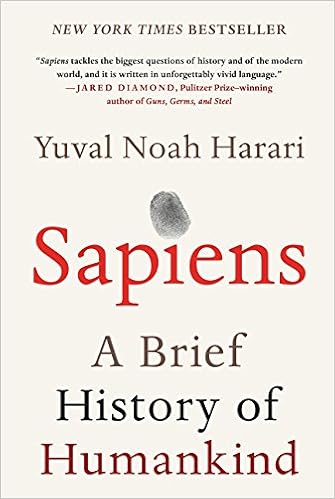
Sapiens: A Brief History of Humankind


I had a hard time enjoying this book by Harari, not because it is not good or interesting --- it is very interesting, but the (inevitable) scatteredness irritated me every few pages. The author was overly ambitious and crammed as many ideas as he could into a small space. It's against my temperament to move on, as quickly as the book does, from one thought to another, without an urge to dig deeper and make connections between some of them. This might be the other extreme of Nassim Taleb, who would pound a perfectly good but not very complex idea to death with 200 more pages than necessary. I find them both to be enlightening but often frustrating.

To me it is only viable to take a couple of the ideas and look closer. I was particularly struck by a subsection in Chapter 8 No Justice in History. The author wrote:

At least since the Agricultural Revolution, most human societies have been patriarchal societies that valued men more highly than women. No matter how a society defined "man" and "women", to be a man was always better.

He went on to point out that sociological and biological attempts to explain this phenomenon have failed so far. Not being a student or scholar in gender studies, I cannot determine whether he is right or there are indeed illuminating theories buried in some university's archives.


Saturday, January 7, 2017

1913 or 1938?

I have been chatting with my Chinese American friends for weeks about the geopolitical and global economic outlooks in the next few years. Whichever way I look at it, the barrel of dynamite sitting between China and US is going to blow up in some shape or form. Both sides need it to blow up, because they have run out of alternatives. They just can't help themselves. Martin Wolf of the Financial Times recently compared today to the eve of WWI. The similarities are striking.

Mr. S refuses to heed my paranoia, but I continue to plot my doomsday scenarios. Not that I want the worst to happen, but it really does seem the most logical outcome given the current conditions. All the other options are rapidly receding into the fog.

I have to admit that, beneath the anxiety and dread there is a sliver of thrill. I was born in 1973, barely escaping the horrors of the Cultural Revolution. I never thought that, in my lifetime, I would witness such historical events as Hemingway or Christopher Isherwood or my parents did. From moment to moment you don't even know whether you will survive the next day! Is there anything more life affirming?!

The somewhat comforting elements of peace are two: 1) China does not have nearly enough long-range nuclear warheads to attack across the Pacific Ocean. 2) At the moment Russia has very little reason to get into any conflicts with US (Why would he? Putin's going to run the show of American national politics.)

So I'm sitting here on the brink, dangling my legs over the abyss, and shivering with a morbid curiosity. It is like the moment immediately after the boy king Joffrey unexpectedly had Ilyn Payne chop off Ned Stark's head, and I'm watching in the crowd through the eyes of Arya Stark or Uncle Yoren, with only a vague anticipation of the storm of swords to descend. There's also a faint whisper that I should write it down --- what it's like to live in January 2017 --- and take a snapshot of the sharp smell of snow halfway between the clouds and the earth.

I suppose we'll find out what is going to happen to the world, once George R. R. Martin finishes his damned book The Winds of Winter.

Thursday, December 29, 2016

The Odyssey

Throughout my formative years, my father would tell and retell his journey out of the countryside in the spring of 1945, his hometown, at the age of 20 years, crossing the line between Japanese occupation and Chinese Nationalist control, to arrive in Chungking, the wartime capital of the Chinese government, and pass the college exam to open a new life for himself.

Mother did something similar at 55, when she officially emigrated to Long Beach, California. A new country. No job. A new language. No social or professional network. But she did not recount this experience nearly as much as Dad did, for a variety of reasons. Regardless, it was no small feat. 

Lately I think about these events often. Their meaning is not entirely clear, but that's OK. There are probably many ways to interpret them, some of which are contradictory, including the two instincts at odds: to migrate and to settle. What are we but contradictory creatures? It's not human to be without contradictions.  

Isn't it funny that The Odyssey is a story both about adventures in strange land and about going home? We're driven to go, go, go, if for no other reason than evolution.

All this calls into question the idea of free will, which, I think, is a problem plagued with ambiguous and muddle definition. A key problem with free will is its being mixed with the problem of conscious thoughts. If we define free will as conscious, reasoned, language-driven choices, then I am almost certain free will is an illusion.

(Consciousness has unfortunately been elevated to an absurd degree by people who consider themselves "scientific" in recent years. This is at least in part motivated by the urge to perpetuate our narcissistic needs to feel oh so special. We have to hold on to our specially favored position in the universe, if not by the rumor of 23 grams of soul, then by the quantum-fueled mumble ... I mean consciousness. But I digress.)

But, what about the unconscious will that might be free in its own way? What about the unconscious drives that push us out into the unknown world, forward and backward, faraway and here? Could it in fact be free nevertheless? Or not? One thing is for sure though, that the will is neither logical nor consistent, and full of contradictions in itself. 

Sunday, December 4, 2016

In the Hospital

It's December 2016. The thoughts of December 2015 have been haunting me lately. They spring up at unexpected and minor provocations and hit me smack on the nose.

My mother was first hospitalized in July 2015. The second time was October. The third and last time was Christmas Day.

What pop into my head nowadays are all these mundane details in memory, sharpened by the anxiety and horror in those moments.

For example, what just occurred to me a moment ago was the adult diapers she had to wear during her hospitalization, which were sometimes replaced by urinary catheter in order to collect urine samples for lab analysis. The discomfort and indignity of being in a hospital really irked her, and each time she was desperate to go home, particularly the last time.

She was always quite particular about her appearance and comfort, both of which cannot be maintained in that environment. I am much the same way. Even as a child I was not very tough in rough conditions. I chafed at noise and other disturbances and required a slightly compulsive level of cushiness. When my dad took me on a trip to Hunan, I was miserable in hot, crowded trains buzzing with mosquitoes, suffering in agitated silence. So I understood her irritation with the hospital gown, the inability to bath or shower for days, the endless needle pricks, and the lack of familiar faces and voices around her. I understood, in my bone, her horror and hatred of spending night after night alone in a hospital room.

All three times, I flew to LA and visited her every day. The second hospitalization lasted almost 10 days and frayed everyone's nerves. One day she complained to me that my brother was too selfish to come visit her and avoided his responsibility by "sending his younger sister to do all the heavy lifting." I secretly agreed with her and resented his absence. Later however I realized that his avoidance was driven by a terror, because he was weaker than I and much, much more afraid of the stench of death. I was not. On this particular issue, I am quite tough.

I still am not afraid of death, but I am afraid of hospitalization, just like she did.

Thursday, November 3, 2016

The Logical Conclusion

Elizabeth Kolbert's short article "How Can Americans Trust Donald Trump" in the New Yorker struck me with her incredulous tone. It's as if the more he lies the more people believe him with more certainty and fervor. She is not alone. I've seen this incredulous tone many time from many writers in the mainstream media.

When I first moved to this country almost 24 years ago, I knew nothing about it, except a few pieces of American pop culture that had been deemed culturally clean and "healthy" enough to be imported into China: The Carpenters, the movie "Love Story," and a few country songs. It took me a very long time to pick up things from incessant consumption of television (especially Law and Order), radio in the car, and summer blockbuster movies. That was before the InterWeb became the black hole that sucked everyone in.  

During college, in the late nights driving home from my intern pharmacy shifts, I caught Rush Limbaugh on the radio and some guy called Lyndon Larouche. It was not very interesting and I paid them little attention. I had no idea what it was all about.

After I graduated from university, on my first job as an editor at a biomedical journal, one of my colleagues, a copyeditor, told me some weird things that I had never heard on the radio or read in newspapers --- outlandish stories about UN black helicopters, secret prisons, government conspiracies, and plans to enslave the American people. She had grown up in rural Maryland and all her friends were farm kids. They all believed these rumors. I had only heard vaguely about Ruby Ridge, Waco, and the Elio Gonzales affair, but never thought there was a vast conspiracy behind all of them. But she made it all sound so real.

Tuesday, November 1, 2016

Sundance Sings the Blues

I have not watched NBC's "The Voice" for a few years but stumbled upon it again this season. My favorite singer of this season is immediately and undoubtedly Sundance Head.

He wears a cowboy hat and picked Blake Shelton as his coach. I don't know country music but I assume he's a country singer. It was a bit odd that I'd automatically prefer a country singer over everyone else, because the genre is never my cup of tea.

Out of curiosity I looked up Sundance's audition song, "I've been loving you too long." It turned out to be an R&B oldie by Otis Redding. Thanks to YouTube, I found out that Sundance Head has covered other blues songs, including At Last. He may look country but his heart is clearly in blues. No wonder... As a person so totally unschooled in music, I am drawn to blues by instinct. Is it me or is it just that blues is universal?

Monday, October 17, 2016

"Scandal" and Zizek's Ideology


Coincidentally --- or perhaps there is no such thing as a coincidence --- I was watching Zizek's psychoanalytical discussion about film and ideology while starting on Season 4 of Scandal.

What seemed like a conventional romantic trope to keep the two lead characters apart in Season 1 has become a bit of a joke in Season 4. Olivia Pope and President Fitzgerald Grant have overcome each apparent external obstacle between their union over the first 2 seasons and by now are resorting to transparent self sabotage.

The need to keep the lead characters apart until the climax (pun intended) of the story has long been explained to me. The audience's pleasure is derived from both the process of prohibition and the eventual release/payoff in comedy or the lack of in tragedy.

Beginning in Season 3 and continuing through at least Season 4, the obstacles to the "happy ending" between Olivia and Fitz are expressed in repeated outbursts with increasingly absurd logic. Take, for example, the scene after Olivia is rescued from her captors. She said, I cannot be with you because I am angry at you, and I'm angry at you because you started a war for me. He said, but you'd have been dead if I hadn't started a war, and what would I have then? Over and over, Olivia is posing her refusal in the most airtight loop that gives him no way out. All answers are wrong, and all options are null.

Her other even more absurd reason of refusal illustrates Zizek's explanation of ideology to a T: All these people, herself included, have cheated in Grant's election. A fake victory requires absolute commitment to make it real by his effort to be a spotlessly awesome leader. In other words, she is saying, "I did bad things to put you into the White House, and I feel guilty about it, so I am depriving myself --- and you particularly --- our union in order to satisfy this guilt."

So, if Olivia fundamentally does not want to be with Fitz, why does she --- or Shonda Rhimes --- continue to string the audience along? Perhaps more important, why do the audience continue to watch this obviously doomed romance? As Zizek points out, ideology is about having your cake and eat it. You satisfy both the id (pleasure) and the superego (guilt) by both indulging in your desires and feeding your guilt. Rhimes continues to insist that Olivia and Fitz must and must not be together. The fantasy of Vermont is perfect because it is forbidden. That is the only way to have your cake and eat it.

The Ending of Le Samourai (1967), Explained

A quick online search after watching Jean-Pierre Melville's Le Samourai confirmed my suspicion: The plot is very rarely understood by E...