Search This Blog

Thursday, January 5, 2023

The Thrills of Middlemarch


Although the novel does contain some digressions and commentary, as George Eliot was prone to include in her novels, it is not a stiff and slow reading experience most of the time. Besides her dry humor, she also wrote some rather suspenseful chapters, which induced me to read deep into the night sans sleep, turning the pages with a mix of anticipation and apprehension, eager to discover the fate of the characters involved. 

One early example is Fred Vincy's odyssey to pay off his debt, from his scheme of flipping horses (as in "flipping houses") to his emotional rollercoaster. Even though his failure was not difficult to foresee, the suspense, for me, lies in how he would confess his failures to the beloved Garth family, and what would come of it. Through this plot arc, we see Fred as the hapless and impulsive guy who is not too smart, but he does not lie, neither to others nor himself. In a sense, Fred is a danger to himself and others (more the former than the latter), and his journey into emotional maturity reminds me of, of all things, a Robert B. Parker novel early in the Spenser series (yes, I know, comparing Middlemarch to pulp fiction) titled "Early Autumn." In that novel, Spenser saves a boy abused by his parents by teaching him to build a house. Similarly, Fred's central relationship is less with Mary and more with Caleb Garth. Mr. Garth also taught Fred how to build a house, well OK, figuratively. 

Two other suspenseful chapters were both scenes of death. The first involves Mary Garth at the deathbed of Fred's uncle Featherstone, who may or may not have left a large amount of money to Fred. I did guess the eventual outcome on the inheritance question, but the process is plenty eerie, and the depiction of his last internal conflict rivals the best gothic novels. The second is Dorothea's viewpoint of her husband's last days. Mr. Casaubon has been stewing in the fear and jealousy of a younger man's attention to the oblivious Dorothea for weeks and months. Feeling his end is near, he wants Dorothea to make an oath sight-unseen. Dorothea says I don't promise anything without first knowing what it is. The hilarity is that he wants her to promise never to marry Ladislaw after he is dead, and she thinks he wants her to write his magnum opus for him after he is dead. She spends all night dreading that she may be pressured into a tedious and meaningless labor, until they have that talk in the morning ... Ah the buildup is so good and delicious, and the resolution so unexpected, that I nearly laughed out loud.

Later in the book, there are multiple plotlines leading to multiple mini-climaxes, intricately woven and acutely described, with unexpected payoffs, each with subtle irony and wisdom upon reflection. Her skills are absolutely breathtaking. Sometimes I wish Eliot had written a few mysteries, if only the genre had existed in her time. I am certain she would have killed it.

Friday, December 30, 2022

No Middle Name


Lee Child

There is just one thing that I have in common with Lee Child, the author of the Jack Reacher series. In the past three years I have been working my way through the series via library audiobooks, as audiobooks tends to be less of a page-turner, so to speak, than paper books. 

Yesterday I finally picked up a paper version of his short story collection "No Middle Name," published in 2017. The third story in the book, "High Heat," confirms my suspicion that Mr. Child, like me, has a particular fondness for people beating each other up with their bare hands. Certainly, there were plenty of guns in the Reacher series, and he devoted one full book ("Persuader") to the study of various guns. But description of hand-to-hand combats is salt to his books. There have to be multiple fight scenes in each book. 

In High Heat, he even devised a plot point to get rid of all the guns the bad guys may have, just to allow the 16-year-old Reacher to beat them all up. It's pretty clever, but a little far-fetched for organized crimes in New York City in 1977.

I have to imagine that Mr. Child's choice to put bare-knuckled fights into every book he writes reflects a real personal interest. (It must be difficult to avoid completely repeating oneself though.) Out of all the different types of violence on screen and on paper, I too most prefer this type of fighting scenes. Sure, the gun battles in John Wick are nicely choreographed and impressive, but they are inspired by unweaponed combat choreography too. There is an intimacy in these scenes that can better portray characters than any other types of fighting. The cold efficiency of guns offers less room for characterization and emotional, as well as visceral, impact. 

Thursday, December 29, 2022

The Prophecy of Middlemarch


Some years ago I read Daniel Deronda on a whim. Two things, or rather two characters, in the novel left a lasting impression: the fervent Zionist Ezra Mordecai Cohen and Daniel Deronda's mother, a Jewish actress who gave her son up, so that she can continue her career on stage. More than anything, it tipped me off to the origin of Israel that predated WWII, even WWI. 

I have not even finished reading Middlemarch, but some elements really blew me away with its modern resonance. It was written in 1871 and depicted an earlier period around 1830, so I never dreamed that I would see so many concerns that I had thought belonged strictly in the 20th century, at least.  

First, one of the main characters, Dr. Lydgate, was a young physician trying to change the way medicine was practiced in the country. Not content with treating local patients for their common illnesses, his ambition was to do research and unravel the pathology of diseases. He had microscopes and experimental apparatuses at home and kept up with new scientific discoveries in the field from the Continent. 

Moreover, he broke from the traditional practice of selling medicinal products (mostly tinctures and potions back then), because he recognized it as a type of conflict of interest. Physicians were incentivized to give patients their own concoctions because they could make more money selling medicines than diagnosing and caring for patients. Who cares if the medicines were effective? 

Oh my God this is so modern. Neither concerns have been completely resolved in medicine today. We are still doing research and unraveling pathology of illnesses. We are still struggling with nudging physicians to do the ethical thing in the face of greed. Both remain front and center in medicine. 

A second main character, Mr. Will Ladislaw, has an even more contemporary profession: campaign manager! I have never, ever seen this profession mentioned in classic literature, until "All the King's Men", which was published in 1946 in the United States. Ladislaw not only wrote speeches and opinion pieces in the partisan newspaper for his boss, Mr. Brooke, he also devised campaign strategy for him and coached him in his campaign! 

Alas, poor Mr. Brooke liked to veer off script and blab to anyone "You have a point there." There is a hilarious campaign rally scene that could happen even today. At one point, Will and the doctor had an argument about whether a politician should be sincere and say what he believes in. The doctor, talking from a scientist's perspective, found Will's cynical approach of saying whatever to keep voters happy appalling. I almost fell out of the chair laughing.

I don't know why George Eliot was so much better at seeing the future than other novelists of the same period, but she seemed to have acute insights into social trends and political sentiment roiling underneath the surface. No, she was not writing about what is often called "universal and timeless human nature," whatever that means, but rather a prediction of the tides to come and wash us away in the new millennia. And she was spot on.  

Sunday, December 18, 2022

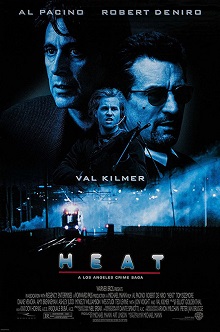
Heat (1995)


I don't think anyone who has seen this movie could forget the bank robbery shootout scene. Living in LA during the 1990s, my memory of this heart-pounding scene was further solidified by a real-life shootout between 2 bank robbers and the police (the notorious North Hollywood shootout in February 1998) that eerily imitated the movie and was televised on network news.

Rewatching the movie 27 years later, I feel it's a real shame that Michael Mann has not been able to repeat his achievement in subsequent movies. The screenplay is extremely efficient and understated. The dialogs strive for a realistic feel on both sides of the law. None of the key information is repeated, so that the audience has to pay attention to understand the chain of events. Some plot elements are done so economically as to verge on underdevelopment --- including Natalie Portman's character and the character known as Waingro, who may or may not be a serial killer. There is a thin line between suggesting a larger world outside of the plot and tossing threads all over the place, and this movie has both. 

Nearly every action set piece in the movie is well done, including a brief one involving a failed money exchange between DeNiro's Neil and a crooked financier. Mann clearly attempted to make the action as realistic as possible with minimal soundtrack and naturalistic sound design. I say "nearly" because the final showdown between Neil and Pacino's Vincent is a disappointment, which did not improve on second viewing. After all the impeccable scenes previously, the chase and the conclusion seem too long and somewhat confusing. Can a person get from the hotel to the runways of LAX on foot? (Why is the hotel next door to LAX in the first place?) Where was the plane that was going to be Neil's escape? Where is the money? Without the money, does Neil really have a reason to get to the airport anyway? How far behind him was Vincent? (The scene has him either very far behind or very close.) If Mann intended the final chase to be anticlimactic and somewhat pathetic, I would be OK with that, but the intention is not clearly conveyed on screen. 

On second viewing, Pacino's performance is particularly jarring when he is surrounded by the understated and matter-of-fact approach from just about everyone. He really stood out like a sore thumb. According to reviews, it was apparently Mann's decision to make the character so ... flamboyant? aggressive? loud? unstable? I guess he wanted a stark contrast between DeNiro's internalized Neil and the half-crazed policeman for unexpected effects. However, everything about Vincent rings false. First and foremost, Pacino reeks of New York and does not fit into the Los Angeles surrounding at all. I know because I spent my formative years there. From his costume to his accent to the manners, Pacino seems to be in a totally different movie. In one scene, Vincent is standing in front of a kitchen sink full of dirty dishes, contemplating washing them, in his suit. Does he ever wash dishes? Does Mann? It looks so fake as to be almost laughable. It is baffling.  

Talk about baffling, it is both interesting and a little hilarious that Mann decided to give every male character a woman, except the financial guy and Waingro, who are apparently considered the lowest of the low. Every single one of the career criminals has a woman in his life. Neil falls hopelessly in love with Judging Amy (oops, that's what I remember Amy Brenneman from). At some point I was thinking that only the Hispanic guy played by Danny Trejo didn't have a woman to warm his bed, and then the movie immediately proved me wrong. So this must mean something. Mann did not stuff his movie with so many side characters for nothing. Heck, the camera even lingered on a woman in the arm of a policeman in one scene. 

Obviously Mann had something to say about the relationship of violent men (on both sides of the law) and the women in their lives. Throughout most of the movie, I thought the point was how delusional they are and how they are incapable of constructing a normal and sane life, as represented by women. But Amy Brenneman's character proves me wrong: Look, here is a woman living a normal life as a graphic designer, who is willing to give up everything to run off with this master criminal! I guess his message is, maybe, that no woman can resist the romanticism represented by violent men? I am not against this theme at all, but it contradicts 80% of the movie that comes before it ... 

Wednesday, December 14, 2022

Barry Lyndon (1975)


Finally, I have watched this movie. My interest was driven first by the music choices (Sarabande and Schubert's Piano Trio in E-flat) and then by some still photos of the cinematography.

In some ways, Kubrick's choices in "Barry Lyndon" remind me of "Tar". The characters' feelings and motivations are deliberately obscured. There are mentions of the main characters' cruelty and harm onto others, but there is also explicit effort to win sympathy for them, including one of the most manipulative devices --- tenderness toward young children.

As expected, the music is beautiful and haunting, the cinematography is stunning. Many a shot leaves me with an illusion of witnessing a scene through a time machine. Well, not quite. The scenes tend to be a little too clean and orderly to be realistic, especially the battlefield ones. Rather, they tend to mimic classical paintings of the era, which are a sanitized version of daily life of aristocracy. The renowned candle-lit scenes, supposedly shot with no artificial light, and the indoor scenes have an eerie quality that is both realistic and dream like. Technically, it is every bit as good as the critical acclaims. 

Nevertheless, something about Lady Lyndon bothered me. Every other characters is vividly drawn, including two other female characters and a dozen or so male characters. The only character that makes no sense whatsoever is Lady Lyndon. We see her son from her previous marriage complain about and fight with Barry over his depravity and greed that are ruining her, but she does nothing. In fact she barely speaks a line or two. Instead, we are treated with an occasional scene of Barry making love to her, on top of many scenes of his debauchery, and left with the impression that she is too in love with him to see his misconduct. We are supposed to believe that this conflict is entirely between the two men. 

Out of curiosity I looked up the source materials, Thackeray's novel The Memoir of Barry Lyndon and the real-life person, Andrew Stoney Bowes, on which the novel was based. So the funny (ironic, not haha) thing is that Stoney married a rich heiress, Lady Bowes, for her money through an elaborate scam (involving a duel), and inside the marriage he not only squandered her fortune but also psychologically and physically abused her for eight years. He beat her frequently and severely. After she finally escaped with the help of a maid, he sent some guys to track her down, who also beat her and threatened to rape and kill her. She was fortunately rescued and then initiated a long and arduous process of divorce and, despite his various efforts to smear her reputation, won back her freedom and what's left of her estate.

Well I suppose no one would ever think that Lady Bowes' story was thrilling, terrifying, dramatic, or heroic enough to turn into a novel or a movie. In Thackeray's novel, it is at least mentioned that Barry admitted to beating his wife (but only when he was drunk, according to himself). In the movie, however, that detail is entirely absent, as all abuse and confrontations are transferred between the stepfather and stepson. To me, it is comparable to narrating the adventure of a Japanese solider in China during WWII without mentioning that he had chopped off a few civilians' heads. I am not against humanizing anyone, even the worst, but excuse me for puking a little over here.

Thursday, December 8, 2022

Andor and THX1138

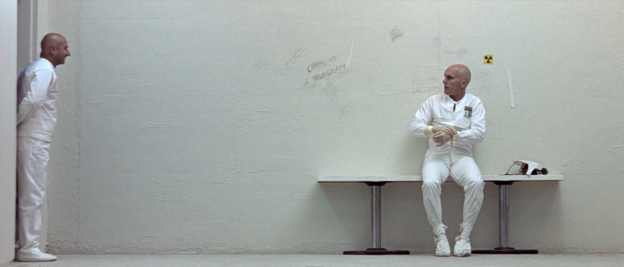
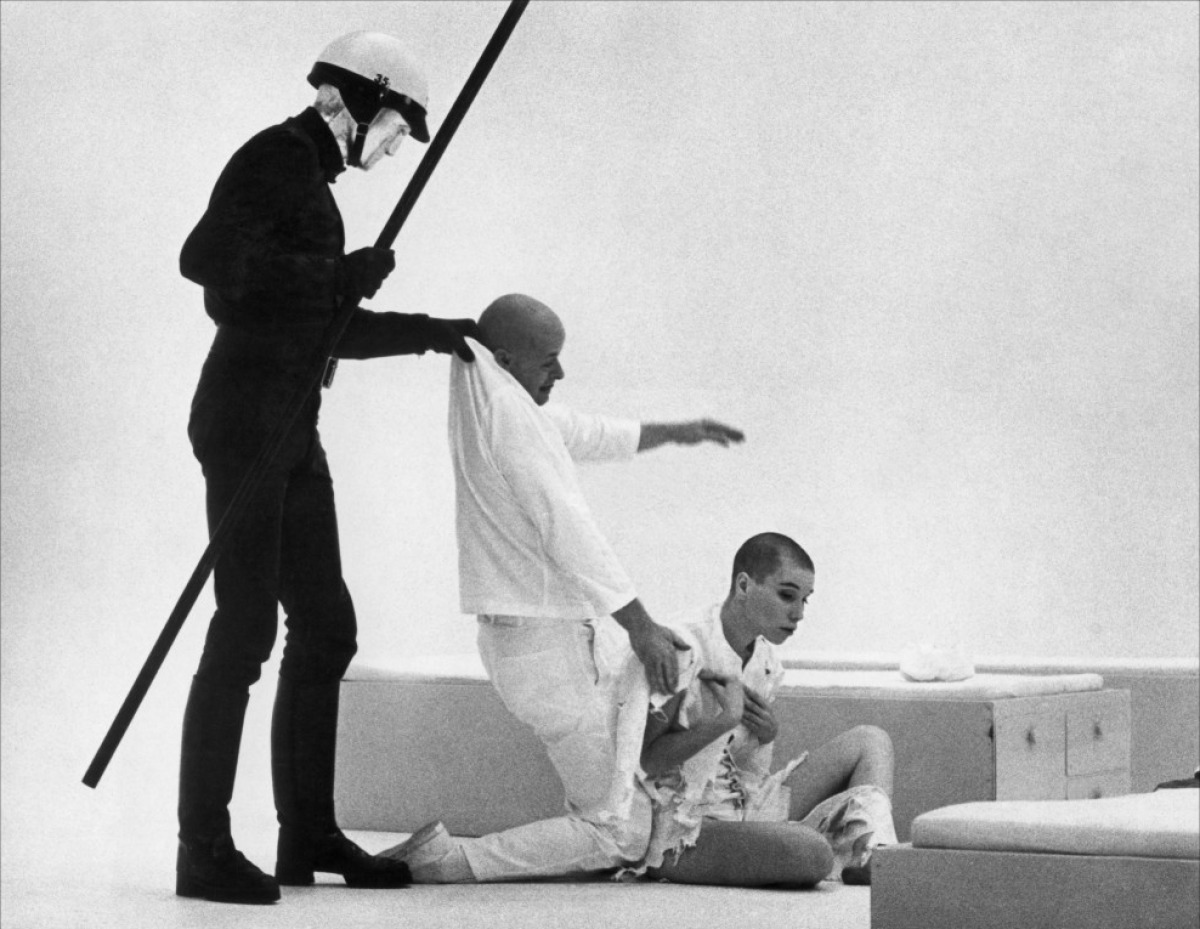
When I watched the prison break episodes in "Andor", I felt there was something familiar about the set design but couldn't put my finger on it. Eventually, the buried memory surfaced. The all-white prison interior is almost certainly a conscious reference to THX1138, which was George Lucas' first feature film, released in 1971, before "American Graffiti" won him wide critical acclaim. Actually he made a short film THX1138 at USC and later expanded it to feature length, casting Robert Duvall in the lead role. 

Of course, THX1138 was hardly the first dystopian science fiction movie, and the influence of 1984, Brave New World, and the Cold War was unmistakable. Super original it was not. Nevertheless, the aesthetics was quite stunning.


Compare this visual style with the set of prison in Andor. 


The orange stripes are the only visual relief from the oppressive whiteness in this world. After all, this is a Disney series, not an experimental art film. 

The question of whether Tony Gilroy talked to Lucas before making Andor remains unanswered. It tickles me to death what the latter thinks of Andor, although I doubt he would comment publicly.  

Coincidentally (not!), THX1138 is, at least metaphorically, also a prison break movie. L.O.L.

Monday, December 5, 2022

Empire-related awkwardness: Avatar


The talk about just who the "evil empire" represents in Star Wars reminds me of another awkward example of imperialism and colonialism --- "Avatar" (2009). One may argue that James Cameron is a little bolder than George Lucas, because the baddies in this movie are obviously American military. However, Cameron's politics is far simpler than Lucas', as the former appears to believe that having a white savior, aka Dances with Wolves, join and lead the natives in their resistance is more than enough to absolve the character's affiliation with the colonialist army. 

The question is, does it work? Can the audience (the descendants of colonialists and beneficiaries of genocide) be relieved of any discomfort and self-examination by gleefully imagining oneself as the white male savior riding the dragon and bedding the pretty native girl? It seems to work for Cameron, who is perhaps more "left wing" (whatever that means) than Lucas but lacks the latter's self-awareness. Indeed, Cameron's left-wing tendencies were on full display in "Titanic," which was despised by a friend who grew up in the final days of USSR and me, who grew up under CCP. The movie's simpleminded familiarity made us laugh. 

Lucas was fully intentional in acknowledging the sins of the father and the darkness inherited by the son. This is why his sextet was so conflicted within itself. I often wonder whether this internal struggle contributed to the storytelling failure in the prequels. There was a sincere desire to demonstrate how the ideals (represented by the old Republic) descended into evil and perhaps to take some ownership in it, but his fear of being truly understood and rejected, maybe even hated, by the audience must have stopped him short. 

The things we do for love (ie, being loved).  

The Ending of Le Samourai (1967), Explained

A quick online search after watching Jean-Pierre Melville's Le Samourai confirmed my suspicion: The plot is very rarely understood by E...