Search This Blog

Sunday, December 18, 2022

Heat (1995)


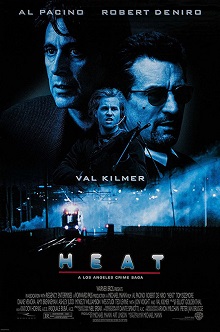
I don't think anyone who has seen this movie could forget the bank robbery shootout scene. Living in LA during the 1990s, my memory of this heart-pounding scene was further solidified by a real-life shootout between 2 bank robbers and the police (the notorious North Hollywood shootout in February 1998) that eerily imitated the movie and was televised on network news.

Rewatching the movie 27 years later, I feel it's a real shame that Michael Mann has not been able to repeat his achievement in subsequent movies. The screenplay is extremely efficient and understated. The dialogs strive for a realistic feel on both sides of the law. None of the key information is repeated, so that the audience has to pay attention to understand the chain of events. Some plot elements are done so economically as to verge on underdevelopment --- including Natalie Portman's character and the character known as Waingro, who may or may not be a serial killer. There is a thin line between suggesting a larger world outside of the plot and tossing threads all over the place, and this movie has both. 

Nearly every action set piece in the movie is well done, including a brief one involving a failed money exchange between DeNiro's Neil and a crooked financier. Mann clearly attempted to make the action as realistic as possible with minimal soundtrack and naturalistic sound design. I say "nearly" because the final showdown between Neil and Pacino's Vincent is a disappointment, which did not improve on second viewing. After all the impeccable scenes previously, the chase and the conclusion seem too long and somewhat confusing. Can a person get from the hotel to the runways of LAX on foot? (Why is the hotel next door to LAX in the first place?) Where was the plane that was going to be Neil's escape? Where is the money? Without the money, does Neil really have a reason to get to the airport anyway? How far behind him was Vincent? (The scene has him either very far behind or very close.) If Mann intended the final chase to be anticlimactic and somewhat pathetic, I would be OK with that, but the intention is not clearly conveyed on screen. 

On second viewing, Pacino's performance is particularly jarring when he is surrounded by the understated and matter-of-fact approach from just about everyone. He really stood out like a sore thumb. According to reviews, it was apparently Mann's decision to make the character so ... flamboyant? aggressive? loud? unstable? I guess he wanted a stark contrast between DeNiro's internalized Neil and the half-crazed policeman for unexpected effects. However, everything about Vincent rings false. First and foremost, Pacino reeks of New York and does not fit into the Los Angeles surrounding at all. I know because I spent my formative years there. From his costume to his accent to the manners, Pacino seems to be in a totally different movie. In one scene, Vincent is standing in front of a kitchen sink full of dirty dishes, contemplating washing them, in his suit. Does he ever wash dishes? Does Mann? It looks so fake as to be almost laughable. It is baffling.  

Talk about baffling, it is both interesting and a little hilarious that Mann decided to give every male character a woman, except the financial guy and Waingro, who are apparently considered the lowest of the low. Every single one of the career criminals has a woman in his life. Neil falls hopelessly in love with Judging Amy (oops, that's what I remember Amy Brenneman from). At some point I was thinking that only the Hispanic guy played by Danny Trejo didn't have a woman to warm his bed, and then the movie immediately proved me wrong. So this must mean something. Mann did not stuff his movie with so many side characters for nothing. Heck, the camera even lingered on a woman in the arm of a policeman in one scene. 

Obviously Mann had something to say about the relationship of violent men (on both sides of the law) and the women in their lives. Throughout most of the movie, I thought the point was how delusional they are and how they are incapable of constructing a normal and sane life, as represented by women. But Amy Brenneman's character proves me wrong: Look, here is a woman living a normal life as a graphic designer, who is willing to give up everything to run off with this master criminal! I guess his message is, maybe, that no woman can resist the romanticism represented by violent men? I am not against this theme at all, but it contradicts 80% of the movie that comes before it ... 

Wednesday, December 14, 2022

Barry Lyndon (1975)


Finally, I have watched this movie. My interest was driven first by the music choices (Sarabande and Schubert's Piano Trio in E-flat) and then by some still photos of the cinematography.

In some ways, Kubrick's choices in "Barry Lyndon" remind me of "Tar". The characters' feelings and motivations are deliberately obscured. There are mentions of the main characters' cruelty and harm onto others, but there is also explicit effort to win sympathy for them, including one of the most manipulative devices --- tenderness toward young children.

As expected, the music is beautiful and haunting, the cinematography is stunning. Many a shot leaves me with an illusion of witnessing a scene through a time machine. Well, not quite. The scenes tend to be a little too clean and orderly to be realistic, especially the battlefield ones. Rather, they tend to mimic classical paintings of the era, which are a sanitized version of daily life of aristocracy. The renowned candle-lit scenes, supposedly shot with no artificial light, and the indoor scenes have an eerie quality that is both realistic and dream like. Technically, it is every bit as good as the critical acclaims. 

Nevertheless, something about Lady Lyndon bothered me. Every other characters is vividly drawn, including two other female characters and a dozen or so male characters. The only character that makes no sense whatsoever is Lady Lyndon. We see her son from her previous marriage complain about and fight with Barry over his depravity and greed that are ruining her, but she does nothing. In fact she barely speaks a line or two. Instead, we are treated with an occasional scene of Barry making love to her, on top of many scenes of his debauchery, and left with the impression that she is too in love with him to see his misconduct. We are supposed to believe that this conflict is entirely between the two men. 

Out of curiosity I looked up the source materials, Thackeray's novel The Memoir of Barry Lyndon and the real-life person, Andrew Stoney Bowes, on which the novel was based. So the funny (ironic, not haha) thing is that Stoney married a rich heiress, Lady Bowes, for her money through an elaborate scam (involving a duel), and inside the marriage he not only squandered her fortune but also psychologically and physically abused her for eight years. He beat her frequently and severely. After she finally escaped with the help of a maid, he sent some guys to track her down, who also beat her and threatened to rape and kill her. She was fortunately rescued and then initiated a long and arduous process of divorce and, despite his various efforts to smear her reputation, won back her freedom and what's left of her estate.

Well I suppose no one would ever think that Lady Bowes' story was thrilling, terrifying, dramatic, or heroic enough to turn into a novel or a movie. In Thackeray's novel, it is at least mentioned that Barry admitted to beating his wife (but only when he was drunk, according to himself). In the movie, however, that detail is entirely absent, as all abuse and confrontations are transferred between the stepfather and stepson. To me, it is comparable to narrating the adventure of a Japanese solider in China during WWII without mentioning that he had chopped off a few civilians' heads. I am not against humanizing anyone, even the worst, but excuse me for puking a little over here.

Thursday, December 8, 2022

Andor and THX1138

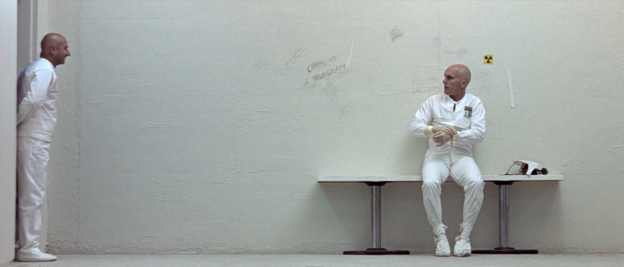
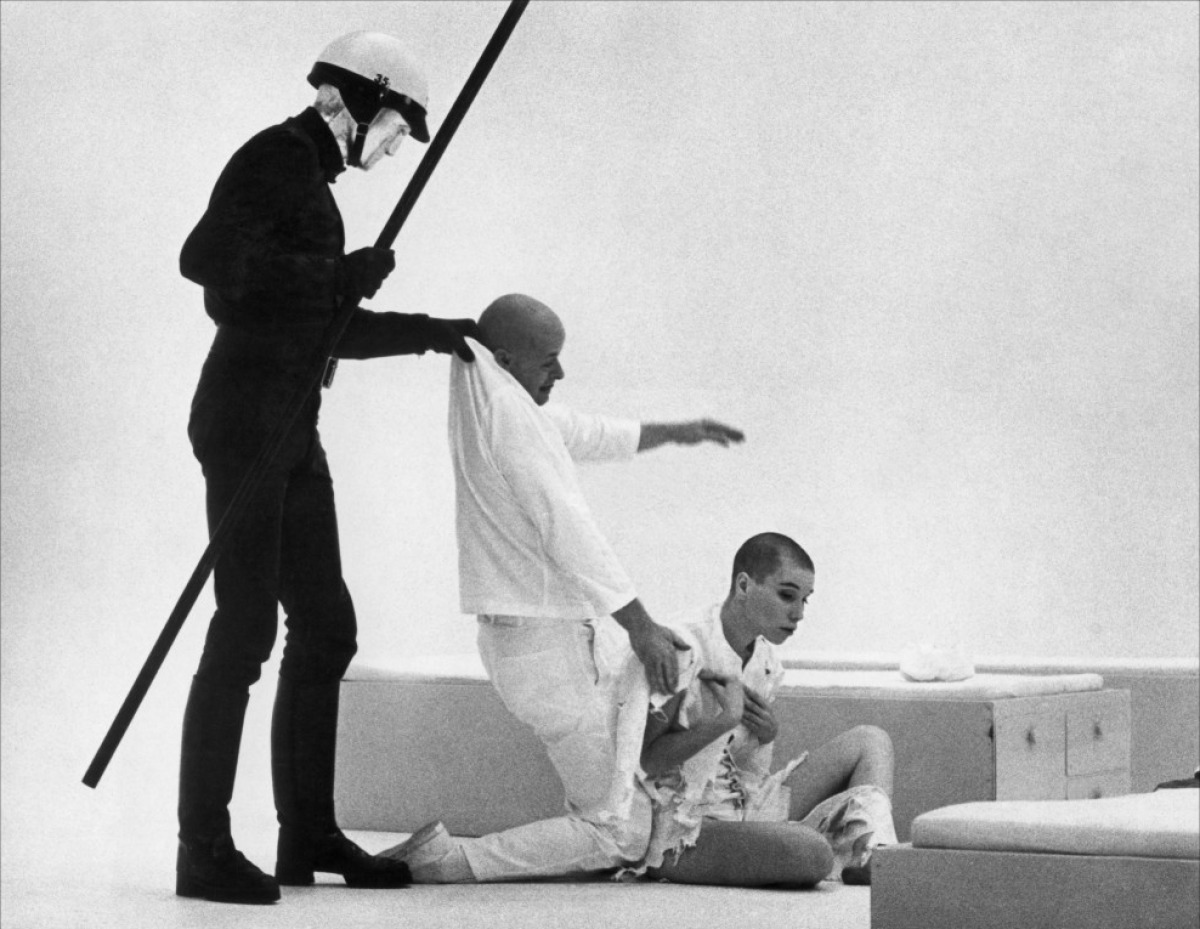
When I watched the prison break episodes in "Andor", I felt there was something familiar about the set design but couldn't put my finger on it. Eventually, the buried memory surfaced. The all-white prison interior is almost certainly a conscious reference to THX1138, which was George Lucas' first feature film, released in 1971, before "American Graffiti" won him wide critical acclaim. Actually he made a short film THX1138 at USC and later expanded it to feature length, casting Robert Duvall in the lead role. 

Of course, THX1138 was hardly the first dystopian science fiction movie, and the influence of 1984, Brave New World, and the Cold War was unmistakable. Super original it was not. Nevertheless, the aesthetics was quite stunning.


Compare this visual style with the set of prison in Andor. 


The orange stripes are the only visual relief from the oppressive whiteness in this world. After all, this is a Disney series, not an experimental art film. 

The question of whether Tony Gilroy talked to Lucas before making Andor remains unanswered. It tickles me to death what the latter thinks of Andor, although I doubt he would comment publicly.  

Coincidentally (not!), THX1138 is, at least metaphorically, also a prison break movie. L.O.L.

Monday, December 5, 2022

Empire-related awkwardness: Avatar


The talk about just who the "evil empire" represents in Star Wars reminds me of another awkward example of imperialism and colonialism --- "Avatar" (2009). One may argue that James Cameron is a little bolder than George Lucas, because the baddies in this movie are obviously American military. However, Cameron's politics is far simpler than Lucas', as the former appears to believe that having a white savior, aka Dances with Wolves, join and lead the natives in their resistance is more than enough to absolve the character's affiliation with the colonialist army. 

The question is, does it work? Can the audience (the descendants of colonialists and beneficiaries of genocide) be relieved of any discomfort and self-examination by gleefully imagining oneself as the white male savior riding the dragon and bedding the pretty native girl? It seems to work for Cameron, who is perhaps more "left wing" (whatever that means) than Lucas but lacks the latter's self-awareness. Indeed, Cameron's left-wing tendencies were on full display in "Titanic," which was despised by a friend who grew up in the final days of USSR and me, who grew up under CCP. The movie's simpleminded familiarity made us laugh. 

Lucas was fully intentional in acknowledging the sins of the father and the darkness inherited by the son. This is why his sextet was so conflicted within itself. I often wonder whether this internal struggle contributed to the storytelling failure in the prequels. There was a sincere desire to demonstrate how the ideals (represented by the old Republic) descended into evil and perhaps to take some ownership in it, but his fear of being truly understood and rejected, maybe even hated, by the audience must have stopped him short. 

The things we do for love (ie, being loved).  

Saturday, December 3, 2022

Andor and the Contradictions of Star Wars


The showrunner Tony Gilroy said he was not a fan of the Star Wars series. However, as one of the best script doctors in Hollywood, he got roped into fixing up "Rogue One" and subsequently was given the (I'm sure a lot of) money to do the spinoff series "Andor" for Disney's streaming business. 

Nevertheless, the relatively dark and menacing "Andor" series caused me to revisit the contradictions in the heart of George Lucas' original Star Wars series. Critics have commented that "Andor" is tonally different from the SW franchise and more "adult" in its depiction of war, police state, oppression, the prison-industrial complex, and revolution.  

For example, the torture scene is quite disturbing in "Andor", even though it is much less graphic than the scene in "The Last Jedi," but we should not forget that there was also one in A New Hope, in which Princess Leia was tortured by Darth Vader (who turned out to be her father, think about that symbolism for a moment) with no apparent effect afterward. (Yes, when they want to show an entity is evil and to induce sympathy and outrage, the go-to device is that they torture and rape/kill women. Everyone knows the trick.)

Another example of parallel plot is how a reluctant central character makes the decision to join the rebellion. Does anyone still remember the turning point of Luke Skywalker? The imperial troopers killed Uncle Owen and Aunt Beru. Similarly, it was only when his mother Maarva had died that Andor decided to stop running from his destiny. His father had been executed by the Empire years ago. Of course Maarva was not directly killed by the empire, but it was close enough. 

So my argument is that Gilroy was really trying to hew pretty close to the original SW, which is pretty dark and sinister if you look closely. And yet, the series also "disneyfied" itself from the start, making it palatable to the American mass audience. It was Lucas' conscious decision to make the deaths completely bloodless, when SW was financed by 20th Century Fox. Hell, the dead characters even come back as smiling, approving ghosts (a device cleverly echoed but not exactly endorsed in "Andor" with the holographic recording of Maarva).

This manipulation cannot be blamed on Disney's production of episodes 7 to 9, unless we consider the decades-long effect Disney had had on the American popular culture since it started to convert dark and vicious folktales into cute cartoons. I was struck, in "Attack of the Clones", how indifferent and meaningless the action scenes were, because the killing was enacted upon thousands and thousands of fleshless droids. There is no feeling, no stake, and nobody cares. But it was intentional to protect the audience from seeing any blood and real death.  

We should also consider the contradiction at the heart of SW. What is the empire an allegory for? Commentators and the public assume that the empire refers to the British Empire and the rebellion the American revolution --- All the imperial characters spoke with an English accent while the heroes spoke with an American accent, and that's no accident. Sometimes Lucas tacitly approved of this interpretation, but occasionally he said openly that ROTJ is an allegory of the Vietnam war, implying that the empire is the American one. Nevertheless, he took care not to be too loud about it. 

I gotta hand it to his sophisticated manipulation. George Lucas is the best case of "having his cake and eat it" that I have ever seen. This is how you do it, baby! We do not need to worry that the audience may recognize themselves in the evil empire (and some actually do so). Contrary to the logical awareness "Are we the baddies?", the human instinct shields people from such uncomfortable reflections, and everyone believes he is one of the good guys. Besides, Ronald Reagan told everyone who the evil empire was --- those guys over there! 

Sunday, November 13, 2022

The Princess and the Queen


After finishing the first season of HBO's House of the Dragon, I hastily read the novella on which the series is based, "The Princess and the Queen", published in 2013. The novella is not that interesting, as this fake-history format barely provides any room for character development. The reader has zero opportunity to bond or identify with any character. Nevertheless, it is easy to see that GRRM has some degree of emotional investment in three characters: Prince Daemon, his final lover Nettles, and another bastard dragonrider named Addam. As for the rest of the aristocracy of the Targaryen court, he has shown very little sympathy for either the Greens or the Blacks. He is more interested in the random nature of history and how the average people are crushed regardless of who rules. The story might also be a sly ode to the surprising power of an angry and desperate populace, which is not something the American TV industry or culture is interested in, and I doubt the series will be able to do it justice in future season(s). 

The novella itself is not all that good, but I am glad I finally read it. Why? Because it is obviously the clue to the laughable dumpster fire that is the ending of the Game of Thrones series. In the last two seasons, without any ASOIAF materials to go on, the pathetic incompetence of Benioff and Weiss was on full display with various dead-end plot lines and out-of-character characters and stiff, trite, cringy dialogs and nonsensical twists to hastily wrap up the series. The worst choice was in the disintegration of Daenerys Targaryen's character and her demise. It's not that she could not, theoretically, become a megalomania and threat to civilization, but the way to get there is a prime example of how lazy, unimaginative, and dumb the writers are.

Regardless, it has now become clear to me that they did not even come up with that storyline with their own mind, which is not surprising. Nearly everything they had independently come up with was either stupid or nonsensical, or both. The only interesting ideas and twists in the series, some executed well and some poorly, came from GRRM. One could safely bet that Sansa's betrayal of Uncle Littlefinger came from GRRM, even if not done in the way shown on TV, while the death of the Night King at Arya's dagger did NOT come from GRRM. Now I can also safely bet that Daenerys' turn into a tyrannical idiot after her occupation of King's Landing also came from GRRM, except not from ASOIAF but instead from Rhaenyra. In addition, the writers took the idea of the scorpion, a dragon-slaying weapon akin to shoulder-launch missiles, from this and perhaps other related stories.

It is curious to observe that all the other 5 or 6 prequels in development were killed off by HBO, while the only 2 series that have received enough money to show up on our screens are both based on a single idea of a woman in power who is stupid and tyrannical and is severely punished for her folly. There is one remaining series in development, which centers on the most boring leads in the ASOIAF, Jon Snow. How very predictable.

Anyway, now that I am fairly confident that GRRM did not tell the bozos the full ending of the series, I have my own idea about how Daenerys came to her demise. As I previously pointed out, the final chapter of Book 5 in ASOIAF previewed the battle between her and the army of the Others. That is the end. She and the Others will perish together, bringing about the end of the winter and leading Westeros into a new cycle. Even The Princess and the Queen has demonstrated GRRM's fondness for mutual destruction. I don't think he can resist the elegant symmetry of such an ending.

Friday, November 4, 2022

Karma (Yoga Sutra Notes #2)

A while ago I wrote about how wars may come and go, but conflicts and hatred do not go away, and no one changes their mind, after watching an episode of La Guerra E Finita. After learning the original concept of karma, it appears that, again, the ancient Indians had thought about it before. Maybe they had thought about everything. 

I am not sure whether the common understanding of karma could be credited to the Buddhist definition of karma, ie, a moralistic understanding of good and bad, reward and punishment. Indeed, I have heard many times that one's suffering and misfortune in the current life is the result (or perhaps "payment") of having done wrong in the past life, like eating meat or harming people, while good fortune is a reward for having done good things in the past life, like being vegetarian. The idea is to encourage (?) people to do good in the current life to ensure a better life next time, lest one comes back as a worm or a donkey or something. 

But the definition of karma in the Yoga Sutras or the Sankya school of philosophy is apparently not so judgmental or ... shall we say, Pavlovian. According to the commentaries collected in the book, karma refers to the endless chain of events that is linked by consequence. One action leads to the next, and the next to the next, and on and on. The Indian mythology is less interested in the origin of everything, when and how the world was created (although there is no lack of origin myths there) than in the perpetuation of change and flutters. What we are doing now has an endless chain of cause and effect before and after us. One could argue, for example, that in 1787, the colonies failed to reach an agreement to abolish slavery or, perhaps more precisely, agreed to preserve slavery as a union, and that occurrence has created an endless chain of consequences that stretches into today and may never end ... until climate change redraws the world map, maybe.

This is a way of looking at any history, from macro to personal, as a continuum that extends beyond major historical events or one's own lifespan. The idea of reincarnation, or samsara, seems scientifically absurd, unless you view it as a metaphor to describe the continuity running through generations. Indeed, the action of one generation reverberates into the next generation, and the next generation into the next, and so on, vastly overwhelming the random de novo mutations. This is karma, and it is a much more accurate description of reality than the "big story"-based theory of humanity in time.

It seems to me that the episodic and event-based view of history (again, it could be either macro or personal) is easier to create and easier to digest for the vast majority of us near-sighted and feeble-minded average people. I don't know what it was about the ancient Indian thinkers that allowed them to come up with such astute and profound insight into the human existence. Maybe wisdom passed down from aliens? (I kid! I kid!)

Being educated in the feeble-minded non-Indian cultures, I have spent much energy and effort in my life to understand how and why we got to this place and where we originally came from (thanks, Jared Diamond!), as if understanding the series of logical links that make me who and where I am can free me from the chain (pun intended but all credits to the Indians) of karma. But the Indians were right: In the subjective experience of an individual, there is no beginning and no end, only a series of consequences within the limits of one life. The ripples of all the karma that led to my life are practically unknowable to me, and so are the ripples of all the karma I am generating, flowing into the future and beyond, mixed with countless other ripples.

The Yoga Sutras contains some vague advice about diminishing the effect of karma within this life and for the next life, such as eating vegetarian food and being nice, or you can devote your life to worshipping a god (but it didn't specify which one, Shiva? Vishnu? Parvati?), which are hardly as specific or didactic as the "donate money now or you come back as a fly" school of persuasion. Rather, the emphasis is on the practice of yoga. This practice of yoga, which Patanjali talks about over and over, is to recognize and experience how the body and mind, thoughts and feelings, the whole lot, is a shell, and even when you shed all of them, there still exists a white light of one's essence, a singular life force completely independent of the shell, that glows on its own energy. (Interestingly, Buddhism does not believe in purusa, but I don't know the details.) What does that mean? I have no idea, but I like it.

The Ending of Le Samourai (1967), Explained

A quick online search after watching Jean-Pierre Melville's Le Samourai confirmed my suspicion: The plot is very rarely understood by E...