Search This Blog

Wednesday, September 14, 2022

The Gaze


Today I saw some discussion on action movie twitter about Tiger Shroff (pictured above). But I have not seen any of his action movies and am not going to talk about him. Rather, I have been puzzled for a few years now as to why Bollywood is rapidly filling up with ever-more-perfectly muscled male stars. 

Sure, Bollywood (and Hollywood, and profit-driven cinema in any country) has always been full of very beautiful women. The male gaze blah blah blah. The standard for male beauty was always pretty lax. Even the unquestionable No. 1 leading man of the past generation, Shah Rukh Khan, hardly looked like a magazine model at his peak. I am sure Indian cinema had no shortage of heartthrobs back in the day, but the average level of looks alone among male leads was way lower than female leads. 

Something started to change in the 2000s. When I saw Lagaan in 2001, Aamir Khan looked more buff than an average guy, but still within normal range, but 13 years later in PK the older Aamir had even bigger muscles. There was a wave sweeping through Mumbai, apparently, that was forcing every actor, even the big-name ones, to bulk up to ever higher levels of physical appearance. 

Akshay Kumar, himself a martial arts practitioner, once said that he and another actor were the only two guys in Bollywood who had not used steroids. I believe him. I am not categorically against anabolic steroid use, particularly when it is a necessity for one's livelihood. Who am I to judge? But I am extremely curious about the forces behind this phenomenon. Who are they building the muscles for? The female gaze? Or another manifestation of the male gaze? Or both? (In the US context, excessive body-building has a rather ambiguous meaning of both hypermasculinity and homoeroticism, which might not be mutually exclusive.)

I always suspect that Indian popular culture has the instinct to appeal to the most massive of the masses. So it is fascinating to wonder what this trend says about the masses and the time. Whose gaze are these muscle men appealing to? 

Monday, August 15, 2022

The Naples Quartet: Unused Intelligence

Throughout the quartet, Lenu often lamented the waste of Lila's intelligence. Lila did not receive any education beyond the fifth grade, a fact she often brought up in adulthood. Lila read voraciously god-knows-what without telling anyone, including Lenu. At various times, Lenu felt as if Lila was speaking through her (Lenu's) writing by inspiring ideas and firing imagination. As the highest praise of Lila's intelligence and creativity, Lenu constantly worried about being proven an inferior writer, should Lila's own writing be discovered by the world. 

Well, Lila never shared her writing with the world and very little with Lenu. Consequently, her intelligence was considered wasted and discarded in Lenu's eyes. This argument invites a fundamental question: How do we live with unused (i.e., wasted) talent?

Sure, we all immediately agree that it is a bad thing, a sad thing, proof of the oppression and erasure of women. It is all true and correct, which does not preclude one to think about the flip side: Can it also be a natural and honest choice to throw away one's intelligence or not make use of it? 

For someone like Lenu, who represents many of us, it is unthinkable. It is largely because she herself attained nearly all of her life goals through rigorously using every bit of her intelligence, tenacity, strength of will, and people skills. Being smart and hardworking led to good grades; good grades were the currency to win professors' approval and assistance, which in turn sent her to high school and college. Using her talent and mind, she made a living as a novelist and journalist. Everything can be made use of in service of her advancement. Most of all, she had thoroughly mined the history and events of the neighborhood in her novels, which brought her money, fame, and access.

Lila held the opposite view and repeatedly begged Lenu not to write about the neighborhood, its people, and especially Lila herself and Tina. Lenu did not understand this attitude at all and repeatedly agreed and then violated her agreement. One exception to Lila's aversion to publicity is the Solaras. The only time Lila collaborated with Lenu was the articles they wrote to expose the Solara criminal organization, with the hope of sending the Solara brothers to jail. Beyond this, Lila had no interest whatsoever in making use of her story and turn it into accolades, admiration, or profit. 

So, then, what is intelligence for, if one does not convert it to tangible benefits? I must admit I had never thought about it until I read the novels. 

Of course, Lila did not throw her talent away completely. Initially, she used her shoe designs to win investment in a shoe factory for her father and brother. Then she used her interior design of the shoe store to facilitate her affair with Nino. Later, she used her intelligence to help Enzo begin a new career in computers. Subsequently, she made plenty of money from her computer programming skills, not to mention becoming Michele's chief computer engineer. But Lenu still did not understand, because Lila did not want to write, to share herself, with the world. After the enormous loss of Tina, she stopped working, and her insatiable energy and curiosity turned toward understanding the context of her personal tragedy, i.e., the tragedy of Napoli itself, but still she was not interested in sharing any of this with anyone, nor did she want to exchange it for anything, nor did she want to contribute to the progress of society. 

I cannot help but recall my twenties and thirties, when I struggled with the motive and purpose of writing stories and stuff outside of work (where I was and still am paid to write), none of which were published. If I had zero desire to be seen by other people, I would have written nothing. No matter how conflicted I was about being read and understood and liked, the secret desire was always there. As I grew more cynical about human capacity to understand each other and lost some of the need to be understood, the urge diminished and dissipated. But still I don't think I could reach the self-contained satisfaction of using my mind for my own satisfaction alone, with absolutely no intention to be seen and validated --- or just reflected back --- by another person.

Lenu's pride and urge to write and be published and be read are easy to understand. She wanted to leave something behind, proof of her existence and a temporary escape from mortality. In other people's eyes we confirm our own solid existence. Lila represents the opposite, which I have to admit is rare to see in this world but not entirely incomprehensible. Nearly everything in this world is wasted in reality. People's talent and abilities come to nothing all the time. Even the corporations and individuals who earn millions and billions of dollars every year, can we really say they have contributed to human progress at all? How many of their products end up on landfills eventually? How many of them make life worse rather than better? 

Indeed, what if intelligence is wasted? What if it does not produce anything? Not money, not fame, not status, not admiration, not even showing off. It stands alone, all by itself, comes and goes, breathes and lives and dies. So what? So the fuck what?

Saturday, August 13, 2022

The Story of the Lost Child


The large majority of this novel, minus the final third, has a very clear arc. With a series of unfolding events, we watch Lenu gradually drawn back to the neighborhood, as if led by irresistible fate, or was it her own unconscious desire? 

Nino appeared once again out of the blue and triggered the destruction of the already-wobbly marriage between Lenu and Pietro. Lenu resisted going to Napoli to be near Nino for as long as she could, finding refuge with Mariarosa Airota and her current boyfriend (Lenu's old one) Franco. Things fell apart with Franco's death. The invisible hand pushed Lenu to Napoli. But still she resisted the call of the neighborhood for more than two years, living in an apartment in the affluent area, rented by Nino, and continuing her journalistic work. Thus, she could pretend that she was not circling closer and closer to ... home. 

As sure as gravity, her orbit crossed with old friends and familiar faces. Alfonso, Carmen, then Lila ... Once Lila appeared in her life, Lenu's homecoming was inevitable. She held out for a little longer, until Nino's double life was revealed, and then his multiple lives surfaced. Meanwhile, Lenu's mother was dying. The journey home was so long and meandering that we hardly realized how insistent and inescapable it always was, but every change in her life pulled her closer to Lila and the neighborhood. Finally, she ended up in the apartment right above Lila's. Welcome home.

Throughout the slow and unconscious journey, Lenu continued her lifelong pattern of projecting her own unconscious motivations onto Lila. She constantly suspected that Lila was plotting to drag her back into the neighborhood and use her in Lila's own struggle against the Solaras, even when it was transparent to the reader that she was fighting with her own desire to go home. Such psychological insight is almost unexpected in an otherwise brutally candid first-person narrative, but we all know how everyone deceives herself all the time. We are all unreliable narrators, first and foremost to ourselves. 

For the final third of the novel, however, we are shown the flip side of homecoming. Lenu would never completely belong to the neighborhood like Lila did, because she had left and built half of her identity in Pisa and Florence, with Adele and Pietro and the editors and publishers and academics. The non-Napoli part of herself was as deep and authentic as her Napoli part. In other words, one could go back, but one could never truly be back. The irreversible force is, of course, time.  

Lenu stayed in the neighborhood for more than ten years, in part to protect and comfort Lila in her grief after the loss of Tina, and in part to further her own literary career. Eventually, she left again. Perhaps she finally accepted the reality that she could not entirely fit in Napoli or the neighborhood. No amount of physical attachment can change the mixture in her identity. In the new era, she was as much a stranger in Napoli as she was in Milan or Turin.

--------

After reading about Elena Ferrante's essays mentioning her admiration for Stanislaw Lem, I can't help but wonder how much Lem influenced her. One of the themes in Solaris is the unknowability of an alien entity, which lately I often compare to the unknowability of other people's mind. Humans do talked to each other and can know a little about each other, but the vast majority of our hearts and minds remain outside of each other's understanding.

In the last book of the quartet, more than any of the previous novels, we are reminded how little we know each other, even our best friends. Lila's actions as well as thoughts and intentions were always just outside of the edges of Lenu's view (one should note that it is by design). From the bits of clues and hints dropped here and there, the reader can piece together a thread of events with a heavy dose of conjecture. Lila's shocking decision to go work for Michele Solara in the previous novel was not some kind of capitulation to money or prestige. She gathered a massive amount of evidence and data on the Solara criminal enterprise, hoping to send them to jail one day. That effort failed because the criminals were rich, powerful, and deeply connected with other powerful networks throughout the political and economic landscape, above and under ground (or as the Chinese say, 黑道白道).  (Sidenote: What a surprisingly relevant observation in current events in a totally different country!) The law could not touch them. For a while, Lila led a peaceful (on the surface at least) but fierce battle with the Solaras and gained an upper hand in the neighborhood. At some point, Pasquale assassinated the matriarch of the Solara family and caused massive chaos. Then the Solara brothers fought back and killed Alfonso, one of Lila's foot soldiers, and regained the upper hand. They were likely responsible for the abduction of Tina, for which Pasquale exacted revenge by killing them. Lila and Pasquale were tragic heroes that fought with the Solara family for years, perhaps decades, and paid a heavy price. 

But that's an entirely different story, one that the author chose not to tell directly. Everything explicit in that story is left out of this one, leaving the reader with nothing but hearsay and innuendo. Perhaps such a story could not be told without a feeling of sensationalism, or perhaps the author does not want to erase the fantastical impression by giving it the full treatment. Either way, it does not belong in this novel.

--------

The disappearance of a child, in particular, a daughter, is obviously of great symbolic meaning to Ferrante, who wrote another novel, The Lost Daughter. There are many possible interpretations of this cataclysmic event in the quartet. In some ways, this is the beginning of Lila's disintegration. If we view Tina as a part of Lila (in a way all children are or used to be a part of their mothers), then her disappearance is a concrete loss of her body and self. In her enormous grief, she discarded her work and connections to the community and her battle for its soul. I see her subsequent wandering in time and space around Napoli as her way of scattering herself around the city, melting and dissolving into the city from which she was never able to leave, perhaps taking possession of it. 

Once could also interpret Tina's kidnapping and probable murder as the patriarchy's violence to erase women, especially on those who refuse to erase themselves. Perhaps the loss of a child is the loss of hope and possibilities. In a city that is old and tired, typified by but not limited to Napoli, the loss of children or youthfulness reflects the calcification of culture and mind, leaving only an ever-shrinking path toward change and progress. The old order would rather go down the road of decay and death than loosing its grip on power for a terrifying new order. This fits with a general sense of lost opportunities since the social movements in the 1960s and 1970s, as the entire world reverted to its relentless conservativism and capitalism for the next half century. For a moment there was a glimmer of hope (or illusion?) of real historical change, but it was quickly snuffed out by the power that be.

Saturday, July 30, 2022

Krishna's Practical Amorality (Mahabharata notes #19)


In an article by Hriput Namu Tara that analyzes the morally ambiguous role of Krishna in Mahabharata, the end struck me as particularly poignant: 

Ultimately, the poetic language of the Mahabharata takes us to the threshold, but not the heart of experience. Words, no matter how eloquent, cannot replace experience ... Krishna's ineffable nature, paradoxical and mysterious, cannot but be understood through perhaps a journey that goes beyond any acquired erudite knowledge.

The subject of the article is the age-old debate of Krishna's tricks and deceptions and apparent lack of impartiality in the central conflicts in Mahabharata. He openly proclaims that he sides with the Pandavas and would do anything to help them defeat the Kauravas. Although he does not directly involve himself in the actions, his advice is crucial to the outcome of the war. At each turning point in favor of Arjuna, Yudhishthira, or Bhima, when each of them commits an act against the kshatriya code to beat their equally mighty rival, the story puts the responsibility squarely on Krishna's shoulder. When Arjuna kills Karna when the latter was pulling his chariot wheels from the mud, when Yudhishthira tells the first lie in his life to cause the death of Drona, when Bhima slams his mace into Duryodhana's thigh, the poems says, it is because Lord Krishna tells them to. 

These plot points are sufficient for many readers and scholars to question the divinity or the moral validity of both the Pandavas and Krishna for as long as Mahabharata is in circulation. Nevertheless, plenty and more people continue to exalt the Bhagavad Gita as the ultimate guidance for behavior and dharma and Krishna as the ultimate figure of worship. People continue to feel both disturbed by all the rule-breaking and dishonorable choices attributed to Krishna in the story and compelled by the feeling that he is right --- that his example and advice are truer and more human than any moral education we have be infused with since childhood. 

In some ways, Krishna's cunning, practicality, and attitude remind me of the Old Testament God. An eye for an eye, a tooth for a tooth. Except Krishna is in no way straightforward. As much as the Pandavas win the war and crown, they are left with fates hardly better than the defeated and dead enemies (in some sense, one could argue that victory is worse than defeat). Krishna himself is cursed, and he does eventually pay the price of a painful and lonely death. The moral ambiguity is sophisticated beyond any religion or mythology that I am aware of, perhaps even beyond Greek philosophy. I have seen a lot of Indian scholars use the word "subtle" to describe the theology of Krishna in Mahabharata. I don't know exactly what they mean, but I would compare it to a warm and glowing ball of hot air hanging in space, emitting powerful electromagnetic rays, defying description and interpretation by words. 

In our well socialized brain, all those tricks, deceptions, and "by any means necessary" practicality (to quote Malcolm X) do not bring us certainty or comfort, but we cannot deny the truth, built upon lived experience. The shock of reading Mahabharata comes, perhaps, from its fundamental difference from all other religions --- we are so used to the routine that we do not question their prescriptive nature, regardless of whether we believe in them or not. In fact, the prescriptive nature of conventional religions is illustrated in Yudhishthira's representation of dharma (never lying is included in his paradigm). Thus, the point-counterpoint debate between Krishna and the Dharma King is but one example of the internal contradictions and co-existence in Mahabharata, where everything is included.

Saturday, July 23, 2022

Those Who Leave and Those Who Stay


A few weeks ago, a debate raged on the twitter-verse over a question of hospitality: Is it strange/cold/unthinkable that a visiting kid/playmate would not be fed by the host family? Some cultures (for example, Middle Eastern countries) are perhaps excessively fond of sharing food with everyone including strangers, while in other cultures (for example, Sweden) people keep enough distance from others so as to spare them of the sense of obligation and indebtedness. There is no right or wrong, and I was only amused by the various expressions of outrage and shock making the rounds online. Because I understand both sides of the argument, growing up in a culture where relationships and kindness are used as a currency and a lubricant in daily life. More often than not, the rule of the transactions puzzled me and made me feel like a failure. Such a culture is certainly not easy on introverts. 

As I am re-reading the third book in the Neapolitan series, the idea of people using people keeps returning to my mind. Never have I read an English language novel in which the subtle transactions in relationships are described so densely and pervasively. Putting aside the undefinable and entangled transactions in families, we are introduced to a huge variety of interpersonal uses. A rich example is how Lenu used her newfound connections to the prominent and well-connected in-laws, the Airota family, to help her exhausted and defeated friend in her lowest point. The Airota family referred Lenu to the editor of l'Unita to publish an expose, to a famous cardiologist to conduct a free examination on Lila, and to a lawyer who forced Lila's boss to cough up the salary he had owed her. At each stop, Lenu was reminded not so subtly that she was using her in-laws' intangible credits in society. A person with highly sensitive social antennae and adaptability, Lenu navigated the referrals with confidence and competence at a young age. In other words, she used her in-laws and their friends in the best way one can and reaped the rewards without depleting the intangible account of social favors. 

Indirectly, Lila was using Lenu in the process, but Lenu instinctively remembered the emotional debt she had owed Lila and how she had used Lila just a few years ago, when Lila bought her textbooks using Stefano's money and let her study in her house, bought by Stefano, not to mention the inspiration she drew from Lila's childish book, The Blue Fairy, for her own successful debut novel. One may recall how Lila casually took money from the store cashier and gave it liberally to her friends, when she was working there as Stefano's wife. It can be interpreted as Lila using Stefano, or perhaps she perceived it as a debt owed to her because Stefano abused and controlled her in their marriage. Ah, the intricate web of the invisible currency passed between one person and the other. It defines a fundamental part of human relationships, but only the Italians can be so acutely aware of it.

Lila's stint at the sausage factory also illustrates the ways people used her. Pasquale and his comrade used her to advance their union-organizing activities against the boss Soccavo. At one point, they even used Lila's first-hand report of working conditions without her consent. When she quit her job, Pasquale was quite unsatisfied with the abrupt end of her contribution to his cause. In parallel, Lila and Enzo used each other and became emotionally dependent on each other, despite the lack of sexual gratification (yet), and enriched each other's life. 

When there is love and reciprocity between two people, the flow of favors and use is free and easy and voluntary, like the relationships between Lila and Lenu, and Lila and Enzo. When it is primarily driven by greed and narcissism, such transactions become dark very quickly. When Lenu visited Gigliola at her super luxurious apartment in Posillipo with an astounding view, it quickly came out that Gigliola paid dearly for her long relationship with Michele Solara, even though she had probably thought that she had made a great bargain in the beginning. She used Michele to gain an upper class status and lifestyle, along with constant neglect and insults.

Michele may be the ultimate user of people among them all. Gigliola described his usual way of using over a hundred women, "to feel them under him, to turn them over, to turn them again, open them up, break them, step on them, and crush them." As Lila held a special place in the heart of this psychopath, she was the only woman he did not want to treat the same way as he did the others. Instead, he "wanted the subtlety of her mind with all its ideas. He wanted her imagination. And he wanted her without ruining her, to make her last." Reading this passage, it suddenly became clear to me that Michele's obsession with Lila's creativity, intellect, and imagination was rooted in his own hollowness and his awareness of this hollowness. So he wanted to possess her and use her and fill up the hole inside himself with her special talent.

In the two cultures with which I am most intimately familiar, sexual desire and the desire for power are so inextricably entangled that there is often no distinction. There are countless women's fantasies in which a man like Michele is the ultimate object of women's desire, in the hopes of rubbing off some of his raw dominance. Yet the author had no such illusions. Even Gigliola was unable to fool herself into enjoying her status as Michele's wife, not to mention Lila's unwavering contempt and hatred toward the Solaras. This is one of the criticisms I've heard about the novels: There is so little self-deception and self-repression in all of these characters. Their instincts are so strong and direct that we the readers are also forced to lay bare our own crudest and truest emotions and motives. There is nowhere to hide from ourselves.

Wednesday, July 13, 2022

The Prodigal Son (1981)


I only recently came upon the anecdote that, according to Sammo Hung's own recollection, when he, Jackie Chan, and their "little brother" Yuen Biao came out of a Bruce Lee movie in theater, he was the only one who was thoroughly won over by Lee's style. "It's brutal," he said, "This will take over the world." The other two guys were not as impressed. Sammo and Jackie went on to build their own stunt teams and glorious careers that revolutionized kung fu movie choreography. True to their youthful inclinations, Jackie's style remained joyful and humorous and very rarely bloody (except when he starred in a Sammo Hung movie), while Sammo became the most vicious choreographer of on-screen fighting since Bruce Lee. 

Years before I heard about Lee's influence on Sammo, it was evident that Sammo's approach to choreography is more brutal and terrifying than anyone else's in Hong Kong cinema, even though he originated from the same Peking opera tradition of stage fighting and acrobatics as Jackie and Yuen Woo-Ping. He got into a lot of street fights since boyhood, which might be another reason he identified with Lee. He might not be as vocal about the real-world applications of kung fu as Lee was, but in "The Prodigal Son," one of his early masterpieces, he inserted some very practical advice of his own: When your opponent is down, follow through and kick him on the ground. If he is injured, keep hitting his injury so that it hurts more. Use any weapon at your disposal, like headbutts and aiming for his groin. 

Ostensibly the movie is an introduction to the Wing Chun style of martial arts, yet it is full of Sammo's signature hilarity and tragedy and absurdity. The Cantonese opera scenes recall the original profession of Sammo and his good friend and costar Lam Ching-Ying (not sure why he shaved his brows for the role, but it was certainly a distinctive look). One has to suspect that the bantering and jabbing on screen between these two guys was a carbon copy of their real-life relationship. The familiar yet discordant flashes of tragedy in the movie lack Chang Cheh's fatalism and instead suggest an undertone of unexpected melancholy. The trend of irreverent sifu-student stories of the late 1970s and early 80s is reflected here, except Sammo brought out a charming authenticity in the relationships between Yuen Biao and Lam, Lam and Sammo himself, and even Biao and his servant boy.

Also rather unusual for the time is the murky morality in the movie. The main bad guy, played by the Renaissance man Frankie Chan, is not that bad after all. He is a mirror image of Biao's character, both precious prodigal sons being over protected by their wealthy or powerful parents. They have grown up in a false sense of their own excellence, only to be taught a lesson by the brutal world. Thus, despite the practical lesson of fight to kill, Biao chooses not to kill Frankie in the end, unlike most movies in the genre at that time.

While full of highlights, the final showdown is not my favorite fight in the movie. The first exchange between Lam and Frankie gives me a cold sweat. It's not just the speed and intricacy of both actors' movement but also the sense of impact when their hands and bodies connect that suggests the possibility of an instant kill. 

Sammo went on to direct more vicious fight scenes in movies that are entirely different from Bruce Lee's but nevertheless evoke a similar sense of lethality. 

The Story of a New Name (2)


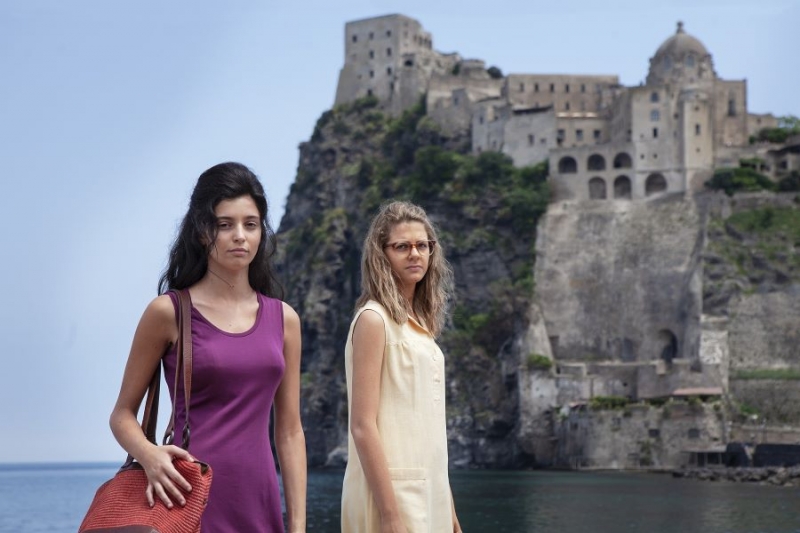
From around Chapter 40 to Chapter 75, the author constructed a self-contained story that took place on the beach of Ischia, where Lila, Lenu, Nino, and, initially, Pinuccia and Bruno Saccovo spent a massive amount of time together. This takes up approximately one third of the book and is constructed like a novella within a novel. The location is limited almost entirely to the beach, away from the neighborhood with a large cast of characters who are always minding each other's business, and only 3 to 5 young people with raging hormones are hanging out at any given time. The confined setting intensifies the relationships and conflicts among them. More important, this story has its own arc of beginning, development, climax, and resolution. But don't worry, the larger novel also has its own arc, and an even more explosive climax comes after the story in the middle. 

It puzzled me for days why this segment has to take up so much space. Lila and Nino fell in love slowly. The girls spent the early days listening to Nino's endless political babbling. There were many ups and downs, hesitant touches, and half-hearted denials. The month on the beach seemed so monotonous, so interminable, as if time had stopped and the summer would never end. Only by Chapter 85 (after the end of the vacation) did I realize how massive Lila's choice to leave her husband for Nino was and why it had to take so long: In an insulated working class neighborhood in 1960s Naples, no one, absolutely no one, had even thought of divorce. A more likely scenario would have been murder (ie, divorce, the Italian style).

Even so, every reader knows, from the last chapter of the previous book, that Lila's marriage to Stefano could not last. It ended before it even started. Lila confessed to Lenu that she had felt numb and on the verge of (spiritual) death in her marriage. But she was only 17 and the most vigorously alive person in the neighborhood. If Lila were to submit to the social norms of the neighborhood, she would have to become another Gigliola or Pinuccia and kill her indomitable spirit. Well, that's not going to happen. So the marriage is doomed. Nevertheless, how to get there without making her look anachronistic or unrealistic could have been a real problem. A young woman of her time and background needed an enormous amount of drive to overcome not only her environment but her own conscience. Thus comes a catalyst to give her a reason to do what she had to do, sooner or later. The love affair with Nino became the impetus for Lila to finally leave Stefano, but the process has to be meticulously and convincingly laid out, at least for Italian readers.

It seems a little reductive to call Nino "a catalyst," but that is more or less the function of this character throughout the quartet --- not that the passions and suffering felt by all three characters were any less palpable or sincere.

For many years, the idea of people using people was taboo to me. It seems so despicable that I was afraid of even thinking about it. However, psychotherapy changed that and helped me see how people never stop using each other, often unconsciously and sometimes constructively. Relationship is not a zero-sum game. A person may not lose anything by being used, and both the user and the used may come out with more than they have had. People who love each other especially use each other all the time and both sides can derive pleasure from it.

A closer look reveals more patterns of characters using each other. When Lila first hired Lenu to accompany her on the beach vacation with a health-related purpose, Lenu agreed on the condition that they go to Ischia instead of another beach town, so that she could be close to Nino, because she knew he would be in the nearby city Forio. Here Lenu used Lila. Then Lila used Lenu's friendship with Nino to become close to Nino, which triggered everything that followed. While Lenu felt used and angry, she was spurred by her disappointment in Nino and Lila to pursue higher education at the free university in Pisa. Before this turn of events, Lenu had always been ambivalent about her future: to stay or to go away, to become just like her mother or to forever escape the same fate. After that, she no longer had any doubt. Unconsciously, Lila's escape brought about Lenu's escape. At the moment it seemed like a loss, but pain pushed both girls beyond what they had thought they were capable of.

The Ending of Le Samourai (1967), Explained

A quick online search after watching Jean-Pierre Melville's Le Samourai confirmed my suspicion: The plot is very rarely understood by E...