Search This Blog

Saturday, May 14, 2022

Area X: The Office Edition


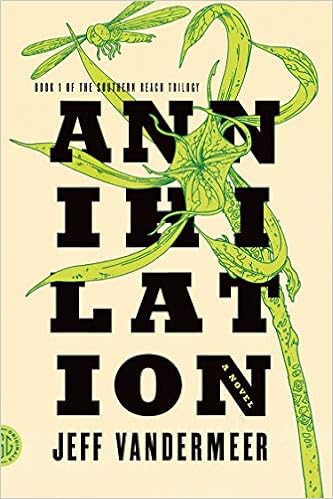
Re-reading the second book in the Southern Reach trilogy demonstrated to me that I did not get it at all the first time. Jeff VanderMeer's writing is subtle and ... I had no excuse except I did not pay attention. 

<Spoilers!> 

On the first reading, I totally missed the nature of the conflict between John Rodriguez ("Control") and Grace, the assistant director of the Southern Reach agency. 

John was hypnotized by Lowry ("The Voice") over the phone. Duh! He was unconsciously carrying out Lowry's orders throughout the book, including putting bugs in Grace's office and searching it at Lowry's orders. Not only was he an idiot for discovering it too late, but so was I for missing such a crucial detail.

Even so, I quite enjoyed "Authority" both times, perhaps because I share two things in common with John: I too had a somewhat distant mother (not as distant as Jackie Severance) and I too worked in a giant bureaucracy and failed. VanderMeer admitted that the office environment at Southern Reach and the shadowy overhanging agency "Central," which evokes the CIA but could well be FBI or NSA or the military, was based on his own soul-crushing experience of working in an office. I know that feeling very well --- the daily confusion of "what the hell am I doing here?" and "what is going on?" 

Some readers prefer the fantastical and perilous environs inside Area X in the first and third book, but I realized that John's journey within the Southern Reach in the second book parallels the biologist's journey in the first book. The labyrinth of the facility and its employees may look familiar to us but, on close inspection, are no less absurd and bizarre than within Area X. Here it is made clear that outside and above the hopeless Southern Reach hovered the Central --- an invisible and more powerful force that monitored and interfered with SR's operations and personnel. This is also a hint for Area X and the force behind or above it. 

The biologist and John form another parallel between the two books. Both characters are what the world would consider "losers" by the usual standard, constantly on the verge of being fired (or having been fired) from their jobs and unable to form stable emotional bonds with other people. At the end of both novels, the biologist and John came to some tenuous relationship with someone else (not with each other) before they are swallowed and transformed by Area X. 

Compared with Annihilation, Authority is able to sketch out several distinctive characters through slow-burn details that are somewhere between normal and crazy, culminating in the famous scene with Whitby, which is straight horror. 

In his Reddit AMA, VanderMeer admits that he writes from his unconscious a lot, which is consistent with my impression of the trilogy. He grew up in Fiji and spends a lot of time outdoors in his current home in Florida. He claims that he never uses psychoactive substances while writing, despite the trippiness of his imagination, but then admits that many elements in the SR trilogy came from a dazed state from painkillers after he had a dental surgery. That sounds about right. 

Monday, May 2, 2022

Enter the Dragon (1973)


Before today, the only Bruce Lee movie I had watched was The Way of the Dragon (1972), which I did not enjoy as much as the later kung fu movies from the 1980s and never went back to check out the rest of his filmography. However, one can outrun one's responsibilities as a kung fu movie fan for only 20 years. So here we are. 

Although the first 45 minutes had very little action, excluding a short one with Angela Mao (who could really fight), and felt slow and cheap, the hour after that became increasingly tense and even riveting. Well, OK, I have forgotten the opening fight between Lee and a very young Sammo Hung with nothing on but bikini shorts and gloves, which is supposed to be the original inspiration for MMA.

While one could argue that Shih Kien's knife claw was derivative of the 1960s 007 franchise, the final battle in the mirror room was thoroughly iconic, even if not necessarily the best vehicle to show off Lee's fight choreography.

My original impression holds true. Lee's choreography is unlike anything else before and since, despite his enormous popularity, which seems inexplicable. Surely people have tried to imitate his style but ... something prevents them from succeeding. 

I never worry about the stuntmen or costars' health and safety as much as I do watching Lee's movies, even though in reality Jackie Chan and Sammo Hung were probably more dangerous to work with. Somehow Lee's fight scenes just seem more brutal and vicious, largely because of the speed of his movement. At some point, Hong Kong movies began to shoot in 22 frames, giving the fight scenes a faster look, but that was later and did not have the same effect as truly fast hits. One can tell Lee's fight scenes were shot at regular speed, and all his movements are natural ... except the kick or the punch. They are not only unnaturally fast but at least appear to be incredibly heavy and powerful, which never fail to startle me. I still cannot think of any actor who could do it with the same visceral impact, no matter how good (or better) they are in other ways.

Lee's fight choreography is not my favorite type, purely from an entertainment point of view. When he worked on the first movie after returning to Hong Kong in 1970, the director and cinematographer found his moves unshootable. He wouldn't do the conventional long takes and rehearsals and just did one or two flashing kicks to end each fight. The scenes were too short and unwatchable. The director begged him to slow down and put on some more moves. Over time he modified his style for the benefit of the camera. And yet still there are too many kicks and punches that 1, do not have enough visual variety and 2, too fast to see clearly. I also prefer the sense of safety and assurance infused in Chan's movies. Chan hardly ever kills anyone, not even the baddest baddies. 

Nevertheless, the fight scenes in Enter the Dragon that involved Lee, which were choreographed by Lee himself, contained some rather intricate (but still minimalist) moves that I had to rewind a couple of times to see clearly. He could have made them more audience friendly if he had wanted to, but he seemed more interested in conveying the speed and the deadliness with as much realism as possible. Now I have to admit his style is thrilling, but it still makes me somewhat uneasy. Even the more violent and bloodier modern action movies (see Evans, Garrett) cannot quite achieve the same sense of lethality as he did with bare hands (and feet).

Tuesday, April 19, 2022

A Journey up the Abyss: The Southern Reach Trilogy


I have started re-reading the Southern Reach trilogy. Since I read the novels (or rather one long novel) a few years ago, certain scenes and images continually surface into my mind from time to time. The lighthouse. The tower. The dive into another dimension. The breathing wall with glowing text. The girl on the beach.

The novel is a journal both outward and inward. The characters hike into Area X, an alien but familiar place. From the start I had a strong feeling that Area X is also that incomprehensible, impenetrable world also known as the mystery of the heart. The further they journey out into this world, the deeper they plunge into their own mind, where words float meaninglessly on the wall. 

Of all the characters in the trilogy, I often think of the relationship between Control and his mother in the second book, Authority. All of the characters defy conventions and categories, but they are all imbued with a loneliness and longing, which eventually resolve, sort of, in Area X. 

The Southern Reach trilogy has stayed with me, not only because I have never seen anything like it, but also because the mood and the feels ring true. 

Thursday, April 14, 2022

More Paz

 I opened "Selected Poems" to a random page. It is "Is there no way out?" ---

The time is past already for hoping for time's
arrival, the time of yesterday, today and tomorrow,
yesterday is today, tomorrow is today, today all
is today, suddenly it came forth from itself
and is watching me, 
it doesn't come from the past, it is not going anywhere, today is here, it is not death ---
no one dies of death, everyone dies of life ...

The words slammed into my face and blindsided me. I tasted them in my mouth and let them slowly slide down my throat. They dissolve into a pink haze and spread into my limbs and evaporate in a shiver.

I am reminded of this ---

Tomorrow, and tomorrow, and tomorrow,
creeps in this petty pace from day to day, 
to the last recorded syllable of recorded time;
and all our yesterdays have lighted fools
the way to dusty death ...


Monday, March 14, 2022

王维和Paz

最近由于巧合而同时在看 Octavio Paz 的诗集和一本关于唐诗的书《蒋勋说唐诗》。Paz 的诗集随手一翻开就看见一句:

We are surrounded
I have gone back to where I began
Did I win or lose? ...
Wang Wei to the Prefect Chang
from his cabin on the lake
But I don't want
an intellectual hermitage
in San Angel or Coyacan
-- Return

然后读了书里讲王维的一章,包括了他的其他五言诗,我有点明白为什么这些年里其他的诗词我都忘记了,只记得“大漠孤烟直,长河落日圆”。王维的直白五言,对于经常会把字儿的顺序记混的人来说真是太贴心了。

王维的诗经常上下文是 throwaway 的唠嗑,突然来一神句,如同兜头淋一桶冰水,提神醒脑。而 Paz 的诗形式不拘,有些很长,充满了大脑认为太抽象而身体知道准确的描写。例如随便一句讲 Mexico City 的,"Noon, pounding fist of light."

抄一段早期作品:

Sky black
            Yellow earth
The rooster tears the night apart
The water wakes and asks for you
A white horse goes by
--- Duration

注意到这首诗有个副标题:"Thunder and wind: duration. -- I Ching". 

王维和Paz的共同点,意象很有冲击力,好像从远处飞来一本书,啪地打在我鼻梁上。看到王维的另一句:“行到水穷处,坐看云起时”,泪水刷地涌了上来。在过去的两年里,这件事我已经做了很多很多次。

Saturday, March 12, 2022

The Night Raid (Mahabharata Notes #18)

Ashwatthama

Leafing through my blog posts over the past years brought the realization that I have written a lot about war. That's hardly surprising as the country has been embroiled in wars in Iraq and Afghanistan for 20 years and just barely ended the last remnant of the intractable mess that caused enormous amounts of death, suffering, cost, loss, and humiliation. Now that the horror of war is again being broadcast live on everyone's Twitter feed, I feel like we barely had a break of peace. Maybe that's the normal reality of humanity anyway? But still. 

Inevitably my mind returns to Mahabharata. I cannot believe I wrote 17 (!) posts in 2015 to sort out my thoughts and feelings about the enormous epic. So this one is #18. 

On the last night of Kurukshetra, Ashwatthama led what was left of the Kauravas army to raid the camps of the Pandavas and killed most of the named characters in their sleep. I'm pretty sure this "special operation", to borrow a phrase in the news, was against the rules of war as both sides initially agreed. But by that time I don't think anyone on either side cared much about following rules any more. Too many of their sons, brothers, fathers, grandfathers, and cousins had died, and too many rules had been broken. Right before the night raid, Bhima had broken Duryodhana's thighs in their mace duel (yeah another duel), an action also against the combat rules.

Unlike many commentators and revisionists, I do not doubt the main authors of Mahabharata took sides when they created the most recent, coherent, and stable version of the epic. I think they did intend to cast the Pandavas and Krishna as the good side and the Kauravas as the bad side. Nevertheless, the complexity and mirror images throughout Mahabharata are nothing short of astounding. Duryodhana certainly committed plenty of atrocities with complete disregard for dharma, but Krishna employed many tricks that were hardly fair. Before the end, Arjuna shot Karna while the latter was defenseless, and even the figure of dharma himself, Yudhishthira, lied in order to kill Drona.

It is a little surprising that wars two to three thousand years ago in India were fought with some sort of mutually agreed rules, not unlike the Geneva Convention today and various treaties that try to dissuade countries from using chemical weapons, cluster bombs, etc. Nevertheless, rules break down as more blood is shed and death looms larger, or when someone just does not care and takes advantage at any cost, which inevitably starts a spiral toward total breakdown of any semblance of order and honor. 

Even if the authors might have taken sides on the grounds of morality and theology, they were completely ruthless in terms of consequences. The outcome of the war is almost a complete mirror image. Although there is a winning side, the Pandavas, very few of their clan and relatives survived, leaving only one child to barely carry on their bloodline. One could argue that nobody won. That is certainly the position of the weeping widows and families from both sides, wandering the post-war Kurukshetra and searching for the corpses of their husbands and fathers and brothers. And Gandhari, the mother of the Kaurava brothers, was able to exact revenge on the almighty Krishna and his entire clan, so that violence and slaughter come for them some years after the war. Is Stri Parva (the Book of the Women) an anti-war segment in an epic about war? It is certainly on par with modern anti-war literature.

There is so much in Mahabharata that continues to hold true now. As long as humans wage wars, Mahabharata remains relevant. 

Friday, March 4, 2022

Paz and Rothko

Octavio Paz

When I was a hormone-raging teenager (yes, that happened to me too), I happened upon a Chinese translation of Octavio Paz's prose poem The Blue Bouquet. Its indelible impression on me never faded. Yet it took me decades to seek it out again, as I recently began to read other poems by Paz. 

Perhaps my excuse is that I have been afraid of poetry all my life. Reading poetry for me is like going to an art museum, especially a modern art museum. I walk by most exhibits and nod with a smile on my face, and promptly forget about them as I turn to the next piece. Only occasionally would a piece strikes me dead on the spot. 

I borrowed a collection of Paz's poems from the library, but it's very slow going. They seem dense to me. In my mind I slowly piece together his words into a series of images, which may or may not produce any meaning. Yet often enough an image punches me in the face. For example, 

I walk without moving forward
We never arrive
Never reach where we are
Not the past
the present is untouchable

                                -- Return

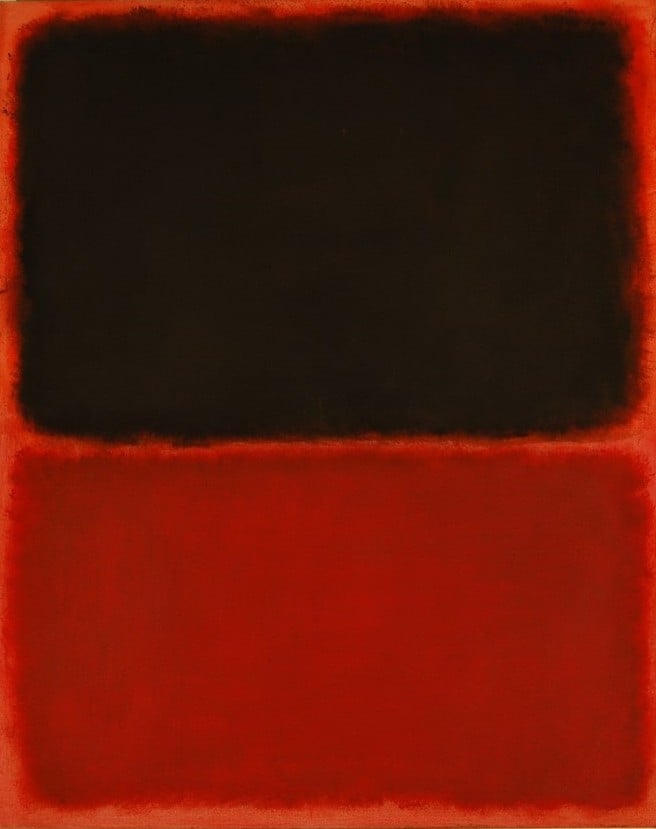
I don't know what it means. I only know how it makes me feel. And how it makes me feel is almost the same as how certain abstract artworks make me feel, primarily Mark Rothko.

It's kind of meaningless to see a Rothko in any medium other than seeing the real thing, because the real impact is in the details. 

Rothko's abstract paintings (not his earlier works) get into a part of my mind that lies underneath language and conscious thoughts, straight into the amygdala, where dark tides of neurotransmitters roil in the electric storms. 

I do believe that people can transmit feelings between them without words when they are in close physical proximity. My Yoga teacher likes to call anything that tingles in the body as "vibrations", so I might as well use the same term. Even though humans do not have telepathy, we catch each other's vibrations when we are in the same room and paying attention. Such transmissions are usually impossible remotely with words but can be done with reduced efficiency with images, which is why moving pictures evoke emotions faster than written words. 

What exactly is remotely transmitted into my head from some of Paz's words and Rothko's images, I don't know, but it's not nothing. 

The Ending of Le Samourai (1967), Explained

A quick online search after watching Jean-Pierre Melville's Le Samourai confirmed my suspicion: The plot is very rarely understood by E...