Search This Blog

Sunday, December 29, 2019

The Ending of Le Samourai (1967), Explained


A quick online search after watching Jean-Pierre Melville's Le Samourai confirmed my suspicion: The plot is very rarely understood by English-language critics. Even Roger Ebert's Great Movie Review and Criterion's essay by David Thomson appear to have entirely missed the point. If one assumes that these two critics both read their colleagues' writing extensively, it is safe to bet that most of their colleagues, too, remain in the dark. Why does the killer-for-hire, Jef Costello, played by the expressionless Alain Delon, show up at the nightclub and pretend to threaten the unnamed jazz pianist (Caty Rosier), thereby committing suicide-by-police? Does Costello follow some made-up samurai code of conduct and his suicide is predetermined? Everyone comments on the movie's style, but none gives a plausible explanation of the plot, especially the character's motivation.

The first time I watched Le Samourai was almost 20 years ago. At the time I too thought the plot was as stoic and incomplete as the characters. I guess in the past 20 years I have learned at least one thing --- how to pay attention to details.

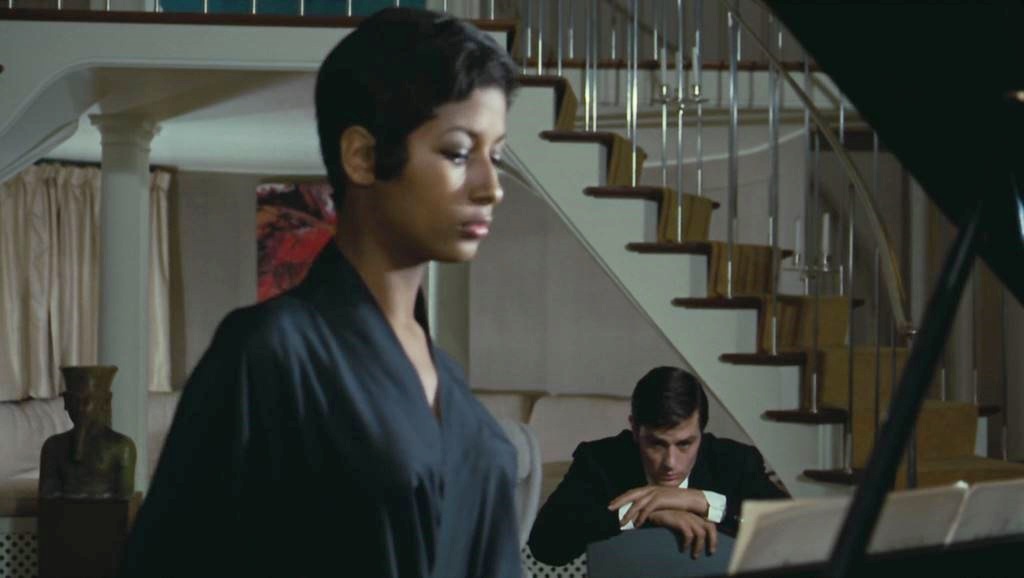
The critics' blind spot, I have realized, is their failure to look closely at the jazz pianist as a key character. There is a crucial scene that is missed by everyone. Approximately two-thirds into the movie, after escaping an attempt to eliminate him by his employer/client, Jef goes to the pianist and tries to suss out from her who has employed him. We watch the pianist driving him in a car. She listens to his questions (after a bit of unconvincing coercion) in a house that we can only assume to be her home (she is wearing a bathrobe or kimono-style pajama). The living room is shown as a grand loft with 2 staircases in the back that lead to an upper deck with railings. This room --- this set --- is the key to the story.

Jef lays out his case to her in a scene that contains more words spoken by him than the entire rest of the movie. He pleads for information on who told her not to identify him in the police station. She appears to be sympathetic and sends him away with a promise to give him information later. "Call me in 2 hours," she says. Why 2 hours?

He goes away and calls her from a payphone as agreed, but she does not pick it up. Instead, she ascends the stairs and passes through a door on the left, and then enters a corridor. The white walls on both sides are lined with paintings. She pauses and bites her nail. The scene cuts away.

Not getting an answer on the phone, Jef goes back to his flat and is ambushed by his handler, the go-between guy who tried to kill him previously. However, he is no longer trying to kill Jef. Shockingly, he pulls out the money he owes Jef for the first job ... and then some more ... for a new job! Jef is skeptical but takes the money anyway (while giving the guy a beating), implying his acceptance of the new job. Importantly, the scene cuts away before we find out who the new target is, but not before we hear the unfortunate go-between guy confess the name and address of the mysterious client who hired him. "Olivier Rey," and "He's not like us." In other words, Monsieur Rey is not a gangster. Although the name has never been mentioned previously, we have seen him in a previous scene, in which he discusses the need to kill Jef so that the murder is never traced back to him. There were 3 other men in this scene: the blond go-between guy, an older bald man, and a man we recognize as the bartender at the nightclub.

In the pre-climactic scene, Jef comes out of an elevator in a building (presumably at the address provided by the go-between guy) and kicks open a rather impressive big door --- a door to something like a penthouse. Here comes the tricky part of Melville's visual game. We see Jef walking through a white corridor lined with paintings on both walls. He opens a familiar-looking white door at the end and comes out on a deck overlooking two sets of stairs. The camera pans down: we see the living room where Jef and the pianist talked the night before. This is the same house!

Because this scene begins from the front door and corridor upstairs, while the previous scene is shot completely downstairs, the audience may not recognize this is the same house, but Jef obviously knows that he was here before (perhaps he and the pianist came through the garage downstairs?). This is the point where he understands the crime(s) and the players behind it.

Jef does not descend the stairs. Instead, he retreats to the white corridor and searches the house for Olivier Rey, the client who is not a gangster. Jef shoots him dead. Before he is killed, however, Rey asks Jef whether he has accepted the second job to kill ... We will soon find out.

"Oui," says Jef, after a pause.

Jef leaves and returns to the crowded nightclub that evening. The jazz pianist comes out in a stunning dress and sits down to play. Jef walks up to the piano and looks into her eyes, then takes out a gun and points it at her. "Why, Jef?" She asks, her eyes soft and unfrightened. "Because I was paid to," he replies. Then he is shot dead by the police who have been hiding in the crowd. They rush over to find Jef's gun empty. He had no intention of assassinating her.

It's reasonable to infer that Jef chooses to commit suicide (this much is obvious) because he has decided to abort the second job. Why didn't he just turn it down? Maybe he accepted the job so that no one else can be hired to do it. Maybe when he heard the name of the second target, he did not understand why. Ergo, his purpose is to protect the pianist. In addition, we now realize that killing Olivier Rey is a part of this mission.

Now let's review the story in chronological order:
- A man hires Jef Costello (through a blond go-between guy) to kill a nightclub owner.
- Jef does his job but falls under the police's suspicion.
- To avoid being traced back to him, the client hires the go-between guy to kill Jef, unsuccessfully.
- Jef investigates through the pianist.
- Jef is ambushed and given a second job to kill the pianist.
- Jef gets the name and address of the client. He goes there and kills him.
- Jef goes to the nightclub to kill, no, to protect, the pianist.

One may argue that the "Bushido Code" (made up by Melville, probably after watching a number of Japanese samurai movies without fully understanding the culture) forces Jef to remove the last threat to the pianist, which is himself. Therefore, he has to die. Makes sense? Not really. He's killed Rey who ordered the hit. She is now safe (probably). Why does he commit suicide?

We have to return to the key revelation: Olivier Rey and the pianist live in the same house. This means that they are probably husband and wife, or at least long-term lovers.

In the first assassination, Rey hires a professional (Jef) to kill the owner of the nightclub (Martey) where his wife plays. Of course we will never know exactly why, but the common excuse in this type of stories is that the wife is having an affair with the nightclub owner and the husband is jealous. This is pure speculation. Perhaps Rey and Martey are doing some seedy business together (even though Rey is not a gangster), and Martey embezzled money, or they just had different views on how to do business. If so, it is nothing but a coincidence that the wife happens to perform at this very nightclub.

Later, Rey hires Jef to kill his wife. Why? Again we can only speculate. There are almost no clues, but we do know that the wife/pianist knows by now that her husband has ordered the murder of Martey and the attempted murder of Jef Costello. Witness elimination or blackmailing would be a usual motive.

The web of connections among Rey--the go-between-guy--Jef--the pianist can also explain why, at the beginning of the movie, the pianist did not identify Jef in police line-up. Without knowing the connections, we can be forgiven to think that she saves Jef from the police because of Delon's beauty. The real reason, as Jef himself points out, is that she was intimidated by someone (maybe the bartender) to keep her mouth shut.

Is Jef the samurai who adheres to a suicidal code of honor or a medieval knight in shining armor to the damsel's rescue? Is he in love with her? Does he choose to protect her so thoroughly to repay her initial protection of him? Yes and yes. Such a sentimental story, if it were presented in a comprehensible way.

One last missing piece in this puzzle. There is too little information to even speculate on, but I will speculate nevertheless. When Jef calls the pianist, she hesitates and chooses not to pick up the phone. She could tell Jef everything and even hire him to kill her husband. But she does not. Instead, she walks up the stairs and enters the corridor, perhaps to go to her husband's office and ... confront him? Did this confrontation lead to Rey's decision to have her killed?

Another missing piece that could fit into this one is the events between the two scenes involving Jef and the go-between guy. In the first scene between the go-between guy and Jef, Jef barely escapes death. In the second, the handler shows up with a gun but chooses to make peace. Instead, he hands Jeff a lot of dough. What happened between these 2 scenes? Is Rey's wife blackmailing him to let Jef live? "I know what you did and I want you to stop"? Why? We will never know. If this is true, however, we could reasonably say that the pianist saves Jef twice in this movie: first from the police and then from her husband.

If that's what she has done, it is entirely justified that Jef Costello should die for her, by Bushido, chivalry, or any other code.

----------

A final note. I find it curious that even the most experienced film critics have failed to connect the dots, because they have failed to pay attention to the Caty Rosier's character. Perhaps I would not have either, if a male friend had not, many years ago, commented to me how beautiful and sexy the jazz pianist is.

Saturday, June 8, 2019

Jazz and La La Land (2016)

Last week I needed some background music to help me concentrate on work. Instead of going with piano tracks from Studio Ghibli movies, I made the mistake of picking La La Land. The music is pleasant enough, but it reminded me how much I despise the movie.

When I first saw La La Land in theaters 3 years ago, I was both amused and slightly uncomfortable about all the passionate talk about old-fashioned "pure" jazz by the male lead, played by Ryan Gosling.


You see, I, too, am a fan of old-fashioned, classical jazz from the 30s and 40s. I am not saying there is anything necessarily wrong with a white man "defending" and "saving" this "dying" art form --- Jazz belongs to everyone --- although I take exception to the tiresome claim that jazz is "dying" or "dead." (Change is not death!) But the scene in which he admonishes another jazz musician (played by John Legend, who is a pianist but NOT a jazz musician) for selling out to popular music is pretty juvenile and dick-ish.

While the character, who obviously speaks for the writer/director Damien Chazelle, lectures others sanctimoniously about the "purity" of old jazz, the music he creates and plays in the movie basically slaps himself in the face, because that is most certainly NOT old jazz. In fact there is no original, memorable jazz music on the entire soundtrack.

Again, I do not hate the movie's music, composed by Chazelle's Harvard classmate Justin Hurwitz. It's catchy, light, charming, typical French Bourgeois fluff. The real egg-on-the-face point is for the character to declare his love and admiration for Thelonious Monk and then play the syrupy theme. It's like Dan Brown declaring himself the one true heir to Shakespeare.

Far be it from me to decide what pure or good jazz is. Real jazz musicians have commented on how ignorant the movie is about jazz.

The cherry on top of all this self-inflicted damage is casting a (according to the American definition) black musician to be lectured by white boy pure-jazz savior. Well I guess an anti-obliviousness pill could do him some good.

Saturday, March 23, 2019

Indian Gangster Cinema

I discovered Indian gangster movies through, of all things, Shakespeare. Specifically, it was Vishal Bhardwaj's Maqbool (2004), an adaptation of Macbeth, that captured my fascination.


In an interview, Bhardwaj mentioned that his inspiration was the auteur Ram Gopal Varma, who broke open the genre with Satya (1998).


Indeed, Satya is extraordinary, with clear influence by and homage to Italian neorealist and French existentialist cinema. The stark naturalism is particularly striking in the context of Indian cinema where Bollywood's opulence and fantasies dominate.

Without having acquired an extensive discography of Indian gangster movies, I stumbled upon Anurag Kashyap via the TV series Sacred Games (2018), purely because I read the sprawling novel of the same title. It was more of a thriller set in the Mumbai underworld. But then I traced Kashyap to the unbelievable Gangs of Wasseypur (2012).


At the end of the Part 1 of Gangs of Wasseypur, Kashyap made an unabashed homage to the movie that every gangster movie after 1970 owes a debt to, no matter where in the world it is made --- The Godfather.

Indeed, the Godfather may not be the granddaddy of world gangster cinema, but it is the most influential and consequential, bar none. Of course, Coppola must have had some exposure to the Italian trashy cinema in the 1960s.

Not that I'm claiming one is superior to the other, but I much prefer Kashyap's gangs to Martin Scorsese's, be they from New York or Boston.

Incidentally, Scorsese's gangs of Boston, ie, The Departed (2006), were originally gangs from Hong Kong, ie, Infernal Affairs (无间道,2002) made by Andrew Lau and Alan Mak.


And of course, the Hong Kong gangster genre was my original entry point, initiated in the early 1990s by John Woo.

Every country's gangster movies have their own lineage and tradition and unspoken code, and yet their shared something in their soul and spirit that no other genres do. Is it bloodthirst? Is it nihilism? Is it a chase of cheap thrills? Or is it an instinct for revenge? Whatever it is, it's universal.

Unexpectedly, more than the death, family, and revenge, the Indian gangster movies taught me the Indian sense of humor. Subtle, dark, self-deprecating, and absurdist, almost a bit like Finnish humor.

Tuesday, January 8, 2019

Gangs of Wasseypur


I don't feel like I should write a wholly enthusiastic post about Gangs of Wasseypur just yet, because I am still only 15 minutes into the second part of this epic. It was made as one 5-hour-long movie by Anurag Kashyap in 2012 but had to be split into two parts because of the length. But still. Holy cow! What a movie! What a contribution to the world genre of mafia/gangster sagas! (And Kashyap was not even 40 years old when he made it. Damn you!)

The first part ends with a shootout that was an unabashed homage to the death of Sonny Corleone in The Godfather, with the dual benefit of Indian authenticity and absurdist black humor. The movie is organized as a series of semi-incoherent scenes cut together with the intention of concealing as much as illustrating the narrative logic from one scene to the next. One could almost hear Anurag whispering in one's ear: Forget about why and how and who, and look at the details. So many delicious, blackly hilarious, and unexpectedly emotional details. It reminds one of how life is actually lived --- fumbling from moment to moment with no premonition of what is to fall in the next scene and no understanding of what has led us to this time and place.

Early in Part 2, there was a prolonged night scene of gruesome beheading. At first I was just taken by the bloodiness with a hint of absurdity, but then it dawned on me how hard it must have been to stage this scene uncut, starting with Actor A sitting and talking with Actor B to A's severed "head" ended up in B's hand. Very clever. And a lot of scenes were done similarly, almost trying to hide its technical brilliance in gritty realism.

Monday, October 22, 2018

Giovanni's Room and the Question of Identity

I have been intending to read some James Baldwin, but picked up "Giovanni's Room" only recently. I suppose what particularly fascinates me about Baldwin is the fact that he emigrated to France but continued to write about United States. There was undeniable love for his homeland (and I don't think he tried to hide it), but the love is only able to live outside of the soil of this land.

(Side note: I recently read some fluffy article on the implied differences among words of similar meaning: White people who move to another country are called expatriates, but nonwhites are immigrants or, worse, migrants. They forgot the term reserved for intellectuals: the exiled. But then what exactly are the differences?)

Back to Baldwin.


A debatable element in Giovanni's Room is that the narrator, "I" (David), is a white American man in Paris, not black like the author. Sure, white men have written mountains of books in the voice of nonwhite men and all colors of women, but a black author writing in the voice of a white man makes everyone uncomfortable.

Actually a lot of the character traits in David are counterfactual to Baldwin's own. For example, David has no mother but a doting and possibly alcoholic father who loves him. Baldwin himself had a stepfather who abused him in childhood.

On some level I have felt a kinship to Baldwin before I read anything he wrote. Besides the realization distance is necessary to allow for love and understanding to survive, I also sensed his ambivalence about identity: American or European, hetero- or homosexual, black or white, here or there. Or both and all of them. The ambivalence can be tormenting, but it can also be delicious. More important, it carries a promise of freedom, which is far more urgent and necessary to those who have less of it.

When one has one or more identities that are not dominant in his milieu, be it black, gay, foreign, poor, or any kind of outsideness, he gets to taste a multitude of feelings, because one does not lose the yearning for a sense of belonging and insideness. But standing a little away, sometimes, also allows for a better and more realistic view of things, a bigger picture. Why? Because we do also identify with the dominant and the powerful. Who hasn't read "Pride and Prejudice" and identify with Mr. Darcy or his "lucky" wife? Who hasn't gone on the adventures of the Fellowship of the Ring? Who hasn't slayed dragons and flown X-wing fighters and blown up Death Stars? (Yes, girls too!) So that part is universal. And everything outside of the dominant identity, we can acquire through experience or empathy.

Giovanni's Room is, in some way, about of self-loathing. Making David white focuses our attention on the hatred brought by one's desires. It's also a story about running away, away from home so that one can be at home with oneself.

Wednesday, October 17, 2018

King Lear Again

Of all the Shakespeare plays I am fond of --- Henry IV Part 1, Antony and Cleopatra, Othello, Much Ado, Richard III --- King Lear was the first and is still the closest to my heart. I had never seriously watched any Shakespeare plays until I happened upon a PBS broadcast of NT's production of King Lear starring Ian Holm. Before this I had seen Branagh's movie version of Hamlet, but that hardly endeared me to the Bard. (Even today I remain puzzled and indifferent to this most famous and celebrated of plays.) This Lear, however, decimated me.

This is a strange family. There is no mother. The father acts like a child. The daughters, even the bad ones, behave more like adults. And yet there is so much truth in these bizarre relationships, truth that we do not talk about in polite society, especially the society in which I grew up, where children are expected to worship and obey their parents, until the parents become senile and childish (and sometimes mad).  

The shattering truths in King Lear lie not only in family dynamics though. Watching a recent version starring Anthony Hopkins, I cannot help but be reminded of the state we're in now, everything that is happening, watching people squirming to escape the confrontation: the true nature of the relationships between men and women in this world. 

We have had thousands upon thousands of stories about the power struggles between fathers and sons, and the necessity of patricide to "make a man." Rivers are choked with the corpses of King Laius and Darth Vader. But fathers and daughters, that is a territory rarely encroached. While Cinderella's evil sisters remain a staple of female characters, where else have we seen the likes of Regan and Goneril? Not until we got Cersei Lannister. She is far from the most evil character in ASOIAF, but she has more haters than Ramsay Bolton or Tywin Lannister (in fact both have plenty of fans). Evil with ambition earns some grudging respect for the Duke of Gloucester and even heroism for Macbeth, but Regan and Goneril got their father's vicious curses on their bodies and their wombs. 

Coincidentally, I heard on the radio a piece of news about a recent study that found women prisoners are twice or thrice more likely to be punished, and punished more harshly, for the same infractions than male prisoners. This is consistent with previous studies indicating that female lawyers get disciplined far more harshly than male lawyers for the same unethical behaviors. Even in abstract psychological experiments, people tend to hand down more severe punishment to women than to men for the same bad deeds. Women are held to much higher moral standards than men are, and that's not a uniquely American or Protestant phenomenon. 

The conflict between men and women is pervasive, unconscious, and intractable, and perhaps impossible to resolve, ever. At the heart of it might be the unbearable (at least for men and probably for many women) fact that we are the same. Women are no better or worse than men, including, but not limited to, the same thirst for power and the same need to vanquish their parents in their rite of passage.

(This is perhaps one of the many ways gender conflict echoes racial conflict: What is intolerable is not the difference, but rather the recognition of similarity and commonality and, subsequently, our shared humanity. That's just going too far!)

Tuesday, September 18, 2018

Short Film by Ruben Ostlund


I have seen a theory that the one trait that separates humans and animals is humor, or perhaps sarcasm or irony, I don't remember exactly. Such efforts to support human-exceptionalism have a long history of failure, and one of these days animal psychologists might just devise a clever experiment to prove it wrong. However, I don't believe this theory to begin with, because humor and irony appear to be traits shared by some but not all humans. I have met a few people whom I could not make laugh by presenting jokes that are somewhat convoluted or absurdist. So it is more likely that one of these days some GWAS (genome-wide association studies) data will identify a set of genes that determine who laugh at Jerry Lewis' jokes and who laugh at Ruben Ostlund's jokes.

I have seen two of Ostlund's feature films, Force Majeure and The Square. I laughed and laughed. It's not just him. See also Aki Kaurismaki. I don't know how to explain it, or what the hell is so funny, but I can't stop laughing.

"Incident by a Bank" above is a perfect example. It's actually kind of a thriller. Ostlund reenacts a real incident of bank robbery in this single-take short film. There are tense moments, gunshots fired, a minor act of heroism, and a bit of a chase. It's deceptively simple but in fact technically quite brilliant. But it's also hilarious. I watched it last night and have been chuckling all day like an idiot over the memory of a particular element in this film: a busload of cheering kids slowly driving by. ("3 years of knowledge erased tonight!") Why? Damned if I know.

The Ending of Le Samourai (1967), Explained

A quick online search after watching Jean-Pierre Melville's Le Samourai confirmed my suspicion: The plot is very rarely understood by E...