I think I'm in love with Chekhov. The thing is that he puts the audience in a situation in which you want to both laugh and cry at the same time. He jams comedy and tragedy together, and yet I don't feel the whiplash from such jarring contradictory tones. Reading the scripts of The Seagull and Three Sisters, I keep laughing even though laughing seems inappropriate because it's all so sad! And funny! And sad and funny! Also I suspect that his scripts are best presented on screen, perhaps television rather than movies (never mind TV was not even invented in Chekhov's time). They are so subtle and full of winks and nudges, totally unsuited for a large theater where actors have to raise their voices to be heard. And the plays are best acted by professional comedians with mature mastery of ... timing.
In The Seagull, at first I was taken aback by how Oedipal it is in the depiction of the mother-son relationship (Irina Arkadina and Konstantin). Chekhov is Freud's contemporary, but surely the latter had no influence in Russia, did he? This is explained in the translator Paul Schmidt's notes --- Chekhov modeled it on Hamlet and Gertrude. No wonder ...
This type of generational rivalry usually occurs between parent and child of the same gender: mother versus daughter, father versus son. Here Arkadina's contempt for her son's literary and dramatic pursuits reflects perhaps a generational conflict between Chekhov and his older or younger colleagues in real life. Her prima donna personality must have been modeled on real stars he had met. Any other writer would surely tar and feather her as a horrible villain, but I want to laugh.
Regardless, more than anything, this particular play seems to disprove the theory that Chekhov always writes about people's inaction and stagnation and unfulfilled dreams. On the contrary, nearly all of the characters in the play have taken quite decisive actions. Trigorin seduces Nina. Nina elopes with Trigorin and even goes forth with her dream of becoming an actress. Konstantin writes and gets published and continues to write his experimental plays. Masha marries Medvedenko and has a baby with him. Even Sorin, the guy with lifelong regrets, has worked as a government bureaucrat for nearly 30 years. He hasn't been sitting in a chair all day. They are not people of procrastination, moping around mumbling should have could have would have. They are people of action!
And look where all the actions get them. Maybe that is the point. Contrary to the advice of American self-help books, taking action does not deliver people to happiness and "self-actualization" (but neither does inaction). What then? All we can do is march on in spite of it all ...
Thursday, April 27, 2017

Sunday, March 26, 2017
Timon of Athens
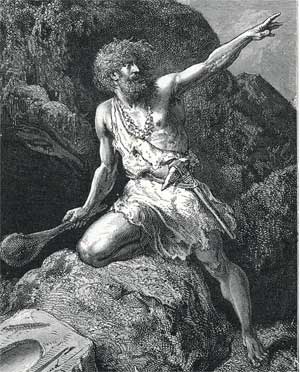
Folger Theater is going to put on a new production of Timon of Athens, directed by Robert Richmond, in a couple of months, so I've started reading it. It is in some ways the same story as Coriolanus, one of ingratitude, betrayal, and rage/revenge. But still ... just like Coriolanus and King Lear, two other characters in parallel with Timon, our feelings toward the protagonist cannot remain purely sympathetic. There is something troubling about his tragedy. Upon first glance, it is a simple injustice done to him by heartless people who betray his generosity. If you chew on it a bit, however, the easy moral lesson just doesn't sit right. The ambiguity is not as explicitly presented as King Lear's opening scene, but Lear's offering his kingdom to his daughters and Timon's free distribution of gifts to anonymous "friends" somehow give off the same vibe.
Timon believes that everyone at his banquet table loves him, because they tell him so while eating his food and pocketing his expensive gifts. Later, a financial downfall proves his judgment wrong, as none of these people wants to lend him a penny to help pay his debts. To Timon, money seems to be the currency of interpersonal relationships. Affection is bought and sold and passed back and forth between people, as solid and countable as gold coins. When it is apparent that this is not the way of humanity, Timon flips out in a rage. People took my money and paid me in love, and now they refuse to love me again by throwing money at me? Bastards! How could they? In Timon's mind, there is no difference between money and relationship. He is not so bad as those who try to buy love and loyalty via exploitation, because his need and neediness for affection are sincere and, can we say, desperate.
Lest we despise or laugh at Timon, who among us have not been plagued by unrequited feelings and unjust relationships? Who has not attempted to win someone's affection by freely giving one's own, only to be rejected or worse, deceived and betrayed? And yet, there is no road of banishment for us, out of Athens and into the woods, alone and independent, never again to beg for someone's unreliable bond. You can give and give and give, with never any guarantee of returned favor. There is no justice or accounting in our relationships with each other.
Thursday, March 16, 2017
Chutney
I happened upon an Indian takeout place today for some tandoori chicken and naan. On the way out I picked up some mango and tamarind chutney in tiny plastic cups.
The el cheapo naan was pretty dense and tough. I would have tossed it out if there weren't the two little cups of watery, sugary liquid to dip it with. Almost unconsciously, I finished a big piece of the lousy bread.
What the hell is chutney? Who invented this stuff to trick people into eating flavorless, nutrition-less, boring and bland starch? Perhaps it's a testament of the ingenuity of ancient people who crushed, boiled, ground, and fermented natural food stuff into unrecognizable shapes.
Substantively, chutney contains hardly anything more than a bit of minced fruit, sugar, and water. And yet, its effect is transforming and transcendent, like a pinch of curry or saffron or a few slices of ginger. It's ... magic.

The el cheapo naan was pretty dense and tough. I would have tossed it out if there weren't the two little cups of watery, sugary liquid to dip it with. Almost unconsciously, I finished a big piece of the lousy bread.
What the hell is chutney? Who invented this stuff to trick people into eating flavorless, nutrition-less, boring and bland starch? Perhaps it's a testament of the ingenuity of ancient people who crushed, boiled, ground, and fermented natural food stuff into unrecognizable shapes.
Substantively, chutney contains hardly anything more than a bit of minced fruit, sugar, and water. And yet, its effect is transforming and transcendent, like a pinch of curry or saffron or a few slices of ginger. It's ... magic.

Monday, February 27, 2017
Work, Meaning, etc.
Through this article on FT, I stumbled into a rabbit hole and just barely pulled myself out before sinking a whole evening into reading more and more lateral links on this subject.
Does work have meaning? What a can of worms. If yes, what is it and why is it so obscure? If no, why work beyond the poverty level?
Of course, on the most fundamental level, the purpose --- if not meaning --- of work is survival. Survival of the self and our genes. It's simple.
But then it got more and more complicated.
Just like "happiness," the word "meaning" should send a shiver down anyone's spine. Both are so chronically abused by cliches and wishful thinking and propaganda that they have by now lost all meaning.
When economists barged into the happiness business, all hell has broken loose. The problem is that economists do not see individuals when they think about people. So intent are they in seeking universal theories about the world and, worse, people, that they would never stoop to the level of individual persons and observe their similarities and differences --- some external and some internal, some constant and some ever-changing. And yet, without taking the interperson and intraperson complexities into consideration, the search for a universal theory of meaning or solution to happiness is doomed.
----------
Post Script: Actually, the whole point of this post is that all the talk about "meaning" --- as in the meaning of work, the meaning of life, blah blah blah --- reminds of me Harari's assertion that almost everything that binds human society together is fiction: morality, religion, human rights, and money.
Or I prefer to quote GRRM:
It applies to the modern concept of "meaning" just as well. Meaning is what one assigns to it. No more and no less. There, GRRM has solved the existential question for ya.
Does work have meaning? What a can of worms. If yes, what is it and why is it so obscure? If no, why work beyond the poverty level?
Of course, on the most fundamental level, the purpose --- if not meaning --- of work is survival. Survival of the self and our genes. It's simple.
But then it got more and more complicated.
Just like "happiness," the word "meaning" should send a shiver down anyone's spine. Both are so chronically abused by cliches and wishful thinking and propaganda that they have by now lost all meaning.
When economists barged into the happiness business, all hell has broken loose. The problem is that economists do not see individuals when they think about people. So intent are they in seeking universal theories about the world and, worse, people, that they would never stoop to the level of individual persons and observe their similarities and differences --- some external and some internal, some constant and some ever-changing. And yet, without taking the interperson and intraperson complexities into consideration, the search for a universal theory of meaning or solution to happiness is doomed.
----------
Post Script: Actually, the whole point of this post is that all the talk about "meaning" --- as in the meaning of work, the meaning of life, blah blah blah --- reminds of me Harari's assertion that almost everything that binds human society together is fiction: morality, religion, human rights, and money.
Or I prefer to quote GRRM:
"Power resides where men believe it resides. No more and no less.”
“So power is a mummer’s trick?”
“A shadow on the wall,” Varys murmured, “yet shadows can kill.”
It applies to the modern concept of "meaning" just as well. Meaning is what one assigns to it. No more and no less. There, GRRM has solved the existential question for ya.
Monday, January 23, 2017
Sapiens: A Brief History of Humankind
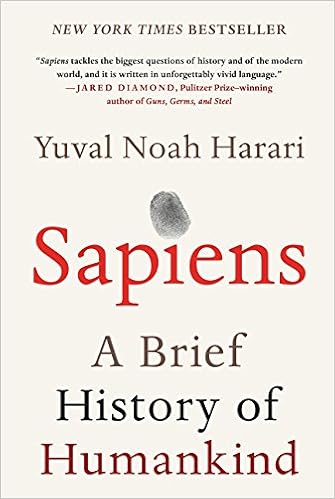
I had a hard time enjoying this book by Harari, not because it is not good or interesting --- it is very interesting, but the (inevitable) scatteredness irritated me every few pages. The author was overly ambitious and crammed as many ideas as he could into a small space. It's against my temperament to move on, as quickly as the book does, from one thought to another, without an urge to dig deeper and make connections between some of them. This might be the other extreme of Nassim Taleb, who would pound a perfectly good but not very complex idea to death with 200 more pages than necessary. I find them both to be enlightening but often frustrating.
To me it is only viable to take a couple of the ideas and look closer. I was particularly struck by a subsection in Chapter 8 No Justice in History. The author wrote:
At least since the Agricultural Revolution, most human societies have been patriarchal societies that valued men more highly than women. No matter how a society defined "man" and "women", to be a man was always better.
He went on to point out that sociological and biological attempts to explain this phenomenon have failed so far. Not being a student or scholar in gender studies, I cannot determine whether he is right or there are indeed illuminating theories buried in some university's archives.
Saturday, January 7, 2017
1913 or 1938?
I have been chatting with my Chinese American friends for weeks about the geopolitical and global economic outlooks in the next few years. Whichever way I look at it, the barrel of dynamite sitting between China and US is going to blow up in some shape or form. Both sides need it to blow up, because they have run out of alternatives. They just can't help themselves. Martin Wolf of the Financial Times recently compared today to the eve of WWI. The similarities are striking.
Mr. S refuses to heed my paranoia, but I continue to plot my doomsday scenarios. Not that I want the worst to happen, but it really does seem the most logical outcome given the current conditions. All the other options are rapidly receding into the fog.
I have to admit that, beneath the anxiety and dread there is a sliver of thrill. I was born in 1973, barely escaping the horrors of the Cultural Revolution. I never thought that, in my lifetime, I would witness such historical events as Hemingway or Christopher Isherwood or my parents did. From moment to moment you don't even know whether you will survive the next day! Is there anything more life affirming?!
The somewhat comforting elements of peace are two: 1) China does not have nearly enough long-range nuclear warheads to attack across the Pacific Ocean. 2) At the moment Russia has very little reason to get into any conflicts with US (Why would he? Putin's going to run the show of American national politics.)
So I'm sitting here on the brink, dangling my legs over the abyss, and shivering with a morbid curiosity. It is like the moment immediately after the boy king Joffrey unexpectedly had Ilyn Payne chop off Ned Stark's head, and I'm watching in the crowd through the eyes of Arya Stark or Uncle Yoren, with only a vague anticipation of the storm of swords to descend. There's also a faint whisper that I should write it down --- what it's like to live in January 2017 --- and take a snapshot of the sharp smell of snow halfway between the clouds and the earth.
I suppose we'll find out what is going to happen to the world, once George R. R. Martin finishes his damned book The Winds of Winter.
Mr. S refuses to heed my paranoia, but I continue to plot my doomsday scenarios. Not that I want the worst to happen, but it really does seem the most logical outcome given the current conditions. All the other options are rapidly receding into the fog.
I have to admit that, beneath the anxiety and dread there is a sliver of thrill. I was born in 1973, barely escaping the horrors of the Cultural Revolution. I never thought that, in my lifetime, I would witness such historical events as Hemingway or Christopher Isherwood or my parents did. From moment to moment you don't even know whether you will survive the next day! Is there anything more life affirming?!
The somewhat comforting elements of peace are two: 1) China does not have nearly enough long-range nuclear warheads to attack across the Pacific Ocean. 2) At the moment Russia has very little reason to get into any conflicts with US (Why would he? Putin's going to run the show of American national politics.)
So I'm sitting here on the brink, dangling my legs over the abyss, and shivering with a morbid curiosity. It is like the moment immediately after the boy king Joffrey unexpectedly had Ilyn Payne chop off Ned Stark's head, and I'm watching in the crowd through the eyes of Arya Stark or Uncle Yoren, with only a vague anticipation of the storm of swords to descend. There's also a faint whisper that I should write it down --- what it's like to live in January 2017 --- and take a snapshot of the sharp smell of snow halfway between the clouds and the earth.
I suppose we'll find out what is going to happen to the world, once George R. R. Martin finishes his damned book The Winds of Winter.
Thursday, December 29, 2016
The Odyssey
Throughout my formative years, my father would tell and retell his journey out of the countryside in the spring of 1945, his hometown, at the age of 20 years, crossing the line between Japanese occupation and Chinese Nationalist control, to arrive in Chungking, the wartime capital of the Chinese government, and pass the college exam to open a new life for himself.
Mother did something similar at 55, when she officially emigrated to Long Beach, California. A new country. No job. A new language. No social or professional network. But she did not recount this experience nearly as much as Dad did, for a variety of reasons. Regardless, it was no small feat.
Lately I think about these events often. Their meaning is not entirely clear, but that's OK. There are probably many ways to interpret them, some of which are contradictory, including the two instincts at odds: to migrate and to settle. What are we but contradictory creatures? It's not human to be without contradictions.
Isn't it funny that The Odyssey is a story both about adventures in strange land and about going home? We're driven to go, go, go, if for no other reason than evolution.
All this calls into question the idea of free will, which, I think, is a problem plagued with ambiguous and muddle definition. A key problem with free will is its being mixed with the problem of conscious thoughts. If we define free will as conscious, reasoned, language-driven choices, then I am almost certain free will is an illusion.
(Consciousness has unfortunately been elevated to an absurd degree by people who consider themselves "scientific" in recent years. This is at least in part motivated by the urge to perpetuate our narcissistic needs to feel oh so special. We have to hold on to our specially favored position in the universe, if not by the rumor of 23 grams of soul, then by the quantum-fueled mumble ... I mean consciousness. But I digress.)
But, what about the unconscious will that might be free in its own way? What about the unconscious drives that push us out into the unknown world, forward and backward, faraway and here? Could it in fact be free nevertheless? Or not? One thing is for sure though, that the will is neither logical nor consistent, and full of contradictions in itself.
All this calls into question the idea of free will, which, I think, is a problem plagued with ambiguous and muddle definition. A key problem with free will is its being mixed with the problem of conscious thoughts. If we define free will as conscious, reasoned, language-driven choices, then I am almost certain free will is an illusion.
(Consciousness has unfortunately been elevated to an absurd degree by people who consider themselves "scientific" in recent years. This is at least in part motivated by the urge to perpetuate our narcissistic needs to feel oh so special. We have to hold on to our specially favored position in the universe, if not by the rumor of 23 grams of soul, then by the quantum-fueled mumble ... I mean consciousness. But I digress.)
But, what about the unconscious will that might be free in its own way? What about the unconscious drives that push us out into the unknown world, forward and backward, faraway and here? Could it in fact be free nevertheless? Or not? One thing is for sure though, that the will is neither logical nor consistent, and full of contradictions in itself.
Subscribe to:
Posts (Atom)
The Ending of Le Samourai (1967), Explained
A quick online search after watching Jean-Pierre Melville's Le Samourai confirmed my suspicion: The plot is very rarely understood by E...
