Search This Blog

Showing posts with label mahabharata. Show all posts

Sunday, December 28, 2025

Salvation for birth and death (Mahabharata Notes #21)


It is not an original insight that all religions, to some extent, offer salvation for death. A religion that does nothing to alleviate human angst over death cannot go very far. However, the only religion that is able to perceive birth and death as both sides of the same coin, as far as I know, originates from ancient India. No other religion has such philosophical depth and insight. 

Isn't it funny? We all tend to take birth for granted and want to wish death away so that life has a beginning but not an end? It is the most natural, most instinctive presumption shared by all mankind. I get a mental image of a cannon shooting out person after person after person for a few million years, piling up in the eternal afterlife. Hmm. It must be an expanding universe.

Thus, it is extraordinary that Hindu priests at some point realized that birth and death are tightly bound together as cause and effect -- few things in nature are so pure and direct -- and dreamed up a scheme in which death is also the cause of birth. They must have loved the aesthetics of circles. 

Death may not cause birth, but birth absolutely causes death. 

Isn't it funny that nobody else in the world talks about this universal truth? Those priests some thousands of years ago not only thought about it but also put it in their scripture. If you want to avoid death, you gotta avoid birth in the first place. This is the kind of airtight logic you can't get from even the most sophisticated theologians in any other religion. 

Therefore, it is only natural and logical that the ultimate salvation offered by the Bhagavan is a total liberation from birth and from death. The all-encompassing god of the universe, through the avatar of Krishna, says kindly that everyone is free to believe in any god they want and make sacrifice to any god they want to obtain favors from. They stay in the cycles of birth and death doing their thing, even if the Atman permeates all of them anyway. However, once you become aware of and devote yourself to the Bhagavan, that's it, that's the end of your deaths ... and your births. The ultimate solution is the absolute salvation.

Thursday, November 27, 2025

The 3 Gunas (Mahabharata notes #20)


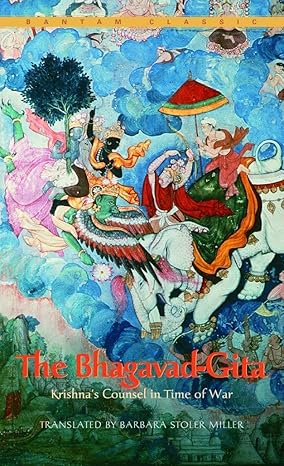
After reading snatches of the Bhagavad Gita over the years, I finally decided to read the whole thing through via Barbara Stoler Miller's translation. Most of the process was a slog, but slog cannot be avoided or skipped, and finally it proves absolutely necessary. When I got to the final chapter last night, at least one understanding broke through my stubborn presumption. 

One can never pin down the meaning of old Sanskrit words, but it is generally accepted that the 3 gunas are sattva, rajas, and tamas and that each word more or less means harmony/light, passion/energy, darkness/intertia, respectively. There are a lot of explanations about how each guna manifests in a person's behaviors or life, and I encountered some of the explanations in Yoga Sutras of Patanjali, suggesting that this theoretical framwork is a persistent element in Hinduism. In the Gita, sattva is most often associated with action with attachment to duty and detachment from outcome; rajas is associated with desire and greed, ie, action with attachment to outcome; and tamas is associated with inaction, laziness, avoidance. 

Born into and living in a judgmental world, I was hardly even aware of the morality-based color that imposes value onto the foreign concept. Tamas is bad, rajas is better, and sattva is the best, and humans should attempt to climb from the lowest rung (tamas) to the highest (sattva), from ignorance to enlightenment. 

There is nothing in the Gita that explicitly dispels this understanding, but when I got to the end it suddenly dawned on me how wrong my presumption was. The 3 gunas are not 3 rungs on a ladder toward heaven. They are 3 coexising elements. All 3 gunas coexist in ... me, a person, all the time. I can no more eliminate tamas than be 100% filled with sattva. That's not how it works. All 3 gunas make up a person (or the world, but for now I'm just focusing on psychology), and we are all composed of dark inertia, desire, and the ability to be illuminated. 

(I was going to question the last part but, hey, why then am I writing this?)

As we steadily march toward winter solstice, tamas swells inside the body, weighing heavily on our eyelids. It is not bad or good. It is merely nature. 

Monday, January 23, 2023

Romanticized Sikhs

Although I have only a sample of two, it struck me that two authors of South Asian descent chose Sikhism for the heroic characters in their novels. The first is Vikram Chandra's Sacred Games (published 2007), in which the leading man, Detective Inspector Sartaj Singh, is Sikh and diffuses a grave terrorist threat to the city of Mumbai. The second is Michael Ondaatje's The English Patient (1992), in which again the pure, idealistic, generous, almost too good to be true protagonist is also Sikh. Note that both authors are definitely not Sikh themselves.

Sikhism is a relatively young religion, emerging in the 17th century. It came out of the Hindu tradition but absorbs a lot of the concerns and needs in modern life, in response to some parts of Hinduism that may have become outdated or inadequate. In some ways it is very idealistic and deeply concerned about morality and justice, and shares some similarities with Jainism. However, Jainism has a large pacifist component, while Sikh men are raised to be warriors. 

I'm no expert in either Jainism or Sikhism. I am just curious as to why Sikhism is attractive to these two South Asian male novelists who are looking at it from the outside. Perhaps there is a sense or hope that Sikhs have solved the contradiction between peace and violence. Just a wild guess. In my mind, however, the path to dharma is paradoxical and multidimensional. There is no magic bullet. 

I do wonder though: Is this some kind of appropriation? But who am I to say? I'm not Sikh. I'm not even Indian. 

Saturday, July 30, 2022

Krishna's Practical Amorality (Mahabharata notes #19)


In an article by Hriput Namu Tara that analyzes the morally ambiguous role of Krishna in Mahabharata, the end struck me as particularly poignant: 

Ultimately, the poetic language of the Mahabharata takes us to the threshold, but not the heart of experience. Words, no matter how eloquent, cannot replace experience ... Krishna's ineffable nature, paradoxical and mysterious, cannot but be understood through perhaps a journey that goes beyond any acquired erudite knowledge.

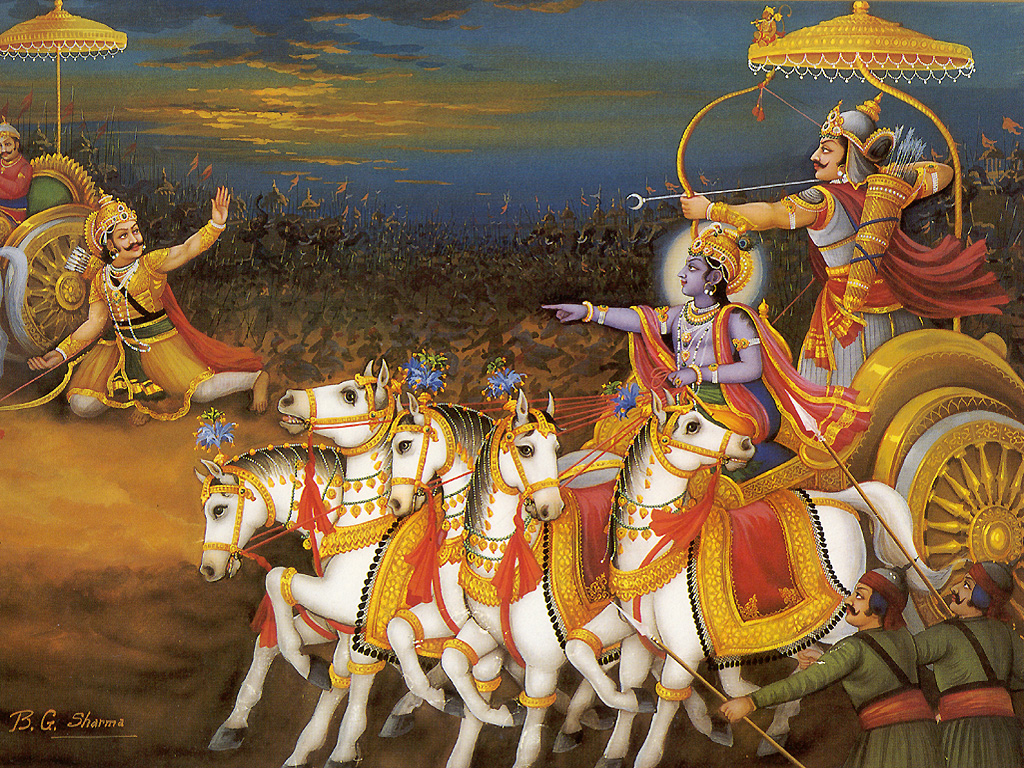
The subject of the article is the age-old debate of Krishna's tricks and deceptions and apparent lack of impartiality in the central conflicts in Mahabharata. He openly proclaims that he sides with the Pandavas and would do anything to help them defeat the Kauravas. Although he does not directly involve himself in the actions, his advice is crucial to the outcome of the war. At each turning point in favor of Arjuna, Yudhishthira, or Bhima, when each of them commits an act against the kshatriya code to beat their equally mighty rival, the story puts the responsibility squarely on Krishna's shoulder. When Arjuna kills Karna when the latter was pulling his chariot wheels from the mud, when Yudhishthira tells the first lie in his life to cause the death of Drona, when Bhima slams his mace into Duryodhana's thigh, the poems says, it is because Lord Krishna tells them to. 

These plot points are sufficient for many readers and scholars to question the divinity or the moral validity of both the Pandavas and Krishna for as long as Mahabharata is in circulation. Nevertheless, plenty and more people continue to exalt the Bhagavad Gita as the ultimate guidance for behavior and dharma and Krishna as the ultimate figure of worship. People continue to feel both disturbed by all the rule-breaking and dishonorable choices attributed to Krishna in the story and compelled by the feeling that he is right --- that his example and advice are truer and more human than any moral education we have be infused with since childhood. 

In some ways, Krishna's cunning, practicality, and attitude remind me of the Old Testament God. An eye for an eye, a tooth for a tooth. Except Krishna is in no way straightforward. As much as the Pandavas win the war and crown, they are left with fates hardly better than the defeated and dead enemies (in some sense, one could argue that victory is worse than defeat). Krishna himself is cursed, and he does eventually pay the price of a painful and lonely death. The moral ambiguity is sophisticated beyond any religion or mythology that I am aware of, perhaps even beyond Greek philosophy. I have seen a lot of Indian scholars use the word "subtle" to describe the theology of Krishna in Mahabharata. I don't know exactly what they mean, but I would compare it to a warm and glowing ball of hot air hanging in space, emitting powerful electromagnetic rays, defying description and interpretation by words. 

In our well socialized brain, all those tricks, deceptions, and "by any means necessary" practicality (to quote Malcolm X) do not bring us certainty or comfort, but we cannot deny the truth, built upon lived experience. The shock of reading Mahabharata comes, perhaps, from its fundamental difference from all other religions --- we are so used to the routine that we do not question their prescriptive nature, regardless of whether we believe in them or not. In fact, the prescriptive nature of conventional religions is illustrated in Yudhishthira's representation of dharma (never lying is included in his paradigm). Thus, the point-counterpoint debate between Krishna and the Dharma King is but one example of the internal contradictions and co-existence in Mahabharata, where everything is included.

Saturday, March 12, 2022

The Night Raid (Mahabharata Notes #18)

Ashwatthama

Leafing through my blog posts over the past years brought the realization that I have written a lot about war. That's hardly surprising as the country has been embroiled in wars in Iraq and Afghanistan for 20 years and just barely ended the last remnant of the intractable mess that caused enormous amounts of death, suffering, cost, loss, and humiliation. Now that the horror of war is again being broadcast live on everyone's Twitter feed, I feel like we barely had a break of peace. Maybe that's the normal reality of humanity anyway? But still. 

Inevitably my mind returns to Mahabharata. I cannot believe I wrote 17 (!) posts in 2015 to sort out my thoughts and feelings about the enormous epic. So this one is #18. 

On the last night of Kurukshetra, Ashwatthama led what was left of the Kauravas army to raid the camps of the Pandavas and killed most of the named characters in their sleep. I'm pretty sure this "special operation", to borrow a phrase in the news, was against the rules of war as both sides initially agreed. But by that time I don't think anyone on either side cared much about following rules any more. Too many of their sons, brothers, fathers, grandfathers, and cousins had died, and too many rules had been broken. Right before the night raid, Bhima had broken Duryodhana's thighs in their mace duel (yeah another duel), an action also against the combat rules.

Unlike many commentators and revisionists, I do not doubt the main authors of Mahabharata took sides when they created the most recent, coherent, and stable version of the epic. I think they did intend to cast the Pandavas and Krishna as the good side and the Kauravas as the bad side. Nevertheless, the complexity and mirror images throughout Mahabharata are nothing short of astounding. Duryodhana certainly committed plenty of atrocities with complete disregard for dharma, but Krishna employed many tricks that were hardly fair. Before the end, Arjuna shot Karna while the latter was defenseless, and even the figure of dharma himself, Yudhishthira, lied in order to kill Drona.

It is a little surprising that wars two to three thousand years ago in India were fought with some sort of mutually agreed rules, not unlike the Geneva Convention today and various treaties that try to dissuade countries from using chemical weapons, cluster bombs, etc. Nevertheless, rules break down as more blood is shed and death looms larger, or when someone just does not care and takes advantage at any cost, which inevitably starts a spiral toward total breakdown of any semblance of order and honor. 

Even if the authors might have taken sides on the grounds of morality and theology, they were completely ruthless in terms of consequences. The outcome of the war is almost a complete mirror image. Although there is a winning side, the Pandavas, very few of their clan and relatives survived, leaving only one child to barely carry on their bloodline. One could argue that nobody won. That is certainly the position of the weeping widows and families from both sides, wandering the post-war Kurukshetra and searching for the corpses of their husbands and fathers and brothers. And Gandhari, the mother of the Kaurava brothers, was able to exact revenge on the almighty Krishna and his entire clan, so that violence and slaughter come for them some years after the war. Is Stri Parva (the Book of the Women) an anti-war segment in an epic about war? It is certainly on par with modern anti-war literature.

There is so much in Mahabharata that continues to hold true now. As long as humans wage wars, Mahabharata remains relevant. 

Tuesday, May 5, 2015

Theological Subversiveness in Mahabharata (Notes #17)

I suppose one should not be surprised by the mess of stories, mythologies, cults, and messages that were crammed into Mahabharata over centuries of telling and retelling. Many of the lessons and points conflict with and even contradict each other, down to the basic definition of "dharma." Fine. There is something in the Indian history and culture that drove the exacting English colonialists crazy, because one can never seem to get a straight answer to any question about India. Any simple question, like, What is dharma? What is maya? What is sin?, can lead to a lifetime of research and philosophical argument with no end in sight.

Be that as it may, I want to sort out a few signs of direct theological antagonism in the epic, particularly in the Bhagavad Gita.

The most striking message in the Gita is to act without expectations of rewards, ie, the karma yoga. This is in opposition to the traditional Indian mythology based on asceticism, which is full of anecdotes of someone getting his wish granted by a god, big or small, by starving himself, chanting the god's name a million times, and standing on his toe for a few years, known as tapasya. If you're a well pampered king who doesn't want to go through that self-torturing routine, you can hire a team of Brahmins to do the praying for you and throw in a lot of good stuff (eg, milk, ghee, flowers) in the ceremony. Voila! You get your wish granted. It is such a straightforward even exchange between the gods and men and universal to nearly all ancient cultures on earth. I offer/sacrifice something precious to the gods, and the gods give me what I want. Simple and instinctive. Yet the Gita says, you should not even expect a reward for your sacrifice to the god. Forget it.

Well, that's an unpleasant gift, isn't it? Even though it is more realistic and empirically true, telling people that they cannot bargain with (and therefore control) fate/gods/fortune is contrary to our hopes and dreams. Such realism can't win any followers. So we are thrown a bone. Yes, there is a reward, which is moksha. Who needs earthly rewards (eg, wealth, happiness, long life, death to your enemies) when you can achieve the ultimate joy of being released from the cycles of life and death, heaven and hell.


Thursday, April 9, 2015

Bhagavad Gita and Figure Skating (Mahabharata Notes #16)

The phenomenon of "choking" in competitive sports is well known. It refers to those high-stake moments when a competitor performs far below his normal ability, as if he has forgotten to be himself. Choking is particularly in sports that require highly precise techniques, such as figure skating. After years of watching skating live, it's become clear to me that, in an important competition, figure skaters routinely achieve no more than 70% of the highest level of difficulty they are capable of in practice. This level can drop further if the skater is temperamentally sensitive to the psychological pressure. For skaters often called "headcases," he might fail on techniques in a critical championship that he would succeed with 90% certainty in practice. Why? Perhaps the reason is that figure skating is exquisitely affected by the skater's mind. I have done a little bit of recreational swimming, running, and skating, and found that skating demands the most attention and concentration. Therefore, when the brain is wandering toward the thoughts of winning and losing, it is so easy to lose focus, which destroys one's technique.

The fact that many of my favorite skaters are prone to "choking" has vexed me for years and led me to wonder years why the mind fails them. Do they unconsciously sabotage their own success? Or does the chance of choking increase with how badly one wants to win? If so, how does one suppress the desire to win for a few minutes in order to focus on just the skating?

This is why, when I first read one of the themes in Bhagavad Gita, "detach from the fruits of your action," I immediately felt a tingling inside my skull. There is something profound and subtle about this seemingly paradoxical about the advice.

And this phenomenon is not limited to sports, for in life the wish to have something does not often lead to choices toward its realization. Thinking about what you want may spur you on sometimes and paralyzes you other times. The problem of self-defeating behaviors is complicated and difficult to remedy.

Monday, March 30, 2015

A Mutual Frustration (Mahabharata Notes #15)

Before the Kurukshetra war commenced, Queen Kunti, the mother of the Pandavas, came to Karna, the dearest friend of Duryodhan, the crown prince of the Kauravas, and a most formidable kshatriya in the land. She came to Karna at mid-day, immediately after he performed a daily prayer to the sun god Surya, to make a favor of him, because Karna never refused a favor asked of him on such an occasion. Not long ago, Karna had granted a boon asked of him by the god Indra, the father of Arjuna his arch-enemy, and given up his own magical armor, effectively giving away his own safety and life, in the upcoming war.

Yet, this time, the absurdly generous Karna who never refused anything asked of him upon his sun-worship ritual, refused the strange but strangely familiar lady who came to ask for a boon.

Karna was Kunti's first and illegitimate son with the sun god. One could easily imagine a realistic version of this scenario: An aristocratic young woman got herself pregnant at fourteen in a moment of indiscretion. When she gave birth to a boy, shame, panic, and fear of disgrace induced her to throw the infant away. The child grew up in a lower class family, ignorant of his origins, and suffered terribly for his mother's moment of weakness and selfishness. On the other hand, his mother went on to a respectable life, a suitable marriage, and five sons born within wedlock, seemingly suffering no consequence for her abandonment. Now, her five legitimate sons were about to fight their bastard brother in a life-or-death battle, while none of the six brothers knew of this looming family train wreck.

Mother Kunti's motive for approaching her first-born with the truth in this critical juncture may be interpreted as an attempt to dissuade Karna from endangering her other sons. Her request to Karna could be boiled down to this: "You are by blood the brother of your best friend's enemies. I ask you to leave the Kauravas' side for the Pandavas' side."

One could argue that Kunti loved her legitimate sons more than her first-born, because she went to Karna rather than the Pandavas with the secret. If she had told the Pandavas, the war would have dissolved into their instant defeat (at least in her mind). Instead she wanted to dissolve the war with their victory. Yet another component of her wish is to ensure the survival and unification of all six of her sons, because the pending conflict presented a threat to Karna as well, considering that he was at least outnumbered five to one. In other words, what she wanted was to "have it all," not just for herself but for her sons.

Karna clearly understood her intentions, both the spoken and unspoken aspects. As a son who had lived with his mother's rejection all his life, he chose revenge over forgiveness. She had not given him what he had wanted, so now he would not give her what she wanted. After denying her request, he granted her something different from what she asked for: "I would not kill any of your other sons, but I will battle Arjuna to the death. Either him or me, but one of us will surely die. So that in the end you will still have five sons." It is as if he was directly denying his mother's unspoken demand --- You can't have six sons and will only have five. His revenge is to turn the table completely on her: You had not wanted six, and now you cannot have six.

One could, of course, argue that Karna rejected Kunti's request because he loved his sworn brother (ie, Duryodhan) more than newly discovered birth brothers, who indeed had had a few run-ins with him previously. Yet, if Karna were so deeply invested in the victory of the Kauravas' cause, he seemed to have a funny way of showing it, by giving away his invincible armor and earrings so easily and by spontaneously promising Kunti to never harm four of the Pandavas. Therefore, his loyalty to Duryodhan seems but an excuse, yet his revenge to frustrate the mother who had disappointed and frustrated him rings true.

(This rather crude analysis is inspired by Adam Phillips' essay "On Frustration" in his book "Missing Out." In the essay he pointed out the symmetry between King Lear and Cordelia, who both withhold something from each other. The same can be said of Kunti and Karna. Phillips wrote, "All love stories are frustration stories. As are all stories about parents and children, which are also love stories.")

Monday, March 9, 2015

Maya: Illusion and Reality (Mahabharata Notes #14)

At least one of the meanings of maya is simply "illusion." In the battle scenes in Mahabharata, maya is often a supernatural weapon used by a few characters to create a distortion of reality --- fog, rain, cold, darkness, demonic figures, etc., that do not actually exist --- to disarm the enemy and create fear and chaos. In fact it sounds a lot like some sort of psychological warfare.

Yet maya is far more complicated than illusion. Its entry in Wikipedia seems to suggest that the evolution of its meaning, coupled with atman, is linked to the pair purusha and prakrti. Yeah, Wikipedia. Obviously I have not read through the relevant vedas and puranas and upanishads to begin to understand these ideas. But, at least, my absurdly superficial glimpse at these abstract concepts is enough to demonstrate how sophisticated the philosophical theories were in Hinduism.

Anyway, not being qualified to discuss these concepts does not deter me from contemplating something along these lines. At some point, maya came to mean the material, external existence, ie, the body or prakrti, that houses and conceals the eternal driving force of life or spirit, ie, the soul or purusha. The theory is that, although the body and its senses seem to be real, they are temporary and constantly changing and subject to inevitable decay. Here, obviously, the Hindu philosophers incorporated time into their observation of the physical world --- All senses pass, including agony and ecstasy, and therefore are elusive over time. Even life itself passes so quickly. Therefore, the need for a life force that permeates the universe and animates things that cannot disappear or diminish is irresistible. And they are not wrong, because energy does fit the concept of purusha and obeys the first law of thermodynamics.

Nevertheless I have been thinking of something that seems to be the opposite: One's perception and thoughts are subjective, conjured by the mind, and unreal, but the body at least somewhat able to get a more concrete and reliable picture of the world around oneself through the senses. Another way of looking at the distinction between the real and unreal is what is actually going on within one's senses and what is not. For example, the room temperature is 75 F and the time is night and I am lying on the couch typing on my laptop --- that's tangible reality. I'm thinking about the work to do tomorrow and reading some babbling on Twitter --- that's not tangible reality, even if the babbling might be someone else's reality. The novel I'm reading is all in my mind, and so is the contemplation of whether I will finish a couple of documents by the end of next week, because none of these exists outside of the electrochemical reactions in my brain. On the other hand, that I am thirsty or hungry is real enough, for the sensations are connected to my blood concentrations of sodium or glucose, not just in the brain. How real is reading fiction, nonfiction, news, and someone else's opinions and editorials?


Wednesday, March 4, 2015

Pluralism and Contradictions (Mahabharata Notes #13)

There are a lot of oddities and inconsistencies in Mahabharata, even in the shortened version (a "modern rendering") I read, in which the author no doubt excised a lot extraneous details and sidetracks from the original versions (yes, plural) of the massive poem. For example, it is described that Arjuna was the son of the deva (god) Indra. There is an interlude in the middle of the story that Arjuna was brought to Indra's heavenly abode. Yet it is also repeatedly claimed that Arjuna is one of the holy twins, Nara and Narayan, who are avatars of Vishnu, one of the trimurti (the three-form gods that are at the top of Hindu deities). Arjuna is the human incarnate of the twins Nara (Krishna is the godly one of the pair Narayan). Just who the hell is he related to, Indra or Vishnu? Another example is the character Ashwatthama, who is supposed to be a partial incarnate of Shiva, another of the trimurti. Ashwatthama fought on the opposite side to the Pandavas against Arjuna and, after the death of his father in the war, nearly caused the termination of their family line. Yet, before the war, Shiva gave Arjuna a deadly supernatural weapon and the blessing to win the war. The rishi Vyasa, who knew everything in the story, told Arjuna that on the battlefield he was led by the invisible Shiva and triumph followed him wherever he pointed his arrows because of this. It is like Shiva blessed his own enemy to defeat a part of himself. Which side exactly is he on? In the end, while the Pandavas seemed to have decisively won the war, they went to heaven and saw all of their enemies returning to their eternal godly forms, happy and content. All the old grudges and hatred and blood feud and even arguments over dharma versus adharma seemed to be washed away by the tide of time. The Pandavas are deemed the good guys, but they nevertheless have to go to hell, even if temporarily. It's enough to drive one crazy.

This kind of delicate and complicated logic, which teeters on the edge between perfect sense and complete nonsense, tickles the mind. One might easily dismiss the phenomenon as the result of centuries of meddling by generations of storytellers. They must have inserted various stories and ideas over time, leaving a big pile of mess. Yet that is not quite true, as the massive story is also filled with meticulous details and characters that remain surprisingly consistent and logical from the beginning to the end. There seems to be method to all this madness. 

(This post is long. I'm going to start using the "Read More" function.)

Monday, March 2, 2015

Nazi and the Gita (Mahabharata Notes #12)

Well, it looks like synchronicity, or coincidence, or my premonition (just kidding), as one of my random thoughts connecting Hitler and Bhagavad Git turned out to be true. Apparently some Nazis did love the Gita. Apparently, ancient Indian mythology and philosophy were a big deal among German intellectuals in the 19th century and subsequently garnered some fans in Nazi leadership. Apparently, it is no accident that Nazis chose the swastika as their symbol and identified themselves as Aryans, which seems to stretch one's imagination if we were to compare the appearances of Indians, however light-skinned they are, with the ideal looks touted by white supremacists. One has to wonder if they asked real Indians whether such re-appropriation of their religion and philosophy was acceptable. Somehow I doubt it.

Perhaps one should not be too surprised. Didn't we all read Herman Hesse's fictional biography of Buddha? Didn't we hear that Schopenhauer was a fan as well? So Hinduism was no doubt pretty fashionable in Germany back then. Here is a fairly substantive article about one of the prominent Gita fans: Heinrich Himmler. He identified the military expansion and aggression of the Third Reich with the martial values and beliefs of kshatriyas (the warrior caste) in Hinduism. According to Himmler, Hitler is Krishna reincarnate (perhaps figuratively) to bring dharma, ie, Nazism, to the world. Funny how mercy and family and the revolving wheel of life and death, and all the other stuff in Hinduism and Buddhism never made it into Nazism, for whom death is just death. You can't blame me for not seeing the connection before.

Nevertheless one does have to wonder whether Herr Himmler actually read Mahabharata. If he had, he might think twice about comparing themselves to kshatriyas, the ancient warrior caste. It does seem to me that he had no idea what happened to kshatriyas in Kurukshetra and what Krishna was sent into the world for. In fact, Krishna was no leader or savior of kshatriyas at all; rather, his true purpose was to wipe out all the kshatriya kings and soldiers in this deadly conflict and leave a world "unburdened" by kshatriyas at the start of the Kali Yuga. If we were to follow this train of logic, hmm, what did happen to Nazi armies in the Kurukshetra of our time? I am not a superstitious person, so I will not say all this is some weird, time-warping phenomenon. But the irony is killing me.

Anyway, what is unexpected in this odd pairing is not that Nazis found inspiration from the Gita (a possibility that even I "foresaw"), but rather that they looked to the Gita at all. I always assumed that they pursued their mission with absolute conviction of their own righteousness and needed no confirmation from anyone, least of all some foreign religious text. Only those with doubts need the Gita to inspire them and spur them into action, no? Might Himmler have doubts about what he was doing, like Arjuna, and feel as if he needed some moral and philosophical support? Taking this thought one step further, we may have to contemplate the possibility that Himmler and other Nazis were indeed human, too.

Saturday, February 28, 2015

Evil and sin (Mahabharata Notes #11)

Despite the claim that "this is a battle between good and evil" and scary omens that show up from time to time (jackals and wolves howling in the streets, birds flying in the middle of the night, other abnormal natural phenomena), it slowly dawned on me that my frame of reference for words translated as "sin" or "evil" is built upon Christianity, which does not quite fit the context of Indian mythology.

For one thing, the concept of hell (naraka) is more like the purgatory in Catholicism. No one is condemned to torture and misery forever. Sinners pay for their sins by serving time in naraka, and get released afterward. The worst punishment is to reincarnate into earthly creatures life after life after life for a few thousand years, until one reaches enlightenment. But the prison sentence is always finite.

This system cleverly solves a common logic problem in the permanent and dichotomous (heaven or hell) scheme in Christianity. Even the virtuous and pious people are not perfect and commit sin sometimes. Catholicism tries to deal with it by the confession-and-absolution ritual. Protestants just stick with the simple "believers go to heaven, nonbelievers hell" rule of thumb. Simple but unsatisfying. In the Hindu system, even the pious and virtuous have to take responsibility for their life on earth. At the end of Mahabharata (I've finally finished it!), it is explained that all kshatriya kings have to make a round in hell to atone for all the killings they undertake in life, even if they were executed at the direct order of god (or his avatar). Nobody is immune. Everyone has to pay. And then they can go to heaven.

The transient nature of both life and death and even afterlife in this system somehow washes away the vehemence of judgment, leaving everyone and everything in different shades of gray (a lot more than fifty). Morality is still important, but not rigid or obsessive. Certifiable villains die heroically on the battlefield and go to warriors' heaven. In general, a flexible and relaxed attitude pervades this world, giving less soil for the growth of hatred and paranoia -- less but not none, for hatred and paranoia are in our nature, aren't they? Cannot be helped.

There is a kind of mercy in this that I did not quite see in my limited encounter with Christianity. In this world, the gods claim to inhabit everything and energize everything in the universe, including sinners and evil ones, and even sages accept death, suffering, injustice, and pain as inevitable tides of time. There is no promise to permanently eliminate any of these by simply being virtuous or a believer. Therefore, I the audience feel like I am treated like an intelligent person with my own eyes, and reality of the world is respected rather than denied.

It is funny (not funny haha but funny weird) that a lack of a severe and judgmental religion has never prevented countless Chinese people from developing a severely moralistic perspective. Perhaps moral dichotomy is something inherent in human society, while tolerance, complexity, and mercy are the exception. 

Wednesday, February 25, 2015

Karna: The Mondern Man (Mahabharata Notes #10)


The first part of Karna's life story --- being born to a princess and the sun god but abandoned and raised by a charioteer and his wife, thus not recognized for his right to be a kshatriya warrior --- is more modern than any other character in Mahabharata. Rising above his caste, based almost entirely on his talent and skills rather than birth, his success in life is singular in his time and society, but eerily similar to the Horatio Alger, hero of the modern American mythology. Nevertheless, the story also has some typical folklore elements: A hero with a hidden identity and mystery of his birth; he is separated from his real family from an early age and his nobility is revealed only later in life. 

Yet, during the prolonged climax of Mahabharata, ie, the 18-day battle of Kurukshetra, Karna's story takes a turn into the realm of modern fiction. No other character in this story --- perhaps none in any story of the ancient times --- is portrayed with the level of psychological complexity seen only in modern novels.

Karna's psychological struggles are two fold. First, his internal thoughts and external behaviors are incongruous. Before the war, Karna found out that his sworn enemies, the Pandava brothers, are his biological brothers. He promised their mother --- also his mother --- that he would spare four of the five brothers' lives. Throughout his involvement in the war, his heart is not in it. His hands slay the Pandava army and Arjuna's son, but his thoughts are in conflict with his action and he no longer hates his oblivious brothers. He is only motivated by honor and duty. Second, his mind is battling itself throughout the war. On the one hand, he yearns to belong to his biological family and their noble status, which could end his lifelong loneliness and misplacement. On the other hand, to do that means betraying his only friend Duryodhan, the Kaurava prince who leads the war against the Pandavas. The two urges are mutually exclusive. Karna cannot have it both ways. So his struggle is purely internal and directed at the self.

This never happens in ancient literature. The earliest psychological novels are generally considered to emerge in French literature in the 17th century. Madame de la Fayette's The Princess of Cleves is often cited as the earliest sample in this genre. From then on, the psychological turmoil of an individual has become the mainstream of European and modern literature, as novelists delve ever deeper into the dark, contradictory crevices of the human psyche.

This psychological focus is a bit like the (re-)discovery perspective in European art in the Renaissance, before which older paintings were "flat." Old literature, derived from folktales, mythology, and epic poems, is full of characters who are consistent in their internal and external presentations. Even when a character is lying, he is described as being fully aware of his intention to lie and its untruth. There is no hint of self deception or internal conflicts. He or she struggles with other characters, with society, with fate, but never with himself. The only internally conflicted character that predates Madame de la Fayette's novel that I can think of is Hamlet. Even Hamlet's internal conflicts (his reluctance to kill Uncle Claudius) are not as well defined as modern literature, and the tension between his thoughts and actions is not as taut as any 19th century Russian novel. Shakespeare still relied mostly on external rather than internal forces to steer him from the revenge he has to carry out.

Therefore it is astounding that Karna seems like a character written by a modern novelist who somehow managed to time-travel to the past and stick it into Mahabharata. There is nothing like it -- that I know of -- in Greek, Roman, or Nordic mythology. For some reason (unknown to me), Indian mythology and philosophy reached a level of psychological insight at a very early time that was absent in other ancient civilizations. It is no surprise that Buddhism seeped into modern psychology rapidly in the 20th century, much more so than the more popular Judeo-Christian religions.

Saturday, February 21, 2015

War is Drug (Mahabharata Notes #9)


After endless politics, conspiracies, gambling, threats, peace talk, and arguments, the war finally broke out on the field of Kurukshetra. Rivers of blood soaked the earth as the Pandavas and Kauravas tried to vanquish each other. People got shot full of arrows or their heads chopped off or trampled by war horses and elephants. By the end of Day Eight, the troops were too exhausted to collect and burn the piling corpses that had been once their comrades and brothers.

It is no accident that two of the most enduring and beloved epics of human history are about war: Mahabharata and Iliad. Just reading the battle scenes gets my blood roiling and adrenaline surging and I can barely put it down --- Me! A peaceful harmless little woman who can't give anyone a flu shot with a tiny needle. Throughout human history, war defines men, and women are complicit. We love and fear men who fight. In the grip of danger and fear, dopamine rushes out and time slows down, and everything becomes a hundred times more vivid than usual. Like the feeling I got seeing "The Hurt Locker," again it dawns on me that I am no different from the others. I am as susceptible to the appeal of death and violence as anyone.

In "War is a Force that Gives Us Meaning," Chris Hedges condemns society's myth-making machines and propaganda that glorify war and killing, all the while admitting its intoxicating effects.

The enduring attraction of war is this: Even with its destruction and carnage it can give us what we long for in life. It can give us purpose, meaning, a reason for living. Only when we are in the midst of conflict does the shallowness and vapidness of much of our lives become apparent. Trivia dominates our conversations and increasingly our airwaves. And war is an enticing elixir. It gives us resolve, a cause. It allows us to be noble. 

Nevertheless Steven Pinker is convinced that humanity is heading to a more peaceful world, because the rate of violent conflicts and deaths has been declining steadily over the past decades. Perhaps the simulation of war --- competitive sports, violent movies, reading war stories, and thrilling activities (eg, ski jumping, sky diving, extreme sports) --- is the only effective way to quench our thirst for danger and excitement and keep our darker urges at bay.

Tuesday, February 17, 2015

The Dangerous Gita (Mahabharata Notes #8)


My friend Eugene made an interesting comparison between the advice from Bhagavad Gita and Wagner's ring cycle and noted that it can be easily used to justify bad things. "Go forth and do what you must. Renounce the fruit (or consequences) of your actions."*

Indeed, this advice is completely morally neutral. It is neither good nor bad, neither kind nor cruel. It tells you to do. It does not tell you what to do.

It can be used by Gandhi to unite his people of different factions for win independence and by Hitler to rally youths to fight and kill for the Third Reich. It can encourage a wavering and fearful pre-criminal to rob a bank and an insecure lover to declare his commitment to an object of his affection.

It is merely a call for action, but it gives one no guarantee or protection from the consequences of one's action. You alone will still have to face these consequences, which may be happy or sad, fabulous or terrible.

In other words, the Gita is not your mother or her substitute, your god. It is all about yourself. Therefore it is a bit of a stretch to call it religion.

Of course, Krishna also says victory accompanies dharma, which seems to be assurance of sort. If you are righteous, you will win. Ah, but there is a trap in this assurance. In Mahabharata, Krishna helped his cousins to victory in the war, in which pretty much everyone on either side was killed. Not only that, but four of the five Pandavas went to hell when they died. Some victory.

So it seems that the ancient Indian philosophers and storytellers had gone through the argument "But the world is clearly not fair or just" many, many rounds. They knew all too well that such a simple assurance means shit. Don't we all believe we are on the side of dharma? Don't we all believe our own morality and good intentions? Aren't we all convinced we are righteous and our competitors or enemies evil? The assurance is no assurance. The guarantee guarantees nothing. When we fail and fall, we do not think, "Oh, that's because we are on the wrong side of dharma." I can claim I know which side is right, but I am not so blind as to deny that everyone else, including those I find appalling and despicable, believes the same of themselves.

George W. Bush said, "We go forward to defend freedom and all that is good and just in the world."
The same line could have been uttered by Krishna himself when he egged on his cousins at Kurukshetra and by their Kaurava enemies, and by countless leaders throughout human history.

Yet the Gita says, go forth and choose and act. Just do it. As to choosing which and doing what in the world, you are on your own, baby! In the end it is still your decision and responsibility, and your mom (or god) is not going to feed you the answer. 

(*One could also argue that the advice encourages undue recklessness, but the what kind of reckless people would need advice in the first place?)

Friday, February 13, 2015

Poly and Mono (Mahabharata Notes #7)

No doubt about it. We want to believe the Just-World Hypothesis despite all evidence to the contrary. Perhaps justice is just an excuse. What we really, truly want is a world in which we get what we want, also despite all evidence to the contrary.

Rather than accepting reality, we invent supernatural powers to help us get what we want, even if only in our mind. Why can't we have what we want? Why do bad things happen to good people (ie, me and mine)? And, of course, the ultimate disappointment is that we are all going to die. There are several ways to deal with the problem ---

1. Polytheism explains the world nicely. Some gods are for you and others against you. Yet it is also unsatisfying, for your victory against your enemy lies in the victory of the gods on your side over those on their side. Who is to guarantee that my gods are "better"?

2. Monotheism. It provides the much desired assurance to believers, with no "bad" gods to spoil your fortune. But its logic and congruence with reality have to weaken. If a person and his enemy pray to the same god, how can he know for sure that god is on his side?

To explain all the bad things in the world that make us unhappy and disappointed, one can further expand the possibilities:

A. The god(s) is benevolent.

B. The god(s) is indifferent.

C. The god(s) is malevolent.

D. The god(s) is fickle and/or unreliable.

Ah, herein lies the problem. Even if we are convinced of our own righteousness and worthiness over our enemies, we have to be blind to deny the reality of the world that does not go along with a predictable and consistent single deity. Clearly he/she/it is neither for or against one all the time. Yet we don't like polytheism either. How is one to go on living without despair? Where does one find the protection and assurance to brave the storms of life?

The people of Indian region came up with a unique and rather brilliant solution to the problem. All the logical explanations for bad things, good things, bad people, good people, bad deeds, good deeds, and problems with just reward and punishment can be kicked like a can down the road. The world is a mess? There is no evidence of consistent and reliable justice? All the problems dissolve within the system of cyclic incarnations. All sins are punished and all virtues are rewarded ... eventually.

The only problem with this system, of course, is that nobody remembers the past lives. It takes a leap of faith to accept. The advantage, however, is that it kind of takes away the persistent and nagging question of "Why?" Why do random injustices happen? The system both satisfies the innate need for justice and makes peace with its apparent absence (not always, but frequent enough) in the world.

Of course, the simplest explanation is that justice does not exist outside of our mind. No one but we need and want it. But that's a deeply unsatisfying answer to the question. It is so unpleasant that we dream up elaborate systems and theories just to run away from the indifferent universe. Therefore, a system that can relieve the tension between reality and dream and nudge people to move on --- because it doesn't matter in this life --- has its appeals.

Sunday, February 8, 2015

Good vs Bad Guys in Stories (Mahabharata Notes #6)

More than a few times, I have heard American voters complain that the kind of leaders who should win elections are exactly those who do not want to be in politics in the first place. What they mean is that they want their communities or state or nation be run by people with no ambitions or are incapable of deception and manipulation. Of course, that's impossible, not to mention probably wrong anyway. Nevertheless, one could find quite the same sentiment described in Mahabharata, despite its time and political system way back when and where. In the ancient story, the rightful emperor to rule the Empire was Yudhishtir, the son of the god representing dharma itself, a man of impeccable personal and public morality and integrity. He is supposed to be every bit the ideal king/leader for average people across different cultures (if one could overlook a minor vice involving gambling).

What is the essential quality of such an ideal king/emperor/president/governor/head of the school board that everyone dreams of? He does not want it. Yes, such is the paradox. We want the assurance that he is doing this not for himself, but for you all! Oh isn't that sweet and lovely? Except this is neither human nor natural. People have to lie to be so saintly. Even if some are occasionally sincere in their selflessness, as we can see in Yudhishtir, such selflessness can be dangerous.

Friday, February 6, 2015

Memory and Future (Mahabharata Notes 5)

I have just got to the point where the wandering poet Narada sat in the Emperor's crowning party and saw, in his mind's eye, all these great kings and warriors sitting there celebrating and laughing at the moment, would soon die on the Kurukshetra, some with their heads cut off and others with arrows sticking out of their bodies. The earth was soaked in rivers of blood. It was the future that he saw. He drank and said nothing.

The obsession of seeing --- seeing the future --- haunts us. I am quite sure this is but an illusion. When we look back in time at the defining traumatic event in our lives, the mind could not remember its obliviousness in the moment before that. Rather, the memory of itself before and after becomes hopelessly mingled and we can no longer clearly remember what we knew when. We want to believe that we had known and seen before it all happened. It is a trick of the memory because ...

Because memory is a palimpsest. Because we have only one copy of the memory of the past, and every time we take it out to remember, we rewrite it, and write over it, with whatever we feel and want to believe now. There never will be a faithful original copy hidden somewhere up there, unlike the cyberspace. Enough research has shown that. We may think we have access the past (unlike the future), but this access is very unreliable.

Yet, the mind may have unknowingly grasped something about the nature of the fourth dimension. Imagine, you are driving on a highway at a constant speed. Five miles ahead, a wreck is blocking the road. You can't see it, yet, but it is sitting there, waiting, existing with you in the same universe, but you will not know it until you get there, face to face, nose to nose, with the wreck. The fact that you are moving forward and cannot yet see the wreck ahead, does not mean it is there, waiting for you to arrive. And arrive you will, because, as they say, "It is written." Like it's written in the last hundred pages of the book, but you are reading in order and cannot flip to the end without finishing all the previous pages.

I imagine that, at some point, the sages or  philosophers or yogis realized the possibility of this analogy, and began to suspect time is a fully written book that we have to live through page by page. Just because our senses cannot skip ahead, it does not mean the later chapters have not been written. One day, when we look back, do we see the past as a series of free choices scribbled on blank pages or predestined, already-printed text?

Friday, January 30, 2015

Consequences and Mahabharata (4)

The ending of Mahabharata is very interesting. After the war at Kurukshetra, millions were killed, including most of the Kuru Dynasty's royal family. The five Pandava brothers and their wives, who all along were described as representing the good side who had defeated the evil side, were left to pick up the pieces and rebuild their nation. Some years later, they left the throne to a son (grandson?) and went on to the Himalayas. One by one they died on the road, leaving only the oldest brother Yudhishtira, who represented righteousness, and his dog (it's a long story). Yudhishtira went to heaven and was shocked to find his cousins there who were on the side of evil and had been slain by the Pandavas. He demanded to see his brothers and was led to hell where his brothers were being punished. Yudhishtira asked angrily, Who decided this? Why are they punished? I want to say here with them.

Note: I'm going with Peter Brook's stage adaptation of Mahabharata, as I have not read the ending of the book to get all the details.

So the meaning of this ending is curious. One's instinct is that this is contradictory. If the Pandavas were the good guys, surely they would have gone to heaven, no? And one would think so because this is how it works in our collective consciousness --- If you do good in life, you will go to heaven. Or, more precisely, do good in life because you want to go to heaven after you die. Therefore, heaven is the cause and good deeds is the effect. Here we can see how cause and effect are flipped temporally. The cause/motive is the future, and the effect/action is the present (or past). Our current behaviors and choices at least appear to be driven by the promise of an afterlife in heaven. Obviously.

Yet this paradigm does not work in Mahabharata. If the Pandavas had known that they would go to hell, would they have chosen the good side and wage war against their cousins? Yet Krishna, who was an avatar of the god Vishnu, clearly and firmly goaded them on. This was the course that had to take place. The way of righteousness must be paved by this war and the death of their evil cousins. Is this a trap? Or, worse, a joke played by the gods on humans? To do this thing is good and necessary, but it will send you to hell. This is obviously contradictory, isn't it?

Then I discovered that the contradiction stems from my assumptions steeped in the Christian culture. Heaven and hell have a different meaning in Hinduism. They are temporary. People are sent to heaven and hell after death to pay for the debts (or spend the surplus, I guess) they incur in life, such as killings any kind of lives. Once your debts are paid, you are released from heaven or hell and go into the next incarnation cycle. The process is not entirely free of moral judgment, but the judgment is far less stringent or definite than Christian judgment because of its lack of permanence. In other words, being sent to hell isn't a permanent conviction of guilt on the Pandavas' choice to wage war against their cousins. Being born as a kshatriya (warrior caste) dictates one's duty to fight and kill in life, but anyone who kills has to pay the debt eventually. Seems like a pretty hopeless trap, but it is somehow more forgiving than the Christian system because it is not permanent or fundamentally damning on a person's identity and worth.

So, regardless of whether one does good or evil, one still has to face the consequences of their actions, which are not always fair or logical. Killing for good does not spare one from the consequences. Future consequences cannot be controlled or calculated by individual choices at present. This seems fundamentally different between Hinduism and the logic I am familiar with.

****

I first started thinking about this issue while reading ASOIAF. Some readers argued that Ned Stark is a bad guy because he is a key piece in the chain of events leading to the War of Five Kings, or that Catelyn Stark is a bad woman because she affects a couple of links (kidnapping Tyrion in Book 1 and releasing Jaime Lannister in Book 2) in the events. (ASOIAF is a pretty good proximation for history, at which I am no good.) Yet I find this line of reasoning disturbing, because none of the characters, not even Joffrey, had the benefit of hindsight like readers do. To what extent can one blame a person for future occurrences that are (in part) caused by his past choices, if the consequences are not foreseeable?

One of the similarities between ASOIAF and Mahabharata is the complex Web of causes and effects. Minor events (or oaths, curses, and prophecies) become catalysts or triggers of snowballed crises and disasters in the future. Assigning blame and moral judgment on characters become exceedingly difficult as shit hits the fan and body counts rise ... But isn't that exactly the problem we face when we look at history and try to pass judgment of various characters involved? We have the benefit of hindsight, but they did not. What if the United States split after the Civil War? Would we be judging Lincoln differently? Is the problem his or ours?

****

Of course, all this is not just about moral judgment of historical or fictional people, but rather about regret --- regret over past actions and choices, and fear of regret for present choices and future consequences.

Again, we are back to the advice from Bhagavad Gita: Go forth and do your duty. Detach from the outcome.  In some ways, Krishna has something very Albert Ellis about him (or maybe it's the other way around).

Sunday, January 18, 2015

Cause and Effect, and Consequences (3)

I continue to grapple with this advice from Bhavagad Gita. It seems completely unnatural to act without regards to the outcome. "Victory and defeat are the same." I have to keep reminding myself this line because it goes against everything we take for granted, yet there is something in the claim that pulls one out of the span of the next day, week and year and forces one to look down at the length of a life or a millennium. In the end everyone dies. If that is true, how can we argue with the statement that, at least on some level, victory and defeat are the same?

On the other hand, consequences are the main way we learn to interact with this world. If you touch fire, you get burned and learn to avoid it the next time. It is the consequence of pain that dictates your choices. This is how we infer cause and effect and subsequently avoid everything that is painful or unpleasant. This may also be why we become more fearful and set in our ways in mid-life. If I do this thing, bad things may result, and I should therefore refrain from action to be safe. And so it goes.

And this learning goes beyond our own experience. We watch the consequences of others' choices and distill lessons into rules of conduct for ourselves. This is how social norms and laws are formed. Do not kill another human, or you will be punished with your own death. Do not steal from another, or you will get your hands cut off. Do help your neighbors, so that you will be awarded with their help when you are in need. How else do we influence people's behaviors if not through the threat or promise of consequences? Aren't we ALL trained by reward and punishment?

Yet now you are telling me to forget about consequences, to go forth and do what I need to do without concerns for outcome, because victory and defeat ARE THE SAME.

Deep down I know there is something valuable in this advice that could cure mid-life malaise and fear-induced paralysis. But it does not come easily. Once I let go of the rules of conduct built upon decades of the reward-and-punishment system, what do I have left? I would have to make decisions and behave according to, uh, not dharma (whatever it means), but rather the motivations and desires and intentions coming from nowhere but within. That is a tall order.

The Ending of Le Samourai (1967), Explained

A quick online search after watching Jean-Pierre Melville's Le Samourai confirmed my suspicion: The plot is very rarely understood by E...