Search This Blog

Showing posts with label books. Show all posts

Friday, September 18, 2026

Dark Places (Spoilers)


I had no idea, until a few minutes ago, that someone made a movie out of Gillian Flynn's second novel, "Dark Places," with a cast of famous and beautiful actors. The level of absurdity is so high that ... I have no words. 

I'm not necessarily a big fan of the novel itself --- the pacing is a bit too slow in the first half but too fast in the second, and the local flavors are overwritten --- but it does impress me with the unflinching grubbiness in its depiction of farm life in Kansas or Oklahoma or Missouri. From the farm on the verge of bankruptcy to the toxic waste dump, from the mean neighbor to the mean school coach to the mean policeman to the mean legal loan shark. What I appreciate the most in the book is all the money pinching (a rare topic in contemporary literature) and the common madness and even the slightly voyeristic attitude, all with no whiff of the moralism that pervades American popular culture. The moral nihilism is what makes people call Gillian Flynn's writing "dark." I wonder if this is also what had made it so hard for her to produce any new novel since "Gone Girl" 14 years ago. Once you become popular, the public pressure to conform can be daunting. 

What I find most fascinating in the novel is the question of complicity. 

The grubbiest depiction of all the grubby things about farm life in Kansas is Runner Day, the patriarch. He is truely a great character, one of the most despicable men I have read about. I can believe there are such men walking the earth throughout history through this hour. The domestic scenes of Runner trying to squeeze the last drop of blood from his ex-wife Patty are vividly appalling. Runner's particular kind of evil is something I only come to see in the world around me well into my middle age. But once I see it I cannot unsee it. It appears everywhere in various degree of severity and manifestation. His psychopathic charm and self-righteousness are fundamentally incurable and seem to have a hypnotic power on people in general and many women specifically. It's not about how bad a character is but how he is bad ... and Runner is a winner: So bad that he is hilarious. 

As such, Patty is utterly unable to do what she should have done to Runner before he impregated her: smash a bottle on his skull and throw him out of her house. Instead, she has 4 children with him and allows him to intermittently live on her farm, smack his children around, eat her food, and steal her money. This father-mother relationship seems to symbolize the real-world gender politics better than most academic feminist studies: Patty commits suicide while Runner lives on in the toxic dump. 

Some highly-educated women friends often blame the condition on "the system" or "patriarchy." I don't disagree, but I do wonder at what point can we at least bring up the question of complicity. Given Patty's unwillingness to sell the farm, paired with her unwillingness to smash a bottle on Runner's head and throw him out, how is "the system" ever going to change? And by what or whom, if we deny women's agency altogether?

Forming Patty's mirror image is her son, Ben. Just like Patty, Ben is depicted largely as a victim throughout the novel, falling under the spell of the crazed rich girl Diondra. His mind may have also been poisoned by patriarchy's notion of "chivalry," whatever that means. Compared with Runner, Diondra's evil feels flimsier but can be captivating in its flame of rage. In his sister's murder, Ben's complicity is more intentionally presented and goes beyond average cowardice. In contrast, I cannot be certain that Flynn was consciously pointing out Patty's complicity in Runner's evil, considering how such things are normalized in real life. Nevertheless, it is a mistake to regard either Ben or Patty as pure and absolute victims, and that's where the darkness lies. 

Saturday, April 19, 2025

The Valley of Fear


"The Valley of Fear" is perhaps the least liked and least adapted Sherlock Holmes story ever. Upon a re-reading, I nevertheless discovered a few interesting elements. 

Indeed, there is not much observation and deduction in the case, as later Holmes stories tend to be (this was written in 1914). Holmes' entire theory was built on one missing dumbbell. What is the most memorable in this case is the decoding of a cipher in the beginning of the story. 

Of all 4 Sherlock Holmes novellas Arthur Conan Doyle wrote, 3 are stretched in length with a story in story containing only adventure but no detection or mystery, with the exception of "The Hound of the Baskervilles." This may be a sign that either it is super difficult to sustain a long(ish) story with repeated application of Holmes' methods, or ACD truly did not have the patience or interest in doing so. Doyle was indeed interested in adventurous stories in faraway lands, as evidenced by his other more fantastic stories. It is interesting that he considered the United States such a land of dangerous and unfathomable adventures, which serves as the source of violence and revenge in both "A Study in Scarlet" and "The Valley of Fear."

Perhaps we should not be surprised by the view of a 19th century English gentleman on America. The English must have read a lot about the westward expansion in the post-Civil War era in the newspapers. The period of Holmes stories coincided with the early stage of the western genre of pulp fiction, and I am convinced that Doyle had read and been inspired by their depiction of a land of lawless killings.

"The Valley of Fear" was inspired by stories Doyle heard from William Pinkerton, the son of Allan Pinkerton, the founder of the Pinkerton Detective Agency. Thus, it is hardly surprising that the American backstory in this story reads like a product placement for the Agency itself. Without other sources at the time, Doyle's portrayal of the American mine country strays pretty far from the reality. Pinkerton was essentially a mercenary army in the class warfare between company owners and unions, doing the majority of the killing and terrorizing (see Homestead Strike and Haymarket Affair). 

Nevertheless, if we put aside the history of Pinkerton, the story's depiction of organized crime is quite reasonable (by the way, the organization in the fictional Vermissa Valley is described as a brotherhood instead of labor union). It has all the characteristics of, say, the mafia, down to the ethnic element, ie, the brotherhood is held together by the members' identity as Irish immigrants.  

Also interesting is the intentional structure, which parallels the Irish mafia in the US with a vast web of criminals in London, at the center of which is our beloved </g> Professor Moriarty (an Irish family name, curiously --- but then so is Doyle). Other than "The Final Problem," this is the story in which Moriarty figures the most and Doyle gives us the most information on his organization. It seems to me that Doyle had always planned to create a series about this underground criminal organization and even worked up some basic infrastructure for it. Why it did not come to fruition, I have no idea. 

It is a shame that various fanfics of Sherlock Holmes, some more respectable than others, have failed to tap into this hidden trove of inspiration. Professor Moriarty is imagined as either a buffoon (eg, Steven Moffat's Sherlock TV series) or Holmes' alter ego (Laura Miller's novel) or delusion (Seven Percent Solution). Apparently, most Holmesian fans fall into the "cozy" genre type and have little interest in the gritty and vicious side of Doyle's imagination. They are not interested in grimy mafia stories set in the dirty back alleys of London among sailors, laborers, and prostitutes. 

The violence described in "The Valley of Fear" is perhaps the darkest and most shocking among all the deaths and crimes in the entire Holmes series. Even today, the scenes of Vermissa Valley assassinations can fit right in with a Martin Scorsese or Park Chan-wook movie. The sense of oppressive terror over the entire town is palpable, better written than that under the Mormon Church in "A Study in Scarlet." It's too bad the overall structure and historical inaccuracy deters people from adapting it to the screen, but there are elements in this novella that can work very well as a genre piece about organized crime or undercover agent (a la "Infernal Affairs"). 

Monday, December 30, 2024

The Black Dahlia


James Ellroy published the first entry of his LA Quartet in 1987, before he turned 40. Viewed purely as a murder mystery, it has a lot of plot but is not well plotted. Bucky Bleichert's reason for concealing the truth of the case (to cover up his initial misconduct with a witness) is very weak to begin with and further weakened by the ending, in which he is kicked out of LAPD anyway. The final few chapters feel super rushed in not only revelations but also characterization and motivation. Many discoveries are built upon coincidences and tenuous deduction. The last bit of revelation about Lee Blanchard's murder is particularly weak, using the silly "eaves-dropping outside the window" tactic that a serious mystery writer would be too embarrassed to adopt. 

While plotting is not a strong point, the novel thrives on Ellroy's way with words as well as the undertone of sexual perversion that is less about the crime itself but about the characters and, by extension, the author. Therein lies the real fascination: a muck of sliminess and self-loathing that pervades the world of LAPD and Hollywood. Ellroy has openly talked so much about his Oedipal problem over his mother, who was unfortunately murdered when he was 10, that I almost wonder whether it is (perhaps unconsciously) a cover for a different source of guilt and shame. In other words, cop to the lesser shame (having sexual feelings toward one's parents) to avoid something even "worse." Sure, the Oedipal subtext is explicitly displayed in Bucky's love triangle with his partner Blanchard and both men's lover Kay Lake: The younger man comes into the established relationship of the older couple and treats them as symbolic parents. He lusts after the mother figure (Kay), who is sexually unsatisfied by the father figure (Lee). Eventually he replaces his father to become his mother's lover, while his father dies in Mexico. The author shows an unusual restraint (repression?) by avoiding the archetypal patricidal imagery, thus maintaining a questionably affectionate father-son relationship. I am not imposing Freudian theory on Ellroy; this is textbook stuff writing itself. 

God knows I too relish in stories of police corruption and the approach of a total lack of morality, and the first half of the novel is well done in this respect, but the author does not delve too deep and only half-hints at the perverse masculinity as the root cause through the Vogel father and son pair. Bucky's endless descent into the psychosexual darkness in the second half seems half-baked as characters lose their internal logic and consistency, ultimately leading to an unsatisfactory conclusion. The only thing of note in the ending is its expression of his hatred of the mother figure, coexisting with the fantasy of male salvation through mother's life-giving. Such is the problem with women, isn't it? This leads me to wonder whether his worse-than-Oedipus-complex shame is in some ways associated with either his father or a symbolic father-son conflict. Or perhaps the panic is homoerotic, considering all the homosexual references peppered throughout the novel, which in turn is also related to the culture of masculinity. All the sexual desires in this novel are problematic -- I don't mean in terms of moral judgment but rather in its reluctance. I suppose the secret relationships within the Sprague family were considered shocking in 1987, even though they hardly exceed the noir crime novels of the 1940s. Yet they seem underdeveloped and rushed, as if the author just wants to get it over with.

It does not seem like Ellroy has ever undergone psychoanalysis, which is a shame (no pun intended). 

----

Adding a note about the real-life Black Dahlia case. 

I used to believe that humans are inherently violent and people killing other people is a more-or-less constant phenomenon. As I grow older and learn more about society, my view is slightly modified. I still think humans are inherent violently and there will always be some people who would kill other people, but context also matters. Depending on social conditions, killings can either spike or decline, and the types of killing also fluctuate. Of course, this is nothing but conjecture on my part, since I am too lazy to read up on sociology studies and textbooks on this subject. 

Regardless and nevertheless, I often think about the difference and connection between sanctioned killing (eg, war, executions) and unsanctioned (eg, illegal) killing throughout human history. There are a couple of notable points to me about this case: 1) It occurred in 1947, soon after WWII, which the American public was very much aware of and involved in. The likelihood is high that the killer had killed before in a sanctioned context. 2) The murderer obviously sought attention through his contact with newpapers, which very much fit the pattern of many later serial killers. 

Friday, December 13, 2024

Kiru/Destiny's Son (斩) (1962)


I became interested in the enormously prolific author Renzaburo Shibata (柴田錬三郎) through the Nemuri Kyoshiro (眠狂四郎) series, which was made into movies and TV series several times, the most famous of which was the 12-movie series released in the 1960s, starring Raizo Ichikawa (市川雷藏). In 1962, Kenji Misumi (三隅研次), who directed loads of chanbara movies (剑戟片), including a couple of Nemuri Kyoshiro entries, helmed this gem and proved that he was much more than a chanbara-churning machine. 

As a fan of Japanese chanbara movies of the 60s and 70s, I have seen well over a hundred of them over the past few years. Never, however, have I seen a movie that is closer to the spirit of the Nemuri Kyoshiro novels --- and the style of Shibata --- than this 71-minute gem of a movie. 

While jidaigeki movies with swordfights come in buckets, what I particularly like about those from this period, right before television sucked most money and talent out of the movie industry, is the real or realistic period scenery and gorgeous art designs in even the pulpiest products. The contrast between the beauty of pre-industrial Japanese society and the bloodthirsty death scenes is at the heart of this aesthetics, which celebrates the co-existence of life and death. Nowhere have I seen this life-and-death aesthetics better expressed in Renzaburo Shibata's novels; and nowhere is Shibata's theme more prefectly realized in this movie. 

While everyone acknowledges the extreme (and deliberately constructed) beauty of the cinematography --- indeed, each frame is perfectly composed --- some criticize the episodic structure of the plot and nihilistic mood. These are features not bugs. The Nemuri Kyoshiro novels (although I have read only the first series) are built on a series of independent but interconnected short stories. Characters may burst into a chapter and get killed off or disappear forever within a few pages; or they may leave and return some chapters later. Like Camus' Sisiphus, Kyoshiro is both immersed in and detached from the absurdity of life and the inevitability of death. Presented as episodes of love and death, Shibata heightens drama and mood with few sentences, permeating each chapter with katana-sharp tension. Therefore, the short format is necessary to maintain this tension, while Shibata has an endless bag of plots to personify his view of life, which is essentially --- "short and meaningless." 

The movie's plot gently subverts genre tropes, such as honor and revenge. While the hero remains undefeated in all the swordfights, he is defeated again and again by petty villains and powerful conspirators, finally swept away in the tide of times. In the novels, Shibata frequently resorts to the term "nihilism" to describe the hero's state of mind, but only this movie is fully able to interpret it on screen, particularly in the hero's father, who spends his final years as a monk by his wife's tomb, and the woman who rushes into death as naked as the day she was born. Perhaps, as the generation that lived through WWII and Japan's defeat, Shibata and Misumi have a shared understanding of nihilism that we can only taste in their works. 

Of particular note is the fight choreography (宫内昌平) and filming style. Chanbara movies from this period had not reached the camp level of bloodshed of the 1970s, but one of the duel scenes foreshadows the later outlandish violence. An earlier brawl, on the other hand, is the earliest single-shot fight scene I have ever seen in this genre. These exquisit fights echo the overall extremely Japanese visual style and elevates it to the height of the beautiful annihilation.

Monday, February 26, 2024

Don Quixote Notes (End of Part 2)

It is evident that Part 2 was written with a more complex and refined structure than Part 1. There are no chunks of excursions into other people's stories for chapters at a time. This is in response to literary criticism against Part 1, as Cervantes acknowledges in the text. Instead, other characters' stories are much reduced and, when they occur, are woven into the adventures of Don Quixote and Sancho Panza. Meanwhile, the main characters are given more complexity and nuance -- less crazy shit from Don Quixote and more display of Sancho's "simple" wisdom, including lifting some old fables of wise judges and anecdotes into a collage of original and uncredited materials. 

Once upon a time I lost someone's respect by voicing my dislike for Hamlet. Now I could probably lose some more by admitting that Don Quixote is one of the most annoying characters I've read. Not that the character himself is poorly written, mind you, but rather there is quite a bit of truth in him. He reminds me of quite a few well-educated men I have met in real life, blathering on about lofty ideals and profound philosophies and "the perfect woman" while entirely detached from real people. Throughout the novel, I kept wondering how many weak and downtrodden people were actually saved or helped by Don Quixote. There is the shepherd boy, who harbors no gratitude for the more severe beating from his master after the knight's intervention. And about his gallantry ... I made a note in Chapter 63, "As much as Don Quixote loves Sancho as a friend and cannot do without him, he has no qualms with making him flog himself for a woman who doesn't exist." What a great friend! Also in at least two places, Sancho and a duenna, respectively, get beaten up by someone in front of Don Quixote, and Don Quixote's reaction is either to run away as fast as he can or hide under the bedcover shivering like a coward. 

From these details, we can infer Cervantes' opinion of his title character. Therefore, I have to wonder about readers who sincerely praise Don Quixote's "idealism" -- Do they genuinely identify with him or have they read only the Cliff's Notes of the novel? 

The depiction of Sancho, on contrast, is full of subtle admiration and affection. I am not ashamed to admit that I identify with many of his qualities, especially his get-rich-quick schemes and flexible understanding of "loyalty." The relationship between Don Quixote and Sancho is not nearly as simple as either friendship or master-servant, which is one of the most interesting aspects of the novel. In Chapter 60 is a fun paragraph that illustrates the relative martial skills between the two men in no uncertain terms:

Sancho Panza got to his feet, rushed at his master in a fury, and tripped him so that he fell to the ground and lay there faceup; Sancho placed his right knee on his chest, and with his hands he held down his master's hands ...

Another interesting aspect, perhaps not entirely intentional, is the interlude about a converted Moor who is forced into exile by the king's immigration policies. Behind the fairy tale in the novel, we see trails of tear and blood of thousands of families being mass deported from their homes or killed. Some things never change. 

Overall, Don Quixote is amusing and highly readable, and I am glad I have read it, but would I go back to read it again in the limited time left of my life? No, thanks. 

Wednesday, February 7, 2024

Don Quixote Notes (Pt. 2, Ch. 30)

 The second part begins with an extremely modern premise: The adventures of Don Quixote and his squire Sancho Panza have been published and become an international bestseller. Don Quixote's dream of worldwide fame has come true. How very meta. It is surprising that such a device has not been widely adopted in the past few hundred years --- For example, having Harry Potter and friends be swarmed by paparazzi in London or letting Bridget Jones enjoy her celebrity in the sequel, or making Clark Kent's parents go on TV to explain the origin of Superman and sell his baby clothes as souvenirs. 

Don Quixote's early adventures in Part 2 are much more pleasant than those in Part 1. He magically defeats the neighbor who pretends to be a similar knight errant and challenges him to single combat. He is hosted by a wealthy gentleman farmer. He gets to use his combat skills (again!) in a disrupted wedding, while Sancho gorges on the wedding feast. 

In addition to the new victories and fame and fortune, Don Quixote has a hallucinatory experience in the cave of Montesinos. At this point, the novel further blurs the line between dream and reality. The text frequently suggests that Don Quixote is aware of his self-deception and his choice of fantasy over reality, perhaps because in the fantasy he is the world's bravest and purest knight errant. However, given the new fame he gained in the "real world" (both in the novel and in Cervantes' world, which is sort of our world), his fantasy is not so far from reality. 

Sancho, meanwhile, gains surprising insight into Don Quixote's madness through his own power of deduction. If Don Quixote is convinced that the peasant girl is Lady Dulcinea of Toboso of his dream, a claim that Sancho just made up, then nothing else he believes is true. As Sancho can verify one of Don Quixote's beliefs as fantasy, it stands to argue that all of his believes are --- except the reward of governorship to an insula promised to Sancho himself. In other words, Sancho is smart enough to see through the delusions of Don Quixote, except when it comes to the hopes of riches for himself. Hmm, where have I seen that behavior before ... ?

Saturday, January 20, 2024

Don Quixote Notes (End of Part 1)

The first half of Don Quixote ended in a brawl, very much reminiscent of a farce in a climactic scene. In fact, there is quite a bit of drama elements in the novel. In particular, the middle part of the novel consists of several loosely connected romantic plots, and the characters of these stories all converge at the inn to resolve these love entanglements. Only one of the interloping stories, presented as a written manuscript about a love triangle in Florence, is not connected with the characters in the narrative. 

One could therefore argue that Cervantes was in fact a dramatist/playwright at heart. He probably started writing the novel because of a lack of success in playwriting and stuffed the novel with plays and stories rotting in his drawers. 

The romantic plots in Don Quixote have been largely ignored now, despite their bulk in the novel. Critics focus entirely on the scattered parts of Don Quixote's ironic adventures and failures. The trials and tribulations of Cardenio and Lucinda, Dorotea and Don Fernando, the captive and the Moorish woman, and various other happy and sad lovers are rarely mentioned, as they are so detached from Don Quixote's story. I think it's a shame. Dorotea is a very interesting and well-drawn character, even if there are some elements in her story that may feel disturbing to modern readers. She is intelligent, resourceful, courageous, and charming that reminds me of Portia in The Merchant of Venice. Given the limitation of the era and the authors, Dorotea and Portia cannot be assigned a better end than a pretty questionable marriage, which cannot be helped. 

At least in the first half of the novel, Cervantes does not have a lot of sympathy for Don Quixote. This is reflected in not only the shepherd boy's complaint but also the endless fights that he initiated with others and gets roundly pounded in consequence. The writing mixes some pretty brutal violence with laughter, which might have been a fad on stage at that time. In the more peaceful and heavily policed modern era, brawls no longer seem so hilarious, but we still like to watch simulated violence on screen, including me. 

On to the second part! 

Saturday, January 13, 2024

Don Quixote Notes (through Pt. 1 Ch. 33)

At some point in the first 20-ish chapters, the author must have realized that inventing a series of fights Don Quixote gets into and loses are unsustainable, if he wants to avoid the tropes of an invincible knight errant or legendary hero. There is a reason that heroes in legends always beat whoever and whatever they combat. Legends that recorded reality must have been very short and long lost in the tide of time. 

After an absolutely hilarious episode of Don Quixote taking penance in the mountains with some X-rated jokes (can't even pass American movie censorship today), the novel takes a turn from episodic adventures of one characters to a collection of stories within a story. It seems like a cheap trick to stuff the pages when one runs out of ideas. The stories of two characters (Cardenio and Dorotea) linked by one villain are kind of clever, but the episode of "two friends in Florence" seems to be a blatant page-stuffer. 

In this segment, which I have not finished, Don Quixote recedes to the background, I guess until the author can uncover another dimension to his madness. Sancho Panza continues to provide most of the witticism in contrast to the hat of "ignorant peasant" he wears. I am particularly fascinated by the way this character is painted and all the contradictions he embodies. 

A particularly poignant point was made in the chapter where the innkeeper confesses, to the priest's exasperation, that he too takes the knight errant books as real --- just not applicable to his time. Here the author is displaying the gradient of perception in tales outside of our daily lives: from Don Quixote who believes every word of chivalry in his immediate world, to the innkeeper who believes the tales as true history, to the priest who knows the stories are made up but the grandiose anecdotes about a true war hero. Then there is Sancho, who knows reality in what he witnesses but is taken in by his master's promises of governorship and riches --- primarily because he is illiterate. One has to wonder, then, whether he would have done better or worse compared with Don Quixote or the innkeeper if he could read. 

That Cervantes was examining the questions of "what is real" and "how do I know" in 1605 suggest that fake news and its subscribers are not a modern phenomenon. Humans are not innately able to discern the truth from fiction. Truth cannot be easily attained by our brain and abilities, despite technological advances we have made. We are, by nature, a species of make-believe. 

Sunday, January 7, 2024

Don Quixote notes (through Pt. 1 Ch. 18)

It is possible that, later in the novel or in the second part of the novel (written and published a few years after the first part), the author began to identify with Don Quixote, leading the readers/commentators to do the same. It is apparent to me, however, that it is not so in the beginning. 

So far, I am surprised by the amount of violence in the novel. I guess it is intended to mimic/spoof the Arthurian romance that it makes fun of? It is not quite accurate to say that Don Quixote "gets into fights" with other people and, more often than not, gets beaten up. Rather, he is the instigator in almost all of the incidents. That he ends up worse off, because the opponents often outnumber him, is a separate matter. In the first episode before Sancho Panza joins his quest, he cracks the heads of a couple of unsuspecting guys who were just trying to water their mules. In a later quest, he kills seven sheep on the road. I guess the fact that he initiates the acts of violence does not matter a lot to commentators because a) we are told he is crazy, and b) he gets beaten up as a consequence. Nevertheless, I want to make a note of it. Rather than interpreting the series of incidents as idealism being crushed by reality, I see the novel more as an exploration of cause and effect, initiation of action and uncontrollable consequences. 

Another observation is how much sex drives the violence. In most but not all of the episodes so far, his sexual desire is the motivation or trigger. This is particularly explicit at the inn where an Asturian maid is on her way to another man but grabbed and groped by Don Quixote instead. This follows the curious episode in which his horse Rosinante got in trouble for doing pretty much the same thing. It is hard to blame it on the fantasy of chivalry, except that the fantasy of chivalry contains a lot of sexual desire cloaked in violence and an honor code. 

One could argue that Don Quixote and Sancho Panza are two aspects of one person. The former represents an artificial and wishful view of the world through the lens of romantic fiction --- or any kind of fiction, including but not limited to honor codes and morality. The latter is at least an attempt to see the world (including cause and effect, initiation of action and consequences, as noted above) as it truly is. That Sancho serves Don Quixote rather than the other way around, is an interesting premise. 

Wednesday, October 18, 2023

The Haunting of Hill House (1959)


Shirley Jackson seems to be enjoying a moment of revived popularity right now. Her major novels, The Haunting of Hill House and We Have Always Lived in the Castle both got a screen adaptation in the past few years. There is a sort-of-biographical-but-not-really movie made starring Elisabeth Moss. 

While I am in general very sensitive to horror stories and movies, reading "The Haunting of Hill House" was not a particularly terrifying experience, even though I did it mostly at night in the dark. It helps that there is no blood and gore, no hacked-up corpses, no severed limps or gouged eyes anywhere in the book.

The novel is written in a very subtle style, which rapidly shifting perspectives, abundant hints and inferences, and omissions that are as meaningful as words on the page. For example, in one scene involving three characters, we see only two conversing, and the silence of the third is where the drama lies. Deceptively simple but technically sophisticated, the novel was recognized as a masterpiece and a finalist for the National Book award. 

There are a number of components in the novel, including an pervert Victorian-era father who probably abused his daughter in a chilling but very brief segment in Chapter 6. Lesbianism is also hovering significantly in the background, not only in the character Theodora but also the bond between Theo and Eleanor, the main character. However, at the heart of the novel is undoubtedly Mother. 

I looked up a few reviews of the novel. That Hill House represents a mother figure is widely accepted: the soft bed, plush chairs, excellent meals cooked by Mrs. Dudley, enclosed rooms (suggestive of the womb). It mothers all four characters who gathered there to investigate it: Professor Montague, future owner of the house Luke Sanderson, and two women with supernatural talents, Eleanor and Theodora. However, Eleanor is the center of the story and the most susceptible among them to this mothering. It took me a while to be convinced that none of the other characters would feature prominently in the relationship with Hill House, which somewhat hampered my appreciation for the novel in the first half. (Actually, I was waiting for some of the side characters to be killed by the House.) 

The roots of Eleanor's susceptibility are vaguely suggested through her history of having spent almost her entire youth, from 21 to 32 years of age, caring for her ailing mother, with no social or personal life outside of the confinement and obligations. All this took place before the opening of the novel, and we only see glimpses of her resentment and desire to escape into independence. What kind of a mother was Mrs. Vance in her illness? There is only a mention of "small guilts and small reproaches, constant weariness, and unending despair." In a word, inadequate. The roles of mother and daughter were reversed, and Eleanor had to mother her mother for 11 years. Thus, the House seems much more welcoming and fits into her desire for a mother. 

(If you do not wish to be spoiled, stop reading here.)

Some reviewers have put forth a theory that postulates that most or all of the haunting in the novel, such as strange noises and writings on the wall, are in fact generated by Eleanor instead of the House, as she has telekinetic abilities. I am in the camp against the theory. I think the House exists as an independent being that sometimes but not always responds to Eleanor's unspoken wishes and desires, which is in fact what most mothers do (respond to and fulfill the wishes of their babies without verbal/linguistic communication). 

While some reviews consider Eleanor's mental evolution throughout the novel as a disintegration or descent into madness, I don't agree. Her mind is increasingly merged with the House (her new mother figure) over time, and her wish to "come home" is then written on the wall. It is indeed Eleanor's wish, which is why Theo the telepath asked "Did you do this?" to Eleanor's rage. 

Among the residents in the House, Eleanor is obviously the closest to Theo, who at first represents an alternative life to Eleanor's, an inspiration and aspiration for her future life. Over time, however, Eleanor turned on her. Although the author somewhat obscured the heart of their quarrels, I am reasonably certain that it is caused by Eleanor's effort to turn Theo into a mother figure and Theo's refusal. This is made clear only in the penultimate chapter:

Theo said carefully, "She wants me to take her home with me after we leave Hill House, and I won't do it."

Luke laughed. "Poor silly Nell," he said. "Journeys end in lovers meeting."

The response from Luke is significant because the quote "journey's end in lovers meeting" is repeated throughout the novel. However, romantic or sexual attraction is sorely lacking between Eleanor and other characters, either male or female. This love is therefore not sexual but rather parental and primitive. Theo's rejection to be Eleanor's request to be the latter's mother is the trigger that pushes Eleanor into the arms of Hill House. 

While we have all heard of Oedipus Complex and its effect on our mating habits -- at least for heterosexual persons, women's relationship with other women is often heavily influenced by their relationship with their mother, especially if the original relationship is unsatisfactory. What Eleanor seeks, with despair, in other women is a new, better mother to replace her inadequate one. Hill House is the only one willing to give it to her.

The male characters sort of fade into the background. There is a brief segment in which Luke flirts with Eleanor and floats the possibility of a romantic relationship. Is this a suggestion that Eleanor is not a lesbian or has a crush on Luke? No. Reading the text closely, it is apparent that Eleanor is merely contemplating a potential escape from her family and old life through marriage. Luke is trying to seduce her by whining that he had no mother and "No one ever loved me," hinting that he too is seeking a mother. This could work with women who want to mother others, but Eleanor is the opposite. That is why she reacted violently:

No, she thought, you are not going to catch me so cheaply. I do not understand words and will not accept them in trade for my feelings; this man is a parrot. ... that maudlin self-pity does not move directly at my heart. 

A baby cannot be a mother, especially after she had already played a mother for 11 years. Her rage and her despair lie in the condition that no one would mother her and give her the satiated infant experience. 

Late in the novel, Mrs. Montague and her male "friend" made an exasperating appearance. Although their function in the novel is unclear, Mrs. Montague is a hilarious character who constantly shushes her husband, the benevolent father/authority figure in most of the previous chapters, rendering him completely impotent. This odd threesome marriage may be an echo of Shirley Jackson's own marriage, in which her husband Stanley Hyman, a college professor, constantly flaunted his affairs with his students. One of them even lived in their house for a while. Perhaps she serves as another argument for the impossibility of escape through marriage, perhaps it is just comic relief. 

The extraordinary opening of the novel lays out the central premise: 

No live organism can continue for long to exist sanely under conditions of absolute reality; even larks and katydids are supposed, by some, to dream. Hill House, not sane, stood by itself against its hills, holding darkness within. 

The absolute reality that drives Eleanor insane is that she cannot have a mother. This is a true human condition, as all mothers are more or less inadequate to a human infant's need. Mothers are human too and all humans have limitations, especially in the insufficient capacity of telepathy and empathy. Infants wish for an omnipotent mother who can read their mind, but this mother does not exist. For some who have had less mothering than most, their hunger is bigger, more urgent, and more desperate, and therefore they are even less soothed by the lukewarm relationships with other people. For them, the absolute reality that they eventually face is a world in which no one comes when you cry, and this is what Eleanor gradually realizes in the final chapters. She cannot escape her absolute reality through "normal" relationships, with either men or women. Her only path is to return to the womb, and it comes true in the end: the warm, dark, silent, absolutely safe confine in which one never moves.

Saturday, October 7, 2023

The Talented Mrs. Sacret

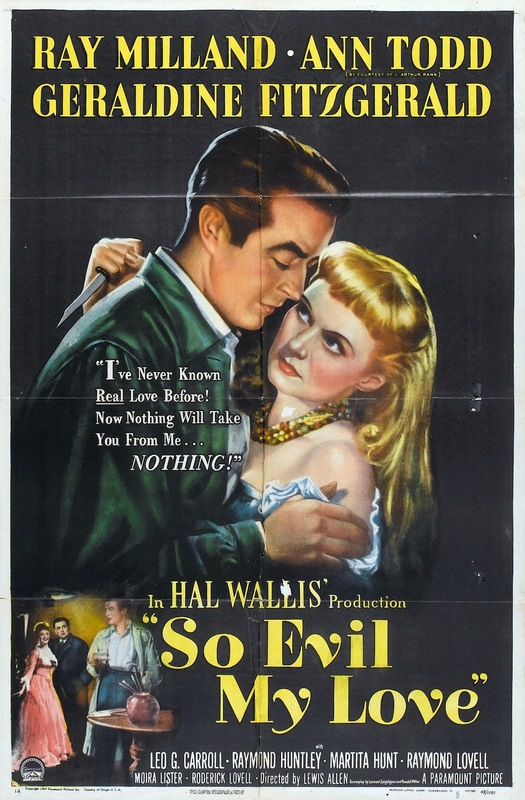
The 1948 movie "So Evil My Love" tickled my brain when I happened on it on Criterion channel. There was so much plot, and the relationship between the lead characters (played by Ann Todd and Ray Milland) was both fascinating and fragmented. One couldn't help feeling that there was a lot more to the story. While the movie takes largely Milland's point of view, I couldn't help but conjure up Todd's perspective the whole time, which seemed far more interesting. The predictable moralizing common in Hays Code-era movies is kept to a minimum, delivering a tense and unusual noir. 


And it turned out to be based on a crime novel, published only a year before (1947), written by Marjory Bowen under the male pseudonym Joseph Shearing and originally entitled "For Her to See." Surprisingly (not!), the novel is almost entirely told from the point of view of the female character Mrs. Sacret (changed to Mrs. Harwood in the movie), while the movie not only shifted it to the male character, a painter who calls himself Mark Bellis, but also made him much more sympathetic than he was in the novel. It was obvious that the filmmakers (the screenwriters and director were all male) needed a male anchor to this story or they wouldn't know how to handle it. 

In many ways, the novel reminded me of "The Talented Mr. Ripley" by Patricia Highsmith, published just 8 years later. I wouldn't be surprised if Highsmith took inspiration from For Her to See. A key difference between these two novels --- and the element that makes this novel extremely original --- is that the main character is not a hero, not even an antihero, but rather a loser. This choice is so daring and difficult to pull off that very few writers have even attempted it. It is so much easier and more appealing for both the author and the reader to identify with a master criminal and imagine oneself to be the smartest guy in the room. It is much more difficult to enter the mind of a not-too-smart character without making it drab and boring. No part of Mrs. Sacret's limited understanding of the world around her is boring, even if I, as the reader, often know more about what's going on than her. As an unreliable narrator with poor insight into other people's motives, it is a darkly comical pleasure to see the world through the very distorted lens of her eyes and introduces a modernist uncertainty rarely seen in this genre. 

In real life, the vast majority of criminals are not nearly as intelligent as the movies and thrillers want us to believe. Mrs. Sacret's motives and calculations are so petty and common that most authors have no interest in exploring them. The central similarity between her and Mr. Ripley is their resentment and envy toward their rich friends. In other words, money. Their conviction for taking money from their friends by any means necessary push the theme of class struggle very near the surface, which might be a source of discomfort for other writers. Mrs. Sacret especially is driven by a sense of grievance and entitlement that is possibly the most prevalent motivation among criminals of our time. We are startled in our recognition of this pervasive sentiment. "I deserve more. I don't have it because those people cheated me. I am wronged. I have cause to take revenge on all of you." 

The psychological insight throughout the novel is refreshing because it is more astute than most thrillers and, let's not kid ourselves, literary fiction about the lives of college English professors. All of the characters are ambiguous and test the limit of our sympathy. This comes with the unreliable lens of Mrs. Sacret and makes the reading experience delightful (especially for a cynic). 

Unlike the movie that centers around the male seducer/mastermind, the novel keeps him in the shadows, drawing a most chilling and irresistible psychopath rarely seen in other works but resonates with reality. The ending is really stunning in its lack of complete resolution. Even after decades of reading mysteries and crime novels, I am hard pressed to name a villain as well written as "the painter." 

What I like the most about this novel, however, is how aggressive and pungent the language is. In a novel by a woman (an English one no less!), about a woman's crime, told in the woman's voice, and filled with female characters, the pages are unapologetically filled with words like "power" and "stupid" and "hate." No euphemisms, no circumlocution, no fluff. Perhaps that was why Bowen chose to publish it under one of her male pseudonyms?

Friday, September 8, 2023

Communist and Capitalist Dictionaries

The Unbearable Lightness of Being in many ways reminds me of certain boys I remember from high school. They are pretty clever, but not as clever as they think they are. They throw around a lot of catchy ideas that, upon closer examination, lack depth and rigor. But the shallowness of their ideas is a feature, not a bug, in their popularity. Some of them are annoying, others not so much.

Many of the stuff in the novel are annoying, but some actually invite a deeper exploration (which the author did not do). One of the interesting ideas is the separate dictionaries used by Sabina and Franz, who are more caricatures than characters. Sabina represents the exiled intellectual from a former Communist country, i.e., Kundera's own uneasiness in France. Franz is a standup comedy version of intellectuals of the west --- It's funny, but also superficial and stupid. 

Sharing some similarity with Kundera's situation but having emigrated at a much younger age, I happen to have a first-hand understanding of this "separate dictionary" phenomenon, except that I have a much better dictionary for the western culture than Kundera wrote for Franz. Sabina is a more precise portrayal, but his observation of the west, as represented by Franz, is largely cringeworthy. 

I'm sure he wrote this part out of frustration with the French intellectuals who fawn over him without being able to understand him. On the other hand, he too failed to understand them. In his version, "the west" has the strength but lacks aggression. Franz is soft and unmanly. That's why he got dumped by Sabina and killed by some lowly Asian thugs. He is unable to arouse his women because he doesn't know how to issue a command "Strip" (in contrast with Tomas, an infinitely virile Czech man).

(One does not have to dig too deep for Kundera's metaphors.)

This characterization is extremely superficial and misses the reality by a long shot. But that's not surprising. Recently, I have been contemplating the impact of Communism on the 20th century history of the world. From time to time I am asked by American-born friends about the Communist regime of China, and every time I have to suppress an urge to give a longwinded answer about why the Chinese political system is only labeled "Communist", not unlike a box of fried chicken labeled as steak. 

I have finally come to the realization that Communism, from the single source of Karl Marx's brain, morphed into a vast array of totally different meanings to different people who did different things with it. People assume they are talking about the same thing when they talk about Communism, but that's just an illusion. The theory of Communism did something to countries that label themselves as Communist or Socialist, including Soviet Union and China, but these are not really Communist things as defined by Marx. The theory also did something to countries that label themselves as Capitalist, but the effects are subtle and complex and requires some exploration. 

To apply a bit of the systems theory, the fact that some countries in the world labeled themselves Communist (regardless of what they were actually doing) and happened to be economic and military rivals to some other countries in the world, caused those other countries to label any internal conflicts as Communist and foreign. For example, during the 1960s and 70s, the counterculture movement involving civil rights, women's rights, and gay rights was labeled as Communist infiltration by conservatives, thus rebranding long-term domestic conflicts as a foreign threat. When I first learned this phenomenon I almost laughed out loud. Obviously we are using different dictionaries in which the definitions of Communism has no resemblance to each other. 

Thursday, September 7, 2023

The Unbearable Promiscuity of Kitsch

I have several curious observations about the novel, one of which is the extensive philosophizing around the concept of kitsch in the beginning of Part 6. 

First, the author goes through great lengths to elucidate human society's awkward attitude about and the theological problem with shit, coming to the conclusion that disgust and excitement (clearly referring to sexual arousal) are two sides of the same coin or at least dependent on each other. 

Then, we come to the original definition of kitsch: "the absolute denial of shit." It's not a stretch to include sexual activities, along with its disgust and excitement, in the idea of "shit", not the least because the promiscuous sexual habits of the hero, Tomas, stands at the center of the novel. 

In subsequent chapters, we are given an definition of Communist kitsch, which has nothing to do with either shit or sex. Rather, the definition becomes the suppression of individualism in favor of a uniform display of total agreement among people, however artificial and coerced. Although we who live in the free world can safely assume that "he is not talking about me," let's not forget that the chapter started with an example of kitsch in an American senator. Moreover, he did write in a previous chapter that "The brotherhood of man on earth will be possible only on a base of kitsch." This statement is so all-encompassing so as to be meaningless, as if the entire history of human society is built upon this concept of kitsch, meaning either the universal disgust of the bodily function or the urge to pretend to agree with each other. 

(Regarding the disgust and shame of bodily function, Freud and others have done plenty of research. There is nothing new here.) 

It's all well and good to interpret the author's critique of kitsch as the grotesque display of unity in Communist propaganda, but I cannot help but wonder what all this has to do with shit. 

If we are to take the following definition of totalitarian kitsch seriously, then it is no longer limited to Communist propaganda and social pressure of conformity: 

Everything that infringes on kitsch must be banished for life; every display of individualism; every doubt; all irony; and the mother who abandons her family or the man who prefers men to women ...

In modern western countries, among intellectuals, none of these infringements is banished, including the mother and the homosexual man. But what about a compulsive womanizer like Tomas? 

Nearly all of the chapters from Tereza's perspective describe how much she suffers excruciating jealousy and despair from Tomas' womanizing. At least half of Tomas' chapters describe how he enjoys having sex with as many women as possible with absolutely no consequences. I am fascinated by the latter (but not Tereza's chapters, which are so shallow and cliched), which is mixed with a little disgust, I guess not that different from the feeling while looking at the Bristol Stool Form Scale. 

It is particularly fascinating to examine Tomas' promiscuity in parallel with his love for Tereza. He gave up a life and career in Zurich for her (although it is never clear why she ran back to Prague, it is obviously a necessary plot device). There are many touching passages about Tomas being deeply moved by Tereza's grief and pain; his love is aroused most intensely when he hears about her horrible dreams of death:

Let the planet be convulsed with exploding bombs, the country ravished daily by new hordes, all his neighbors taken out and shot -- he could accept it all more easily than he dared admit. But the grief implicit in Tereza's dream was something he could not endure.

To this passage I wrote: Her grief is obviously not as unendurable as a life without collecting women in his sexual escapades.

I have some even more uncharitable thoughts, but I would stick to the more concrete interpretation with a relatively obvious chain of logic strung through the consecutive chapters. Sure, the argument for individualism and against collective display of feeling is all fine and dandy, but I don't think that's the whole point. The point is presented to the reader everywhere in the world: If you are disgusted by the compulsive womanizer, you too are kitsch! 

------

As the chapters go on, the definition of kitsch expands out of control and becomes so general and vague that it loses all meaning. Sabina's longing for a picture-perfect home life in which she can compensate for her early loss of parents (which in itself is very banal characterization) is also lumped into the author's classification of kitsch, even though he admits that this longing is genuine and specific to Sabina. The sentiment comes from within Sabina herself and not a desire to fit in with any kind of social norm. 

In other words, even the first tear is kitsch, despite the earlier definition that only the second tear is so. By this point, any human sentiment can be called kitsch, and there is no longer any distinction between authentic emotions and affectations. He also throws a number of other concepts into kitsch, including but not limited to cliques, tribes, ideology, identity, and affiliation. This ceaseless expansion leads to the inevitable conclusion: 

For none among us is superhuman enough to escape kitsch completely. No matter how we scorn it, kitsch is an integral part of the human condition. 

Hmm. You have put the entire human condition into kitsch. So why should anyone scorn it?

Sunday, January 22, 2023

The English Patient

I am not putting on a photo of the movie, released in 1996 by Miramax and adapted and directed by Anthony Minghella. When I first saw it I disliked it a lot without being able to explain my reaction. After I have read the novel, I despise the movie all the more. 


For the novel I have some conflicting feelings. Indeed it is split into two halves: the pre-war years in Cairo and the desert where the extramarital affair between Katharine Clifton and the Hungarian explorer Almasy took place; and 1945 (the present) at an abandoned Tuscan villa where the nurse Hana, her father's friend Caravaggio, a Sikh bomb disposal specialist Kirpal Singh, and a burned, dying Almasy converge. 

The question in my mind was always why these two halves. There is very little apparent thematic connection between the two couples and relationships. One is obsessive and violent and destructive. The other is equal and uncomplicated and healing. One is fundamentally cliched and carries a whiff of rottenness, while the other is raw and young.

The movie gave me the initial impression that Minghella was trying to sell a stale love triangle story as a grand, epic, and simple tragedy. No matter how glossy it is presented, I just can't get the rotten smell out of my nostril. I am not at all against adultery in art, but this is a week-old fish left out of the refrigerator. When you come at such a century-old plot, shouldn't you try to inject some new blood? The "new blood" injected here comes in the form of weird exoticism from Naveen Andrews making love to Juliet Binoche. In the movie, this subplot seems tacked on and awkward. Too much to be a sidebar and too little to compete with the main storyline.

Unfortunately, the novel does not help much in this aspect. The Almasy chapters still leave a bad taste in my mouth. At some point I realized why. These chapters are entirely told from Almasy's point of view. We get none of Katharine's point of view, even though there is a chapter named for her and gives a few pages that appear to be her point of view but have to have been filtered through him. The only thing that could potential save this story from these frustrating and suffocating cliches is the sinister undercurrent that is buried in Almasy's account. He insists that she left him out of conscience and loyalty for her marriage or perhaps fear of her husband (whatever, it's very vague), but her dialogs suggest that she was angry because she could not be more than a secret mistress to him. There is a general feeling of deceit in his overall account, but I won't go there for now. 

Staleness aside, I just find the movie adaptation to be so gigantically ironic. Out of curiosity, I skimmed a number of book reviews, and maybe one out of 10 has a throwaway mention of the unpleasant factoid that Almasy is a Nazi. Throughout the novel, Almasy struggles to conceal this fact, going so far as talking about himself in the third person. That he worked for German spies in the desert for 3 years is revealed only by Caravaggio's exposition. (Yeah, plotting is not a strong point of this novel.) Almasy implies that he decided to help the Axis as a revenge for Katharine's death ("[Rommel] was a brilliant man..."). The real-life Almasy, on which the character is based, was in fact quite active in German army during the war.

Minghella was sensitive to the inconvenient element, and skillfully revised it to some harmless excuse for his "collaboration" with the Germans that even the novel Almasy is unable to cook up out of self-interest. He knew that he must protect the audience from any uneasiness. Adultery is already pushing their limits. 

Indeed the movie unabashedly centers around Almasy's love affair. If Minghella really loved the novel and wanted to adapt it faithfully, he could have made a WWII "The Hurt Locker." Hana's storyline equally shares the intensity with Almasy in the first half, but Kirpal Singh's storyline dominates the second half of the novel. Everything is compelling -- the strength of the character, the thrilling details of bomb disposal, the emotional ambiguity, the cultural conflicts -- which contrasts with the tired cliches in Almasy's half. But Minghella did not want that story.

I don't really know why he kept a shadow of the Hana-Kip storyline in the movie at all. Maybe he liked the framing device. It remains the less stale part of the movie, but we also get a clear sense that the two young characters are there to serve Almasy's story. The irony lies in the fact that Ondaatje is making a similar observation in Singh's story. The throughline is how he has served the Allies for 5 years, risking gruesome death every day. This is a betrayal of his own country, India, and his older brother, who is thrown in jail by the British colonial government. But he loves his English mentors and comrades and amiably suffers the discrimination and hostility from British soldiers. Service, intelligence, generosity, courage, all purported virtues of Sikhism. His love for Britain continues until the real climax of the novel, when he finally reaches the breaking point --- 

"American, French, I don't care. When you start bombing the brown races of the world, you're an Englishman. You had King Leopold of Belgium and now you have fucking Harry Truman of the USA. You all learned it from the English."

So he splits. From love, from work, from his comrades and employment, from being used and exploited. He goes back to India, where independence will be won in a couple of years. Although Ondaatje is not Indian himself (born in Sri Lanka and grew up in Canada), the shadow of the empire constantly hovers over the four main characters, none of whom is English despite the title. 

Of course, as an English filmmaker selling to an American audience, Minghella carefully scraped away all of this, every little strand of anti-colonialism and every little bit of heroism in the Indian character. Despite the desert scenes, he kept the movie clean from any sand that may seep into the shoes of the British and American consumers to rub against their delicate feet, with the same meticulous attention as Singh dismantles a bomb.

And he was absolutely correct. Imagine the shock and indignation and rage when they read the novel and see the line "They would never have dropped such a bomb on a white nation." Indeed, the rage erupted, making the novel more controversial in the English-speaking market than the movie was.

I wonder how Ondaatje feels about the movie. He couldn't avoid being appropriated and used by the British after all. 

(PS. There is added irony that Almasy is designated as "Count" in the movie, while he is not identified as aristocracy in the novel. The real-life Almasy called himself "Count" but was in fact a commoner. Well, I guess if being a Nazi doesn't stop him from becoming a big romantic hero, what's a little fake news, eh? And then there is also the little issue of necrophilia ... What a guy.)

Saturday, January 14, 2023

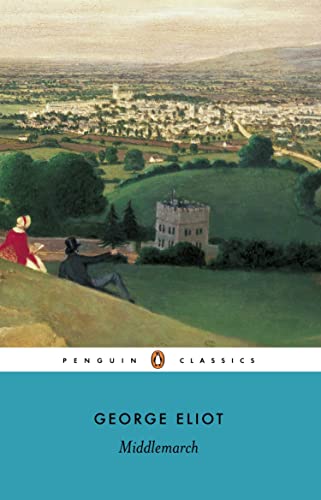
Communication in Middlemarch


The question of whether a person can actually, truly understand another is one that I think about all my life. Within psychological sciences, it appears that this impossibility is now well established. What a person goes through is to receive signals from another person (e.g., language, behavior, facial expression, vocal sounds, body language) and interpret its meaning to oneself, using his own set of tools, including the memory he associates with the signal and the learned meaning of a concept. For example, Person A eats a lychee fruit, says "ah, sweet," and Person B in her presence can only know what it means by conjuring up his own memory of eating a lychee fruit. If he has never eaten one, he's out of luck. The sensation cannot be directly transmitted from one to the other. 

For more abstract feelings, such as happiness and sadness and fear, the same principle applies, even though we tend to imagine that emotions are universally the same in every person and forget the specificity of each occasion and memory. The point is that we understand the external world completely through our internal machinery, and other people is a part of the external world. To date, we have no way of truly "walk in another person's shoes" or living in their skin, despite some science fiction that proposed such possibilities.

Of course, this impossibility to share thoughts and feelings does not stop anyone from trying or believing the illusion that we understand each other. This illusion is rewarding, irresistible, and perhaps absolutely necessary to our emotional health --- I know, the thought is a little disturbing, that our life and sustenance depend on an objective falsehood. What can you do. We can't handle the truth because the truth isn't always good for us. 

This is not to say that the self-derived signal-interpretation process is useless. At least we have the ability to evoke our own knowledge, memories, and feelings in an attempt to interpret the signals from another person. And this process is able to facilitate an incomplete but real amount of communication. Heck, we can even simulate other people's emotions to some extent, ie, empathy, drawing on our own emotional reserve. However limited, this is good enough to create interpersonal bonds so strong that we have built massive human civilizations encompassing millions and billions of individuals. 

While reading Middlemarch, I was struck again and again by the meticulous description of how people understand and misunderstand each other's thoughts and intentions, how things go awry because each character has his or her own motivation and logic. It's almost a high-definition dissection of the above-mentioned mechanism. To use a cliché, there is no villain in this book. It's not because the author started out with a plan to make every character good or neutral. Rather, she mapped out every character's motivation and then took it down its logical path, which then clashes with another character's logical path. This is the most elevated kind of conflict-making in fiction, and to do it to such a massive extent with so many characters must have been an enormously complex undertaking. 

The best example is the drama in Rosamond and Dr. Lydgate's marriage. Initially, my mind was gliding along the well-tread path of how a beautiful but immature or stupid young woman who causes the disillusion of her man, recalling Louisa Musgrove's relationship with Captain Wentworth ("Persuasion"). The more it went on, however, the harder I began to laugh at the one-upmanship between Rosamond and Tertius. Rosamond may be young and naïve and a bit of a ditz, but stupid she is not. Despite Lydgate's repeated yelling and threats, pulling his hair out, she goes off and thwarts him every single time. Each is stubbornly committed to their own way of coping with the debt situation, to which both had contributed. Hilarity ensues. Marriage hardly improves one's ability to read another's mind, Eliot seems to say, good luck with trying to change one another. 

No kidding. Who hasn't gone through the futility of trying to change one's spouse, so that two think as one? But what appears to be marital harmony due to a mind convergence is but an illusion. What really happens in a seemingly harmonious marriage is illustrated in the Garth family, in which Mrs. Garth grumbles, either inwardly or outwardly, but sighs and lets Mr. Garth go off to do his own thing. If we can't make peace with our fundamental differences ... then we are just banging our heads on the wall until they explode into bloody pulp. Oh well. 


The discussion on the limitations of our mind goes beyond marriage in Middlemarch. The novel is full of characters who believe they have a firm grip on reality, only to be proven wrong. From a particular perspective, Middlemarch is an exploration of the limitations of mind, and the illusion of control, with scientific insights based on clinical observations of real people, that is later proven correct by systematic and rigorous research. 

Thursday, January 5, 2023

The Thrills of Middlemarch


Although the novel does contain some digressions and commentary, as George Eliot was prone to include in her novels, it is not a stiff and slow reading experience most of the time. Besides her dry humor, she also wrote some rather suspenseful chapters, which induced me to read deep into the night sans sleep, turning the pages with a mix of anticipation and apprehension, eager to discover the fate of the characters involved. 

One early example is Fred Vincy's odyssey to pay off his debt, from his scheme of flipping horses (as in "flipping houses") to his emotional rollercoaster. Even though his failure was not difficult to foresee, the suspense, for me, lies in how he would confess his failures to the beloved Garth family, and what would come of it. Through this plot arc, we see Fred as the hapless and impulsive guy who is not too smart, but he does not lie, neither to others nor himself. In a sense, Fred is a danger to himself and others (more the former than the latter), and his journey into emotional maturity reminds me of, of all things, a Robert B. Parker novel early in the Spenser series (yes, I know, comparing Middlemarch to pulp fiction) titled "Early Autumn." In that novel, Spenser saves a boy abused by his parents by teaching him to build a house. Similarly, Fred's central relationship is less with Mary and more with Caleb Garth. Mr. Garth also taught Fred how to build a house, well OK, figuratively. 

Two other suspenseful chapters were both scenes of death. The first involves Mary Garth at the deathbed of Fred's uncle Featherstone, who may or may not have left a large amount of money to Fred. I did guess the eventual outcome on the inheritance question, but the process is plenty eerie, and the depiction of his last internal conflict rivals the best gothic novels. The second is Dorothea's viewpoint of her husband's last days. Mr. Casaubon has been stewing in the fear and jealousy of a younger man's attention to the oblivious Dorothea for weeks and months. Feeling his end is near, he wants Dorothea to make an oath sight-unseen. Dorothea says I don't promise anything without first knowing what it is. The hilarity is that he wants her to promise never to marry Ladislaw after he is dead, and she thinks he wants her to write his magnum opus for him after he is dead. She spends all night dreading that she may be pressured into a tedious and meaningless labor, until they have that talk in the morning ... Ah the buildup is so good and delicious, and the resolution so unexpected, that I nearly laughed out loud.

Later in the book, there are multiple plotlines leading to multiple mini-climaxes, intricately woven and acutely described, with unexpected payoffs, each with subtle irony and wisdom upon reflection. Her skills are absolutely breathtaking. Sometimes I wish Eliot had written a few mysteries, if only the genre had existed in her time. I am certain she would have killed it.

Friday, December 30, 2022

No Middle Name


Lee Child

There is just one thing that I have in common with Lee Child, the author of the Jack Reacher series. In the past three years I have been working my way through the series via library audiobooks, as audiobooks tends to be less of a page-turner, so to speak, than paper books. 

Yesterday I finally picked up a paper version of his short story collection "No Middle Name," published in 2017. The third story in the book, "High Heat," confirms my suspicion that Mr. Child, like me, has a particular fondness for people beating each other up with their bare hands. Certainly, there were plenty of guns in the Reacher series, and he devoted one full book ("Persuader") to the study of various guns. But description of hand-to-hand combats is salt to his books. There have to be multiple fight scenes in each book. 

In High Heat, he even devised a plot point to get rid of all the guns the bad guys may have, just to allow the 16-year-old Reacher to beat them all up. It's pretty clever, but a little far-fetched for organized crimes in New York City in 1977.

I have to imagine that Mr. Child's choice to put bare-knuckled fights into every book he writes reflects a real personal interest. (It must be difficult to avoid completely repeating oneself though.) Out of all the different types of violence on screen and on paper, I too most prefer this type of fighting scenes. Sure, the gun battles in John Wick are nicely choreographed and impressive, but they are inspired by unweaponed combat choreography too. There is an intimacy in these scenes that can better portray characters than any other types of fighting. The cold efficiency of guns offers less room for characterization and emotional, as well as visceral, impact. 

Thursday, December 29, 2022

The Prophecy of Middlemarch


Some years ago I read Daniel Deronda on a whim. Two things, or rather two characters, in the novel left a lasting impression: the fervent Zionist Ezra Mordecai Cohen and Daniel Deronda's mother, a Jewish actress who gave her son up, so that she can continue her career on stage. More than anything, it tipped me off to the origin of Israel that predated WWII, even WWI. 

I have not even finished reading Middlemarch, but some elements really blew me away with its modern resonance. It was written in 1871 and depicted an earlier period around 1830, so I never dreamed that I would see so many concerns that I had thought belonged strictly in the 20th century, at least.  

First, one of the main characters, Dr. Lydgate, was a young physician trying to change the way medicine was practiced in the country. Not content with treating local patients for their common illnesses, his ambition was to do research and unravel the pathology of diseases. He had microscopes and experimental apparatuses at home and kept up with new scientific discoveries in the field from the Continent. 

Moreover, he broke from the traditional practice of selling medicinal products (mostly tinctures and potions back then), because he recognized it as a type of conflict of interest. Physicians were incentivized to give patients their own concoctions because they could make more money selling medicines than diagnosing and caring for patients. Who cares if the medicines were effective? 

Oh my God this is so modern. Neither concerns have been completely resolved in medicine today. We are still doing research and unraveling pathology of illnesses. We are still struggling with nudging physicians to do the ethical thing in the face of greed. Both remain front and center in medicine. 

A second main character, Mr. Will Ladislaw, has an even more contemporary profession: campaign manager! I have never, ever seen this profession mentioned in classic literature, until "All the King's Men", which was published in 1946 in the United States. Ladislaw not only wrote speeches and opinion pieces in the partisan newspaper for his boss, Mr. Brooke, he also devised campaign strategy for him and coached him in his campaign! 

Alas, poor Mr. Brooke liked to veer off script and blab to anyone "You have a point there." There is a hilarious campaign rally scene that could happen even today. At one point, Will and the doctor had an argument about whether a politician should be sincere and say what he believes in. The doctor, talking from a scientist's perspective, found Will's cynical approach of saying whatever to keep voters happy appalling. I almost fell out of the chair laughing.

I don't know why George Eliot was so much better at seeing the future than other novelists of the same period, but she seemed to have acute insights into social trends and political sentiment roiling underneath the surface. No, she was not writing about what is often called "universal and timeless human nature," whatever that means, but rather a prediction of the tides to come and wash us away in the new millennia. And she was spot on.  

Friday, November 4, 2022

Karma (Yoga Sutra Notes #2)

A while ago I wrote about how wars may come and go, but conflicts and hatred do not go away, and no one changes their mind, after watching an episode of La Guerra E Finita. After learning the original concept of karma, it appears that, again, the ancient Indians had thought about it before. Maybe they had thought about everything. 

I am not sure whether the common understanding of karma could be credited to the Buddhist definition of karma, ie, a moralistic understanding of good and bad, reward and punishment. Indeed, I have heard many times that one's suffering and misfortune in the current life is the result (or perhaps "payment") of having done wrong in the past life, like eating meat or harming people, while good fortune is a reward for having done good things in the past life, like being vegetarian. The idea is to encourage (?) people to do good in the current life to ensure a better life next time, lest one comes back as a worm or a donkey or something. 

But the definition of karma in the Yoga Sutras or the Sankya school of philosophy is apparently not so judgmental or ... shall we say, Pavlovian. According to the commentaries collected in the book, karma refers to the endless chain of events that is linked by consequence. One action leads to the next, and the next to the next, and on and on. The Indian mythology is less interested in the origin of everything, when and how the world was created (although there is no lack of origin myths there) than in the perpetuation of change and flutters. What we are doing now has an endless chain of cause and effect before and after us. One could argue, for example, that in 1787, the colonies failed to reach an agreement to abolish slavery or, perhaps more precisely, agreed to preserve slavery as a union, and that occurrence has created an endless chain of consequences that stretches into today and may never end ... until climate change redraws the world map, maybe.

This is a way of looking at any history, from macro to personal, as a continuum that extends beyond major historical events or one's own lifespan. The idea of reincarnation, or samsara, seems scientifically absurd, unless you view it as a metaphor to describe the continuity running through generations. Indeed, the action of one generation reverberates into the next generation, and the next generation into the next, and so on, vastly overwhelming the random de novo mutations. This is karma, and it is a much more accurate description of reality than the "big story"-based theory of humanity in time.

It seems to me that the episodic and event-based view of history (again, it could be either macro or personal) is easier to create and easier to digest for the vast majority of us near-sighted and feeble-minded average people. I don't know what it was about the ancient Indian thinkers that allowed them to come up with such astute and profound insight into the human existence. Maybe wisdom passed down from aliens? (I kid! I kid!)

Being educated in the feeble-minded non-Indian cultures, I have spent much energy and effort in my life to understand how and why we got to this place and where we originally came from (thanks, Jared Diamond!), as if understanding the series of logical links that make me who and where I am can free me from the chain (pun intended but all credits to the Indians) of karma. But the Indians were right: In the subjective experience of an individual, there is no beginning and no end, only a series of consequences within the limits of one life. The ripples of all the karma that led to my life are practically unknowable to me, and so are the ripples of all the karma I am generating, flowing into the future and beyond, mixed with countless other ripples.

The Yoga Sutras contains some vague advice about diminishing the effect of karma within this life and for the next life, such as eating vegetarian food and being nice, or you can devote your life to worshipping a god (but it didn't specify which one, Shiva? Vishnu? Parvati?), which are hardly as specific or didactic as the "donate money now or you come back as a fly" school of persuasion. Rather, the emphasis is on the practice of yoga. This practice of yoga, which Patanjali talks about over and over, is to recognize and experience how the body and mind, thoughts and feelings, the whole lot, is a shell, and even when you shed all of them, there still exists a white light of one's essence, a singular life force completely independent of the shell, that glows on its own energy. (Interestingly, Buddhism does not believe in purusa, but I don't know the details.) What does that mean? I have no idea, but I like it.

Monday, August 15, 2022

The Naples Quartet: Unused Intelligence

Throughout the quartet, Lenu often lamented the waste of Lila's intelligence. Lila did not receive any education beyond the fifth grade, a fact she often brought up in adulthood. Lila read voraciously god-knows-what without telling anyone, including Lenu. At various times, Lenu felt as if Lila was speaking through her (Lenu's) writing by inspiring ideas and firing imagination. As the highest praise of Lila's intelligence and creativity, Lenu constantly worried about being proven an inferior writer, should Lila's own writing be discovered by the world. 

Well, Lila never shared her writing with the world and very little with Lenu. Consequently, her intelligence was considered wasted and discarded in Lenu's eyes. This argument invites a fundamental question: How do we live with unused (i.e., wasted) talent?

Sure, we all immediately agree that it is a bad thing, a sad thing, proof of the oppression and erasure of women. It is all true and correct, which does not preclude one to think about the flip side: Can it also be a natural and honest choice to throw away one's intelligence or not make use of it? 

For someone like Lenu, who represents many of us, it is unthinkable. It is largely because she herself attained nearly all of her life goals through rigorously using every bit of her intelligence, tenacity, strength of will, and people skills. Being smart and hardworking led to good grades; good grades were the currency to win professors' approval and assistance, which in turn sent her to high school and college. Using her talent and mind, she made a living as a novelist and journalist. Everything can be made use of in service of her advancement. Most of all, she had thoroughly mined the history and events of the neighborhood in her novels, which brought her money, fame, and access.

Lila held the opposite view and repeatedly begged Lenu not to write about the neighborhood, its people, and especially Lila herself and Tina. Lenu did not understand this attitude at all and repeatedly agreed and then violated her agreement. One exception to Lila's aversion to publicity is the Solaras. The only time Lila collaborated with Lenu was the articles they wrote to expose the Solara criminal organization, with the hope of sending the Solara brothers to jail. Beyond this, Lila had no interest whatsoever in making use of her story and turn it into accolades, admiration, or profit. 

So, then, what is intelligence for, if one does not convert it to tangible benefits? I must admit I had never thought about it until I read the novels. 

Of course, Lila did not throw her talent away completely. Initially, she used her shoe designs to win investment in a shoe factory for her father and brother. Then she used her interior design of the shoe store to facilitate her affair with Nino. Later, she used her intelligence to help Enzo begin a new career in computers. Subsequently, she made plenty of money from her computer programming skills, not to mention becoming Michele's chief computer engineer. But Lenu still did not understand, because Lila did not want to write, to share herself, with the world. After the enormous loss of Tina, she stopped working, and her insatiable energy and curiosity turned toward understanding the context of her personal tragedy, i.e., the tragedy of Napoli itself, but still she was not interested in sharing any of this with anyone, nor did she want to exchange it for anything, nor did she want to contribute to the progress of society. 

I cannot help but recall my twenties and thirties, when I struggled with the motive and purpose of writing stories and stuff outside of work (where I was and still am paid to write), none of which were published. If I had zero desire to be seen by other people, I would have written nothing. No matter how conflicted I was about being read and understood and liked, the secret desire was always there. As I grew more cynical about human capacity to understand each other and lost some of the need to be understood, the urge diminished and dissipated. But still I don't think I could reach the self-contained satisfaction of using my mind for my own satisfaction alone, with absolutely no intention to be seen and validated --- or just reflected back --- by another person.

Lenu's pride and urge to write and be published and be read are easy to understand. She wanted to leave something behind, proof of her existence and a temporary escape from mortality. In other people's eyes we confirm our own solid existence. Lila represents the opposite, which I have to admit is rare to see in this world but not entirely incomprehensible. Nearly everything in this world is wasted in reality. People's talent and abilities come to nothing all the time. Even the corporations and individuals who earn millions and billions of dollars every year, can we really say they have contributed to human progress at all? How many of their products end up on landfills eventually? How many of them make life worse rather than better? 

Indeed, what if intelligence is wasted? What if it does not produce anything? Not money, not fame, not status, not admiration, not even showing off. It stands alone, all by itself, comes and goes, breathes and lives and dies. So what? So the fuck what?

The Ending of Le Samourai (1967), Explained

A quick online search after watching Jean-Pierre Melville's Le Samourai confirmed my suspicion: The plot is very rarely understood by E...