Search This Blog

Wednesday, November 22, 2023

Battle Royale (2000)


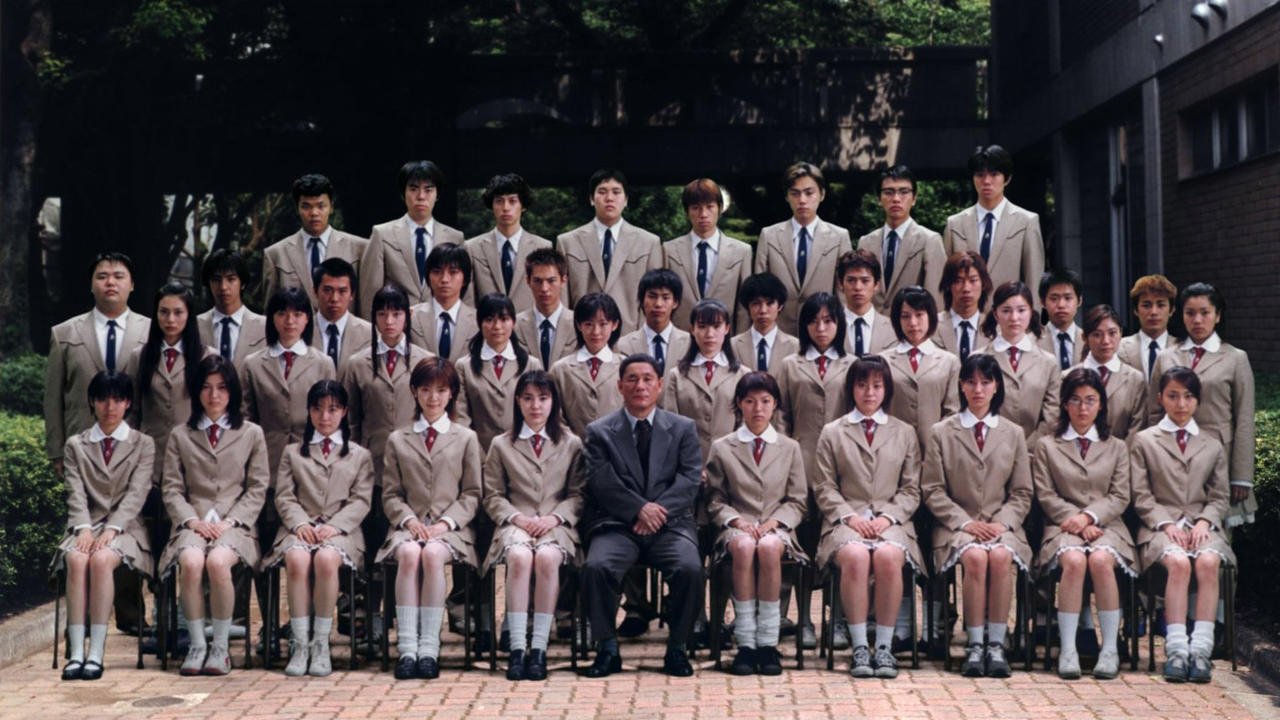
At the turn of the century, Battle Royale was an international cultural phenomenon. Soon enough I saw a blurry pirated copy on video, which seemed rather confusing in terms of characters and plot. Thus it is a surprise to learn recently that the movie was not officially released on video in the US until 2012, long after its poor cousin, Hunger Games, gained popularity with the American public. (I must note that the author of HG, Susan Collins, has always maintained that she had not heard of BR before she finished the novels. I believe her.)

The movie, directed by Kinji Fukasaku, is a variation of the horror/action movie genre. The original novel, written in 1997 and published in 1999, was considered shocking and controversial in Japan. There is obvious reference to Lord of the Flies, but it also bares the mark of shonen popular entertainment (mostly manga), which centers on the life of young adults (roughly 12-18 years). 

Rewatching it on Criterion Channel in the middle age, I am surprised by its prescience; no, perhaps it is simply astute social observation and commentary. It is me who has been too stupid to realize that our time, in contrast to the post-WW2 baby boom that came to age in the 1960s and 70s, is a time of the old against the young. 

In 2023, it is hard not to be inundated with the dumbass meme that the leading politicians are "too old." News media parrot the meme without any insight, crowing on about the age of presidents, presidential candidates, congressional leaders, etc., etc., without a hint of understanding why. When the very old president tries to do something good for young people, for example, by using tax dollars to pay off a portion of their student loans, look how the entire society goes into hysterics: "No one helped me with my student loans. Why should today's young people get any free money?"

Ours is a time in which older generations take ever greater power and resources from younger generations. The shift in population age pattern in the past 80 years is one of the main forces that drive the political and social climates in this era. (Another force is "the pill.") People tend to hoard more resources and power naturally over time (if they stay alive), but this trend is exacerbated by the delay in death. As the proportion of older people grows more rapidly than ever, young people quickly lose the little power they gained through the 1970s. The election of Ronald Reagan in 1980 is the first sign that we were entering of an increasingly conservative era with no end in sight, simply because old people continue to outnumber young people. Since then, (draft-dodging) conservatives never stopped complaining about younger generations for being too soft, too lazy, too fragile, too whiny, too whatever ... (The podcast If Books Could Kill has plenty of materials on this phenomenon. The fear and hatred of younger generations are on full display.)

To express the youth-elderly conflict, director Fukasaku derived inspiration from his youth as a middle-schooler carrying corpses killed by US bombs in WW2. The war is a killing game that old men throw young people into. That's certainly true. That the allegory continues to resonate from 2000 to 2023 is an indication that the generational struggle for power and resources remains the same in peace time and will continue in the foreseeable future, when the population continues to live longer and become older, gripping power and money ever tighter in our spotted, wrinkled, bony hands.

An example of this generational conflict? Climate change politics. Older people have less incentive to sacrifice some of their comfort and convenience, and more importantly financial position, to fend off an uninhabitable environment some years from now, no matter how much lip service is paid to loving their children and grandchildren.

----

I have not watched the Hunger Games movies, but I did read the first book. It is OK but vastly inferior to Battle Royale. The difference between HG and BR is precisely a reflection of the difference between the American and Japanese popular cultures. HG is a typical American fantasy of playing pretend revolution in a faraway land/galaxy of dictatorship. Both exciting and safe, because "it will never happen here!" BR, on the other hand, is a horror story smack in the middle of its own place and time with a unique absurdist humor. The Japanese are the best in the world at the art of death, while the American ... well, as Disney has told us, Americans are immortal; death does not exist for them. 

Ironically, 2 decades later, Battle Royale looks more like real-life America than Japan, with young people shooting each other dead in schools (with automatic weapons, just like the movies!) every day while older people buy more and more guns. If Fukasaku could see it from heaven, would he laugh out loud? 

Wednesday, October 18, 2023

The Haunting of Hill House (1959)


Shirley Jackson seems to be enjoying a moment of revived popularity right now. Her major novels, The Haunting of Hill House and We Have Always Lived in the Castle both got a screen adaptation in the past few years. There is a sort-of-biographical-but-not-really movie made starring Elisabeth Moss. 

While I am in general very sensitive to horror stories and movies, reading "The Haunting of Hill House" was not a particularly terrifying experience, even though I did it mostly at night in the dark. It helps that there is no blood and gore, no hacked-up corpses, no severed limps or gouged eyes anywhere in the book.

The novel is written in a very subtle style, which rapidly shifting perspectives, abundant hints and inferences, and omissions that are as meaningful as words on the page. For example, in one scene involving three characters, we see only two conversing, and the silence of the third is where the drama lies. Deceptively simple but technically sophisticated, the novel was recognized as a masterpiece and a finalist for the National Book award. 

There are a number of components in the novel, including an pervert Victorian-era father who probably abused his daughter in a chilling but very brief segment in Chapter 6. Lesbianism is also hovering significantly in the background, not only in the character Theodora but also the bond between Theo and Eleanor, the main character. However, at the heart of the novel is undoubtedly Mother. 

I looked up a few reviews of the novel. That Hill House represents a mother figure is widely accepted: the soft bed, plush chairs, excellent meals cooked by Mrs. Dudley, enclosed rooms (suggestive of the womb). It mothers all four characters who gathered there to investigate it: Professor Montague, future owner of the house Luke Sanderson, and two women with supernatural talents, Eleanor and Theodora. However, Eleanor is the center of the story and the most susceptible among them to this mothering. It took me a while to be convinced that none of the other characters would feature prominently in the relationship with Hill House, which somewhat hampered my appreciation for the novel in the first half. (Actually, I was waiting for some of the side characters to be killed by the House.) 

The roots of Eleanor's susceptibility are vaguely suggested through her history of having spent almost her entire youth, from 21 to 32 years of age, caring for her ailing mother, with no social or personal life outside of the confinement and obligations. All this took place before the opening of the novel, and we only see glimpses of her resentment and desire to escape into independence. What kind of a mother was Mrs. Vance in her illness? There is only a mention of "small guilts and small reproaches, constant weariness, and unending despair." In a word, inadequate. The roles of mother and daughter were reversed, and Eleanor had to mother her mother for 11 years. Thus, the House seems much more welcoming and fits into her desire for a mother. 

(If you do not wish to be spoiled, stop reading here.)

Some reviewers have put forth a theory that postulates that most or all of the haunting in the novel, such as strange noises and writings on the wall, are in fact generated by Eleanor instead of the House, as she has telekinetic abilities. I am in the camp against the theory. I think the House exists as an independent being that sometimes but not always responds to Eleanor's unspoken wishes and desires, which is in fact what most mothers do (respond to and fulfill the wishes of their babies without verbal/linguistic communication). 

While some reviews consider Eleanor's mental evolution throughout the novel as a disintegration or descent into madness, I don't agree. Her mind is increasingly merged with the House (her new mother figure) over time, and her wish to "come home" is then written on the wall. It is indeed Eleanor's wish, which is why Theo the telepath asked "Did you do this?" to Eleanor's rage. 

Among the residents in the House, Eleanor is obviously the closest to Theo, who at first represents an alternative life to Eleanor's, an inspiration and aspiration for her future life. Over time, however, Eleanor turned on her. Although the author somewhat obscured the heart of their quarrels, I am reasonably certain that it is caused by Eleanor's effort to turn Theo into a mother figure and Theo's refusal. This is made clear only in the penultimate chapter:

Theo said carefully, "She wants me to take her home with me after we leave Hill House, and I won't do it."

Luke laughed. "Poor silly Nell," he said. "Journeys end in lovers meeting."

The response from Luke is significant because the quote "journey's end in lovers meeting" is repeated throughout the novel. However, romantic or sexual attraction is sorely lacking between Eleanor and other characters, either male or female. This love is therefore not sexual but rather parental and primitive. Theo's rejection to be Eleanor's request to be the latter's mother is the trigger that pushes Eleanor into the arms of Hill House. 

While we have all heard of Oedipus Complex and its effect on our mating habits -- at least for heterosexual persons, women's relationship with other women is often heavily influenced by their relationship with their mother, especially if the original relationship is unsatisfactory. What Eleanor seeks, with despair, in other women is a new, better mother to replace her inadequate one. Hill House is the only one willing to give it to her.

The male characters sort of fade into the background. There is a brief segment in which Luke flirts with Eleanor and floats the possibility of a romantic relationship. Is this a suggestion that Eleanor is not a lesbian or has a crush on Luke? No. Reading the text closely, it is apparent that Eleanor is merely contemplating a potential escape from her family and old life through marriage. Luke is trying to seduce her by whining that he had no mother and "No one ever loved me," hinting that he too is seeking a mother. This could work with women who want to mother others, but Eleanor is the opposite. That is why she reacted violently:

No, she thought, you are not going to catch me so cheaply. I do not understand words and will not accept them in trade for my feelings; this man is a parrot. ... that maudlin self-pity does not move directly at my heart. 

A baby cannot be a mother, especially after she had already played a mother for 11 years. Her rage and her despair lie in the condition that no one would mother her and give her the satiated infant experience. 

Late in the novel, Mrs. Montague and her male "friend" made an exasperating appearance. Although their function in the novel is unclear, Mrs. Montague is a hilarious character who constantly shushes her husband, the benevolent father/authority figure in most of the previous chapters, rendering him completely impotent. This odd threesome marriage may be an echo of Shirley Jackson's own marriage, in which her husband Stanley Hyman, a college professor, constantly flaunted his affairs with his students. One of them even lived in their house for a while. Perhaps she serves as another argument for the impossibility of escape through marriage, perhaps it is just comic relief. 

The extraordinary opening of the novel lays out the central premise: 

No live organism can continue for long to exist sanely under conditions of absolute reality; even larks and katydids are supposed, by some, to dream. Hill House, not sane, stood by itself against its hills, holding darkness within. 

The absolute reality that drives Eleanor insane is that she cannot have a mother. This is a true human condition, as all mothers are more or less inadequate to a human infant's need. Mothers are human too and all humans have limitations, especially in the insufficient capacity of telepathy and empathy. Infants wish for an omnipotent mother who can read their mind, but this mother does not exist. For some who have had less mothering than most, their hunger is bigger, more urgent, and more desperate, and therefore they are even less soothed by the lukewarm relationships with other people. For them, the absolute reality that they eventually face is a world in which no one comes when you cry, and this is what Eleanor gradually realizes in the final chapters. She cannot escape her absolute reality through "normal" relationships, with either men or women. Her only path is to return to the womb, and it comes true in the end: the warm, dark, silent, absolutely safe confine in which one never moves.

Monday, October 16, 2023

eXistenZ (1999)


Not only is this David Cronenberg movie is often compared with "The Matrix" from the same year, it also reminds me of Christopher Nolan's "Inception." It lacks the exuberance of The Matrix, but far outdoes Inception in its handling of multiple layers of game/dream. Perhaps more important, it is funny. It is playful with a wink and a chuckle, something that is not in Nolan's dictionary. 

To apply the psychoanalytical premise that fiction serves the same function as dream, games --- or movies, for that matter --- are the same. Cronenberg's dream is obviously more imaginative, more gross, and perhaps less inhibited than most people's, but I had a feeling of recognition with the organic game world in eXistenZ, even when I heard about it in 1999 but never watched the movie at the time. There are shared-dream elements in it, as bizarre as they are. It's not just the bone gun. There are creatures/objects in this world that are somewhere between machine and organism, or between dead and alive. Humans tend to regard other living species as either stupid enough to be no different from machine or smart enough to anthropomorphize. Are the "machines" or game pods living organisms or dead tools? Anyway, this is not necessarily a central concern of the movie, but the idea is lurking somewhere beneath the commentary about game/dream/fantasy. 

In 1999, people were not yet walking around with a smartphone permanently attached to their hands. Twenty-four years later, we are all sinking deeper and deeper into a mental existence further detached from our bodily existence. Perhaps there has always been a bodily desire to escape reality that has been discovered, exploited, and monetized only in the past decades. Perhaps this insidious but sweeping change to human existence is largely environmental. In terms of prescience, eXistenZ remains far more relevant than Inception and, to a lesser extent, The Matrix. 

Saturday, October 7, 2023

The Talented Mrs. Sacret

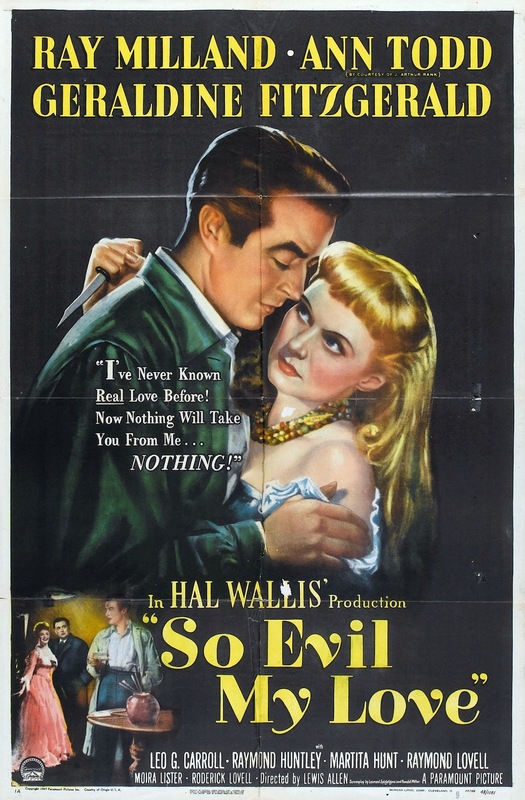
The 1948 movie "So Evil My Love" tickled my brain when I happened on it on Criterion channel. There was so much plot, and the relationship between the lead characters (played by Ann Todd and Ray Milland) was both fascinating and fragmented. One couldn't help feeling that there was a lot more to the story. While the movie takes largely Milland's point of view, I couldn't help but conjure up Todd's perspective the whole time, which seemed far more interesting. The predictable moralizing common in Hays Code-era movies is kept to a minimum, delivering a tense and unusual noir. 


And it turned out to be based on a crime novel, published only a year before (1947), written by Marjory Bowen under the male pseudonym Joseph Shearing and originally entitled "For Her to See." Surprisingly (not!), the novel is almost entirely told from the point of view of the female character Mrs. Sacret (changed to Mrs. Harwood in the movie), while the movie not only shifted it to the male character, a painter who calls himself Mark Bellis, but also made him much more sympathetic than he was in the novel. It was obvious that the filmmakers (the screenwriters and director were all male) needed a male anchor to this story or they wouldn't know how to handle it. 

In many ways, the novel reminded me of "The Talented Mr. Ripley" by Patricia Highsmith, published just 8 years later. I wouldn't be surprised if Highsmith took inspiration from For Her to See. A key difference between these two novels --- and the element that makes this novel extremely original --- is that the main character is not a hero, not even an antihero, but rather a loser. This choice is so daring and difficult to pull off that very few writers have even attempted it. It is so much easier and more appealing for both the author and the reader to identify with a master criminal and imagine oneself to be the smartest guy in the room. It is much more difficult to enter the mind of a not-too-smart character without making it drab and boring. No part of Mrs. Sacret's limited understanding of the world around her is boring, even if I, as the reader, often know more about what's going on than her. As an unreliable narrator with poor insight into other people's motives, it is a darkly comical pleasure to see the world through the very distorted lens of her eyes and introduces a modernist uncertainty rarely seen in this genre. 

In real life, the vast majority of criminals are not nearly as intelligent as the movies and thrillers want us to believe. Mrs. Sacret's motives and calculations are so petty and common that most authors have no interest in exploring them. The central similarity between her and Mr. Ripley is their resentment and envy toward their rich friends. In other words, money. Their conviction for taking money from their friends by any means necessary push the theme of class struggle very near the surface, which might be a source of discomfort for other writers. Mrs. Sacret especially is driven by a sense of grievance and entitlement that is possibly the most prevalent motivation among criminals of our time. We are startled in our recognition of this pervasive sentiment. "I deserve more. I don't have it because those people cheated me. I am wronged. I have cause to take revenge on all of you." 

The psychological insight throughout the novel is refreshing because it is more astute than most thrillers and, let's not kid ourselves, literary fiction about the lives of college English professors. All of the characters are ambiguous and test the limit of our sympathy. This comes with the unreliable lens of Mrs. Sacret and makes the reading experience delightful (especially for a cynic). 

Unlike the movie that centers around the male seducer/mastermind, the novel keeps him in the shadows, drawing a most chilling and irresistible psychopath rarely seen in other works but resonates with reality. The ending is really stunning in its lack of complete resolution. Even after decades of reading mysteries and crime novels, I am hard pressed to name a villain as well written as "the painter." 

What I like the most about this novel, however, is how aggressive and pungent the language is. In a novel by a woman (an English one no less!), about a woman's crime, told in the woman's voice, and filled with female characters, the pages are unapologetically filled with words like "power" and "stupid" and "hate." No euphemisms, no circumlocution, no fluff. Perhaps that was why Bowen chose to publish it under one of her male pseudonyms?

Friday, September 8, 2023

Communist and Capitalist Dictionaries

The Unbearable Lightness of Being in many ways reminds me of certain boys I remember from high school. They are pretty clever, but not as clever as they think they are. They throw around a lot of catchy ideas that, upon closer examination, lack depth and rigor. But the shallowness of their ideas is a feature, not a bug, in their popularity. Some of them are annoying, others not so much.

Many of the stuff in the novel are annoying, but some actually invite a deeper exploration (which the author did not do). One of the interesting ideas is the separate dictionaries used by Sabina and Franz, who are more caricatures than characters. Sabina represents the exiled intellectual from a former Communist country, i.e., Kundera's own uneasiness in France. Franz is a standup comedy version of intellectuals of the west --- It's funny, but also superficial and stupid. 

Sharing some similarity with Kundera's situation but having emigrated at a much younger age, I happen to have a first-hand understanding of this "separate dictionary" phenomenon, except that I have a much better dictionary for the western culture than Kundera wrote for Franz. Sabina is a more precise portrayal, but his observation of the west, as represented by Franz, is largely cringeworthy. 

I'm sure he wrote this part out of frustration with the French intellectuals who fawn over him without being able to understand him. On the other hand, he too failed to understand them. In his version, "the west" has the strength but lacks aggression. Franz is soft and unmanly. That's why he got dumped by Sabina and killed by some lowly Asian thugs. He is unable to arouse his women because he doesn't know how to issue a command "Strip" (in contrast with Tomas, an infinitely virile Czech man).

(One does not have to dig too deep for Kundera's metaphors.)

This characterization is extremely superficial and misses the reality by a long shot. But that's not surprising. Recently, I have been contemplating the impact of Communism on the 20th century history of the world. From time to time I am asked by American-born friends about the Communist regime of China, and every time I have to suppress an urge to give a longwinded answer about why the Chinese political system is only labeled "Communist", not unlike a box of fried chicken labeled as steak. 

I have finally come to the realization that Communism, from the single source of Karl Marx's brain, morphed into a vast array of totally different meanings to different people who did different things with it. People assume they are talking about the same thing when they talk about Communism, but that's just an illusion. The theory of Communism did something to countries that label themselves as Communist or Socialist, including Soviet Union and China, but these are not really Communist things as defined by Marx. The theory also did something to countries that label themselves as Capitalist, but the effects are subtle and complex and requires some exploration. 

To apply a bit of the systems theory, the fact that some countries in the world labeled themselves Communist (regardless of what they were actually doing) and happened to be economic and military rivals to some other countries in the world, caused those other countries to label any internal conflicts as Communist and foreign. For example, during the 1960s and 70s, the counterculture movement involving civil rights, women's rights, and gay rights was labeled as Communist infiltration by conservatives, thus rebranding long-term domestic conflicts as a foreign threat. When I first learned this phenomenon I almost laughed out loud. Obviously we are using different dictionaries in which the definitions of Communism has no resemblance to each other. 

Thursday, September 7, 2023

The Unbearable Promiscuity of Kitsch

I have several curious observations about the novel, one of which is the extensive philosophizing around the concept of kitsch in the beginning of Part 6. 

First, the author goes through great lengths to elucidate human society's awkward attitude about and the theological problem with shit, coming to the conclusion that disgust and excitement (clearly referring to sexual arousal) are two sides of the same coin or at least dependent on each other. 

Then, we come to the original definition of kitsch: "the absolute denial of shit." It's not a stretch to include sexual activities, along with its disgust and excitement, in the idea of "shit", not the least because the promiscuous sexual habits of the hero, Tomas, stands at the center of the novel. 

In subsequent chapters, we are given an definition of Communist kitsch, which has nothing to do with either shit or sex. Rather, the definition becomes the suppression of individualism in favor of a uniform display of total agreement among people, however artificial and coerced. Although we who live in the free world can safely assume that "he is not talking about me," let's not forget that the chapter started with an example of kitsch in an American senator. Moreover, he did write in a previous chapter that "The brotherhood of man on earth will be possible only on a base of kitsch." This statement is so all-encompassing so as to be meaningless, as if the entire history of human society is built upon this concept of kitsch, meaning either the universal disgust of the bodily function or the urge to pretend to agree with each other. 

(Regarding the disgust and shame of bodily function, Freud and others have done plenty of research. There is nothing new here.) 

It's all well and good to interpret the author's critique of kitsch as the grotesque display of unity in Communist propaganda, but I cannot help but wonder what all this has to do with shit. 

If we are to take the following definition of totalitarian kitsch seriously, then it is no longer limited to Communist propaganda and social pressure of conformity: 

Everything that infringes on kitsch must be banished for life; every display of individualism; every doubt; all irony; and the mother who abandons her family or the man who prefers men to women ...

In modern western countries, among intellectuals, none of these infringements is banished, including the mother and the homosexual man. But what about a compulsive womanizer like Tomas? 

Nearly all of the chapters from Tereza's perspective describe how much she suffers excruciating jealousy and despair from Tomas' womanizing. At least half of Tomas' chapters describe how he enjoys having sex with as many women as possible with absolutely no consequences. I am fascinated by the latter (but not Tereza's chapters, which are so shallow and cliched), which is mixed with a little disgust, I guess not that different from the feeling while looking at the Bristol Stool Form Scale. 

It is particularly fascinating to examine Tomas' promiscuity in parallel with his love for Tereza. He gave up a life and career in Zurich for her (although it is never clear why she ran back to Prague, it is obviously a necessary plot device). There are many touching passages about Tomas being deeply moved by Tereza's grief and pain; his love is aroused most intensely when he hears about her horrible dreams of death:

Let the planet be convulsed with exploding bombs, the country ravished daily by new hordes, all his neighbors taken out and shot -- he could accept it all more easily than he dared admit. But the grief implicit in Tereza's dream was something he could not endure.

To this passage I wrote: Her grief is obviously not as unendurable as a life without collecting women in his sexual escapades.

I have some even more uncharitable thoughts, but I would stick to the more concrete interpretation with a relatively obvious chain of logic strung through the consecutive chapters. Sure, the argument for individualism and against collective display of feeling is all fine and dandy, but I don't think that's the whole point. The point is presented to the reader everywhere in the world: If you are disgusted by the compulsive womanizer, you too are kitsch! 

------

As the chapters go on, the definition of kitsch expands out of control and becomes so general and vague that it loses all meaning. Sabina's longing for a picture-perfect home life in which she can compensate for her early loss of parents (which in itself is very banal characterization) is also lumped into the author's classification of kitsch, even though he admits that this longing is genuine and specific to Sabina. The sentiment comes from within Sabina herself and not a desire to fit in with any kind of social norm. 

In other words, even the first tear is kitsch, despite the earlier definition that only the second tear is so. By this point, any human sentiment can be called kitsch, and there is no longer any distinction between authentic emotions and affectations. He also throws a number of other concepts into kitsch, including but not limited to cliques, tribes, ideology, identity, and affiliation. This ceaseless expansion leads to the inevitable conclusion: 

For none among us is superhuman enough to escape kitsch completely. No matter how we scorn it, kitsch is an integral part of the human condition. 

Hmm. You have put the entire human condition into kitsch. So why should anyone scorn it?

Sunday, July 2, 2023

Showgirls (1995)


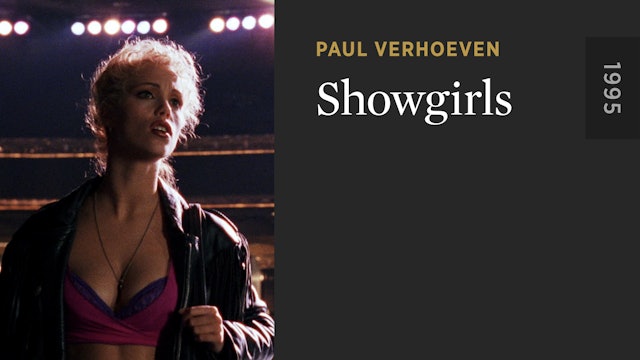
I got to this notorious Verhoeven movie after seeing at least 6 other movies of his. So, by this time, I am familiar enough with his internal logic and worldview and no longer have that vague disturbing feeling. While I do not disagree with a lot of the discourse on the movie's themes of misogyny, commodification of the female body, and female rage, I do feel like observers are consistently hampered by their inability to imagine that a male author/creator can project his own self into female characters. The universality of this blind spot is absolutely baffling, as I dare say every female storyteller has tried to write from a male point of view. Is it so hard to imagine that male storytellers would identify with female characters sometimes? George RR Martin mentioned that of course all those female characters came out of his own mind just like the male ones, including Cersei. He had to identify with them to write their POV chapters.

What I mean is, social and gender critiques aside (all valid), Nomi represents a pretty big part of Verhoeven himself.

(If the character were male, this identification would be apparent to everyone immediately.)

Many have observed, and Verhoeven himself also acknowledged, that the character's introduction is more than a little strange. From the start, Nomi is presented as brusque, irritable, and combative. In other words, the audience does not recognize her as a white American woman of a lower class. Her behaviors would be far more understandable and acceptable if they had come from a white Dutch man.

Most of the movie demonstrating Nomi's ambitious but conflicted pursuit of success in Las Vegas is an obvious analogy of Verhoeven's own ambitious and conflicted pursuit of success in Hollywood. Nomi's repeated and earnest insistence that she is not a prostitute is cited by critics as one of the laughable choices of the movie --- and indeed I agree, as she clearly seduced the Kyle McLaughlin character in order to get the understudy role --- I interpret this as Verhoeven's self-mockery of his career in America. Sure, he slipped satire into Total Recall, Robocop, and Basic Instinct, but these movies nevertheless were primarily crowd-pleasing blockbusters that sucked the American audience's collective dick. So I can imagine he felt a little bit conflicted about how much he was prostituting his talent and sensibility for fame and fortune. (I read somewhere that he claimed that he moved to Hollywood because his wife pushed him into it. Regardless of the credibility of his claim [throwing his wife under the bus?], it's an indication of his ambivalence.)

In the past 30 years, I have been to Las Vegas twice, once for a professional conference and the other for a figure skating event. The vulgarity and gaudiness and excess of Vegas are accurately reflected in Showgirls' own style. Besides the vulgarity and naked (no pun intended) greed, I am surprised by a sense of hostility permeating ordinary interactions, even though it is 90% service economy. I repeatedly got ripped off by taxi drivers. Restaurant staff were unfriendly. Unlike rural America, the general indifference and antagonism are not related to race or immigration or the usual political trigger points. People just seem tired and hardened, with no empathy to spare. The only nice and honest taxi driver I met, a middle-aged woman, told me that she was a Los Angeles transplant and contemplating moving back to LA.

In that sense, the Molly character in the movie is almost unrealistically tender and generous. Perhaps it is just Verhoeven's commentary about the general condition of African Americans; I don't know. That element aside, Verhoeven's unapologetic cynicism about human nature (see "Flesh and Blood", 1985) fits perfectly for the setting and makes his observation of Las Vegas and, by proxy, Hollywood totally spot on, especially the bosses, from the strip club owner to the show director to the businessmen, are all as ugly as the decorations of Vegas hotels.

Another complaint in the barrage of critical and pop-culture hatred toward Showgirls at the time was that none of the nudity and sex scenes are titillating or gratifying at all. Again I agree, except that it's not necessarily a bad thing. Everyone knows, and Verhoeven admitted himself, that sex is a central concern in his work, and he wants to examine it whenever he can. And yet, nothing in Showgirls is sexually appealing. Quite the opposite. All the sex and nude scenes are about dominance, and I do mean ALL. There is no warmth or tender feeling in any of them. If we have to dig deeper for feelings, perhaps the intense rivalry between Nomi and Gina Gershon's character contains a hint of mutual attraction, but I don't think it was successfully conveyed.

What is truly impressive and not cynical, however, is the dance choreography. Yes, the nudity could be a little distracting, but once we ignore that part (one gets numb quickly), it becomes clear that the dance scenes were well choreographed, filmed, and edited. Elizabeth Berkley performed her dance sequences with a crazed intensity that no doubt was required by Verhoeven. They were not only set pieces but also character- and plot-driven. In a way, it is a pretty good movie musical, if we ignore the Hollywood tradition of movie musicals as wholesome "family" entertainment. 

The movie is a little too long (excess is another Verhoeven trait). About two-thirds way through, I was getting somewhat bored. But the revenge scene near the end, although short, woke me up from the slump. The straight, blond ponytail hairstyle, used ONLY in this scene, suggests an entirely different movie that is more committed to rage, which might be more interesting. It reminds me of an early Verhoeven movie, The Fourth Man (1983). 


The Ending of Le Samourai (1967), Explained

A quick online search after watching Jean-Pierre Melville's Le Samourai confirmed my suspicion: The plot is very rarely understood by E...