Search This Blog

Wednesday, July 1, 2015

Re-reading A Dance With Dragons, Final Chapter


The last chapter before the epilogue in ADWD was one of my favorite chapters in the entire series, if only for the beautiful imagery of flying over the Dothraki sea. It's a "quiet" chapter in which hardly any action happens except Daenerys' wandering thoughts. Upon re-reading it I realize that it is full of hints for future events. It's an excellent example of George RR Martin's subtle writing and the game he plays.

There are mini-arcs within the chapter itself. Like episodic television, some plots begin and resolve within an episode. For example, within the first few pages (on my Kindle), Daenerys' thoughts go back to her past as the bride to Khal Drogo, in the paragraph starting with "Daenerys Targaryen was no stranger to the Dothraki sea." Her pregnancy and loss of the unborn son are mentioned. We are reminded of Mirri Maz Duur's curse. This strand later concludes with her miscarriage at the end of the chapter, which some have pointed out signals the fulfillment of the curse. Daenerys is fertile again.

The implication of this is not necessarily that Daenerys can bear children again, although it should not be dismissed, either. The curse says,
When your womb quickens again ... Then he will return, and not before. 
Here the "he" refers to Drogo. The Citadel believes that her next child will be named Drogo and therefore become this return. I think it might be more metaphorical (also it's difficult to imagine Daenerys laid up with a pregnancy in the next two books involving lots of battles and action). Perhaps it is simply the return of Drogon the black dragon (named after Drogo), or the return of her khalasar, which is all but certain with the arrival of Khal Jhaqo at the end of the chapter.

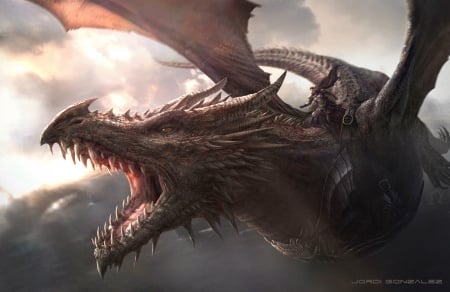
And Drogon certainly returns. The taming of Drogon began in the previous chapter, in the fighting pit of Meereen when she cracked her whip and made him sit, and then jumped on him and flew. Here, Drogon is unresponsive to her at the start of the chapter. She rides him every day but cannot make him go back to Meereen. The whip and words no longer direct him. So she leaves him and walks for two days and two nights toward Meereen. But throughout the journey he follows her. On the second day, she sees him in the sky at least three times. Clearly he is her mount now and they can never be separated again, but Martin remains coy until the end of the chapter to complete this mini-arc. After seeing the Dothraki scout, she "called until her voice was hoarse ... and Drogon came, snorting plumes of smoke." She jumps on him and they follow the scout to find Jhaqo's khalasar. By now she doesn't even need the whip any more. The ending may sound like Jhaqo has come to her, but it is the other way around. She has commanded Drogon to meet the khalasar rather than fly back to Meereen. She is now in control of the biggest, most bad-ass dragon in the world, so why would she be afraid of a horse lord?

Yet another mini-arc here is in character development. At the beginning of the chapter Daenerys mutters the mantra that has sustained her until now, "If I look back I am lost." So she keeps walking, on and on, always forward. Quaithe's prophecy is revisited,
To go north you must go south. To reach the west you must go east. To go forward you must go back, and to touch the light you must pass beneath the shadow. 
Both Daenerys and most readers interpret this as circling around the globe (?) to reach Westeros, passing through Asshai. Well, I'm not convinced it's so literal, although her journey to the east since A Game of Thrones has been literal so far. Near the end of the chapter, in the same paragraph of calling back Drogon.
"To go forward I must go back," she said. Her bare legs tightened around the dragon's back. 
She then flies to meet the khalasar. On some level, she is already retracing her steps from Meereen to Vaes Dothrak (now that her womb has quickened again and "he" has returned).

A curious symbol in the chapter is that she calls the hill on which Drogon has been living as Dragonstone. Dragonstone is the springboard where Aegon the Conqueror took off to conquer Westeros with fire and blood. On and near her Dragonstone, Daenerys has not only tamed Drogon and regained her fertility (and possibly her khalasar), but also comes to the important psychological turning point --- Rather than always charging ahead (If I look back I am lost), she is now looking back toward where she has been (To go forward I must go back). Before the Slaver's Bay, she was in the Dothraki Sea. Before that she was in Pentos and Braavos. And before that she was on Dragonstone.

The need of looking back is also a spiritual growth of some kind, considering that GRRM is a historian at heart and has a deep understanding of what lies behind the present world. If Meereen is an analogy for US occupation of Iraq and Afghanistan (which it is, but that's for another discussion), he is begging us to look back toward the forgotten lessons of the Vietnam War and all the other failed attempts at Imperialism. Daenerys has learned her lesson. We haven't.

There is much symbolism and foreshadowing throughout the chapter that serves both as Dany's backward gaze and forward outlook, such as her dream of Viserys and her imaginary conversation with Jorah Mormont. This time if Jorah makes it back to her (after having been punished for his history in slave trade), she will not banish him again. And mentioning Viserys might be a reminder of Ilyrio of Pentos?

In the middle of the chapter, before Daenerys falls asleep, there is a line that made me laugh out loud, "Off in the distance, a wolf howled." As far as he has spread the story, GRRM does try to connect the separate locations and strands with this kind of hints and imagery. If one reads closely A Feast for Crows and A Dance With Dragons, one would see the traces of invisible links. And immediately the mention of wolf brings about another more substantive link to the other side of the world.

On the second morning of her journey, Daenerys wakes up and discovers that ants have crawled all over her. She brushes them off her and crushes some with her fingers. She has slept by some crumbling stone wall in the grass the night before.
It turned out that their anthill was on the other side of her wall. She wondered how the ants had managed to climb over it and find her. To them these tumbledown stones must loom as huge as the Wall of Westeros ... 
Well, I don't know how much more explicit he could make it. This seemingly pointless segment is obviously a foretelling of the fall of the Wall in the North and a scene of the Others and their wights (I call them ice zombies) climbing over it, pouring into Westeros like the ants all over Dany. The Wall may have already fallen with Jon Snow's assassination (that's for another day), so the invasion is imminent.

My friend Ellyn once astutely noted that reading ASOIAF is labor intensive because Martin has buried many clues and hints of future events in current text, but he is particularly skillful at hiding them among a sea of details that seem to do with only the present events. One never knows which details will become echos of the future or a trigger for major events. This is why I am particularly drawn to the "slower" books (A Clash of Kings, AFFC, ADWD) where nothing seems to happen. I find them much more fascinating precisely because of their demand on my attention and my intellect. They are puzzles where only the patient reader can dig out and piece together the shape of the world. It is a game he plays with readers. AGOT and A Storm of Swords are more like payoffs, in which we are given the answers in the back of the puzzle book, which is not nearly as fun.

Beyond the above-mentioned clues and puzzle pieces, this chapter is also centered around the theme of "The human heart in conflict with itself" within Dany. She is torn between the wish to be a young girl and sense of duty as a queen and leader. As sprawling as the series have become, it is slowly dawning on me that GRRM is not a wasteful writer. There is a purpose to every chapter and every segment within each chapter. It's not always clear what the purpose is until much later. It is a very complicated puzzle that rewards the patient reader. The joy is in the journey, not the end. I think this point has been amply proven by the by-now failed attempt to "condense" the books into TV adaptation.

There is a lot more I can say about this chapter and the overall Meereen story line in ADWD. But I will leave it here. BTW, I don't think either Daario or Jorah Mormont will live very long in the next installment, but I have nothing to support this outlook.

Saturday, June 27, 2015

The Dolezal Case and Outsiders

One can never tell exactly what motivated Rachel Dolezal to pretend to be a black woman. Besides all the complexes and embarrassment that she has provoked in many Americans, black and white and, oddly, transgendered people and their advocates (fascinating how they got mixed up in all this), there is a kernel of recognition of a common --- perhaps even universal --- phenomenon. Here is a person who at some point feels that she does not belong in her environment and wants to find the sense of belonging elsewhere. She wanted to find the sense of belonging among black people, for whatever reason, and was willing to pile on lie after lie to get it. Is that so strange?

Coincidentally, I saw a documentary about Broadway musicals a few weeks ago. The short version is that nearly all notable Broadway musicals were written by Jews (except Cole Porter). They wanted to talk about their feelings of being outsiders in the American society, but in the musicals they chose to express it through other outsiders rather than Jewishness. Hence we got "West Side Story" with Puerto Ricans, "South Pacific" with Polynesians, "Showboat" with blacks, even "The King and I" with reversed roles between whites and Asians. And the kicker is that everyone loves them. Not only the immigrants who all see themselves in the disguised Jews, but even the dominant white audience find themselves in the stories of outsiders. This sense of being excluded from other people and therefore alone in the cold outside has to be a feeling that is universally appealing.

The stories of social outcasts and outsiders are the mainstream of literature and other forms of narratives. That is the irony. If the majority feels alone, are they alone in their likeness, or are they alike in their loneliness?

I wonder if there are people who never feel a sense of isolation and loneliness from time to time. Extroverts? Bullies? Psychopaths? It seems obvious that they are either nonexistent or definitely in the minority. For most of us, what would it take to rid oneself of the sense of being alone in the universe once and for all? Maybe nothing. Maybe that is just one of the permanent human conditions that we want to escape but have to live with, like the inevitability of birth and death.

Another phenomenon that had baffled me until I understood the universality of loneliness is fandom. Average people identifying with famous people in various fields and projecting themselves onto these strangers. People feel such a deep connection and kinship with flickering images or words of the page or glimpses from faded pictures. In the fans' mind, the self and the idol merge into a strange entity that is neither the same nor separate. The idol's success feels sweeter than the fan's own success, and the idol's failure more bitter. The animosity between two opposing camps of fans can be intensely vicious, despite the lack of real conflicts or harm to the celebrities in question. Anyone with exposure to figure skating would be familiar with the venomous and vehement battles between fans of Yuna Kim and Mao Asada, or Michelle Kwan and Tara Lipinski, or Plushenko and Lysacek. I am not immune to this type of sentiment, even though I never understood why.

Now I think I do. Public celebrities serve as a conduit for our need to escape the feeling of being alone outside the crowd. Their function is two fold. In their public glamor and glory, we boost our own sense of worth through projection. In sharing our adoration with other fans we get a sense of togetherness and belonging to a larger group. What wouldn't we do to come inside, away from the cold, even if for a moment of hallucination and self deception, like the little Matchgirl in the Hans Christian Andersen story. Note that Andersen was a very typical outsider and, with his stories about being the outsider, moved millions of readers.

Of course, the more realistic and less hallucinatory realm where one escape the loneliness is family. But family carries their own risk of disillusion. Knowing someone so closely and intimately can dispel the sense of belonging and heighten the feeling of difference. Fantasy togetherness with strangers, on the other hand, can be as perfect as your imagination can achieve.

Thus the space created by the Internet is most curious. The people you are sharing message with on the other side of email or Web site or group chat are real. You feel like you know them, but not too much to dispel the sense of belonging. If you know how to play this game, you can be as close as you want without being too close to be reminded that, in the end, we still each live out here.

Oh, and another irony. Every time I read about how lonely it is "at the top" for famous people (or superheroes in comics) --- being so famous that they cannot mix with ordinary people and have to keep to their sad loneliness as celebrities, I laugh. Isn't the point of being famous to be universally admired and never be left out (again)? Yet, somehow, by being "special" one might exclude oneself from the common experience of feeling alone and insignificant.

Monday, June 22, 2015

Rosencrantz and Guildenstern Are Dead at Folger


I have heard the name Aaron Posner mentioned in association with DC theater scenes several times, but only today saw his direction for this Folger production of Tom Stoppard's early but most famous play. It's indeed quite good, quite impressive. The comic timing was spot on and had the audience laughing all the way through, despite the play's length and the absurdist dialog. The casting was inspired and the two young lead actors had real chemistry.

Yes, it's known as an existentialist and absurdist play. It's about the unreal space occupied by minor characters between their sporadic appearances in the main characters' story. It's the meaninglessness and aimlessness of life, and the inevitability and pointlessness of death.

It's all very clever and meta. The production notes point out that it owes as much to Shakespeare (ie, the source in Hamlet) as to Waiting for Godot. I have not seen Waiting for Godot, but I cannot shake the feeling that all this was said by Shakespeare already, not only in "the undiscovered country from whose bourn no traveler returns," but also "tomorrow, and tomorrow, and tomorrow, creeps in this petty pace from day to day, to the last syllable of recorded time. And all our yesterdays have lighted fools the way to dusty death."

Tuesday, May 12, 2015

Note to Self: Othello @STC next season

Just got the brochure in the mail. No dates yet. I will go see it.

Below is a poster of Vishal Bhardwaj's modern adaptation of Othello, Omkara (2006). It's pretty excellent and very faithful to the play. Like in most productions, Iago, played by Saif Ali Khan, steals the show.


Tuesday, May 5, 2015

Theological Subversiveness in Mahabharata (Notes #17)

I suppose one should not be surprised by the mess of stories, mythologies, cults, and messages that were crammed into Mahabharata over centuries of telling and retelling. Many of the lessons and points conflict with and even contradict each other, down to the basic definition of "dharma." Fine. There is something in the Indian history and culture that drove the exacting English colonialists crazy, because one can never seem to get a straight answer to any question about India. Any simple question, like, What is dharma? What is maya? What is sin?, can lead to a lifetime of research and philosophical argument with no end in sight.

Be that as it may, I want to sort out a few signs of direct theological antagonism in the epic, particularly in the Bhagavad Gita.

The most striking message in the Gita is to act without expectations of rewards, ie, the karma yoga. This is in opposition to the traditional Indian mythology based on asceticism, which is full of anecdotes of someone getting his wish granted by a god, big or small, by starving himself, chanting the god's name a million times, and standing on his toe for a few years, known as tapasya. If you're a well pampered king who doesn't want to go through that self-torturing routine, you can hire a team of Brahmins to do the praying for you and throw in a lot of good stuff (eg, milk, ghee, flowers) in the ceremony. Voila! You get your wish granted. It is such a straightforward even exchange between the gods and men and universal to nearly all ancient cultures on earth. I offer/sacrifice something precious to the gods, and the gods give me what I want. Simple and instinctive. Yet the Gita says, you should not even expect a reward for your sacrifice to the god. Forget it.

Well, that's an unpleasant gift, isn't it? Even though it is more realistic and empirically true, telling people that they cannot bargain with (and therefore control) fate/gods/fortune is contrary to our hopes and dreams. Such realism can't win any followers. So we are thrown a bone. Yes, there is a reward, which is moksha. Who needs earthly rewards (eg, wealth, happiness, long life, death to your enemies) when you can achieve the ultimate joy of being released from the cycles of life and death, heaven and hell.


Sunday, May 3, 2015

The Palace

Last night I dreamed of the palace again. This has become a recurrent dream in recent months. The building is always somewhere nearby, in downtown DC or on the National Mall, behind one of the Smithsonian museums but easily. Or it might be just past Old Town Alexandria, between the red-brick buildings and the river. Or it was a ten-minute walk from home, across a field of waist-high grass and behind willow trees.

On the outside it is not gigantic but exquisitely complex. Topped with a golden dome, the deep blue frames and colored glass form intricate patterns. Whenever I visit it in a dream, it is always with someone --- family, friends, or just Sam, but never alone. It's a hidden gem that I show off to them. We have to first pass through a plain and ordinary building and a courtyard to see the grandeur of this palace.

At the sight of the dome and the glorious walls, a gentle gladness and calm excitement wash over me. We enter the palace and up the spiraling stairs. No royalty live here; it is an art museum, like National Gallery of Art. Let me show you all the good stuff, I say to my companions. It feels like home.

Friday, May 1, 2015

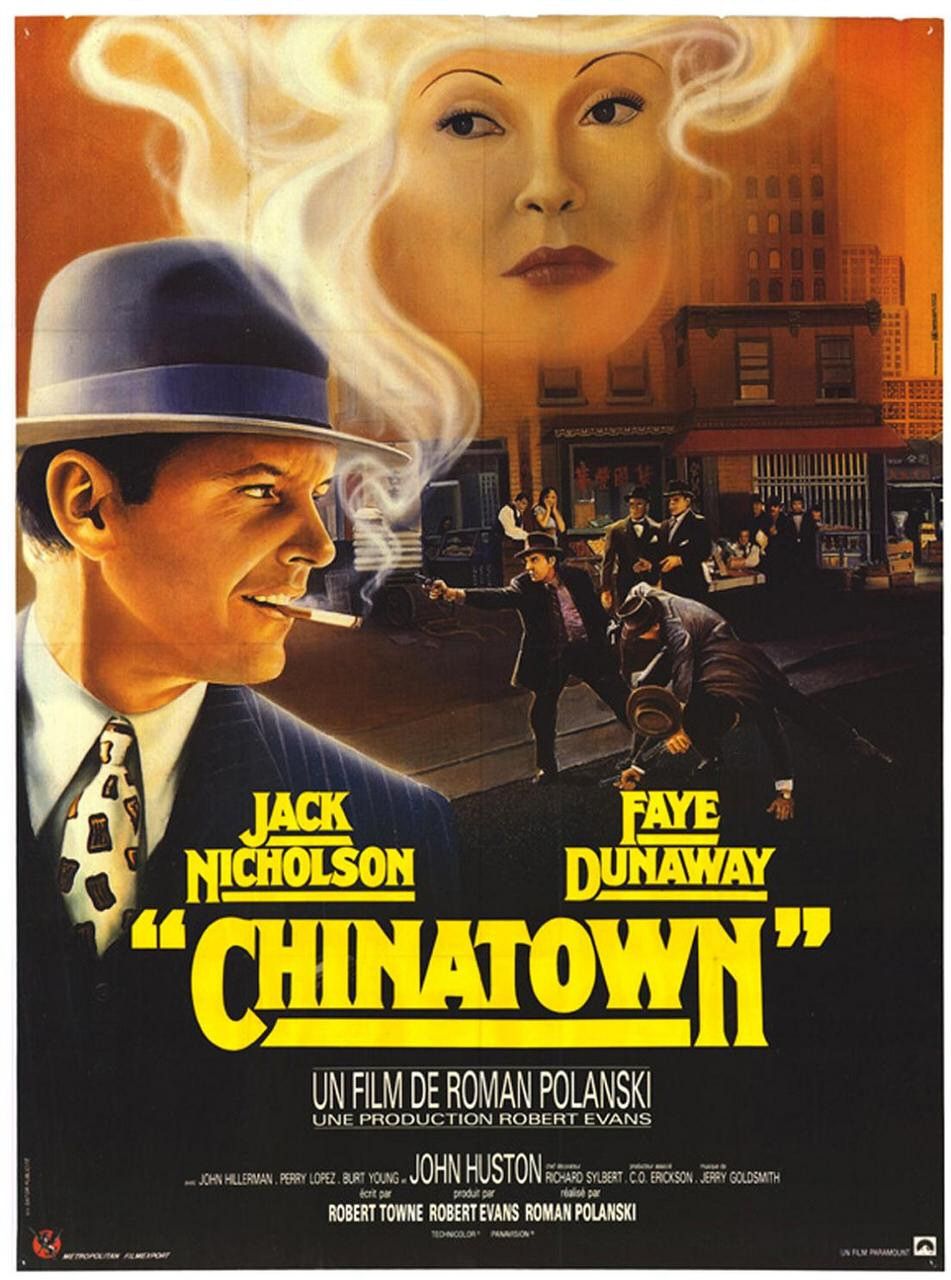
The Ending of Chinatown (1974)


The original ending of Chinatown, written by Robert Towne, was changed by the director Roman Polanski to be more tragic and ironic, and Towne complained about it later in some book he wrote. Film critics generally take Polanski's side as the superior choice.

In Polanski's version (ie, the movie version), Jake the private detective (Jack Nicholson) and his associate, the villain Noah Cross (John Houston) and his henchman, his daughter Evelyn Cross (Faye Dunaway) and her daughter/sister Kathrine, and a couple of police detectives all congregate in Chinatown. Evelyn tries to drive away with Kathrine. Her father, the henchman, the police, and even Jake try to stop her, but somehow by holding a gun she gets into a car and drives off, and then one of the policeman shoots and kills Evelyn. Noah takes Kathrine. The end.

Towne's version is in some sense indeed more conventional to the genre and appealing to the popular expectation. Jake, Noah, Evelyn, and the police (but no Kathrine) also converge on a beach in pouring rain. Evelyn takes her revenge by shooting her father dead. She goes to jail. The end.

Well, I can see why critics favor Polanski's version of the ending, and clearly he wanted to do this when he read the script, because earlier in the movie he dropped several foreshadowing hints to duplicate the climactic ending (eg, Jake has his car's tire shot out by an orange farmer, Evelyn lowers her head in the car and accidentally hits the horn). An unsatisfying and tragic ending in which "the bad guy wins" is bound to stay with you longer than a just resolution. It is also understandable that Polanski wants a bleak ending in which the lead female character dies, since this was a few years after his wife was murdered by the Mansons.

Yet, I am not happy about Polanski's ending, either. All 3 female characters in the movie are victims through and through, used and abused lying down. They are weak and neurotic and pathetic. It is suggested but not confirmed that Evelyn has given her daughter to her husband as a sexual gift. One might excuse this treatment of women within the context of time and culture, but it becomes a lot harder to excuse when the original ending gives so much more power to Evelyn. Even if she fails in her revenge --- which would be an ending I prefer, she would have made an attempt and done something more than running away. Why not keep her fight while still kill her off and let the bad guy win?

I know it is not fashionable to bring Polanski's personal life into critiques of his work, but if we want to acknowledge the effect of his wife's murder, then I think his sexual preference for adolescent girls is fair game. One may argue that it is no surprise that he doesn't much like women with any strength. I suppose a male critic is unlikely to notice the dismal portrayal of women or be disturbed by Faye Dunnaway getting slapped around by the hero without much resistance. Even I did not much think of it, until I read up on what Towne had in his original script.

Last week I re-watched "The French Connection" (1971) and was much disappointed by several plot holes and unrealistic, illogical details in a film that prides itself for the documentary-like realism in style. The plot problems in "Chinatown" are less glaring, but nevertheless quite visible. For example, it is never explained clearly who hired Jake to expose Mulwray's extramarital affair in the first place, and the feeble reveal is limp and unconvincing and does not fit into the two main threads of the story. It is never explained how the police get to Chinatown in the end, yet do not seem to make a real effort to arrest Evelyn, who is by then the main suspect in her husband's murder and is about to become a fugitive. Why and where does Evelyn intend to run in the car? The story states early on that she did run away from home years ago, yet this time she is still incredibly incompetent at running away. It also makes no sense for Jake to confront Noah Cross, right before he carries out Evelyn and Katherine's escape. What is he, born yesterday? What's the rush?

I don't know what's the problem with these classic movies from the early 1970s. Did they not have script editors back then? Maybe I should re-watch The Godfather next because I do not remember any visible plot holes in that movie. This is not to say movies today do not have glaring holes and mistakes, but tightly written scripts like "Michael Clayton" and "One False Move" are not uncommon.

The Ending of Le Samourai (1967), Explained

A quick online search after watching Jean-Pierre Melville's Le Samourai confirmed my suspicion: The plot is very rarely understood by E...