Search This Blog

Sunday, March 15, 2015

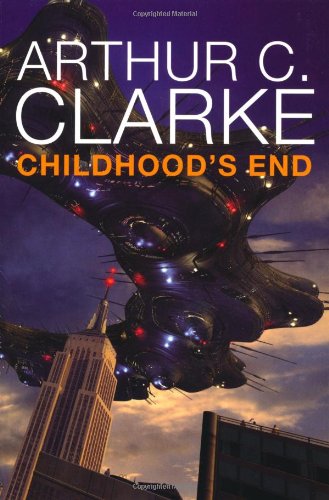
Childhood's End by Arthur Clarke


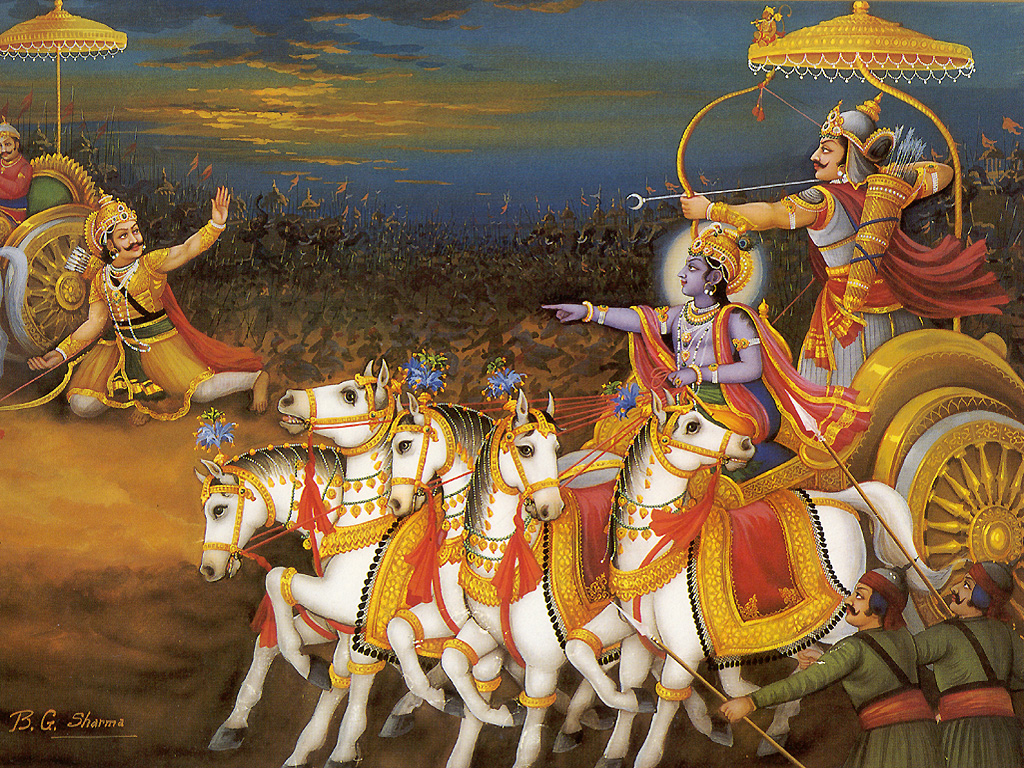
What prompted me to re-read this book is, of course, my recent obsession with Mahabharata. When I first read it about twenty years ago, I didn't understand most of it, but much of the imagery left a deep impression and seeped into my unconscious memory. In some ways, I could say that this novel, Rendezvous with Rama, and a few of his short stories (eg, "The Star", "Nine Billion Names of God") cultivated a latent taste for mysticism that kind of blew up two decades later, when I happened upon Mahabharata.

The first part of the story is about an alien invasion by "Overlords" (which was later ripped off in Independence Day and other movies) and the subsequent utopia on earth. The second part is about the conversion of the human species into a mysterious and unknowable existence that is eventually absorbed into "Overmind." Indeed there is similarity between the concept of merging with a cosmic consciousness and similar ideas in Buddhism and Hinduism, in which people might, through meditation, yoga, and whatever mind-altering practice, might transcend the limits of individual mind and become one with gods or absorbed into the gods or something to that effect. The novel makes a few direct references to Christianity (references to Jonah and devils), but the central concepts are closer to Buddhism and Hinduism, plus elements of popular mysticism, such as seance, telepathy, inherited racial memory, and UFO sightings. Clarke was clearly having some mash-up fun.

I can't remember who said it --- something about the individualism being not a common or dominant idea in human societies. When I first read "Childhood's End," I had the impression that the loss of human individuality at the end was a tragedy. Mr. S admitted to the same impression (he read it in high school). Clearly the theme is not that palatable to modern people with a western education --- or modern Chinese people, for that matter. Yet Clarke's depiction is ambiguous with a sense of both loss (of humanity as we know it) and marvel (merging into a great collective consciousness).

What left the deepest impression on me the first time is the speculation of time and memory. The Overlords had never been to earth until its arrival in twentieth century, yet their devilish appearance always existed throughout human history, because some minds can access memory in all directions, both forward and backward. Future and past are the same. That is a dazzling idea and, somehow, thematically connected to Bhagavad Gita and Mahabharata.

Monday, March 9, 2015

Maya: Illusion and Reality (Mahabharata Notes #14)

At least one of the meanings of maya is simply "illusion." In the battle scenes in Mahabharata, maya is often a supernatural weapon used by a few characters to create a distortion of reality --- fog, rain, cold, darkness, demonic figures, etc., that do not actually exist --- to disarm the enemy and create fear and chaos. In fact it sounds a lot like some sort of psychological warfare.

Yet maya is far more complicated than illusion. Its entry in Wikipedia seems to suggest that the evolution of its meaning, coupled with atman, is linked to the pair purusha and prakrti. Yeah, Wikipedia. Obviously I have not read through the relevant vedas and puranas and upanishads to begin to understand these ideas. But, at least, my absurdly superficial glimpse at these abstract concepts is enough to demonstrate how sophisticated the philosophical theories were in Hinduism.

Anyway, not being qualified to discuss these concepts does not deter me from contemplating something along these lines. At some point, maya came to mean the material, external existence, ie, the body or prakrti, that houses and conceals the eternal driving force of life or spirit, ie, the soul or purusha. The theory is that, although the body and its senses seem to be real, they are temporary and constantly changing and subject to inevitable decay. Here, obviously, the Hindu philosophers incorporated time into their observation of the physical world --- All senses pass, including agony and ecstasy, and therefore are elusive over time. Even life itself passes so quickly. Therefore, the need for a life force that permeates the universe and animates things that cannot disappear or diminish is irresistible. And they are not wrong, because energy does fit the concept of purusha and obeys the first law of thermodynamics.

Nevertheless I have been thinking of something that seems to be the opposite: One's perception and thoughts are subjective, conjured by the mind, and unreal, but the body at least somewhat able to get a more concrete and reliable picture of the world around oneself through the senses. Another way of looking at the distinction between the real and unreal is what is actually going on within one's senses and what is not. For example, the room temperature is 75 F and the time is night and I am lying on the couch typing on my laptop --- that's tangible reality. I'm thinking about the work to do tomorrow and reading some babbling on Twitter --- that's not tangible reality, even if the babbling might be someone else's reality. The novel I'm reading is all in my mind, and so is the contemplation of whether I will finish a couple of documents by the end of next week, because none of these exists outside of the electrochemical reactions in my brain. On the other hand, that I am thirsty or hungry is real enough, for the sensations are connected to my blood concentrations of sodium or glucose, not just in the brain. How real is reading fiction, nonfiction, news, and someone else's opinions and editorials?


Saturday, March 7, 2015

Note to Self: Books to Read

1. Fountain of Paradise and Songs of A Distant Earth
2. The Journalist and the Murderer
3. Missing Out: In Praise of the Unlived Life
4. Ramayana (maybe)

The start of a New Yorker's article about Adam Phillips' "Missing Out" had me laughing hysterically. I suppose it's not meant to be funny, and I don't know why it seems so to me.

Adam Phillips, Britain’s foremost psychoanalytic writer, dislikes the modern notion that we should all be out there fulfilling our potential, and this is the subject of his new book, “Missing Out: In Praise of the Unlived Life” (Farrar, Straus & Giroux). Instead of feeling that we should have a better life, he says, we should just live, as gratifyingly as possible, the life we have. Otherwise, we are setting ourselves up for bitterness. What makes us think that we could have been a contender? Yet, in the dark of night, we do think this, and grieve that it wasn’t possible. “And what was not possible all too easily becomes the story of our lives,” Phillips writes. “Our lived lives might become a protracted mourning for, or an endless trauma about, the lives we were unable to live.”

Wednesday, March 4, 2015

Pluralism and Contradictions (Mahabharata Notes #13)

There are a lot of oddities and inconsistencies in Mahabharata, even in the shortened version (a "modern rendering") I read, in which the author no doubt excised a lot extraneous details and sidetracks from the original versions (yes, plural) of the massive poem. For example, it is described that Arjuna was the son of the deva (god) Indra. There is an interlude in the middle of the story that Arjuna was brought to Indra's heavenly abode. Yet it is also repeatedly claimed that Arjuna is one of the holy twins, Nara and Narayan, who are avatars of Vishnu, one of the trimurti (the three-form gods that are at the top of Hindu deities). Arjuna is the human incarnate of the twins Nara (Krishna is the godly one of the pair Narayan). Just who the hell is he related to, Indra or Vishnu? Another example is the character Ashwatthama, who is supposed to be a partial incarnate of Shiva, another of the trimurti. Ashwatthama fought on the opposite side to the Pandavas against Arjuna and, after the death of his father in the war, nearly caused the termination of their family line. Yet, before the war, Shiva gave Arjuna a deadly supernatural weapon and the blessing to win the war. The rishi Vyasa, who knew everything in the story, told Arjuna that on the battlefield he was led by the invisible Shiva and triumph followed him wherever he pointed his arrows because of this. It is like Shiva blessed his own enemy to defeat a part of himself. Which side exactly is he on? In the end, while the Pandavas seemed to have decisively won the war, they went to heaven and saw all of their enemies returning to their eternal godly forms, happy and content. All the old grudges and hatred and blood feud and even arguments over dharma versus adharma seemed to be washed away by the tide of time. The Pandavas are deemed the good guys, but they nevertheless have to go to hell, even if temporarily. It's enough to drive one crazy.

This kind of delicate and complicated logic, which teeters on the edge between perfect sense and complete nonsense, tickles the mind. One might easily dismiss the phenomenon as the result of centuries of meddling by generations of storytellers. They must have inserted various stories and ideas over time, leaving a big pile of mess. Yet that is not quite true, as the massive story is also filled with meticulous details and characters that remain surprisingly consistent and logical from the beginning to the end. There seems to be method to all this madness. 

(This post is long. I'm going to start using the "Read More" function.)

Monday, March 2, 2015

Nazi and the Gita (Mahabharata Notes #12)

Well, it looks like synchronicity, or coincidence, or my premonition (just kidding), as one of my random thoughts connecting Hitler and Bhagavad Git turned out to be true. Apparently some Nazis did love the Gita. Apparently, ancient Indian mythology and philosophy were a big deal among German intellectuals in the 19th century and subsequently garnered some fans in Nazi leadership. Apparently, it is no accident that Nazis chose the swastika as their symbol and identified themselves as Aryans, which seems to stretch one's imagination if we were to compare the appearances of Indians, however light-skinned they are, with the ideal looks touted by white supremacists. One has to wonder if they asked real Indians whether such re-appropriation of their religion and philosophy was acceptable. Somehow I doubt it.

Perhaps one should not be too surprised. Didn't we all read Herman Hesse's fictional biography of Buddha? Didn't we hear that Schopenhauer was a fan as well? So Hinduism was no doubt pretty fashionable in Germany back then. Here is a fairly substantive article about one of the prominent Gita fans: Heinrich Himmler. He identified the military expansion and aggression of the Third Reich with the martial values and beliefs of kshatriyas (the warrior caste) in Hinduism. According to Himmler, Hitler is Krishna reincarnate (perhaps figuratively) to bring dharma, ie, Nazism, to the world. Funny how mercy and family and the revolving wheel of life and death, and all the other stuff in Hinduism and Buddhism never made it into Nazism, for whom death is just death. You can't blame me for not seeing the connection before.

Nevertheless one does have to wonder whether Herr Himmler actually read Mahabharata. If he had, he might think twice about comparing themselves to kshatriyas, the ancient warrior caste. It does seem to me that he had no idea what happened to kshatriyas in Kurukshetra and what Krishna was sent into the world for. In fact, Krishna was no leader or savior of kshatriyas at all; rather, his true purpose was to wipe out all the kshatriya kings and soldiers in this deadly conflict and leave a world "unburdened" by kshatriyas at the start of the Kali Yuga. If we were to follow this train of logic, hmm, what did happen to Nazi armies in the Kurukshetra of our time? I am not a superstitious person, so I will not say all this is some weird, time-warping phenomenon. But the irony is killing me.

Anyway, what is unexpected in this odd pairing is not that Nazis found inspiration from the Gita (a possibility that even I "foresaw"), but rather that they looked to the Gita at all. I always assumed that they pursued their mission with absolute conviction of their own righteousness and needed no confirmation from anyone, least of all some foreign religious text. Only those with doubts need the Gita to inspire them and spur them into action, no? Might Himmler have doubts about what he was doing, like Arjuna, and feel as if he needed some moral and philosophical support? Taking this thought one step further, we may have to contemplate the possibility that Himmler and other Nazis were indeed human, too.

Saturday, February 28, 2015

Evil and sin (Mahabharata Notes #11)

Despite the claim that "this is a battle between good and evil" and scary omens that show up from time to time (jackals and wolves howling in the streets, birds flying in the middle of the night, other abnormal natural phenomena), it slowly dawned on me that my frame of reference for words translated as "sin" or "evil" is built upon Christianity, which does not quite fit the context of Indian mythology.

For one thing, the concept of hell (naraka) is more like the purgatory in Catholicism. No one is condemned to torture and misery forever. Sinners pay for their sins by serving time in naraka, and get released afterward. The worst punishment is to reincarnate into earthly creatures life after life after life for a few thousand years, until one reaches enlightenment. But the prison sentence is always finite.

This system cleverly solves a common logic problem in the permanent and dichotomous (heaven or hell) scheme in Christianity. Even the virtuous and pious people are not perfect and commit sin sometimes. Catholicism tries to deal with it by the confession-and-absolution ritual. Protestants just stick with the simple "believers go to heaven, nonbelievers hell" rule of thumb. Simple but unsatisfying. In the Hindu system, even the pious and virtuous have to take responsibility for their life on earth. At the end of Mahabharata (I've finally finished it!), it is explained that all kshatriya kings have to make a round in hell to atone for all the killings they undertake in life, even if they were executed at the direct order of god (or his avatar). Nobody is immune. Everyone has to pay. And then they can go to heaven.

The transient nature of both life and death and even afterlife in this system somehow washes away the vehemence of judgment, leaving everyone and everything in different shades of gray (a lot more than fifty). Morality is still important, but not rigid or obsessive. Certifiable villains die heroically on the battlefield and go to warriors' heaven. In general, a flexible and relaxed attitude pervades this world, giving less soil for the growth of hatred and paranoia -- less but not none, for hatred and paranoia are in our nature, aren't they? Cannot be helped.

There is a kind of mercy in this that I did not quite see in my limited encounter with Christianity. In this world, the gods claim to inhabit everything and energize everything in the universe, including sinners and evil ones, and even sages accept death, suffering, injustice, and pain as inevitable tides of time. There is no promise to permanently eliminate any of these by simply being virtuous or a believer. Therefore, I the audience feel like I am treated like an intelligent person with my own eyes, and reality of the world is respected rather than denied.

It is funny (not funny haha but funny weird) that a lack of a severe and judgmental religion has never prevented countless Chinese people from developing a severely moralistic perspective. Perhaps moral dichotomy is something inherent in human society, while tolerance, complexity, and mercy are the exception. 

Wednesday, February 25, 2015

Karna: The Mondern Man (Mahabharata Notes #10)


The first part of Karna's life story --- being born to a princess and the sun god but abandoned and raised by a charioteer and his wife, thus not recognized for his right to be a kshatriya warrior --- is more modern than any other character in Mahabharata. Rising above his caste, based almost entirely on his talent and skills rather than birth, his success in life is singular in his time and society, but eerily similar to the Horatio Alger, hero of the modern American mythology. Nevertheless, the story also has some typical folklore elements: A hero with a hidden identity and mystery of his birth; he is separated from his real family from an early age and his nobility is revealed only later in life. 

Yet, during the prolonged climax of Mahabharata, ie, the 18-day battle of Kurukshetra, Karna's story takes a turn into the realm of modern fiction. No other character in this story --- perhaps none in any story of the ancient times --- is portrayed with the level of psychological complexity seen only in modern novels.

Karna's psychological struggles are two fold. First, his internal thoughts and external behaviors are incongruous. Before the war, Karna found out that his sworn enemies, the Pandava brothers, are his biological brothers. He promised their mother --- also his mother --- that he would spare four of the five brothers' lives. Throughout his involvement in the war, his heart is not in it. His hands slay the Pandava army and Arjuna's son, but his thoughts are in conflict with his action and he no longer hates his oblivious brothers. He is only motivated by honor and duty. Second, his mind is battling itself throughout the war. On the one hand, he yearns to belong to his biological family and their noble status, which could end his lifelong loneliness and misplacement. On the other hand, to do that means betraying his only friend Duryodhan, the Kaurava prince who leads the war against the Pandavas. The two urges are mutually exclusive. Karna cannot have it both ways. So his struggle is purely internal and directed at the self.

This never happens in ancient literature. The earliest psychological novels are generally considered to emerge in French literature in the 17th century. Madame de la Fayette's The Princess of Cleves is often cited as the earliest sample in this genre. From then on, the psychological turmoil of an individual has become the mainstream of European and modern literature, as novelists delve ever deeper into the dark, contradictory crevices of the human psyche.

This psychological focus is a bit like the (re-)discovery perspective in European art in the Renaissance, before which older paintings were "flat." Old literature, derived from folktales, mythology, and epic poems, is full of characters who are consistent in their internal and external presentations. Even when a character is lying, he is described as being fully aware of his intention to lie and its untruth. There is no hint of self deception or internal conflicts. He or she struggles with other characters, with society, with fate, but never with himself. The only internally conflicted character that predates Madame de la Fayette's novel that I can think of is Hamlet. Even Hamlet's internal conflicts (his reluctance to kill Uncle Claudius) are not as well defined as modern literature, and the tension between his thoughts and actions is not as taut as any 19th century Russian novel. Shakespeare still relied mostly on external rather than internal forces to steer him from the revenge he has to carry out.

Therefore it is astounding that Karna seems like a character written by a modern novelist who somehow managed to time-travel to the past and stick it into Mahabharata. There is nothing like it -- that I know of -- in Greek, Roman, or Nordic mythology. For some reason (unknown to me), Indian mythology and philosophy reached a level of psychological insight at a very early time that was absent in other ancient civilizations. It is no surprise that Buddhism seeped into modern psychology rapidly in the 20th century, much more so than the more popular Judeo-Christian religions.

The Ending of Le Samourai (1967), Explained

A quick online search after watching Jean-Pierre Melville's Le Samourai confirmed my suspicion: The plot is very rarely understood by E...